The fundamental vocation of Lutheran higher education creates learning environments that value every person and enables their educational and vocational endeavors through empowerment and support. So That All May Belong: Lutheran Roots for Diversity, Equity, Inclusion, and Justice (DEIJ) explores the theological and institutional commitments to DEIJ within the Network of ELCA Colleges and Universities (NECU). Theologically, these activities emerge from the belief that every person reflects God’s image; anthropologically, systemic obstacles inhibit historically marginalized groups from fully benefiting from educational opportunities and community involvement.
NECU institutions employ the Lutheran concept of vocation to explain their dual mission to educate and to build inclusive communities where every person can succeed. This includes intentional removal of existing barriers and continual reform of institutional structures that provide equitable access and support to all academic community members. Lutheran higher education stands uniquely to elevate diversity, equity, inclusion, and justice beyond aspirational principles through deeply rooted commitments in our theological tradition.
Accompanying So That All May Belong are four pieces that demonstrate vocation as a societal responsibility rooted in justice and not solely an individual pursuit.
Jason Mahn challenges the common view of vocation as mere personal satisfaction and presents a more intricate model of calling which requires responsibility and service toward others.
Than Oo places importance on care and community while honoring the dignity of work to strengthen the Lutheran principle of recognizing all work as essential to the common good.
Tracy Paschke-Johannes examines transitional spaces where multiple identities and religious backgrounds meet, highlighting the dedication of Lutheran higher education to creating inclusive and transformative educational settings.
Kat Peters provides essential insights into both global and domestic mission work by demonstrating how structural boundaries and limitations can transform into opportunities for innovative solutions and acts of grace.
These works call on Lutheran higher education to progress from superficial efforts at inclusion to meaningful institutional change. The call for belonging reflects the Lutheran tradition of unending reform by pushing institutions to face their history and current The pursuit of justice and inclusion serves as a tangible embodiment of Lutheran principles which uphold neighbor love, communal welfare and institutional reformation for the benefit of all.
My deepest gratitude and thanks goes to all contributors and specifically to the NECU leadership team behind the creation of So That All May Belong…: Marcia Bunge, Robert Clay, Angie Hambrick, Altheia Richardson, Caryn Riswold, Deanna Thompson, and Colleen Windham-Hughes. My aim for the content of this volume of Intersections is to function as a resource, guidance, and a challenge for NECU institutions to fully embrace their stated principles through campus environments that uphold dignity and respect while delivering transformative education to everyone.
-
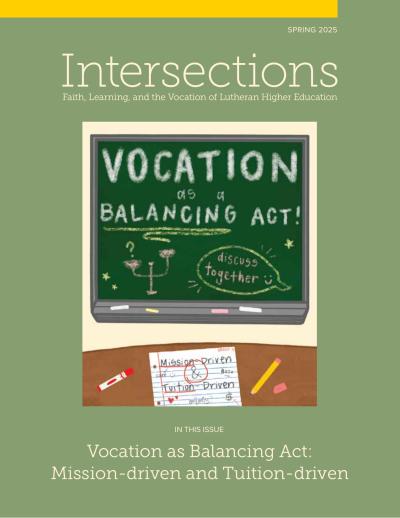 Editorial
From the Editor
Colleen Windham-Hughes
5 min audio
Windham-Hughes uses Fred Rogers’ neighborhood as a living embodiment of a Lutheran understanding of vocation — seeing dignity in each person, offering one’s gifts generously, and trusting that the well-being of the neighborhood is intrinsically connected to the well-being of every neighbor.
-
Institutional Focus
So That All May Belong: Lutheran Roots for Diversity, Equity, Inclusion, and Justice
Altheia Richardson, Angie Hambrick, Caryn Riswold, Colleen Windham-Hughes, Deanna Thompson, Marcia Bunge, Robert Clay
22 min audio
The full NECU statement grounds DEIJ work in Luther’s 16th-century reforms and Lutheran theological claims about the image of God, equal dignity, and the limits of human knowing — offering definitions, Lutheran roots, and calls to action for diversity, equity, inclusion, and justice, with belonging as the outcome of DEIJ at work.
-
Institutional Focus
Scriptures That Inspire Work for Diversity, Equity, Inclusion, and Justice
Altheia Richardson, Angie Hambrick, Caryn Riswold, Colleen Windham-Hughes, Deanna Thompson, Marcia Bunge, Robert Clay
9 min audio
A companion list of biblical verses — from Genesis 1:27 and Galatians 3:28 to Micah 6:8 and Luke 4:18-19 — that grounded NECU’s drafting of So That All May Belong, organized by the four DEIJ commitments and offered as an invitation to share other texts that ground and sustain the work.
-
Institutional Focus
So That All May Belong: Lutheran Roots for Diversity, Equity, Inclusion, and Justice [abridged]
Altheia Richardson, Angie Hambrick, Caryn Riswold, Colleen Windham-Hughes, Deanna Thompson, Marcia Bunge, Robert Clay
8 min audio
A condensed version of the NECU statement that consolidates Lutheran theological grounding for DEIJ and a single combined call to action for Lutheran colleges and universities — offered as a shareable summary alongside the complete document.
-
Article
Vocation at Full Stretch: Reflections on Follow Your Bliss and Other Lies about Calling and its Use among College Students
Jason A. Mahn
43 min audio
Mahn engages Bonnie Miller-McLemore’s Follow Your Bliss and Other Lies about Calling as required reading in a sophomore religion course, showing how her categories of missed, blocked, conflicted, fractured, unexpected, and relinquished callings empower young adults to perceive embodied, unplanned, and often painful dimensions of life as essential parts of vocation — and help close the gap between mission-driven and tuition-driven realities.
-
Article
How Mister Rogers’ Neighborhood Reminds Us About Work
Than Oo
5 min audio
Drawing on a Season 15 arc of Mister Rogers’ Neighborhood in which residents redirect pool funds to fix a plumbing problem, Oo finds in Fred Rogers’ vocation-honoring storytelling a reminder that limited resources are an invitation to creativity, perseverance, and optimism in higher education.
-
Reflection
Ecotones of Faith
Tracy Paschke-Johannes
7 min audio
Paschke-Johannes draws on the ecological metaphor of the ecotone — the life-teeming transitional space between two ecosystems — to claim that we are not called to minister in the world of the past or one fifty years hence, but to nurture the kairos moments God is creating in the freshwater-to-saltwater present.
-
Article
Finding the Miracle in the Intersection of Mission and Limitations: Lessons from Latin America
Kat Peters
14 min audio
Peters draws on her time interning with Lutheran World Relief and leading a study abroad program in Central America — including a Costa Rican women’s farm cooperative whose ecotourism project was “unprofitable” but life-giving — to argue that the intersection of God’s preference for struggle and God’s desire for abundant life is itself the miracle higher education can claim amid scarcity.
-
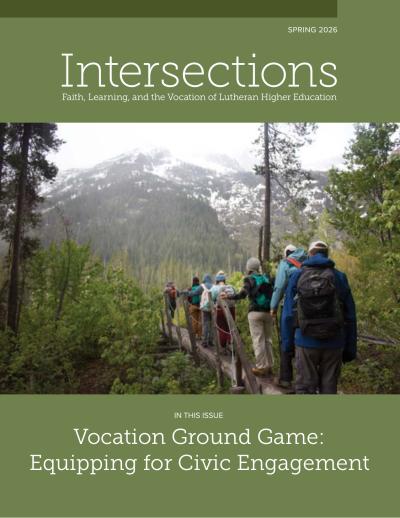 Editorial
From the Publisher & Editor
Colleen Windham-Hughes, Lamont Anthony Wells
No. 63 · Spring 2026
6 min audio
Wells and Windham-Hughes frame vocation as “ground game” — the practical, public living-out of faith through civic engagement — and introduce the issue’s focus on how Lutheran higher education equips students to repair the world.
-
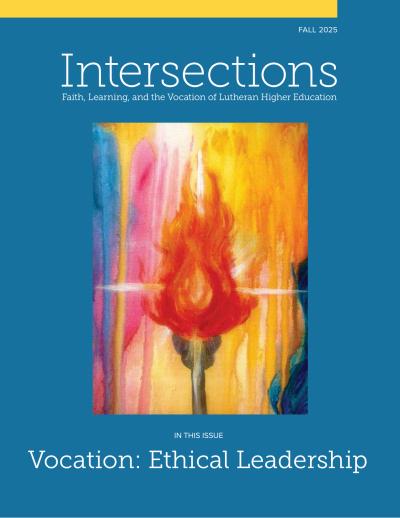 Editorial
From the Publisher
Lamont Anthony Wells
No. 62 · Fall 2025
5 min audio
Wells frames the issue as a record of the 2025 VLHE Conference at Augsburg under the theme “Ethical Leadership in a Changing World,” arguing that vocation is never solitary but a collective, public witness of ethical formation, theology and care, flourishing and belonging, and leadership rooted in God’s grace.
-
Article
Fostering Moral Imagination and Inclusivity: The Role of Ethical Leadership in ELCA Colleges and Universities Amid Societal Challenges
Lamont Anthony Wells
No. 62 · Fall 2025
12 min audio
Wells argues that “moral imagination” — the capacity to envision ethical alternatives, empathize across difference, and respond creatively to injustice — is the heart of ethical leadership in NECU institutions, and that anchoring leadership in this principle positions Lutheran higher education to cultivate socially responsible citizens.
-
 Editorial
From the Publisher: Reflections on the 2024 Vocational Leaders in Higher Education Conference
Lamont Anthony Wells
No. 60 · Fall 2024
Wells reflects on the 2024 VLHE Conference theme — “Educational Access: Lutheran Roots, Contemporary Practices” — tracing today’s commitment to inclusivity back to Martin Luther’s radical 16th-century insistence that both boys and girls be educated, and previews NECU’s expanded engagement of student leaders alongside faculty and administrators.
-
 Editorial
From the Publisher: Navigating Affirmative Action, DEI Policies, and Lutheran Vocational Identity
Lamont Anthony Wells
No. 59 · Spring 2024
Wells surveys the converging pressures on NECU institutions — the unsettled landscape of affirmative action, political and academic scrutiny of DEI work, and the preservation of distinctively Lutheran vocational identity — and previews how the issue draws on affirmative practices, sociological viewpoints, and theological responses to navigate a path forward.
-
 Editorial
Maintaining Our Lutheran Identity: A Source of Strength
Lamont Anthony Wells
No. 58 · Fall 2023
Wells reflects on the well-being of staff, faculty, and administration in Lutheran higher education across four pillars — rest, creativity and innovation, religious diversity and pluralism, and the preservation of Lutheran identity — and addresses the painful reality of Finlandia University’s closure as a reminder of the network’s shared mission.
-
 Article
Making Diversity Matter: Inclusion is the Key
Monica Smith
No. 50 · Fall 2019
Smith, Augustana’s inaugural Vice President for Diversity, Equity and Inclusion, frames the work of a Chief Diversity Officer as that of a disrupter and argues that while diversity in higher education is already happening, inclusion is a choice — one requiring a fundamental institutional transformation that diversifies faculty and staff, infuses diversity into the curriculum, invests in professional development, and draws on senior leadership to dismantle barriers.
-
 Article
Radical Hospitality on Haunted Grounds: Anti-Racism in Lutheran Higher Education
Krista E. Hughes
No. 52 · Fall 2020
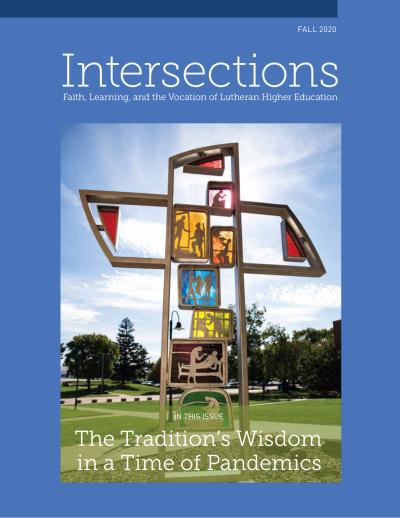
Writing from Newberry College’s campus on land once home to the Cherokee and within a day’s drive of Mother Emanuel A.M.E., Hughes argues that NECU’s call to “practice radical hospitality” demands that predominately white institutions open themselves to the hauntings of racism — pursuing belonging rather than mere welcome, and risking kenotic transformation of institutional identity itself.
-
 Editorial
From the Editor
Robert D. Haak
No. 33 · Spring 2011
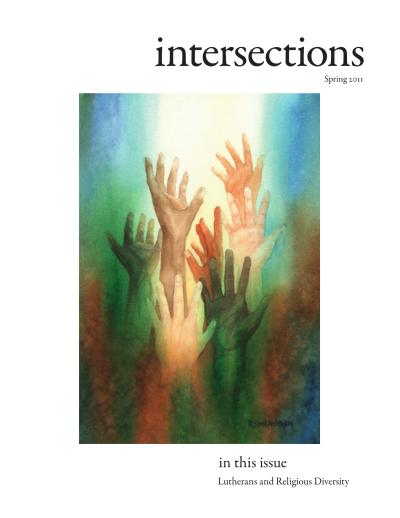
Haak frames the issue by asking how Lutheran colleges and universities understand the changing landscape of religious identification on their campuses, and argues that Lutheran theological commitments — including the work of the Spirit and the Incarnation — call institutions to create places where the voice of “the other” is heard and valued.
-
 Article
Rich and Poor in an Era of Globalized Religion and Economies: Challenges to Lutheran Colleges
Pamela K. Brubaker
No. 25 · Spring 2007
Brubaker opens with two World Council of Churches communion stories—a generous Aymara potato meal in Bolivia and a gated invitation-only lunch at a prosperous immigrant German Lutheran church in Brazil—to frame the question of which stance Lutheran colleges will adopt toward diversity. Drawing on Richard Hughes and Ernest Simmons on Lutheran “ecumenical confessionalism,” Linell Cady, Ulrich Beck, Held and McGrew, the World Bank’s 2006 Equity and Development report, Mark Juergensmeyer’s Global Religions, Harvey Cox on the Market as God, the WCC’s “economy of life” / AGAPE document, and Larry Rasmussen on universal human rights, she argues that part of the academic work of Lutheran colleges is to educate for critical citizenship by questioning neo-liberal assumptions and equipping students to claim social, economic, cultural, civil, and political rights for the whole human family.
-
 Article
The Vocation of Intersections on its Twentieth Birthday
Jason A. Mahn, Robert D. Haak, Tom Christenson
No. 43 · Spring 2016
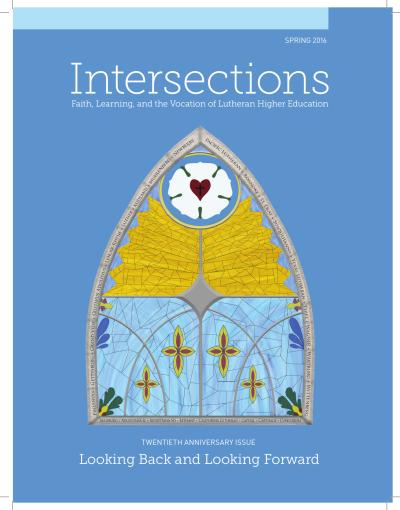
The three editors of Intersections — Bob Haak, Jason Mahn, and Tom Christenson (in spirit, following his death in 2013) — trace the twenty-year vocation of the journal itself: its 1996 birth at Capital University; its coming-of-age years of debate over institutional markers, two-kingdoms theology, and Lutheran identity; the ascendancy of “education for vocation” as the central marker of Lutheran higher education; and its ongoing identity in relation to a changing ELCA and to the broader cultural conversation about purpose, wholeness, and the vocation of higher education.
-
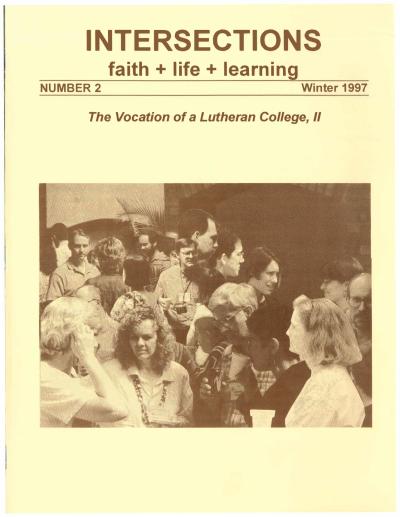 Response
“My Wife, We Have Not Come to the End of All Our Trials, but a Measureless Labor Yet”: The Lutheran Argument in Colleges
Steven Paulson
No. 2 · Winter 1997
Paulson of Concordia College responds to Bouman by invoking Penelope’s unreasonable patience for Odysseus and asking whether Bouman’s five “principles” deliver the “continuities of conflict” that MacIntyre’s account of a living tradition demands. He argues that the proper Lutheran “continuity of conflict” is the praxis of proclamation—Christ crucified as “a stumbling block to Jews and folly to Gentiles”—which is given outside the institution’s walls and which colleges and universities, as socially embodied arguments, “can’t like” because it places truth beyond their control. The Lutheran problem, he concludes, is not the Enlightenment or Post-Modernism but the “old Adam,” the Odysseus still unsure of his identity.