From the Publisher & Editor
Colleen Windham-Hughes
California Lutheran University
Lamont Anthony Wells
Network of ELCA Colleges and Universities
Intersections No. 63 · Spring 2026
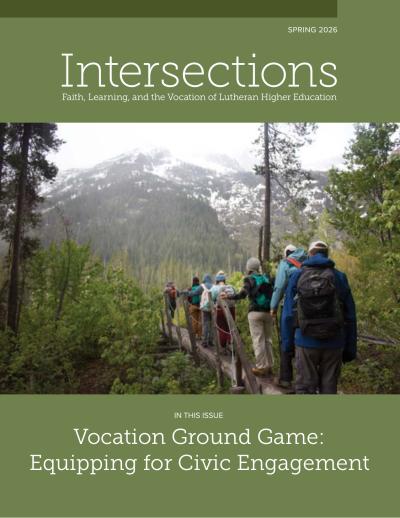
We have heard it and we have struggled with it ourselves: vocation as a word and a concept can seem abstract or high-fallutin’. It can seem out of reach, esoteric, even reserved for the privileged. Yet here is what we witness time and again in Lutheran higher education and in our own lives: vocation is ground game. Vocation is nothing less than what we live out each day in what we do and how we live with others. Sure, it can be hard to connect with the fullness of the concept in each moment, yet because vocation is connected to each person’s gifts and the giving of them to neighbors, our lives present many opportunities to receive, refine, and reflect on vocation. Doing so deepens relationships with others and enlivens meaning in us.
The centerpiece of Lutheran higher education is vocation, emphasizing “the development of the whole person (mind, body, spirit), love of neighbor, and social and environmental justice.”1 This requires an approach to education that expects transformation in the lives of students, staff, and faculty. How do you educate for transformation? You bring your ground game. You introduce students to the ground game of others. You invite students into a ground game and equip them for civic engagement.
In an era where democracy feels threatened and justice work can be labeled as partisan or fringe, vocation in Lutheran higher education affirms that civic engagement is not elective nor theoretical. It is practical. It is living our faith in public. As the late Rev. Jesse Jackson often said, “justice isn’t charity…it’s what we demand of our common humanity.” His vocational witness showed us what it looks like to take our faith to the streets, to the ballot box, and to the halls of power without losing sight of justice or hope. Rooted in questions of neighbor-love, vocation shapes students to ask not only what they will do with their lives, but how will their lives help to repair the world. Lutheran higher education nurtures students to become citizens who can stand in conviction and love, welcome differences with bravery, and work for a democracy that embraces the dignity, equity, and belonging of all.
In this issue you will read a first person account of the role of Lutheran higher education in engaging students in civic life and the shape it has taken in a recent graduate. And you’ll peek into several examples of ground game from the Civic Engagement and Faith Perspectives conference, held at Texas Lutheran University in the Fall of 2025. See the introduction to this section by Dr. William O’Brochta, our guest editor.
Ready to explore Vocation Ground Game? Join us this summer at the Vocation of Lutheran Higher Education Conference at Augsburg University in Minneapolis, Minnesota, July 13-15, 2026: “Beyond Walls, For the Common Good: Lutheran Higher Education and Civic Responsibility.” In an age marked by polarization, inequality, and public distrust, Lutheran higher education is uniquely called to witness to faith active in love through its contributions to the civic and common good. The 2026 Vocation of Lutheran Higher Education Conference invites participants to step “beyond walls” — of campus, culture, and comfort — to rediscover how core values of faith and sharing “good news” shapes our shared responsibility for the world.
Rooted in the Lutheran tradition of two kin-doms and vocation as service to neighbor, this gathering explores how our institutions embody public faith: nurturing civic imagination, moral discernment, and courageous leadership. Together, we will examine how Lutheran colleges and universities can help heal the social fabric, cultivate democratic engagement, and advance justice for all people through education that integrates faith, reason, and the call to serve.
Endnote
1. So That All May Belong: Lutheran Roots for Diversity, Equity, Inclusion, and Justice (2025)
-
 Reflection
I am a Treaty Partner
Kyrie Fairbairn
7 min audio
A recent California Lutheran graduate reflects on how a course on Indigenous Rights and Practices, and a conversation with a former Chairman of the Lummi Nation, led her to claim a “treaty partner” identity and to challenge readers to learn the treaties that shape the lands they call home.
-
Article
Civic Engagement and Faith Perspectives
William O'Brochta
15 min audio
Guest editor William O’Brochta introduces the section by overviewing the ELCA’s call to civic engagement, recapping the Fall 2025 Civic Engagement and Faith Perspectives conference at Texas Lutheran University, and previewing the participant essays that follow.
-
Article
Leaning-In to the Civic Lessons of Our Namesakes
A. Lanethea Mathews-Schultz
6 min audio
Mathews-Schultz uses the civic legacy of the Muhlenberg family — from General Pete’s Revolutionary call to action to President Muhlenberg’s inaugural address on the “education of conscience” — to invite students at Muhlenberg College into a shared civic inheritance.
-
Article
Teaching and Mentoring in Service of Civic Engagement
Haco Hoang
6 min audio
Hoang describes how her teaching, mentoring, and research at California Lutheran University — including a multi-year collaboration with the Lutheran Office of Public Policy on Lutheran Lobby Day — cultivate civic skills grounded in ELCA social statements and the Lutheran tradition of faith and reason.
-
Article
Community-Based Research as Engaged Citizenship
James Paul Old
6 min audio
Old argues that genuine citizenship requires more than charitable gestures — it demands long-term, reciprocal community partnerships — and describes how Valparaiso’s Community Research and Service Center embodies that vision even amid the financial pressures threatening such programs.
-
Article
An Ecosystem of Democracy
David Thomason
6 min audio
Thomason argues that faith-based institutions should equip students not to dominate the public sphere with their convictions but to cultivate an “ecosystem of democracy” — pursuing universal values with virtue and tolerance while acknowledging humanity’s incomplete grasp of truth.
-
Article
Bringing Core Values to Life through Civic Engagement
Austin Trantham
5 min audio
Trantham shows how Saint Leo University’s Benedictine Core Values shape his civic engagement work — from advising a “Why Vote?” campaign and Constitution Day panels to engaging students in the Unify Challenge for respectful cross-institutional discourse.
-
Article
Civic Engagement, "Baylor In Deeds," and Engaged Learning
Rebecca Flavin
6 min audio
Flavin describes how Baylor’s strategic plan “Baylor in Deeds” and its Office of Engaged Learning are building civic engagement into the Arts & Sciences core curriculum, with early Global Engagement Survey data showing gains in civic efficacy and global civic responsibility.
-
Article
Fragmented in Faith: The Concerns and Hopes Found in Student Spirituality and Civic Engagement
Emma Bohmann, Monica Sitachitta
11 min audio
Two Texas Lutheran University students reflect on the cyclical pattern of low spiritual and civic engagement on their campus and argue that distinguishing Lutheran values from Lutheran practice could open space for civic engagement to become a non-optional expression of neighbor-justice for all students.
-
 Article
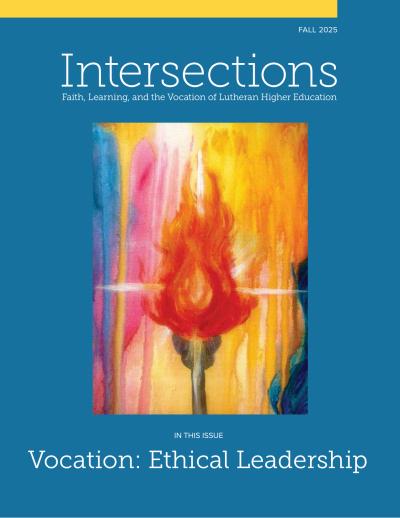
Fostering Moral Imagination and Inclusivity: The Role of Ethical Leadership in ELCA Colleges and Universities Amid Societal Challenges
Lamont Anthony Wells
No. 62 · Fall 2025
12 min audio
Wells argues that “moral imagination” — the capacity to envision ethical alternatives, empathize across difference, and respond creatively to injustice — is the heart of ethical leadership in NECU institutions, and that anchoring leadership in this principle positions Lutheran higher education to cultivate socially responsible citizens.
-
Editorial
From the Editor
Colleen Windham-Hughes
No. 62 · Fall 2025
5 min audio
Windham-Hughes plays on the shared Latin root of “education” and “seduction” (ducere, to lead) to warn against the No-saying seductions of giving up or condemnation, and to call educators to the riskier Yes of showing up to build third-space communities of truth-telling and hope.
-
Editorial
From the Publisher
Lamont Anthony Wells
No. 62 · Fall 2025
5 min audio
Wells frames the issue as a record of the 2025 VLHE Conference at Augsburg under the theme “Ethical Leadership in a Changing World,” arguing that vocation is never solitary but a collective, public witness of ethical formation, theology and care, flourishing and belonging, and leadership rooted in God’s grace.
-
 Institutional Focus
So That All May Belong: Lutheran Roots for Diversity, Equity, Inclusion, and Justice
Altheia Richardson, Angie Hambrick, Caryn Riswold, Colleen Windham-Hughes, Deanna Thompson, Marcia Bunge, Robert Clay
No. 61 · Spring 2025
22 min audio
The full NECU statement grounds DEIJ work in Luther’s 16th-century reforms and Lutheran theological claims about the image of God, equal dignity, and the limits of human knowing — offering definitions, Lutheran roots, and calls to action for diversity, equity, inclusion, and justice, with belonging as the outcome of DEIJ at work.
-
Institutional Focus
So That All May Belong: Lutheran Roots for Diversity, Equity, Inclusion, and Justice [abridged]
Altheia Richardson, Angie Hambrick, Caryn Riswold, Colleen Windham-Hughes, Deanna Thompson, Marcia Bunge, Robert Clay
No. 61 · Spring 2025
8 min audio
A condensed version of the NECU statement that consolidates Lutheran theological grounding for DEIJ and a single combined call to action for Lutheran colleges and universities — offered as a shareable summary alongside the complete document.
-
Editorial
From the Editor
Colleen Windham-Hughes
No. 61 · Spring 2025
5 min audio
Windham-Hughes uses Fred Rogers’ neighborhood as a living embodiment of a Lutheran understanding of vocation — seeing dignity in each person, offering one’s gifts generously, and trusting that the well-being of the neighborhood is intrinsically connected to the well-being of every neighbor.
-
 Editorial
From the Editor
Tom Christenson
No. 7 · Summer 1999
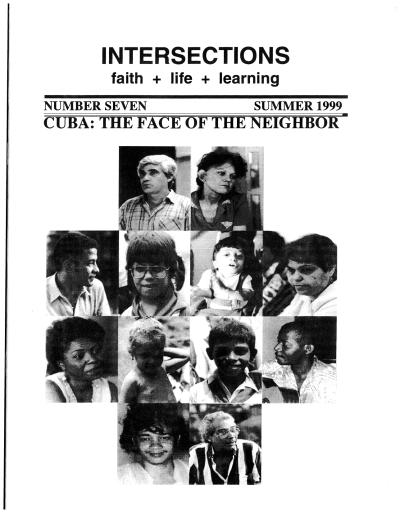
Christenson introduces the issue’s contents—papers from the 1998 Vocation conference by Cheryl Ney and Robert Scholz, a response by Jennifer Sacher Wiley, an interview with four Capital University faculty about Cuba, a meditation by St. Olaf senior Erik Haaland, and the journal’s first letter to the editor—and commends the Mount Mary College volume Wagering on Transcendence as a model of a faculty community sustained by Friday-afternoon conversation over a glass of wine.
-
 Article
The New (con)Texts of Jewish-Christian Engagement
Karla R. Suomala
No. 33 · Spring 2011
Suomala surveys four contemporary contexts of Jewish-Christian engagement on American college campuses — campus populations, Jewish studies curricula, the changing nature of Jewish identity among Millennials, and the shift from formal Jewish-Christian dialogue toward broader religious pluralism — and argues that at Lutheran colleges this success story can serve as a model for engaging the other religious neighbors who increasingly form part of our society.
-
 Editorial
From the Publisher
Arne Selbyg
No. 6 · Winter 1999
Selbyg reports on the work of the Division of Higher Education and Schools to focus what makes Lutheran colleges and universities distinctive, recaps the 1998 Vocation of a Lutheran College conference at Wittenberg, previews the 1999 Susquehanna conference on “Identity and Fragmentation: Can the Lutheran Center hold?” (inspired by Yeats’s vision of the Second Coming), commends Ernest Simmons’s Lutheran Higher Education: An Introduction for Faculty (Augsburg Fortress, 1998), and announces a new NEH/NSF-style initiative called “The Lutheran Academy of Scholars in Higher Education.”
-
 Editorial
From the Editor
Jason A. Mahn
No. 35 · Spring 2012
Mahn introduces five essays from the 2011 Vocation of a Lutheran College Conference at Augsburg, framing how Torvend, Anderson, Svennungsen, Tunheim, and Pribbenow press Lutheran colleges to turn outward—recovering the public character of Luther’s gospel, forming students for moral deliberation, investing in the infrastructure of civic renewal, and pursuing justice and education “off the main road.”
-
 Article
Access, Accessibility, & Change: A Call for Trustworthy Leadership in Higher Education
Emma Jones
No. 60 · Fall 2024
Jones surveys the converging pressures on higher education — cost, the enrollment cliff, shifting demographics, and declining public confidence — and uses Reichheld and Dunlap’s four factors of trust (transparency, capability, reliability, humanity) to call campus leaders to rebuild trustworthy leadership from the inside out.
-
 Article
Why Did the Chicken Cross the Road? A Homily on Liminality and Vocation
Lori Brandt Hale
No. 45 · Spring 2017
Drawing on Wes Moore’s The Other Wes Moore, Warren St. John’s Outcasts United, Victor Turner’s anthropology of liminality, and Dietrich Bonhoeffer’s poem “Who Am I?”, Hale considers how Hmong, Muslim, Latinx, LGBTQ+, non-traditional, and other students live in “double liminal” spaces — and asks whether liminality might itself be a place of transformation in conversations about vocation.