Mister Rogers’ Neighborhood premiered nationally in the U.S. on February 19, 1968. Around a year later, Thiel College, a NECU institution, extended Fred McFeely Rogers his first honorary degree. Several other colleges and universities would later follow suit.
“I like children to know that people can take pride in their work and that everyone’s job is important.” —Fred Rogers
While most students beginning their higher education today were born after Fred Rogers’ passing in 2003, they are familiar with his legacy—as confirmed by an enthusiastic showing of hands during a first-year seminar at Thiel where we discussed themes from the trailblazing series.
Though not explicitly religious in messaging, Fred Rogers incorporated faith-based values throughout his program: the iconic intro song, approach to sensitive subjects, and depiction of inclusive representation.
His appreciation for vocation is also evident during the show’s frequent factory visits segments, or as he referred to them, “How people make things.” From guitar stringing to tofu pressing, he regularly promoted different kinds of work we are called to.
The finale of Season 15’s five-part arc “Mister Rogers Talks About Work” further highlights Fred Rogers’ reflections on the subject. Originally airing in April 1984, the plot follows residents in the Neighborhood of Make-Believe who learn they must divert their hard-earned funds for a swimming pool to repair a plumbing issue instead.
Special scenes throughout the episode also play relevant commentary on the dimensions and realities of “work”:
Mr. Rogers shares a rare glimpse of the WQED television studio with an on-camera introduction of the band and production crew. He explains the necessity of various roles, built from individual talents and interests, in creating his show.
Beaver O’Day nearly breaks character laughing, as he’s questioned whether people should ever take time to relax before their jobs are fully completed.
There is a noticeable emphasis on how much things cost and the importance of properly compensating others for their services. Handyman Negri almost misplaces a payment for Patterson’s Pipes. What did you do with the check, Joe?
The storyline does have a happy conclusion. After the pipes are fixed, the nearby town of Westwood proposes a combination of funds with Make-Believe to create a shared pool conveniently situated between both locations.
“You know, it’s fun to pretend that things work out like that, isn’t it?” comments Mr. Rogers.
However, things can work out in real life like they do in the Neighborhood.
Many of us embrace the mission of strengthening our students and campus with already limited resources. We skillfully strategize and formulate the best plans, only to encounter obstacles from changing institutional priorities and needs.
The community of Make-Believe offers us a reminder that these challenges are an effective opportunity to practice creativity, perseverance, and optimism. To reframe, edit, and collaborate. We find other ways to achieve our goals, and the results turn out even better than expected.
As Fred Rogers famously said…
“Often when you think you’re at the end of something, you’re at the beginning of something else.” —Fred Rogers
The Mister Fred M. Rogers Room is a collaboration space, located inside the James Pedas Communications Center at Thiel College, Greenville, Pennsylvania.
Works Cited
“Mister Rogers Talks About Work.” Mister Rogers’ Neighborhood, written by Fred Rogers, directed by Paul Lally, season 15, episode 30, WQED Pittsburgh / Family Communications, Inc., 1984.
“Factory Visits.” Mister Rogers’ Neighborhood, 7 Apr. 2020, www.misterrogers.org/articles/factory_visits.
“Fred Rogers H’69.” Thiel College, www.thiel.edu/about/thiel-college-connection-to-fred-rogers. Accessed 17 February 2025.
-
 Editorial
From the Publisher
Lamont Anthony Wells
5 min audio
Wells introduces So That All May Belong: Lutheran Roots for Diversity, Equity, Inclusion, and Justice as a theological and institutional articulation of NECU’s commitments, and previews four accompanying essays that frame vocation as a societal responsibility rooted in justice and not solely an individual pursuit.
-
Editorial
From the Editor
Colleen Windham-Hughes
5 min audio
Windham-Hughes uses Fred Rogers’ neighborhood as a living embodiment of a Lutheran understanding of vocation — seeing dignity in each person, offering one’s gifts generously, and trusting that the well-being of the neighborhood is intrinsically connected to the well-being of every neighbor.
-
Institutional Focus
So That All May Belong: Lutheran Roots for Diversity, Equity, Inclusion, and Justice
Altheia Richardson, Angie Hambrick, Caryn Riswold, Colleen Windham-Hughes, Deanna Thompson, Marcia Bunge, Robert Clay
22 min audio
The full NECU statement grounds DEIJ work in Luther’s 16th-century reforms and Lutheran theological claims about the image of God, equal dignity, and the limits of human knowing — offering definitions, Lutheran roots, and calls to action for diversity, equity, inclusion, and justice, with belonging as the outcome of DEIJ at work.
-
Institutional Focus
Scriptures That Inspire Work for Diversity, Equity, Inclusion, and Justice
Altheia Richardson, Angie Hambrick, Caryn Riswold, Colleen Windham-Hughes, Deanna Thompson, Marcia Bunge, Robert Clay
9 min audio
A companion list of biblical verses — from Genesis 1:27 and Galatians 3:28 to Micah 6:8 and Luke 4:18-19 — that grounded NECU’s drafting of So That All May Belong, organized by the four DEIJ commitments and offered as an invitation to share other texts that ground and sustain the work.
-
Institutional Focus
So That All May Belong: Lutheran Roots for Diversity, Equity, Inclusion, and Justice [abridged]
Altheia Richardson, Angie Hambrick, Caryn Riswold, Colleen Windham-Hughes, Deanna Thompson, Marcia Bunge, Robert Clay
8 min audio
A condensed version of the NECU statement that consolidates Lutheran theological grounding for DEIJ and a single combined call to action for Lutheran colleges and universities — offered as a shareable summary alongside the complete document.
-
Article
Vocation at Full Stretch: Reflections on Follow Your Bliss and Other Lies about Calling and its Use among College Students
Jason A. Mahn
43 min audio
Mahn engages Bonnie Miller-McLemore’s Follow Your Bliss and Other Lies about Calling as required reading in a sophomore religion course, showing how her categories of missed, blocked, conflicted, fractured, unexpected, and relinquished callings empower young adults to perceive embodied, unplanned, and often painful dimensions of life as essential parts of vocation — and help close the gap between mission-driven and tuition-driven realities.
-
Reflection
Ecotones of Faith
Tracy Paschke-Johannes
7 min audio
Paschke-Johannes draws on the ecological metaphor of the ecotone — the life-teeming transitional space between two ecosystems — to claim that we are not called to minister in the world of the past or one fifty years hence, but to nurture the kairos moments God is creating in the freshwater-to-saltwater present.
-
Article
Finding the Miracle in the Intersection of Mission and Limitations: Lessons from Latin America
Kat Peters
14 min audio
Peters draws on her time interning with Lutheran World Relief and leading a study abroad program in Central America — including a Costa Rican women’s farm cooperative whose ecotourism project was “unprofitable” but life-giving — to argue that the intersection of God’s preference for struggle and God’s desire for abundant life is itself the miracle higher education can claim amid scarcity.
-
 Article
Sustaining Sustainability
Baird Tipson
No. 36 · Fall 2012
Tipson—former Provost of Gettysburg College, President of Wittenberg University, and President of Washington College—reads Romans 12:2 (“be not conformed to this world…”) against Victor Ferrall’s Liberal Arts at the Brink and the contemporary financial reality of small Lutheran colleges. He tells three case-study stories from Washington College’s Center for the Environment and Society—the Chino Farms partnership, the Chesapeake Semester, and the acquisition of the work boat Callinectes—to show how presidents must engage “the world” to secure resources for sustainability work without being conformed to it.
-
 Editorial
From the Editor
Robert D. Haak
No. 22 · Spring 2006
Haak introduces himself as the new editor inheriting the journal from Tom Christenson and frames the issue around the question of what ELCA colleges might contribute to conversations about human sexuality. He summarizes the contributions of Yeager, Benne, Williams, Bussie, and Nack, and shares previously uncollected National Study of Youth and Religion data on the sexual attitudes and behaviors of Lutheran teens—including that 25% of regularly-attending ELCA teens report the church has done nothing to help them with their sexuality.
-
Institutional Focus
Health Food in the Inner City: An Interview with Brian Noy about Augsburg's Campus Kitchen
Brian Noy
No. 36 · Fall 2012
Noy, Director of Campus Kitchen at Augsburg College in Minneapolis, describes the Kitchen’s four-fold program—Food to Share (2,000 meals per month from surplus dining-services food and Campus Cooking Classes), Food to Grow (an 80-plot community garden), Food to Buy (two farmers markets that accept EBT/food stamps), and Food to Know (educational programming)—and the deep history of Augsburg’s service to the immigrant communities of the Cedar Riverside neighborhood, now Somali and Mexican as well as historically Norwegian.
-
 Editorial
From the Editor
Tom Christenson
No. 15 · Winter 2002
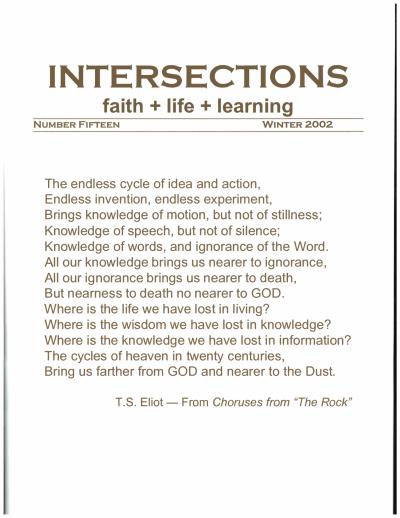
Christenson introduces an issue of varied voices—bishops and university presidents, philosophers and poets, students and their teachers—and defends the T. S. Eliot cover selection (“Where is the wisdom we have lost in knowledge?”) against the charge of being too depressing, arguing with cover artist Ida that Lutherans are realists about human accomplishments and that there is a huge difference between optimism and hope.
-
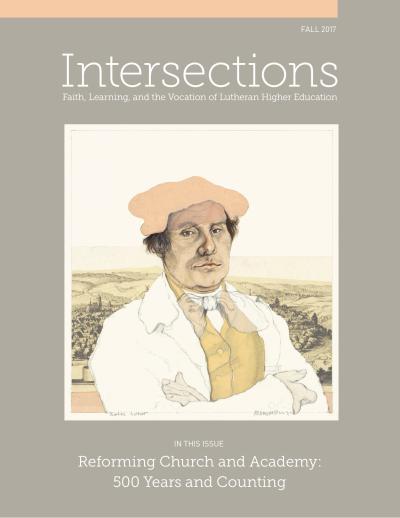 Article
Reforming Lutheran Higher Education: Ecclesiological Reflection and Theological Leadership
Brian Beckstrom
No. 46 · Fall 2017
Beckstrom diagnoses an “identity crisis” at ELCA colleges and universities rooted in inherited Enlightenment assumptions and a thin functional ecclesiology, and proposes that a Trinitarian, perichoretic understanding of God offers an ecclesiological foundation that holds together unity and diversity in a pluralistic, post-Christian context.
-
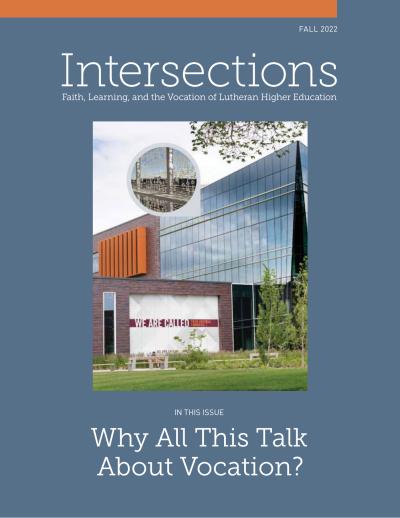 Article
Why All This Talk About Understanding the Mission of NECU Member Institutions as a Vocation?
Mark Wilhelm
No. 56 · Fall 2022
In his valedictory keynote, retiring NECU Executive Director Mark Wilhelm argues that Lutheran higher education is, properly understood, vocation-based education — outlining four core practices recovered over the past fifty years and naming the constructive and corrective work still to be done, including a fuller embrace of DEIJ and of the diverse vocations of NECU’s 27 institutions.