Mission-Driven Learning Resources
Discover publications that illuminate the shared calling of Lutheran higher education. These resources invite faculty, staff, and institutional partners into deeper reflection on faith, learning, and vocation. Explore foundational statements, scholarly conversations, and visionary essays that help NECU campuses embody an education that is both rooted in tradition and open to new possibilities.
Rooted and Open:
The Common Calling of the Network of ELCA Colleges and Universities
Rooted and Open is NECU’s statement about the vocation shared by the diverse institutions in the ELCA higher education community. It describes the Lutheran theological roots that anchor and continue to inform their educational mission. The rich and living Lutheran intellectual and educational tradition of these institutions also compels them to be open to a wide variety of insights from people with a wide variety of backgrounds. They welcome all people of good will into their communities of learning and service. Like the tradition that grounds them, the colleges and universities of the NECU are always in the process of being reformed. Their foundational commitments promise to make them flexible, open to change, ready to partner, institutionally curious and intellectually alive. They share a calling that is both rooted and open.
The statement was endorsed by the Board of Directors, Network of ELCA Colleges and Universities on January 4, 2018.
Faculty and others at NECU institutions are encouraged to read and discuss the statement. Hardcopies of Rooted and Open are available at no cost to NECU institutions. The Spring 2019 issue of Intersections includes a copy of the original statement, and the issue’s articles are devoted to commentary on Rooted and Open.
Intersections:
Faith, Learning and the Vocation of Lutheran Education
Intersections is the biannual publication by the Network of ELCA Colleges and Universities (NECU). Each issue reflects on faith, learning, and teaching within Lutheran higher education, especially as these intersect with contemporary challenges, opportunities, and initiatives.
Current and back issues of Intersections are available on our Intersections page. NECU institutions may order hardcopies of a current issue by contacting the editor.
Faith and Civic Life :
Seeking the Well-Being of All
The ELCA Churchwide Assembly 2025 has adopted a social statement on faith and civic life, the relationship of religious organizations and political authority, and related matters, as called for by the 2019 Churchwide Assembly.
Social statements are the ELCA’s primary documents to address significant social issues. They are intended to aid reflection, shape conscience and set forth the ELCA’s teaching and policy on the major social issues and questions of contemporary life. Social statements are developed by task forces, using an established process of study and widespread participation across the church to guide theological and moral deliberation.
So That All May Belong:
Lutheran Roots for Diversity, Equity, Inclusion, and Justice
“So That All May Belong: Lutheran Roots for Diversity, Equity, Inclusion, and Justice” was published in Intersections No. 61.
This foundational resource articulates how commitments to diversity, equity, inclusion, and justice are deeply rooted in the Lutheran tradition and the shared calling of NECU institutions. Grounded in theology, vocation, and the love of neighbor, the document offers clear definitions, theological connections, and practical calls to action that help campuses foster belonging, accountability, and collective flourishing. Ideal for presidents, trustees, faculty, staff, and campus leaders seeking a common framework for DEIJ work that is mission-aligned and distinctly Lutheran.
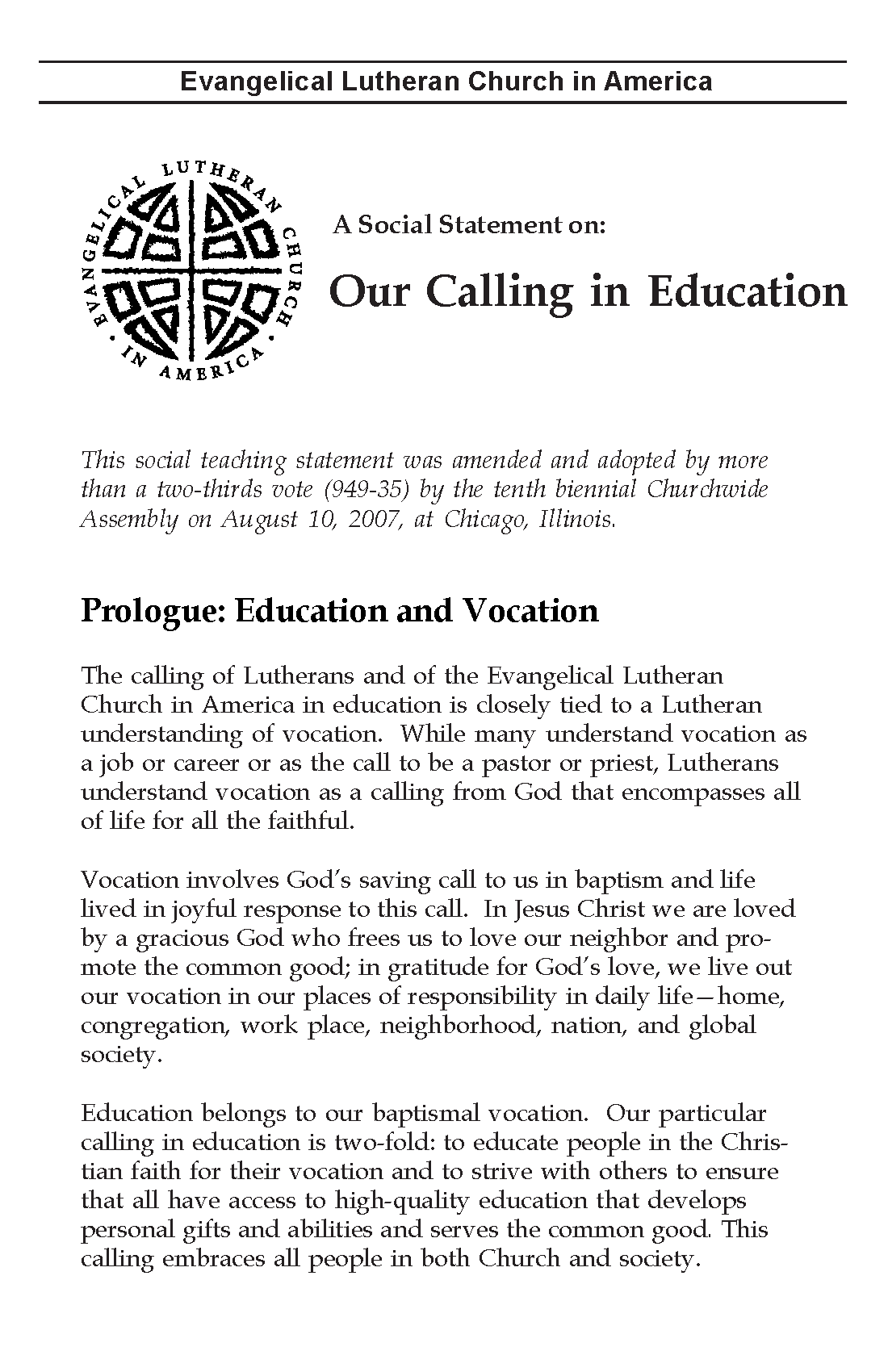
Our Calling in Education:
An ELCA Social Statement
Our Calling in Education is centered around the belief that God calls us to educate people in the Christian faith for their baptismal vocation and to seek with others to ensure that all have access to high-quality education. By seeking greater access for all to education, we serve the common good and ultimately make possible the development of each person’s personal gifts and abilities. This calling is rooted in a Lutheran heritage that values education for all people in both church and society.
The statement discusses particular responsibilities among people of faith that range from increased attention to faith formation in congregational life to public advocacy for equitable, sufficient and effective funding of public schools. It lifts up – among other concerns – renewed attention to the quality of ELCA colleges, universities and seminaries, the vital role of campus ministries, and the importance of corporate and non-profit support for institutions and for students who need opportunities for education. This social statement was adopted by the 2007 ELCA Churchwide Assembly.
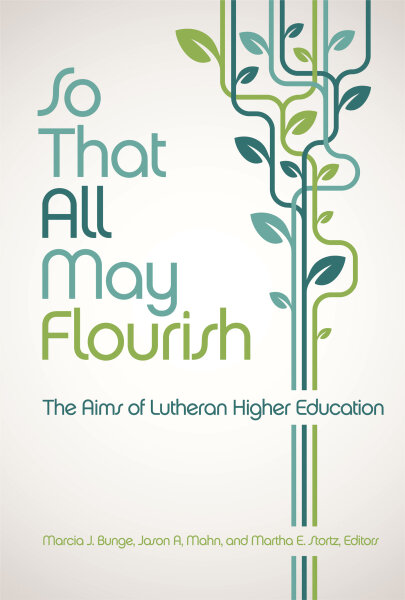
So That All May Flourish:
The Aims of Lutheran Higher Education
So That All May Flourish provides a substantive and accessible introduction to the vocation, educational priorities, and theological foundations of Lutheran Higher Education (LHE) and the Network of ELCA Colleges and Universities (NECU). Intended as a “primer,” the book seeks to cultivate knowledge of LHE and NECU that is both appreciative, critical, and constructive. The book includes 16 chapters across three important organizing sections: Core Commitments, Distinctive Strengths, and Contemporary Callings.
Each chapter is written by scholars from various NECU institutions and highlights a distinctive educational priority, explores its theological groundings, and offers examples of how it is embodied in a variety of distinctive ways on different NECU campuses. The result is a rich tour of Lutheran higher education as a site for important formative work. The book also includes a short preface, forward, and epilogue.
Written by a veritable who’s who of Lutheran higher education, this volume is a must read for everyone concerned about the work being done on Lutheran campuses.
The book is available from Fortress Press.
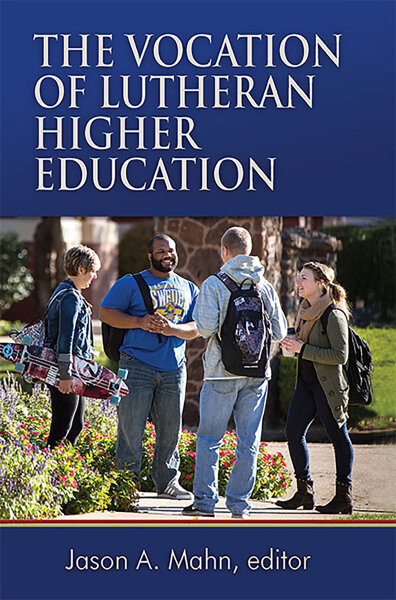
The Vocation of Lutheran Higher Education
What is the vocation of Lutheran higher education, especially now that it is not only or primarily education for and by Lutherans? Over the past several decades, this question has led to a new concerted effort to retrieve and redefine what it means to be a college of the church.
The book, The Vocation of Lutheran Higher Education, addresses this question. Edited by Jason A. Mahn, editor of NECU’s journal, Intersections, the book includes significant essays drawn from and celebrating the 25th anniversary of Intersections, as well as essays written for the volume by authors from outside NECU, such as Eboo Patel, the founder of Interfaith Youth Core.
The book is available from the Augsburg Fortress division of 1517 Media.

ELCA College, University, and Seminary Resources
The ELCA Resource Center contains additional NECU-related resources.