Years ago, I traveled with Cal Lutheran students on a Service Learning trip to El Salvador. Our posture was one of being attentive and reflective learners. Leaders taught us about economic forces that impacted their communities in negative ways. We witnessed music, education, and arts fueling the healing of a city. We heard people describe social justice ventures which broke apart systems that did not enhance human flourishing. Our leader, Pastor Kim, shared these words: “Your theology depends on where your feet are standing.” He may not have been the first person to speak these words, yet they cracked open my ears and the imagination of my heart.
Your theology depends on where your feet are standing.
Cal Lutheran stands tall as the youngest of the colleges and universities of the ELCA perched within the Conejo Valley of southeastern Ventura County. We are located halfway between Los Angeles and Santa Barbara. Birds who take refuge in the landscape of Kingsmen Park and find water to drink in the two creeks on campus can swiftly fly to the Pacific Ocean 12 miles away. For humans in cars or bicycles, it is a journey of about 25 miles.
Every family has a story, one that they tell with a sense of honesty or humor. Cal Lutheran has a particular founding story that we have said with great Cal Lutheran pride for many years. It is a story about immigrant people eking out an existence working the land, raising sheep and chickens (selling 1,500 eggs a day in the informal economy), selling assorted baked goods, and harvesting walnuts and citrus. When one looks at the pictures in the Pederson Administration Building of the landscape from over 70 years ago, one sees black and white photographs of people working the land. Who could imagine that others would transform their chicken coops into classrooms?
However, the story does not begin with that particular founding story. Rather, the university has centered—and, more importantly, I have centered—the immigrant story of Scandinavian ancestors. In doing so, I have excluded indigenous people who stewarded this land for years. Today I am mindful of the Chumash, Fernandino Tataviam, and Ohlone peoples and their tribal leaders among us. In gratitude for their grit and grace, I thank them and for this land upon which we work, learn, play, and pray.
This history tells us where our feet are standing on the Cal Lutheran campuses.
There are times when a different question emerges. What if the university, what if our mission, was dependent on where our students are standing? Would a notion like that inflame our imagination about the courses we teach, the pedagogy that we utilize, the faculty and staff that we hire and seek to retain, the ministries that we would enable, and the programs and opportunities that would stir up among us? I think it would.
Cal Lutheran has received the designation of being a Hispanic-Serving Institution of higher education. The HSI designation means that 25 percent of the undergraduate students are from Latinx populations. This designation, at its core, is a commitment and responsibility that informs our mission. The challenge is to “become what we are” so that our identity is centered not in enrollment, as crucial as that is, but instead in service. How shall we live into what our inaugural HSI Director, Dr. Paloma Vargas, terms as our “HSI Servingness?”
Cal Lutheran reached the 25 percent threshold of Latinx students in 2013. In 2021, nearly 39 percent of our student population identified as Latinx. This statistic might be surprising high, compared with other ELCA colleges and universities. But it is also surprisingly low, given the ethnically diverse populations of the surrounding communities. The Latinx population in two local counties is between 42 and 49 percent.
Nevertheless, the demographics of Thousand Oaks, the city where our main campus is nested, are different (68 percent white, 18 percent Hispanic, 1 percent Black, 9 percent Asian, and 3 percent two or more races).These demographics impact the sense of belongingness that our students experience, especially first-generation students or those from underrepresented populations. Can this place be one in which they can stand, feel a sense of safety, and name it “home?”
Can this place be one in which they can stand, feel a sense of safety, and name it ‘home?’
Fifty-three percent of the students are from underrepresented populations. The same is true of only 30 percent of our full-time faculty, 37 percent for exempt staff, 50 percent of our non-exempt staff, 18 percent of our Board of Regents, and 21 percent of the Convocation, the shareholders of the university.
Experts who research belonging inform us of the importance of a rich and varied ethnic, gender identity, and cultural diversity within the institution. If our students flourish, they need to interact with and learn alongside leaders, educators, and mentors who share a common background.
Our university has more work to do in this area of belonging.
Thanks to many campus leaders and the work of the University of Southern California’s Center for Urban Education, we have established a new search and hiring process for faculty with trained equity advocates and anti-bias training. However, human resources has not developed a similar process for staff. More work is needed here.
Promising innovations have expanded our capacity to serve and retain students and employees even as we wrestle with what remains to be reformed. Some of those innovations include:
- The development of a “transfer pathway” and articulation agreement with community colleges. This pathway assists many who are first in their family to attend college and complete their degree taught by dedicated faculty, staff, and admissions personnel who mentor and support them.
- Project CHESS is a collaborative program between Cal Lutheran and a local community college to help students find success by engaging in the classroom, connecting to peer mentors and the campus community, and focusing on careers. Our faculty in this project join a CIRCLE Collaborative, a faculty learning community whose goal is to redesign introductory 100-200 level courses to align pedagogy with the diverse academic needs of historically marginalized students. Our students connect through peer mentorship partnering minoritized men entering their sophomore year at a junior college with rising juniors and seniors at Cal Lutheran.
- The Alexander Twilight Legacy of Black Excellence is a space within the student union named for the first African-American to earn a bachelor’s degree from an American university or college. As the university creates a new strategic plan intersecting with a new master plan, I will join those who advocate creating similar places for our LGBTQ+, Asian Pacific Island, and Latinx students. To have a place of one’s own to be known and seen can enhance the experience of belongingness for our students. I believe that our students need more than just a network of support. Students flourish and go out into the world when they have “networks of networks” as traveling companions for every time and place.
- Five campus affinity groups have been enlarged to support faculty and staff, impacting the retention of gifted employees.
- The Center for Cultural Engagement and Inclusion, campus ministry, and student life team honor cultural celebrations from students’ lived histories—including the Día de Los Muertos, Pride month, Filipino heritage celebrations, and many more.
Suppose we want a campus environment where all individuals come to trust that they are called and empowered to serve the neighbor so that all may flourish. In that case, we will need an ongoing commitment to cultural proficiency. I value the language of Rooted and Open: The Common Calling of the Network of ELCA Colleges and Universities, which states that, in our “openness to the new perspectives and fresh insights of others, these institutions practice a spirit of intellectual humility.” I want to add “cultural humility” to this practice as well.
California Lutheran faculty member, Lisa Dahill, writes of “baptizing in local waters,” of encouraging religious leaders to leave their buildings, find natural flowing water, and go to those places whenever they are celebrating baptism. In her article “Living, Local, Wild Waters,” she writes that using local waters for baptisms would “implicate communities in the health of the water and watershed, recognizing that entrusting infants and adults to these waters requires ongoing collaboration with scientists monitoring a given watershed, activists safeguarding it, other humans living near these waters, and patterns of habitation, pollution, species migration, zoning, and flow affecting it all” (Dahill).
This image of local waters prompts me to think of our students and the importance of place, not only the place of this land, but also the landscape within each student, in their ancestors, traditions, and ways of being in the world. As my colleague Pastor Hazel Salazar-Davidson reminds me, this is especially true of the Latinx community. These students bring their stories, histories, traumas, and proud occasions with them as they nest within the community. They come to our campus surrounded by their ancestors in their hopes and dreams, in the faithful practices of familial life and food preparation, and in care for multiple generations within their homes. We are to attend to the social location of our students, not simply within our particular zip code, but deeper in the stories that come in, with, and under their life experiences.
This image of local waters prompts me to think of our students and the importance of place, not only the place of this land, but also the landscape within each student, in their ancestors, traditions, and ways of being in the world.
I have heard it said that “Change happens at the speed of trust. Trust happens at the speed of relationship.”
Suppose we are to be the change we seek in the world. In that case, a part of our vocations as colleges and universities of the ELCA is to develop trustworthy relationships of belonging and inclusion in the classroom, field, studio, music hall, residence hall, and workplace so that all may flourish.
Works Cited
Dahill, Lisa. “Living, Local, Wild Water: Into Baptismal Reality.” AllCreation.org. Accessed 1 Nov. 2021, http://www.allcreation.org/home/waters
NECU (Network of ELCA Colleges and Universities). “Rooted and Open: The Common Calling of the Network of ELCA Colleges and Universities.” Accessed 1 Nov. 2021, https://download.elca.org/ELCA%20Resource%20Repository/Rooted_and_Open.pdf.
-
 Editorial
From the Editor
Jason A. Mahn
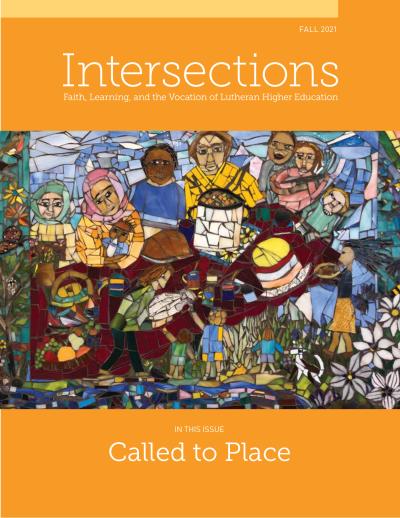
Mahn introduces the “Called to Place” theme of the 2021 VLHE Conference, arguing that Lutheran higher education’s emphasis on vocation must be grounded in particular geographies and embodied communities — for, as Wallace Stegner put it, “If you don’t know where you are, you don’t know who you are.”
-
Article
Community-Building On Campus and Beyond
Krista E. Hughes
Hughes describes Newberry College’s effort to build a “culture of community” that mirrors South Carolina’s demographics while reckoning with the institution’s founding ties to slavery — and names the challenges and promising city-college collaborations that shape this ongoing work.
-
Article
Just Communities: From Liberal Arts in Prison to Racial Healing over Zoom
Monica Smith
Smith showcases how Augustana College’s commitment to social justice extends into the Quad Cities through two initiatives: the Augustana Prison Education Program at East Moline Correctional Center, and Racial Healing conversations developed through the Truth, Racial Healing and Transformation framework.
-
Reflection
Caught in a Place Between Caesar and God
Darrel D. Colson
Colson reflects on his anguish, as Wartburg’s president, over an Iowa law that prevents him from requiring student COVID-19 vaccinations — reading Luther’s “Whether One May Flee From a Deadly Plague” alongside the conflict between obeying the law and serving neighbor.
-
Article
Hospitality to the Wild
Laura M. Hartman
Drawing on research with a Wild Ones Native Landscaping chapter and Marilyn Matevia’s ethic of “creature comfort,” Hartman argues that Christian hospitality must extend to non-human animals and plants — and asks whether college campuses can foster not just human diversity but biodiversity.
-
Article
Return to Purpose: Learning in an Age of Collapse
Ahmed Afzaal
Afzaal argues that the cascading crises facing higher education are not temporary glitches but symptoms of planetary and civilizational collapse — and that colleges must embrace “double-loop” learning and return to a shared sense of purpose if they are to help humanity descend gradually rather than catastrophically.
-
 Article
Assessing Self-Assessment Instruments at Finlandia University
René Johnson
No. 55 · Spring 2022
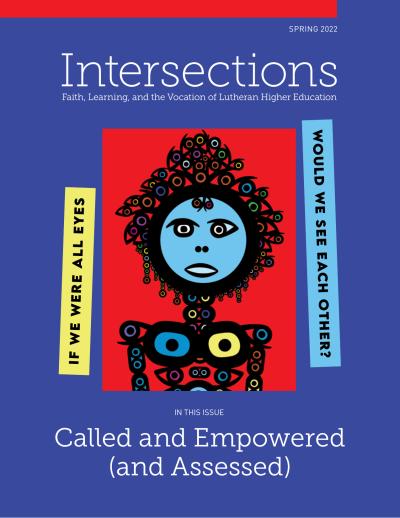
Johnson surveys three self-assessment instruments presented at the NetVUE conference — PathwayU at Colorado State, the Intercultural Development Inventory at Friends University, and Mark Savickas’s Career Construction Counseling Manual at Union College — and describes Finlandia’s use of the CliftonStrengths© assessment to link students’ personhood to “behaviors that benefit the community.”
-
 Editorial
From the Editor
Tom Christenson
No. 17 · Summer 2003
Christenson introduces the four essays by participants in the first Lutheran Academy of Scholars as fruit of the “genuine conversation” that emerges when specialists set aside their lecturers’ podiums to speak as human beings, and welcomes the issue’s additional “Intersections first”—a response to a response to a review—continuing the conversation between Baird Tipson and Robert Benne about the paradigm of Lutheran higher education.
-
 Article
Leaning-In to the Civic Lessons of Our Namesakes
A. Lanethea Mathews-Schultz
No. 63 · Spring 2026
6 min audio
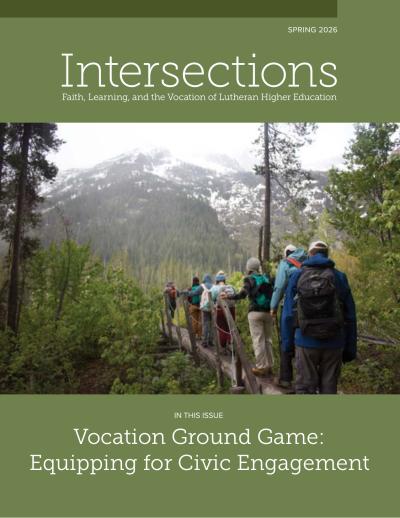
Mathews-Schultz uses the civic legacy of the Muhlenberg family — from General Pete’s Revolutionary call to action to President Muhlenberg’s inaugural address on the “education of conscience” — to invite students at Muhlenberg College into a shared civic inheritance.
-
 Response
Response to Mark Wilhelm: Vocation—Wide Perspective Questions
Mary-Paula Cancienne
No. 56 · Fall 2022
Cancienne, drawing on Iain McGilchrist, asks whether higher education has prioritized micro lenses at the expense of the macro view, and invites educators to hold the drama of individual vocation stories within a wider plot that includes James Webb Telescope wonder, climate grief, the long shadow of enslavement, and the resilience of native populations.
-
 Editorial
Guest Editorial
Kristen Glass Perez, Richard Priggie
No. 40 · Fall 2014
Glass Perez and Priggie introduce the issue by recounting the campus conversations and the June 2014 Interfaith Understanding Conference at Augustana College that gave rise to it, framing the central question, “What does it mean to be Interfaith at a Lutheran College?,” as a living example of the praxis of being a Lutheran college in the twenty-first century.
-
 Article
Practicing Hope: The Charisms of Lutheran Higher Education
Martha E. Stortz
No. 32 · Spring 2010
Stortz names four charisms—theological gifts of identity rather than commodities—that Lutheran higher education brings to a culture of fear: semper reformanda as flexible, responsive institutions; the freedom of a Christian as simul justus et peccator critical inquiry that holds opposites in creative tension; regard for the other as “neighbor” rather than friend or alien; and the priesthood of all believers as a public, civic calling to know the poor. Drawing on Augustine, George Lindbeck, Patricia Killen, James Clifford, Earl Shorris, Carter Lindberg, and Augsburg’s Center for Global Education, she argues that immersion trips, neighbor-regard, and welfare reform witness that the gift Lutherans bring is hope grounded in Christ in you, the hope of glory.