Leadership in a Pandemic: Grace-Filled Lessons in Unprecedented Times
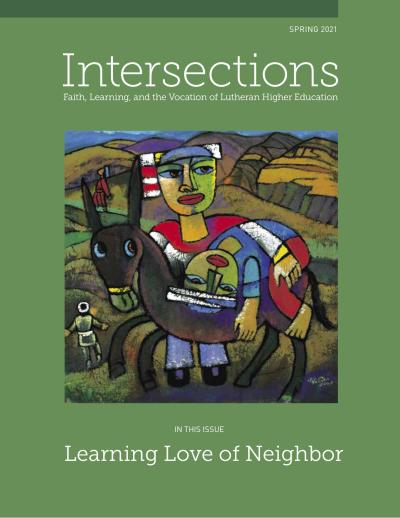
Intersections No. 53 · Spring 2021
It has now been just over a year since the severity and impact of the COVID-19 virus sent us scurrying home from our campuses, trying to pivot to remote operations, a concept that was unheard of for most university campuses across North America. Yes, online course delivery is a growing trend with some institutions (such as Athabasca University, Alberta). But, for most of us, complete remote operations—including financial services, HR, student services and supports, and so forth—seemed unthinkable.
At the time, I was teaching within academic disciplines (economics and leadership) for which traditional teaching methods depend on in-person class interactions (leadership) and on visual graphical explanations (economics). I am of a vintage for whom manually drawing the graphs in class and walking students through them was a fulfilling and effective teaching method, particularly with macroeconomic analysis. Manually drawing graphs—whether by smart board, wireless tablet, whiteboard, or even chalk—created an interactive experience that students craved because of its clarity and in-person nuances. Certainly, I used online learning management systems such as Moodle and Blackboard, which have excellent collaboration tools. Still, I believed that nothing could replace the “magic” of the in-classroom experience.
The inconvenience that I experienced after having to deliver content remotely pales in comparison to what I will describe as the real effects of the pandemic, which I know first-hand as a teacher, pastor, and new college president. I want to summarize some highlights and learnings by briefly answering three questions:
1) What have we learned about our community during the pandemic?
2) What have we learned about leadership in a long-term crisis?
3) What does a “new” normal or “next” normal look like for our institutions post-pandemic?
Community in a Pandemic
As a pastor who is writing this during a pandemic and during Lent, I cannot help but think of time spent in exile, wandering about the wilderness. When we all went home last March, many of us were expecting a couple weeks of a “makeshift” remote operation before returning to campus for business as usual. Now, a full year later, the Canada-United States border remains closed to all nonessential travel, and many post-secondary schools (including mine) are still operating completely remotely.
If the pandemic has emphasized anything for us, it has reiterated how important our call is to care for those around us and to work for justice and peace in God’s world. It has reminded us of the value of kindness, both given and received, and the need for sharing grace in all that we do. For Christians, this is a simple measure of the grace we receive in the Spirit-infused waters of baptism.
“The pandemic has reminded us of the value of kindness, both given and received, and the need for sharing grace in all that we do.”
Most importantly, the pandemic has reminded us of how much our university campuses crave community and connection. At Luther College in Regina, all the community-building activities so essential to the niche of our college have been either moved online, offered in a limited way according to the health authority guidelines, or offered not at all. Daily chapel at the high school campus has moved to Zoom. While we cannot gather as we normally would, a silver lining is that now alumni chapel speakers join us electronically from around the world. On the university campus, where no one except essential workers are on campus, weekly chapel and all events of the faith-based programming have been moved online. What we have learned is how important gathering in community will be when it will finally be safe to do so.
Leadership through a Long-Term Crisis
There is also some learning about leadership. Despite being an economist and past professor of strategy and leadership, likely the best preparation for my new role as president in a pandemic has come from my seminary and pastoral training. We are seeing an unusual level of anxiety and PTSD-like effects of the pandemic, even in those of us in relatively privileged and protected positions. People have run out of capacity to manage issues via email—a medium that loses nuances of language and can cause even small problems to explode.
More than anything, what is demanded of leaders at this time is to display a calm, pastoral, listening approach to servant leadership. Our teams need to be reassured, even when there is often no information to be shared or answers to give. Leadership is about looking after those in our care so that, in turn, they can care for our students.
It is also noteworthy that the pandemic has had a disproportionate effect on women and those in relatively lower income service industries. It has heightened the divide in society around racial issues and income inequality. In March of 2020, our college’s large proportion of students who are single parents suddenly had no childcare options, and their children were learning from home. A pastoral approach to teaching was needed to help those students just trying to cope.
Today, as the pandemic drags on, our employees’ and students’ life-transitions continue. Deaths in families still happen, except one cannot gather for a funeral to grieve. Relationships that were held together by a thread saw the pressures magnified, including a risk of increased domestic violence. Access to internet bandwidth and computers are limited in many homes. Many students who are also parents cannot get university work done until late at night after family members have gone to bed. Student expectations about the quality of online learning have (rightfully) risen as time goes on.
“Leadership is about looking after those in our care so that, in turn, they can care for our students.”
Leadership in a crisis is all about a patient pastoral presence without illusory hope.
The New or Next Normal
True hope, however, does appear to be on the horizon. While vaccinations, particularly here in Canada, have been slow to roll out, they are now rolling out, and with them a new sense of hope. Just as the hope of the gospel propels us out of the darkness into the light, the end of the pandemic will come. There are still more silver linings. In Saskatchewan, Indigenous post-secondary student participation rates are as high as ever, thanks to the flexible delivery options now available. I am hopeful that these kinds of innovations will remain post-pandemic.
There are still lots of issues to resolve even beyond vaccinations. What if an employee refuses to be vaccinated? How long will physical distancing, mask wearing, and sanitation practices continue—and what should continue? The influenza season was virtually nonexistent this past winter because of these procedures. Should some version of them continue in the years ahead?
“There are still more silver linings. In Saskatchewan, Indigenous post-secondary student participation rates are as high as ever, thanks to the flexible delivery options now available.”
As leaders we will also need to be aware and concerned about the long-term sustainability of our institutions and the long-term impacts of the shutdowns on our balance sheets. We will wonder about the recovery of international travel, including the arrival of international students who stay in our dorms and on whom our institutional finances depend a great deal. To what extent will we continue to offer online delivery? To what extent will our “in-person” model return post-pandemic? At Luther College, the in-person, personal touch has been an important part of our brand and niche as a small college. How much of that will we be able to retain?
At the end of the day, many of these questions are still unanswerable. What I will say is that good leadership is needed to help us to continue focusing on the things we have learned over the past year. They include: kindness, grace, and community. Perhaps our NECU institutions will continue to have a special role to play in the healing of our world. We may continue to produce graduates who have learned how to care for one another and the world around us, and the importance of the true value of kindness, grace, and community.
May the grace of God that sustains us each day refresh and renew us to, in turn, be grace-filled and kind to those around us as we recover. May that action of grace also be a lasting change for the better in the days ahead.
-
 Editorial
From the Publisher
Mark Wilhelm
Wilhelm reflects on an NPR report of teenagers’ pandemic diaries and the fraught Christian history of struggling to live out Jesus’s ethic of love, framing the issue as a record of NECU institutions working out how to act for the common good through the pandemic of 2020–2021.
-
Article
Teaching as an Expression of a Love Ethic
Abbylynn Helgevold
Drawing on Kierkegaard’s Works of Love and Kevin Gannon’s teaching manifesto, Helgevold describes how an ethic of upbuilding love—love that presupposes goodness in students—reshapes inclusive pedagogy at Wartburg College, from syllabus language to how she addresses plagiarism and attendance.
-
Reflection
Keeping Close from a Distance: Pandemic Reflections of a Library Coordinator
Carla Flengeris
Flengeris reflects on a year of running Luther College’s library at the University of Regina from her basement and mourns the loss of the hourly walks through the stacks—the “roving reference” that, she realizes, were never disruptions to her work but were the work itself.
-
Article
Preaching in Christ Chapel on Yom HaShoah: Reflections on Interfaith Relations at a Lutheran College
Sarah Ruble
Ruble shares her 2019 Holocaust Remembrance Day homily preached before the cross in Christ Chapel at Gustavus Adolphus, then reflects on whether “professional Christians” on Lutheran campuses might practice a non-mutual, witnessed confession before colleagues of other traditions as a check on Christian self-deceit.
-
Article
Down and Out: First Year Students Encounter Lutheran Theology
Lindsey Leonard
Leonard describes how Wartburg’s IS 101 first-year seminar wove the Dalai Lama, Paul Kingsnorth, Chimamanda Ngozi Adichie, and Mary Robinson’s Climate Justice into the Fall 2020 reader so the “COVID class” could encounter Lutheran theology’s call to serve the neighbor across the pandemics of disease, racism, and climate change.
-
Article
(Re)Defining Vocation: Gladly Challenging a Vocational Giant
Andrew Tucker
Tucker challenges Frederick Buechner’s famous definition of vocation as “where your deep gladness and the world’s deep hunger meet,” arguing that gladness reflects a privileged perspective and proposing instead that vocation be defined as “any meaningful, life-giving work you do for the world.”
-
Article
Vocation Outside of Career: Discovering Purpose through Comics
María Evelia Emerson
Emerson recounts building an Augustana Vocational Discernment course around G. Willow Wilson’s Ms. Marvel series, using Kamala Khan’s juggling of family, friendship, faith, and superhero identity to help sophomores see vocation as not what they do for a living but how they want to live.
-
Book Review
Unconventional Wisdom and Talking about God: A Review of Beckstrom’s Leading Lutheran Higher Education in a Secular Age
Ann Rosendale
Rosendale reviews Brian Beckstrom’s Leading Lutheran Higher Education in a Secular Age, recommending its diagnosis of the gap between espoused and perceived Lutheran identity at ELCA schools and its prescription—Trinitarian Missiological Ecclesiology and a campus-wide willingness to talk explicitly about God.
-
Reflection
Shelter in Place: Reflections from March 22, 2020
Jason A. Mahn
On the fourth Sunday of Lent in 2020, Mahn meditates on the etymology of “shelter” (from shield) and on an email from a former student in Boston whose mutual-aid organizing models a Lutheran understanding of vocation: the upending of ego by divine love that frees us, finally, to see and serve the neighbor.
-
 Article
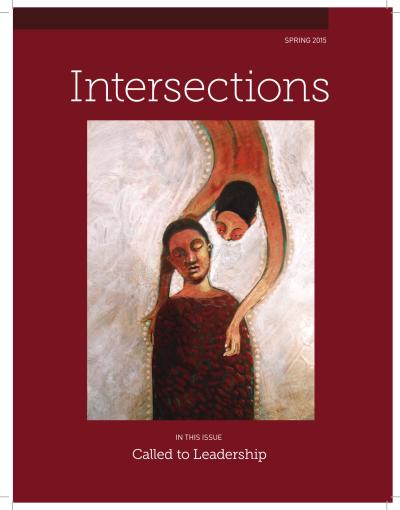
Superheroes and Origin Stories: Tools to Discover and Claim One's Callings
TJ Warren
No. 41 · Spring 2015
Warren argues that the “Hero’s Journey” — Joseph Campbell’s monomyth with its ordinary world, call to adventure, mentors, and return with the elixir — offers a powerful pedagogical tool for helping college students discover their origin stories and claim their callings. Drawing on Superman, Wonder Woman, and Rosa Parks alike, he invites educators to mentor students into becoming the heroes of their own lives.
-
 Article
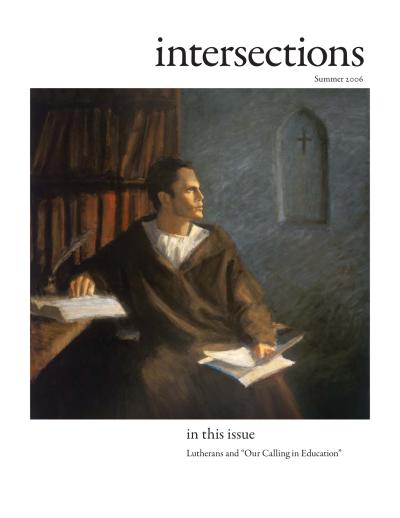
"Our Calling in Education": Working Together to Generate a Strong Social Statement on Public Schools, Lutheran Schools and Colleges, and the Faith Formation of Children and Young People
Marcia Bunge
No. 23 · Summer 2006
Bunge, Professor of Theology and Humanities at Christ College, Valparaiso University, makes two claims about the ELCA’s forthcoming social statement on education: first, that it should be built on a robust Lutheran understanding of vocation, addressing four common misconceptions (vocation as occupation, as self-fulfillment, as ordained ministry, and as “vo-tech”) and recovering the breadth of Luther’s teaching; and second, that the statement should narrow its focus to three urgent areas affecting children and young people — public schools, Lutheran schools and colleges, and faith formation — rather than addressing the full lifespan of education in equal depth.
-
 Article
Diversity, Integrity, and Lutheran Colleges
Florence D. Amamoto
No. 8 · Winter 2000
Amamoto—a sansei Jodo Shin Shu Buddhist who is “an inside outsider” at Gustavus Adolphus—argues that diversity and integrity belong together in Lutheran higher education, perhaps in a way unmatched by other church-related traditions. She affirms the importance of Gustavus’s 60% Lutheran student body and vibrant Christ Chapel under Richard Elvee and Brian Johnson while warning that numbers and chapel are not enough, draws on Tom Christenson, Patricia Gurin, Sylvia Hurtado, Anthony Carnevale, Martha Nussbaum, W. E. B. DuBois (the deaths of Matthew Shepard and Isaiah Shoels), Richard Hughes’s reading of finitum capax infiniti, Richard Solberg, and Mark Schwehn’s mutual hospitality model, and concludes that the real enemy is not diversity but indifference—and that Lutheran finitude grounds a theological commitment to keeping diversity and identity in creative conversation.
-
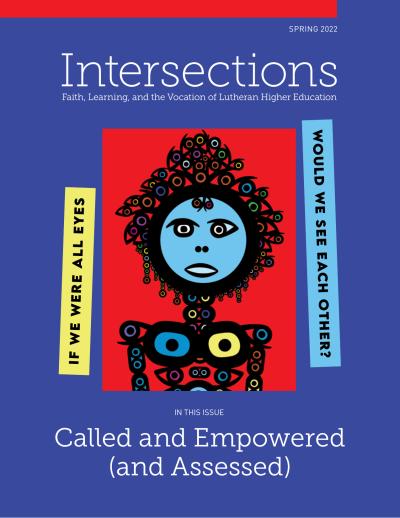 Editorial
From the Outgoing Editor
Jason A. Mahn
No. 55 · Spring 2022
Mahn closes out a decade of editing Intersections, passes the duties to Colleen Windham-Hughes, gives thanks to Mark Wilhelm and Augustana College, and introduces an issue largely drawn from comments by Lutheran faculty, staff, and administrators at the 2022 NetVUE national gathering.
-
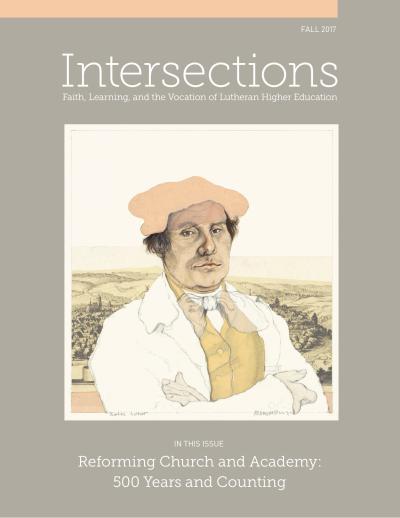 Article
Reforming Our Visions of City Nature
Lea F. Schweitz
No. 46 · Fall 2017
Through a Chicago story of Canada geese at North Pond, Schweitz takes up two Reformation-era ways of reading the “Book of Nature” — Konrad Rosbach’s moral readings and Philip Melanchthon’s scientific ones — and proposes a third: Luther’s sacramental principle that the finite is capable of the infinite, worn as “reading glasses” for an urban planet.
-
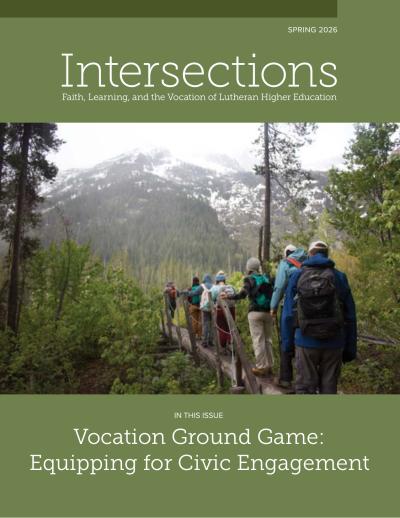 Article
Community-Based Research as Engaged Citizenship
James Paul Old
No. 63 · Spring 2026
6 min audio
Old argues that genuine citizenship requires more than charitable gestures — it demands long-term, reciprocal community partnerships — and describes how Valparaiso’s Community Research and Service Center embodies that vision even amid the financial pressures threatening such programs.