Many students don’t arrive at our universities with a clear understanding of vocation, and especially not one that reflects the Lutheran approach to vocation. Some evidence suggests this is because use of the English term vocation has dramatically decreased in common parlance since its height in the sixteenth century (Google). You can do a simple search of this yourself using Google’s Ngram Viewer, which analyzes the use of words in tens of millions of print publications since 1500.
In our ecumenical context, confusion also can arise since Roman Catholic traditions typically use vocation to refer to the specifically religious callings of priesthood, marriage, or celibacy, while Protestants typically refer to God’s call in a broader sense. Since Roman Catholics makeup a majority (or at least, a significant minority) of self-identified students on many of our campuses, this almost certainly makes an impact on the conversation. It also puts the onus on NECU institutions to clarify what we mean by vocation and to offer a compelling definition that invites students, faculty, and staff to see vocation through a Lutheran lens.
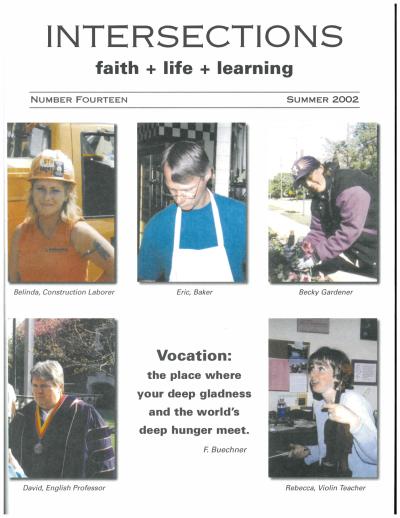
It seems to me that the greatest challenge is that, often by tacit support or silent disregard, we’ve ceded the ground of vocational clarity to other voices in the field. Perhaps the most famous of these vocational gurus is Frederick Buechner, who, in his book Wishful Thinking, defines vocation as “the place where your deep gladness and the world’s deep hunger meet” (Buechner). Far be it from me, a not famous (though I hope not infamous) college pastor, to challenge this giant in the field of vocation. But as David thought when he faced Goliath, and Lin-Manuel Miranda’s Hamilton vocalized on stage, I’m not throwing away my shot. Simply put, Buechner’s vocation definition, and specifically his focus on gladness, is insufficient for colleges, universities, and religious institutions in the twenty-first century. Rather than gladness, meaning should be the cornerstone of our definition of vocation.
Important and Insufficient: Experiencing Joy
For most in Gen Z—who comprise the majority of undergraduate students on our campuses—the word glad is practically synonymous with happiness. Now, don’t get me wrong. I believe there’s far too little happiness in our world, especially one plagued with the dual pandemics of COVID-19 and racism. Gladness is not something we should avoid, nor is it something we should ignore. It is, in fact, what makes Buechner’s definition so attractive. If there are things that can make me happy and meet the profound needs of the world in which I live, surely I would want to participate in those vocations.
On the one hand, then, taking joy in an activity certainly doesn’t preclude that activity from being one of your vocations. Many things we do inspire joy within us, while also serving a deep and abiding purpose. As a college pastor whose students recently received full-ride-plus-stipend graduate school offers, who just started their dream jobs, who just invited me to perform their marriage ceremonies, I frequently feel gladness in this vocation work. For that, I am deeply grateful.
On the other hand, gladness is not something that should solely define the central purposes of our lives. God calls us, at times, to things that have holy purpose and are deeply meaningful, and yet bring no gladness. I think back to the times where couples asked for prayer in deep moments of sorrow at the loss of a child, or to the people who sought support after experiencing assault. Those, too, were my vocation. I was in no way glad, and yet, they were deeply meaningful moments full of holy purpose.
Another concern (and one that almost certainly seems ridiculous coming from me) is that the conversation around vocation is often controlled by straight, white, cisgender, Christian men with at least middle-class wealth. You know, people like me. Of course, from within our privilege, we can focus on happiness. We’ve got time to ruminate on such things, the means to pursue them, and audiences to listen to our conjectures as if they are categorical imperatives. Certainly, all people have the capacity for gladness, but not all people have the luxury to focus on it as a primary mode of purpose or existence. Such a focus on gladness doesn’t account for the holiness in work that requires toil, and even suffering, to meet the needs of our neighbors, nor does it attend to the ways that others have found meaningful purpose despite oppression and marginalization. That’s why, in my forthcoming book on vocation, my primary conversation partners are Black, Indigenous, and other people of color, along with people who are Queer and of religious and spiritual traditions other than Christianity. Simply because they have not controlled the conversation on vocation does not mean they have no wisdom to share; in fact, there is profound purpose for vocation that we’ve often ignored through a narrow focus on predominantly white, Christian, male, affluent approaches to vocation.
Decisive: The Flourishing of the Neighbor
Despite my critique, there is also some harmony with Lutheran vocational theology and Buechner’s definition. Consider Luther’s thoughts in “The Freedom of a Christian”: “In all of one’s works a person should… contemplate this thought alone: to serve and benefit others in everything that may be done, having nothing else in view except the need and advantage of the neighbor” (Luther 520). Five hundred years later, Buechner echoes this concern that Luther penned in 1520, namely that the world’s needs are the paramount purpose of vocation. Our neighbors—not just humanity, but all of God’s creation—have needs which may be met by the work we have to offer. Luther reminds us that, since God in Christ guaranteed we need not work for our own salvation, we are empowered instead to serve the bodily needs—mental, physical, emotional, civic, economic, political, relational, familial, and others—as the primary locus of and reason for our work. Wingren, in his Luther On Vocation, offers this helpful paraphrase: “God doesn’t need our good works, Luther said, but our neighbor does” (Wingren 10).
“Our neighbors—not just humanity, but all of God’s creation—have needs which may be met by the work we have to offer.”
It is the needs of our neighbor, the images and works of God in the world, that guide our vocations. Since gladness is not always found in meeting these needs, how can we understand vocation in a clear way that connects our purpose to the needs of our neighbors? I propose this working definition: your vocation is any meaningful, life-giving work you do for the world. This highlights a few key factors.
First, vocation is at least theoretically possible in any work that we do. Vocation isn’t limited to monetizing skills, or biological families, or public deeds. We hold multiple vocations simultaneously as family members and friends, as citizens and workers, as volunteers and as earth keepers.
Second, the definition asserts that vocation is found in work that is meaningful, especially meaningful to you. Again, not all things we are called to make us happy, but all things we are called to have meaning that connects with our identities and our values. It doesn’t bring good parents gladness to discipline children, nor are good teachers glad to give negative feedback on assignments. But those moments of correction are full of meaning as we participate in the identity and vocational development of those under our care. I am not alone in this framing. For instance, Marsha Rehm offers the notion of vocation as meaning-making in her foundational article “Vocation as Meaning Making Narrative.” The proposed definition ties together Rehm’s valuable thread with Buechner’s attentiveness to the world’s deep needs, but with a twist.
Third, then, rather than utilize the language of need, this definition instead echoes Jesus’s words from John 10. Christ came to give “life to the full” or “abundant life.” While that’s categorically different than the work we’re called to in our vocations—I can’t guarantee anyone’s salvation, including my own—as images of God (and for some of us, as followers of Christ), we’re called to do work that reflects the God that we love. To meet needs is to give life, but to speak about meeting needs in the twenty-first century can sound too close to a toxic charity approach that creates or supports an unhealthy dependency. To give life intends to enable freedom, to honor the integrity of those that give and receive.
One distinction that’s worth noting is that your vocation should be meaningful and life-giving for both you and those you’re serving. This is where our tradition’s language of internal and external call matter deeply. Just because something is meaningful for you doesn’t mean it’s life-giving for others. And just because people have needs doesn’t mean you’re capable of fulfilling all those needs all the time.
Last, and most importantly, this definition allows a place for gladness in our vocations but does not require it. This is important for our vocations and our identities. Even when I’m not happy, I’m still human. Even when you’re not glad, you still have purpose. As someone who has lived all my life with mental illness, only diagnosed in college, its liberating to know that my purpose doesn’t disappear with my joy. That, in fact, not only does God remain present in the valleys, but so do my neighbors and their needs. My vocation remains valid even if I’m not feeling its value in the moment.
Life-Giving Work
If vocation is any meaningful, life-giving work that we do for the world, then we can see how our lives are imbued with holy purpose not just in our individual gladness, but in our shared purpose. There is no more import to the vocations of clergy, medical doctors, or lawyers than there is to carpenters, Uber drivers, or photographers. There is no more value to work that is occupational than work that is volunteer or familial. Vocation is found at any intersection of our capacities with the needs of the world that is meaningful for us and life-giving for others.
It’s time we redefine vocation in a way that is accessible to all within our institutional spheres of influence: not just students, faculty, and staff at NECU schools, but our community partners, our interreligious networks, and beyond. More than accessible, though, this definition intends to honor the holy work that permeates the lives of all people and acknowledge the needs for abundant life so prevalent within the cosmos. May you, your colleagues, and your institutions find work that is meaningful and life giving.
Works Cited
Buechner, Frederick. “Vocation.” The Frederick Buechner Center. Accessed 1 April 2021, https://www.frederickbuechner.com/quote-of-the-day/2017/7/18/vocation.
Google. “Vocation.” Google Books Ngram Viewer. Accessed 1 April 2021, https://books.google.com/ngrams/graph?content=vocation&year_start=1500&year_end=2019&corpus=26&smoothing=3&direct_url=t1%3B%2Cvocation%3B%2Cc0.
Luther, Martin. “The Freedom of a Christian (1520).” The Annotated Luther Study Edition. Edited by Timothy J. Wengert. Fortress, 2016.
Rehm, Marsha L. “Vocation as Meaning Making Narrative: Implications for Vocational Education.” Journal of Vocational Education Research, 24.3 (1999): 145–59.
Wingren, Gustaf. Luther on Vocation. Translated by Carl C. Rasmussen, Wipf & Stock, 2004.
-
 Editorial
From the Publisher
Mark Wilhelm
Wilhelm reflects on an NPR report of teenagers’ pandemic diaries and the fraught Christian history of struggling to live out Jesus’s ethic of love, framing the issue as a record of NECU institutions working out how to act for the common good through the pandemic of 2020–2021.
-
Article
Teaching as an Expression of a Love Ethic
Abbylynn Helgevold
Drawing on Kierkegaard’s Works of Love and Kevin Gannon’s teaching manifesto, Helgevold describes how an ethic of upbuilding love—love that presupposes goodness in students—reshapes inclusive pedagogy at Wartburg College, from syllabus language to how she addresses plagiarism and attendance.
-
Reflection
Keeping Close from a Distance: Pandemic Reflections of a Library Coordinator
Carla Flengeris
Flengeris reflects on a year of running Luther College’s library at the University of Regina from her basement and mourns the loss of the hourly walks through the stacks—the “roving reference” that, she realizes, were never disruptions to her work but were the work itself.
-
Article
Preaching in Christ Chapel on Yom HaShoah: Reflections on Interfaith Relations at a Lutheran College
Sarah Ruble
Ruble shares her 2019 Holocaust Remembrance Day homily preached before the cross in Christ Chapel at Gustavus Adolphus, then reflects on whether “professional Christians” on Lutheran campuses might practice a non-mutual, witnessed confession before colleagues of other traditions as a check on Christian self-deceit.
-
Article
Down and Out: First Year Students Encounter Lutheran Theology
Lindsey Leonard
Leonard describes how Wartburg’s IS 101 first-year seminar wove the Dalai Lama, Paul Kingsnorth, Chimamanda Ngozi Adichie, and Mary Robinson’s Climate Justice into the Fall 2020 reader so the “COVID class” could encounter Lutheran theology’s call to serve the neighbor across the pandemics of disease, racism, and climate change.
-
Article
Vocation Outside of Career: Discovering Purpose through Comics
María Evelia Emerson
Emerson recounts building an Augustana Vocational Discernment course around G. Willow Wilson’s Ms. Marvel series, using Kamala Khan’s juggling of family, friendship, faith, and superhero identity to help sophomores see vocation as not what they do for a living but how they want to live.
-
Article
Leadership in a Pandemic: Grace-Filled Lessons in Unprecedented Times
Marc Jerry
Reflecting on his first year as president of Luther College at the University of Regina, Jerry argues that the best preparation for leading through a long crisis was not his economics or strategy training but seminary and pastoral formation—and that NECU institutions are called to a post-pandemic ministry of kindness, grace, and community.
-
Book Review
Unconventional Wisdom and Talking about God: A Review of Beckstrom’s Leading Lutheran Higher Education in a Secular Age
Ann Rosendale
Rosendale reviews Brian Beckstrom’s Leading Lutheran Higher Education in a Secular Age, recommending its diagnosis of the gap between espoused and perceived Lutheran identity at ELCA schools and its prescription—Trinitarian Missiological Ecclesiology and a campus-wide willingness to talk explicitly about God.
-
Reflection
Shelter in Place: Reflections from March 22, 2020
Jason A. Mahn
On the fourth Sunday of Lent in 2020, Mahn meditates on the etymology of “shelter” (from shield) and on an email from a former student in Boston whose mutual-aid organizing models a Lutheran understanding of vocation: the upending of ego by divine love that frees us, finally, to see and serve the neighbor.
-
 Article
Holy Odors
John P. Trump
No. 14 · Summer 2002
A one-act play by John P. Trump, premiered at Pacific Lutheran University, in which Maggie, a senior studying Reformation history in the library stacks, falls asleep over the Apology of Augsburg and dreams a 16th-century pickled-herring merchant—Herr Leonard Kopp, the man who smuggled Katie von Bora and eight other nuns out of the convent—into existence to argue that her call to archaeology (“digging up old bones”) is as holy as ordained ministry, with Luther’s joke that the church burns incense to insulate priests from the “holy odors” (not holy orders) of everyday life.
-
 Article
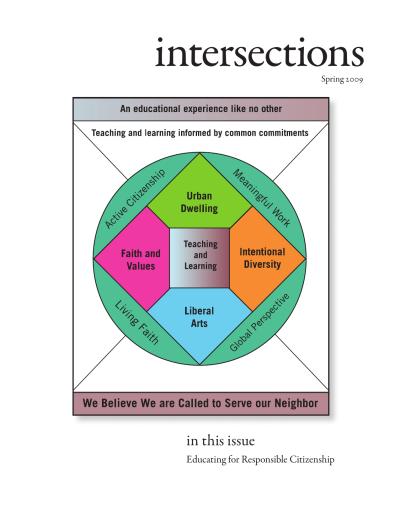
From Alien to Citizen
Arne Selbyg
No. 29 · Spring 2009
Selbyg reflects on three experiences of being educated for citizenship—growing up in Norway under the legacy of Lutheran pastors and public school teachers who resisted the Nazi occupation, arriving in America as a resident alien, and becoming a naturalized American citizen—and proposes the jazz ensemble as a better metaphor for American society than the melting pot, one in which different citizens learn skills, study other instruments, and dialog with one another in service to the common music.
-
 Editorial
From the Publisher
Arne Selbyg
No. 17 · Summer 2003
Selbyg explains that the four essays in this issue grew out of the first Lutheran Academy of Scholars in Higher Education—a two-week seminar funded by the Lutheran Brotherhood Foundation and the Lilly Endowment, led for its first three years by Dr. Ronald Thiemann of Harvard Divinity School—whose official theme “Finding Our Voice—Christian Faith and Critical Vision” became informally “What’s Faith Got To Do With It?”
-
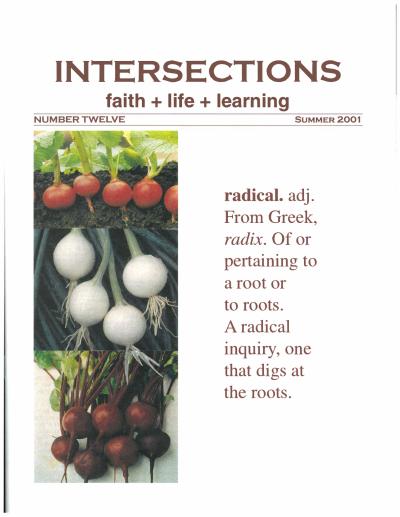 Article
Teaching as a Form of Servant Leadership
Leonard G. Schulze
No. 12 · Summer 2001
Schulze defines teaching as a paradoxical “servant leadership” rooted in the etymology of educare, e-ducere, Erziehung, and Bildung, surveys representative models of the teacher (Plato’s cave, the Theatetus midwife, Socrates of the Apology, and Freire’s Pedagogy of the Oppressed), and proposes a four-fold taxonomy of learning—information, critical thinking, praxis, and teleology—each requiring its own form of teacherly leadership. He closes with ten Wittenberg-style theses for teachers at Lutheran colleges, including that the Gospel liberates us from using knowledge as power, that disputatio is an expression of faith, and that we are called to lead students from the tyrannies of ignorance, rote knowledge, incompetence, and anomy to the freedoms of awareness, critical understanding, skillful action, and purposive lives in community.
-
 Book Review
Review of Educating for Shalom: Essays on Christian Higher Education
Tom Christenson
No. 20 · Fall 2004
Christenson reviews Nicholas Wolterstorff’s Educating for Shalom: Essays on Christian Higher Education (Eerdmans, 2004), edited by C.W. Joldersma and G.G. Stronks. After recounting his own early prejudice against Wolterstorff’s Reason Within the Bounds of Religion and his subsequent conversion through Art in Action, he focuses on two threads: Wolterstorff’s expansive reading of shalom—not merely peace but justice, community, communal responsibility, and delight—as the overall goal of Christian collegiate education, and the influence of Abraham Kuyper’s claim of “privileged cognitive access” for Christian inquirers, which Wolterstorff demonstrates rather than declares.
-
 Article
Religion in the Age of Trump
Daniel A. Morris
No. 45 · Spring 2017
Morris reads the 81% evangelical vote for Donald Trump through two historical theses: that evangelicals’ once-coherent story about Godly participation in political life has fallen apart, and that their long-running tendency to exclude others — once aimed at Black Americans and Catholics — has now turned decisively against Muslims. He argues that scholars of religion and politics have a responsibility to tell these stories well, and that appeals to classroom objectivity can no longer be a luxury.