Unconventional Wisdom and Talking about God: A Review of Beckstrom’s Leading Lutheran Higher Education in a Secular Age
Intersections No. 53 · Spring 2021
I was a brand new campus pastor when my colleague and I took a four hour road trip from Sioux Falls, South Dakota, to Waverly, Iowa, to visit Brian Beckstrom and his colleague—another duo of chaplains at another ELCA college. The purpose of the visit was to compare notes and share best practices in our work.
Close to a decade later my most vivid memory of our time together was lunch as a foursome of clergy at a quaint cafe in downtown Waverly. It was more than the meal that gave me something to chew on. Brian talked, even in those early years of his call at Wartburg, about the challenges of secularization facing Lutheran Higher Education. He was adamant that the antidote had to do with talking about God more. It sounded so simple, and it should be obvious, but it wasn’t.
In Leading Lutheran Higher Education in a Secular Age: Religious Identity, Mission, and Vocation at ELCA Colleges and Universities, Brian Beckstrom lays out in detail all that we lamented years ago over lunch in the cafe, this time backed by rich research and the work of other keen theologians whose voices make Beckstrom’s arguments all the more compelling.
Beckstrom uncovers a troubling disconnect that exists between the espoused religious identity of our institutions and the religious identity as perceived by many who live and work there (54-56). Who we are is not congruent who we say we are, and people are taking notice. Beckstrom’s research at five ELCA schools bears this out.
To those who have spent more than a year or two in higher education, the first few chapters of Beckstrom’s book will be a review. Times at our institutions are tough. Resources are scarce. Enrollment numbers are harder to come by than ever. The cost and value of a four-year college are often in question, and families’ finances are stretched. Discount rates aren’t helping like we thought they might, but we’re stuck in what Beckstrom describes as “a sort of circular arms race” (43) in which no one dares to be the first to reduce unfunded aid and risk losing coveted prospective students.
To those new to the distinctives of Lutheran higher education, read chapters 1, 2, and 3 closely. Beckstrom outlines the history of how and why these institutions exist in the first place and raises an important ecclesiological question: What is the relationship between our colleges and universities and the larger church? For those less steeped in the life and rhythms of the church, it may come as a surprise (or not) when Beckstrom highlights that “Lutheran colleges belong to not one, but two sectors undergoing massive changes” (39). Shifting economics and culture threaten both higher education and the church. Is it any wonder, then, that our ELCA institutions are feeling especially strained?
Chapter 5 is where my pen started working overtime, underlining and starring the adaptive challenges unique to Lutheran higher education and Beckstrom’s ideas about how we might face them.
“Shifting economics and culture threaten both higher education and the church. Is it any wonder, then, that our ELCA institutions are feeling especially strained?”
Using qualitative coding, Beckstrom examines mission and identity statements of the five schools he studied. His findings are striking. All five institutions, while claiming their Lutheran identity, tended to downplay it in favor of more secular descriptors such as “service, inclusion, and discovering one’s purpose in life.” Several even followed the naming of their Lutheran identity with a disclaimer, “that being Lutheran is really about freedom and openness” (93). While this characteristic is not untrue, there is little eagerness among our institutions to talk about the gift or importance of religious conviction, even as our rootedness is the very thing that inspires our openness.
Beckstrom argues that our institutions are described, either in print or by members of the communities, using “a rather vague and ambiguous sort of humanism that seems intentionally designed to avoid any mention of God or the transcendent” (112). Institutions and their leaders are, Beckstrom suggests, very comfortable espousing the virtues of “service, justice, and vocation,” which are valued in both the sacred and secular spheres. It is much harder to name or describe God’s action in any of this. Beckstrom writes, “We are good at talking about what we do but not why we do it” (109). Even the “common calling” touted by the Network of ELCA Colleges and Universities (NECU) in the document “Rooted and Open,” which reads, “called and empowered to serve the neighbor so that all may flourish,” is nebulous about who is doing the calling and empowering (135). Why is it so difficult to make God’s agency explicit in Lutheran higher education?
A particularly convicting and powerful insight in Beckstrom’s book comes around to the topic of what is said about the Lutheran identity of our schools on campus tours: “Campus tour guides often get a bad rap for not accurately describing the religious identity of the institution, but perhaps they are actually describing the religious identity of the school accurately” (104). I starred this sentence twice and cringed, recalling overhearing a tour guide at my own university state emphatically that worship in the chapel was optional and that many use the “dedicated” time each morning to take a nap.
Beckstrom astutely notes that another factor contributing to the disconnect between espoused and perceived Lutheran identity is the way that religious faith and even the work of interpreting the Christian mission of the university has become reserved for a select few, typically the campus pastor and sometimes the religion faculty. They are seen as the primary custodians of faith and namers of God’s activity on our campuses. Few leaders in other parts of the institution have any theological training, and many even lack their own significant religious life experiences. Though the hiring of theologians and church professionals was initially done as a strategic response to a perceived loss of faith at our institutions, putting the onus of paying attention to God’s work on just one person (the campus pastor) or campus building (the chapel) has had the unintended effect of diffusing others’ responsibility to steward this vital piece of our identity (28).
Additionally, an increasingly pluralistic society makes it difficult for Lutheran colleges and universities to know how to talk about their Christian convictions without alienating those who do not share their beliefs. Keeping Jesus at the center feels incongruent with the openness that is needed in an era of increasing diversity and a clearer call to accommodate, include, and celebrate neighbors who are not Christian. Hence, we shy away from talking about beliefs that might offend and settle for a watered-down relativism. For those interested in a third way that holds tension between conviction and openness, Beckstrom offers helpful suggestions of language that can be used to articulate Christ as the one by whose example and for whose sake we are radically inclusive (128).
Moving toward a path forward, Beckstrom helps us understand how secularization has influenced society from the time of the Reformation until now. He uses Charles Taylor’s A Secular Age and his theory of three secular worldviews (Secular 1, 2, and 3) as a foundation for opening new possibilities for our institutions. I will not go into detail about each worldview here, but I am taken by Beckstrom’s notion that Secular 3, a paradigm in which transcendence is hardly on anyone’s radar, is, in fact, a more promising space to hold than Secular 2, where believers are fighting tooth and nail to avoid irrelevance and non-believers are simply resigned to a world in which religion is obsolete. Beckstrom posits that we are entering an era (Secular 3) where more and more people are unchurched or uninfluenced by religion. While that may seem a threat to advancing the gospel, it may well be the opportunity that our institutions need. Lack of religious experience and literacy is fertile ground for nurturing curiosity as opposed to the Secular 2 worldview, where non-believers’ posture toward religion is often unwaveringly hostile (122).
“We are entering an era where more and more people are unchurched or uninfluenced by religion. While that may seem a threat to advancing the gospel, it may well be the opportunity that our institutions need.”
Beckstrom proposes a more faithful and authentic way forward for our ELCA schools—what he calls Trinitarian Missiological Ecclesiology, or TME (5). It sounds like a mouthful, and it is. TME calls our institutions to examine who they are through the lens of God’s mission. And although Lutheran colleges and universities have mission statements of their own, as institutions of the church, these statements ought to be grounded, first and foremost, in the mission of God. Lutheran colleges and universities are a part of God’s mission, just as congregations are. This is a mission to share the Gospel and to bring the kingdom of God ever nearer to earth. Though our schools do this in a particular way, distinct from congregations, they are no less integral to God’s mission.
Trinitarian theology, as it is understood in eastern and western Christian traditions, is especially helpful for imagining how our schools can live out God’s mission in an age of pluralism and secularization. Emphasizing both the oneness (western) and threeness (eastern) of God is an example of the tension that Lutheran higher education must dance with as it discerns how to exist both broadly and deeply. For the visual learners among us, Beckstrom shares the metaphor of a rubber band stretching—“the very thing that pulls the rubber band outward (my thumb and index finger) finds itself included within it. A centripetal force then acts to pull what is included back to the center” (78). The theological term for this is “perichoresis” (76).
So what does Trinitarian Missiological Ecclesiology look like in practice? How do our Lutheran colleges and universities make their way amid significant threats to both higher education and religiously affiliated institutions? And, how can our schools find greater congruence between espoused and perceived Lutheran Christian identity?
Beckstrom offers several concrete suggestions beginning with, not surprisingly, talking more about God. His instincts at our cafe lunch a decade ago were spot on. Institutional leaders, faculty, staff, and students, should feel encouraged to name God as an active participant in all that is happening to and at our schools. We ought to talk about God, aloud and explicitly, at faculty meetings, cabinet meetings, board meetings, and in student government. This is not just the responsibility of the college chaplain, or even the president. All can work to become more fluent in the language of faith.
Beckstrom is convinced, and readers will be too, that the religious identities of our schools are not sustained simply by offering chapel services and spiritual care for those who want to engage that sort of thing. On the contrary, embracing the call and mission of God at colleges and universities of the church is “critical to [our] future” (133). Adaptive leadership, an innovative and entrepreneurial spirit, courage, and tenacity are not enough. “Engaging the community in theological reflection is a necessity”; Beckstrom urges institutional leaders (outside of ordained clergy) to be theologically trained and minded (126). This may seem like a tall order. Perhaps it is the least we can do to give Lutheran higher education every advantage in this difficult climate.
I appreciate Beckstrom’s lifting up the NECU document “Rooted and Open: The Common Calling of the Network of ELCA Colleges and Universities.” This document has been significant in my own institution’s deepening understanding of what it means to be Lutheran. I don’t disagree with many of Beckstrom’s critiques of the document. We surely could stand to talk about God more, even in this piece of writing that serves to make us clearer about our Lutheran Christian identity.
“How do leaders make decisions about institutional rites and rituals that call for both Christian prayer and authentic inclusion of non-Christian and non-religious persons?”
I do wish Beckstrom would have given more concrete examples of his thesis, as it is lived out at his institution or others. I suspect his work will receive push back from some who are non-Lutheran, and especially non-Christian, still wrestling with feelings of marginalization at a school affiliated with a tradition different from their own. How, for instance, do leaders make decisions about institutional rites and rituals that call for both Christian prayer and authentic inclusion of non-Christian and non-religious persons? A case study or two would have been helpful in imagining how to talk about God with boldness and integrity while at the same staying open and mindful of the neighbor who holds a different worldview.
A couple years ago, as Brian was in the throes of working on his book, he attended our annual gathering of NECU chaplains and gave us a sneak peek of his outstanding research and findings. At a quaint Episcopal retreat center in Racine, Wisconsin, heads nodded in agreement as our colleague presented what our group of campus pastors already knew to be true, that our institutions would not be able to live out their mission with integrity without seeking and naming a God actively at work among us. My fellow chaplains and I strive daily to do this work with all we’ve got—mind, body, and spirit. But it’s clearer than ever that we can’t do it alone. We need the partnership of presidents, provosts, deans, department chairs, faculty members, choir directors, coaches, and student body presidents to do this work with the care and faithfulness that it deserves. As Beckstrom repeatedly says, the future of Lutheran higher education depends on it.
And when we fall short, which we all will and do, we return to the promise that it is God who buoys us. It is the Holy Spirit who sustains us. It is Christ who calls us. We do none of it alone. Even the most savvy college presidents and people with PhDs will not save our institutions. God does and God surely will, even as that saving work often looks different from what we might expect.
Works Cited
Beckstrom, Brian. Leading Lutheran Higher Education in a Secular Age: Religious Identity, Mission, and Vocation at ELCA Colleges and Universities. Lanham: Lexington Book/Fortress Academic, 2020.
-
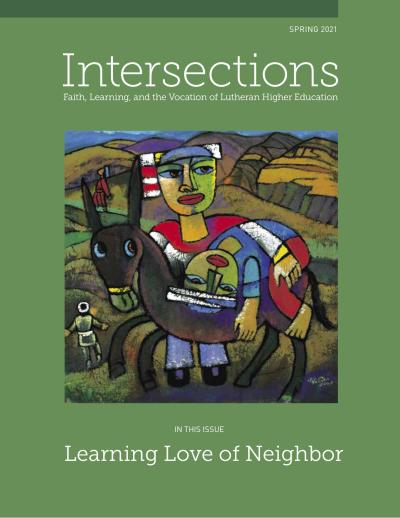 Editorial
From the Publisher
Mark Wilhelm
Wilhelm reflects on an NPR report of teenagers’ pandemic diaries and the fraught Christian history of struggling to live out Jesus’s ethic of love, framing the issue as a record of NECU institutions working out how to act for the common good through the pandemic of 2020–2021.
-
Article
Teaching as an Expression of a Love Ethic
Abbylynn Helgevold
Drawing on Kierkegaard’s Works of Love and Kevin Gannon’s teaching manifesto, Helgevold describes how an ethic of upbuilding love—love that presupposes goodness in students—reshapes inclusive pedagogy at Wartburg College, from syllabus language to how she addresses plagiarism and attendance.
-
Reflection
Keeping Close from a Distance: Pandemic Reflections of a Library Coordinator
Carla Flengeris
Flengeris reflects on a year of running Luther College’s library at the University of Regina from her basement and mourns the loss of the hourly walks through the stacks—the “roving reference” that, she realizes, were never disruptions to her work but were the work itself.
-
Article
Preaching in Christ Chapel on Yom HaShoah: Reflections on Interfaith Relations at a Lutheran College
Sarah Ruble
Ruble shares her 2019 Holocaust Remembrance Day homily preached before the cross in Christ Chapel at Gustavus Adolphus, then reflects on whether “professional Christians” on Lutheran campuses might practice a non-mutual, witnessed confession before colleagues of other traditions as a check on Christian self-deceit.
-
Article
Down and Out: First Year Students Encounter Lutheran Theology
Lindsey Leonard
Leonard describes how Wartburg’s IS 101 first-year seminar wove the Dalai Lama, Paul Kingsnorth, Chimamanda Ngozi Adichie, and Mary Robinson’s Climate Justice into the Fall 2020 reader so the “COVID class” could encounter Lutheran theology’s call to serve the neighbor across the pandemics of disease, racism, and climate change.
-
Article
(Re)Defining Vocation: Gladly Challenging a Vocational Giant
Andrew Tucker
Tucker challenges Frederick Buechner’s famous definition of vocation as “where your deep gladness and the world’s deep hunger meet,” arguing that gladness reflects a privileged perspective and proposing instead that vocation be defined as “any meaningful, life-giving work you do for the world.”
-
Article
Vocation Outside of Career: Discovering Purpose through Comics
María Evelia Emerson
Emerson recounts building an Augustana Vocational Discernment course around G. Willow Wilson’s Ms. Marvel series, using Kamala Khan’s juggling of family, friendship, faith, and superhero identity to help sophomores see vocation as not what they do for a living but how they want to live.
-
Article
Leadership in a Pandemic: Grace-Filled Lessons in Unprecedented Times
Marc Jerry
Reflecting on his first year as president of Luther College at the University of Regina, Jerry argues that the best preparation for leading through a long crisis was not his economics or strategy training but seminary and pastoral formation—and that NECU institutions are called to a post-pandemic ministry of kindness, grace, and community.
-
Reflection
Shelter in Place: Reflections from March 22, 2020
Jason A. Mahn
On the fourth Sunday of Lent in 2020, Mahn meditates on the etymology of “shelter” (from shield) and on an email from a former student in Boston whose mutual-aid organizing models a Lutheran understanding of vocation: the upending of ego by divine love that frees us, finally, to see and serve the neighbor.
-
 Article
Access, Accessibility, & Change: A Call for Trustworthy Leadership in Higher Education
Emma Jones
No. 60 · Fall 2024
Jones surveys the converging pressures on higher education — cost, the enrollment cliff, shifting demographics, and declining public confidence — and uses Reichheld and Dunlap’s four factors of trust (transparency, capability, reliability, humanity) to call campus leaders to rebuild trustworthy leadership from the inside out.
-
 Article
How Can We Keep From Singing?
Robert Scholz
No. 7 · Summer 1999
Scholz, professor of music at St. Olaf, responds to Tom Christenson’s “Freedom of a Christian” by walking through his own Nunc dimittis for the St. Olaf Christmas Festival, an Elderhostel choir of singers aged 60 to 95, and the four liberating arts (enablement and change, melioristic, embodying, and critical) as they shape conducting, composition, and music education. He defends the fine arts and folk traditions over “contemporary Christian” soft pop-rock and taped accompaniments, citing Luther’s preface to Georg Rhau’s Symphoniae iucundae and the family of God’s need to interact in song against the virtual community of TV evangelism and the Crystal Cathedrals of the air.
-
 Article
Living at the Intersection of Fear and Hope
Mark S. Hanson
No. 32 · Spring 2010
Hanson draws on his January 2009 ELCA/ELCIC visit to Jordan, Israel, and Palestine—a Hebron Quran that did not burn, fifth graders dancing at the Hope School, a conversation with King Abdullah II—to frame the vocation of Lutheran higher education at the intersection of fear and hope. Engaging Brueggemann, Sittler, Buechner, Auden, Strandjord, Douglas John Hall, W. Robert Connor, Lewis Mudge, and Cynthia Moe-Lobeda, he argues that Lutheran colleges are called to critical inquiry that does not collapse into a hermeneutic of suspicion, to a “thinking faith” that resists religious fundamentalism, and to communities of discernment that work for the common good.
-
 Article
Our Place in Church-Related Higher Education in the United States
Richard Hughes
No. 4 · Winter 1998
Adapting his 1997 Vocation of a Lutheran College Conference address, Hughes asks how the Lutheran heritage can sustain the life of the mind in church-related higher education. He compares Reformed, Mennonite, and Catholic traditions in turn—the Reformed integration of faith and learning around a Christian worldview, the Mennonite priority of discipleship over cognition, and the Catholic sacramental affirmation of the secular as bridge—before arguing that the Lutheran heritage’s particular gifts (justification by grace, theology of the cross, two kingdoms, paradoxical sensibility, vocation, and openness to ambiguity) uniquely support rigorous inquiry, genuine pluralistic conversation, and critical analysis. Drawing on Arthur Holmes, John Howard Yoder, Mark Schwehn, Alasdair MacIntyre, and Lutheran writers including Bob Benne and Tom Christenson, Hughes contends that Lutheran finitude grounds an unusually open and self-critical academic posture.
-
 Book Review
Vocation on Campus: Reading Mark Tranvik's Martin Luther and the Called Life at Pacific Lutheran University
Alex Lund, Michael Halvorson
No. 47 · Spring 2018
Halvorson and Lund — faculty member and student — review Mark Tranvik’s Martin Luther and the Called Life alongside PLU’s Wild Hope Center for Vocation, weighing the book’s warning against “vocation lite” against the challenge of speaking of God’s call to students in the Pacific Northwest’s “None Zone,” where most students have little exposure to Lutheranism.
-
 Response
Disputatio Pro Quo? The Search for Lutheran Education
Jon-David Hague, Kimberly Hague
No. 2 · Winter 1997
Kimberly and Jon-David Hague—both Luther College graduates completing graduate studies at Berkeley and Boston University respectively—respond to Bouman by offering Luther’s curriculum reform at Wittenberg University in the spring of 1518, only months after the 95 theses, as a model of the Lutheran voice in higher education. Inspired by humanistic principles, Luther introduced lectures on classical authors and the first instruction in Greek and Hebrew, giving students the tools to encounter scripture directly rather than receive dictated doctrine. The spirit of that reform—providing students with every possible tool while acknowledging that an instructor’s perspective is neither ultimate authority nor final word—remains useful for the search for Lutheran academia today.