Preaching in Christ Chapel on Yom HaShoah: Reflections on Interfaith Relations at a Lutheran College
Intersections No. 53 · Spring 2021
How does a Christian preach a homily for Yom HaShoah, Holocaust Remembrance Day? An invitation in 2019 from the Gustavus Adolphus Bonnier Chair of Jewish Studies presented me with that question. The chaplains’ office at Gustavus had scheduled the Yom HaShoah service in Christ Chapel. My colleague, who was organizing the service, decided that since the event was being held in front of a cross in Christ Chapel, a Christian should preach. Fair enough, but what to say?
What follows is my homily and then a few reflections about why I chose to speak in a distinctively Christian idiom at a remembrance framed by Jewish tradition and how that might offer one (but only one) way of thinking about interfaith interactions on a Lutheran campus.
The Yom HaShoah Homily
Today, we are gathered here, in Christ Chapel, before this enormous cross, to commemorate Holocaust Remembrance Day. I’m tempted, on this day, to ignore whose name we stand under and what we stand in front of. It seems, in many ways, like a good day for general religiosity, for what is in common. But that might be too easy for those of us who claim a tradition wrapped up in the horrifying history of antisemitism, a tradition whose few righteous Gentiles cannot outweigh the many more whose apathy and collaboration made what we commemorate today possible.
So, in this place and before these symbols, I want to ask what it would mean for Christians to be able, truly able, to pray with Jews the prayer we just prayed. To pray to a God “who is full of mercy, who is Justice of widows and Father of orphans.” To pray that that God would not be silent. What does it mean for Christians to pray about justice with Jews, to pray to a God of justice with Jews on a day we remember the Holocaust?
Not infrequently—in classes, in churches—I hear something that goes like this: the God of the Hebrew Bible is wrathful, but the God of the New Testament is loving and forgiving. This comment tells me that the speaker has not read very far in either the Hebrew Bible or the New Testament, that he or she has certainly never gotten far in the Psalms or to the book of Revelation. It is also a reminder of one way Christians have derided Jews and Judaism: by depicting Jews as interested in wrath and punishment—even as Christians used the comparison to rationalize Christian’s own wrath toward and punishment of Jews.
But the comment is also, I think, a very telling Christian self-diagnosis, albeit an unintentional one. God’s wrath, when it appears in Hebrew Bible or New Testament, is usually related to God’s justice. God’s wrath is not that of an arbitrary tyrant, suddenly flying off the handle, but that of good God steadfastly opposed to that which harms others, particularly the weak and vulnerable. God’s wrath is, then, part of God’s ultimate purpose of rectification, of saying no to all that is wrong with the cosmos, to making right the world. That many Christians separate the wrath of God from the love and forgiveness of God is a tell. It tells that we all too often want to be justified, want our own justification, but we don’t really want justice, particularly not if it will cost us anything. We want forgiveness, not rectification; we want ourselves declared right, not the world, and ourselves, made right.
It is, I assume, fairly obvious why, say, a German Christian in 1945 might be more interested in forgiveness than rectification. It might be less obvious why any of us in this chapel who are Christians would have the same problem. None of us were Nazis. We were not the SS. We may feel like we can pray this prayer without a problem.
But I wonder. The orthodox rabbi Irving Yitzchak Greenberg said that the Holocaust was a revelation for both Jews and Christians (249). He meant that in the traditional sense of revelation, of something new being revealed in the world. I too would call it revelation, but perhaps in a slightly different sense. The Holocaust revealed us Christians to ourselves. It showed us our traditions and our faith, not as we say that they are but as they are, as they have appeared in the world. And what it showed was horrifying. It showed that, for most Christians during the 1930s and 1940s, so much of what we say happens through Christian faith and practice didn’t happen.
Baptism did not teach us to recognize a family that isn’t about blood and kin—or blood and soil—but one made and named by God who started that family with Abraham and never abandoned it. Eucharist did not form us in God’s way of self-giving love. Prayer did not open us to the cry of the hurt and the oppressed.
No, I wasn’t a Nazi, I wasn’t in the SS. But I’m invested, deeply invested, in a tradition revealed by the Holocaust to be largely morally spent or incredibly malleable to evil or—and this one is terrifying—an incubator of the hatred that made the gas chambers possible. A tradition that too often becomes allied or even identical with nationalism in all its hideous forms. I’ve committed myself to being formed by a tradition that so poorly formed a lot of people who I have to imagine were a lot like me that they cheered a madman, ignored the disappearance of their neighbors, and, in some cases, ushered them into gas chambers. And it is finally that that for me is so hard to look at. That there are things to which I am deeply committed, beliefs or ways of seeing the world to which I cling that might be deeply broken in ways I might not fully recognize. So, please, for me God, justification, not justice.
That may all sound like an argument against Christianity en toto. It isn’t. What it is is an argument against a Christianity that only hears, for itself, God’s yes. Karl Barth, the twentieth-century theologian, argued that the Cross was God’s no contained within God’s yes. It is God’s no to all that is wrong with the cosmos and God’s yes to redeeming the whole creation. Christians are often really good at half of that. Or, better put, really good at accepting half of it for ourselves and leaving the other half for other people. Guess which half. I think in order to pray well with Jews—as well as with any other people Christians have wronged, particularly when we have done it explicitly as Christians—we have to be willing to hear God’s no, God’s Nein to us. We have to hear that there are parts of us that cannot be part of a rectified world. There are ways of our being, ways of our seeing things that cannot be part of a final justice.
Yes, there is ultimately a yes, but it isn’t a yes to everything we are without remainder. Rather, it is a yes to God making us the kind of people who can live in a rectified world. It is God’s assurance that, in God and through God, all shall be well and all manner of things shall be made well. God will make things well—which means that I do not get to hold onto my sicknesses, no matter how dear they are to me. To pray this prayer I have to be willing to pray that those parts of me, even the ones I treasure, that cannot be part of a world made right will cease to be. Perhaps this is what Jesus meant when he talked about cutting off a hand or gouging out an eye—an interesting part of the New Testament for those who think Jesus never said anything that wasn’t nice. God’s yes to justice and no to all that stands in its way might demand amputation for us.
I’m not exactly sure what that will mean, what limbs we might lose. And maybe that is as it should be, that one of the things to which God says Nein is to a Christian tendency to certainty about ourselves. Not about God, but about ourselves. A certainty that suggested to Christians, fairly early on, that we didn’t need to learn from Jews, that we only needed to talk at them, to tell them how they had missed the messiah. A certainty that we could understand a first century Jewish man without help from third-century and tenth-century and twentieth-century Jews. A certainty that we were privileged interpreters of our own virtue, our own godliness. A certainty that told us that we had no need to ask other people what it was like to have to live among us.
I’ll admit that something about preaching in this chapel, really any chapel, on Holocaust Remembrance Day feels wrong. It feels wrong to be in front of a cross, in front of the table, in front of the font. Maybe not these very Christian things today of all days.
But, on the other hand, it is I think right to lay out Christian practice and preaching in front of Jewish friends and colleagues. Not because they need to hear our sermons, but because we need them to hear God’s Nein to us. If part of what the Holocaust revealed is that we need to hear that no about ourselves and cannot tell it to ourselves, then we need to listen to people who, often to their own horror, know us all too well. We need to listen when they tell us that what we say about God can’t be said of the God of Abraham and Isaac so we need to stop saying it, when they tell us that we are making them less so that we might be more, and when they tell us that our way of telling our story makes it sound like neither our story nor our world has need of them. We need to hear what rectification might look like and what it might mean for us from people who know both our capacity for injustice and God’s thirst for justice. And then, perhaps, we can truly pray.
Reflections on the Homily
“Please don’t make your homily about the righteous Gentiles,” a colleague said to me. I would like to think that she knew I did not really need the advice—that even without it, I would not have used my eight minutes on Holocaust Remembrance Day to talk about “good” Christians—but I also understood why she made the plea. She’d heard a lot about good Christians from what you might call the “professional” Christians on my campus—those of us (I am one) who by virtue of official position, education, or training, are called upon to explain why the college’s Lutheran heritage is good for the college as a whole. We explain that the Lutheran tradition with its emphasis on knowing and loving creation for God’s sake provides a firmer foundation for the liberal arts than the market and claim that Luther’s theology (as opposed to say, that of the reformer from Geneva) invites the free exploration of ideas and a commitment to religious diversity. Because we know that many of our colleagues come to campus with some wariness about a church-related college, we highlight what is positive in the tradition (everybody say Dag Hammarskjold!) and our differences with those “other” type of Christians (let the reader understand). We take pains to show that our faith demands justice and compassion, openness and inclusivity. We’re good Christians.
As a professional Christian, I think there is a time and a place to emphasize what is positive in our tradition, to assure colleagues that the college’s heritage complements the liberal arts and academic freedom. But I also recognize that the desire to emphasize what is good can go wrong. Repeatedly explaining the goods of the tradition can lead us into a defensive posture, a sense that we are under threat (not—mind you—the kind of defensive posture those “other” Christians have, certainly not) while ignoring that we literally own the college ground. It’s Christ Chapel, after all. This posture, in turn, can tempt us to deflect criticisms of Christianity. Those critiques apply to those “other” Christians. The not good ones. The ones from those other institutions with those other politics. The unrighteous ones. Yet while the people on our campuses who hear our explanations—the people whose services take place in a multifaith chapel that bears no religious symbols, who probably do not have a religious leader paid by the college on campus, who must miss class for their religious holidays—may experience some of what we say as assuring (we have a multifaith chapel, you can ask for your religious holiday off), they might also find it tone deaf (really, the Christians are playing defense?) and difficult to critique. How do you tell the people who are assuring you that their tradition underwrites all the goods of your college that they aren’t always what they imagine themselves?
I had a non-Christian colleague tell me about being stopped on a stairwell by a professional Christian so that the professional Christian could tell her about how good the good Christians had been to her tradition. All while mispronouncing her name.
Christians do have a practice intended to counteract self-deceit: confession. Certainly, on our campus, many of the professional Christians engage in confession as both an ecclesial practice and, sometimes, a professional one. I am a U.S. religious historian. In my classes, I discuss many Christian wrongs.
But the reality of the ecclesial practice of confession is that it is ecclesial—taking place among Christians—and the reality of professional confession is that it takes place in a classroom, where I’m an “expert.” Just as I have some choice about what to confess (or what to think about while I intone “what we have done and what we have left undone”), I have control over what books I assign, and what narratives I tell. As historian Lauren Winner notes, all Christian practices have the capacity to deform for they all suffer “characteristic damage,” or damage that “is proper to the thing which expresses the damage” (3). Perhaps one way to think about confession and its characteristic damage is that it reinforces the notion that we know what we have done wrong, that we know the truth well enough to tell the truth about ourselves.
I do not see a future in which I will not need to explain the potential goods of the Christian or Lutheran tradition to people on campus. Students, faculty, and staff certainly aren’t coming to campus with more knowledge than they used to about Christianity nor with less (understandable) skepticism. But I am also wary of the dynamics created by the need to explain and defend and I am uncertain that the normal modes of “confession” suffice to check Christian self-deceit or that they create space for people well-positioned to catch our falsehoods to tell us about them.
What I do see as a possibility is an occasional practice of non-mutual “confession” by Christians in front of people from other traditions (or no tradition). And, here, confession not necessarily referring to specific harms (when we commit specific harms we should, of course, make specific confessions), but confession in a more Augustinian sense, of a truth-telling about ourselves. We should create time and spaces where we invite people to listen to us tell what we understand to be the truth about ourselves and then offer to hear them if they say “that is not how we experience you; that is not who we know you to be.” To hear them say it and to not protest, to not bring up Bonhoeffer, to not talk about Corrie Ten Boom. I am not necessarily thinking of a formal practice—a ceremony or ritual. Perhaps—to take a pedestrian example—it means that we ask colleagues from other traditions and no tradition to read what we say about our Lutheran heritage or the goods of the Christian tradition in our college materials (ideally, we also compensate them for their time). Or it could be a practice we undertake when circumstances arise—when we are asked to preach for Holocaust Remembrance Day in front of a cross.
To be clear, I am not calling for a mutual exchange. For reasons both historic and theological, I would not call for a mutual truth-telling (remember: preaching about the Holocaust in Christ Chapel). Nor am I suggesting a frequent practice. It is not the job of people from other traditions to make Christians honest; it is not their job to tell us about ourselves. Thus, we could only ask for witnesses to our confession as a favor, a gift to us that we could not reciprocate (although we might be able to compensate), one predicated on our certainty (and perhaps that of the giver) that history suggests that we cannot be trusted to name the truth about ourselves by ourselves and that that failure harms us and all who must live with us.
My sermon was, among other things, one attempt to talk truthfully about Christians in front of people well positioned to know if I spoke truthfully. It was, I hope, a recognition that some of what I do in my professional life on my campus, indeed, precisely what I do in service to both my faith and the campus, can deform and malform me. There might be righteous Gentiles. It is dangerous to suppose that we are them.
Works Cited
Greenberg, Irving Yitzchak. “New Revelations and New Patterns in the Relationship of Judaism and Christianity.” Journal of Ecumenical Studies 16.2 (1979): 249-67.
Winner, Lauren. The Dangers of Christian Practice: On Wayward Gifts, Characteristic Damage, and Sin. Yale U.P., 2018.
-
 Editorial
From the Publisher
Mark Wilhelm
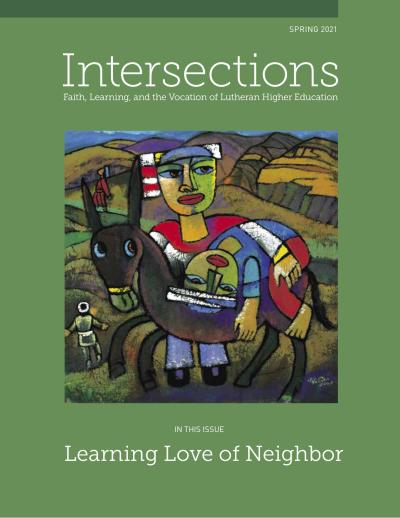
Wilhelm reflects on an NPR report of teenagers’ pandemic diaries and the fraught Christian history of struggling to live out Jesus’s ethic of love, framing the issue as a record of NECU institutions working out how to act for the common good through the pandemic of 2020–2021.
-
Article
Teaching as an Expression of a Love Ethic
Abbylynn Helgevold
Drawing on Kierkegaard’s Works of Love and Kevin Gannon’s teaching manifesto, Helgevold describes how an ethic of upbuilding love—love that presupposes goodness in students—reshapes inclusive pedagogy at Wartburg College, from syllabus language to how she addresses plagiarism and attendance.
-
Reflection
Keeping Close from a Distance: Pandemic Reflections of a Library Coordinator
Carla Flengeris
Flengeris reflects on a year of running Luther College’s library at the University of Regina from her basement and mourns the loss of the hourly walks through the stacks—the “roving reference” that, she realizes, were never disruptions to her work but were the work itself.
-
Article
Down and Out: First Year Students Encounter Lutheran Theology
Lindsey Leonard
Leonard describes how Wartburg’s IS 101 first-year seminar wove the Dalai Lama, Paul Kingsnorth, Chimamanda Ngozi Adichie, and Mary Robinson’s Climate Justice into the Fall 2020 reader so the “COVID class” could encounter Lutheran theology’s call to serve the neighbor across the pandemics of disease, racism, and climate change.
-
Article
(Re)Defining Vocation: Gladly Challenging a Vocational Giant
Andrew Tucker
Tucker challenges Frederick Buechner’s famous definition of vocation as “where your deep gladness and the world’s deep hunger meet,” arguing that gladness reflects a privileged perspective and proposing instead that vocation be defined as “any meaningful, life-giving work you do for the world.”
-
Article
Vocation Outside of Career: Discovering Purpose through Comics
María Evelia Emerson
Emerson recounts building an Augustana Vocational Discernment course around G. Willow Wilson’s Ms. Marvel series, using Kamala Khan’s juggling of family, friendship, faith, and superhero identity to help sophomores see vocation as not what they do for a living but how they want to live.
-
Article
Leadership in a Pandemic: Grace-Filled Lessons in Unprecedented Times
Marc Jerry
Reflecting on his first year as president of Luther College at the University of Regina, Jerry argues that the best preparation for leading through a long crisis was not his economics or strategy training but seminary and pastoral formation—and that NECU institutions are called to a post-pandemic ministry of kindness, grace, and community.
-
Book Review
Unconventional Wisdom and Talking about God: A Review of Beckstrom’s Leading Lutheran Higher Education in a Secular Age
Ann Rosendale
Rosendale reviews Brian Beckstrom’s Leading Lutheran Higher Education in a Secular Age, recommending its diagnosis of the gap between espoused and perceived Lutheran identity at ELCA schools and its prescription—Trinitarian Missiological Ecclesiology and a campus-wide willingness to talk explicitly about God.
-
Reflection
Shelter in Place: Reflections from March 22, 2020
Jason A. Mahn
On the fourth Sunday of Lent in 2020, Mahn meditates on the etymology of “shelter” (from shield) and on an email from a former student in Boston whose mutual-aid organizing models a Lutheran understanding of vocation: the upending of ego by divine love that frees us, finally, to see and serve the neighbor.
-
 Article
What I Have Learned: Maybe Plato Was Right
Richard Ylvisaker
No. 4 · Winter 1998
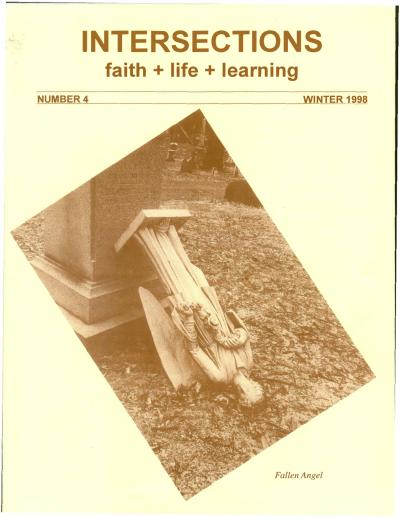
Inaugurating the new “What I Have Learned” column, Ylvisaker reflects on a career of teaching philosophy at Luther College and offers four hard-won “preliminary examples” in which Plato turned out to be more right than fashionable criticism allowed: (1) communities are not necessarily better off by becoming more diverse—diversity needs a unity of purpose if it is to enrich rather than fragment; (2) politics, to be more than a struggle for power by competing interests, must rest on a moral basis that transcends those interests; (3) the much-derided body-soul dualism contains a measure of truth about the cognitive and moral limitations of embodied life; and, deepest of all, (4) reason itself depends on a community of discourse in which doctrinaire pronouncement gives way to disciplined inquiry. Athens and Jerusalem, he concludes, should meet at the college of the church.
-
 Article
Why Did the Chicken Cross the Road? A Homily on Liminality and Vocation
Lori Brandt Hale
No. 45 · Spring 2017
Drawing on Wes Moore’s The Other Wes Moore, Warren St. John’s Outcasts United, Victor Turner’s anthropology of liminality, and Dietrich Bonhoeffer’s poem “Who Am I?”, Hale considers how Hmong, Muslim, Latinx, LGBTQ+, non-traditional, and other students live in “double liminal” spaces — and asks whether liminality might itself be a place of transformation in conversations about vocation.
-
 Editorial
From the Publisher
Arne Selbyg
No. 17 · Summer 2003
Selbyg explains that the four essays in this issue grew out of the first Lutheran Academy of Scholars in Higher Education—a two-week seminar funded by the Lutheran Brotherhood Foundation and the Lilly Endowment, led for its first three years by Dr. Ronald Thiemann of Harvard Divinity School—whose official theme “Finding Our Voice—Christian Faith and Critical Vision” became informally “What’s Faith Got To Do With It?”
-
 Editorial
From the Editor
Tom Christenson
No. 14 · Summer 2002
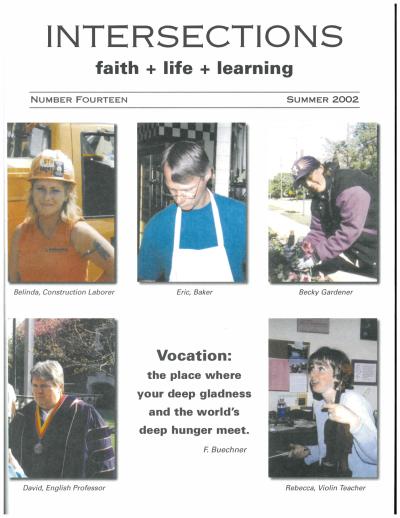
Christenson argues that whether or not the conversation is funded by the “Lilly lottery,” vocation should just be part of who we are and what we do at ELCA colleges, and proposes three low-cost conversations—among faculty (twenty dollars of wine, in vino veritas), with students throughout their four years, and with alumni—explaining why this issue is deliberately “fatter” than usual and inviting feedback on other single-topic issues.
-
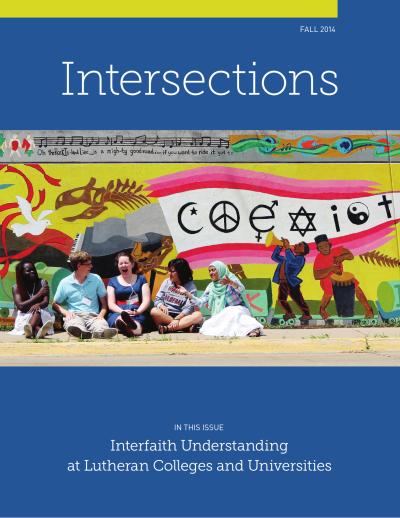 Reflection
Gifty Arthur
Gifty Arthur
No. 40 · Fall 2014
Reading John 10:3 as a Ghanaian Christian student at Luther College, Arthur reflects on how Luther’s Journey Conversations have deepened her own spirituality precisely by giving room for students to share the personal experiences and beliefs at the center of their own traditions.
-
Article
What it Means to Build the Bridge: Identity and Diversity at ELCA Colleges
Eboo Patel
No. 40 · Fall 2014
Through the contrasting stories of two college students — Cassie’s identity relativism and April’s soft fundamentalism — Patel diagnoses Peter Berger’s twin pathologies of modernization and argues that ELCA campuses, anchored in Bonhoeffer and the Lutheran capacity to “have faith without laying claim to certainty,” are uniquely equipped to be places where the light falls: bridges of cooperation that nurture both strong religious identity and benevolence toward others.