Intersections and the Vocation of a Lutheran College Conference give focus to a rich heritage of learning. It is a heritage that enables a community of scholars, as the late Ernest Boyer once said, to “probe both the deep places of the mind and the deep longings of the human spirit.” This ability, as we know, is not frequently found in higher education today and the lack of it has become an obvious weakness in late twentieth century education. This journal and the conference with which it is connected are meant to widen the scope of inquiry that the separation of mind from spirit has curtailed. I hope they will continue to be places of exciting and important ideas.
At the 1998 conference, another announcement will be made to strengthen this effort. I will be able to tell you of a publishing project named in honor of the late Conrad Bergendoff, a scholar and former president of Augustana College in Rock Island, Illinois. His writing, speaking, and teaching were penetrating expressions of faith and learning. Every few years the Division for Higher Education and Schools will publish a volume in the Conrad Bergendoff Series. These works will be written primarily by faculty from our ELCA Colleges and Universities and will support the development of an Academy of Scholars in Lutheran Higher Education.
The first volume, written by Professor Ernest Simmons of Concordia College, is now being published and will be available at our Vocation of a Lutheran College Conference this summer. It is a book to help faculty explore this heritage of learning and will be, as I indicated, the first of ongoing publications from the various academic disciplines.
My hope is that these three ventures — Intersections, The Vocation of a Lutheran College Conference, and the Bergendoff Series — will be vehicles to help faculty in our colleges and universities expand scholarship that probes both mind and spirit. If we do, we will benefit both church and academy. Just as importantly, we will also provide a distinctive education for students that is as rich as it is rare.
Robert W. Sorenson
Division for Higher Education and Schools
ELCA
-
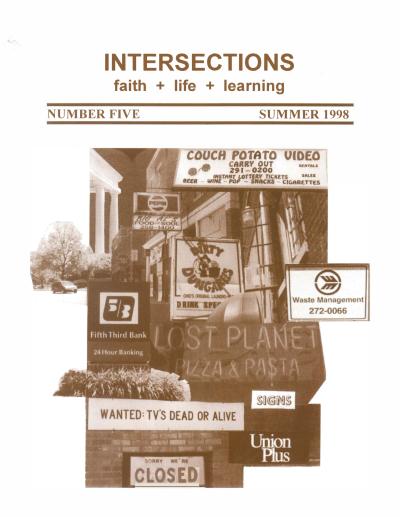 Editorial
From the Editor
Tom Christenson
Christenson introduces the issue as an illustration of the diversity of interests Intersections aims for, surveys the contents (Lagerquist on method, Mori on art and ritual, Baer on falling walls, Bergendoff as memorial, Funk and Powell in dialogue), urges readers to send in “your good stuff,” asks for distribution feedback, and closes with a sabbatical-year reading list—Kieran Egan, Robert Coles, Daniel Kemmis, David W. Gill, Sallie McFague, Roger Scruton, E.M. Adams, Freeman Dyson, Colamosca and Wolman, Gribbin and Goodwin, van Wyk, Wislawa Szymborska, and Flannery O’Connor.
-
Article
You Don't Seem Angry: Methodological Confessions Of A Lutheran Lay-Woman
L. DeAne Lagerquist
Lagerquist, opening from a colleague’s 1981 observation about her M.A. thesis on four female abolitionists, traces her path from feminist historian and battered women’s shelter advocate through the University of Chicago’s obsession with method to a more self-conscious account of her own. The method grows out of four Lutheran themes—original sin (caution and humility), the eighth commandment against bearing false witness (generosity and forgiveness), the neighbor as “little Christ” (cooperative interpretation), and vocation (interpretation as calling, located alongside feeding the hungry and visiting the lonely)—and shapes her ongoing work on a history of Lutherans in the United States with a plot about learning to live with diversity.
-
Article
Redemption Through Imperfection
Kyoko Mori
Mori, drawing on a visit to the Philadelphia Museum of Art with a friend, contrasts Marcel Duchamp’s Étant donnés—a peephole work whose mysterious motion sweeps every viewer into a shared, perpetual performance—with the static, glass-encased Liberty Bell as parody of spiritual experience. She extends the contrast into a meditation on rituals (comfort and consolation) versus art (truth, however painful), and on writing as a redemptive process that moves from orderly first drafts toward chaos and deeper, frightening truth—closing with master potters who skewed each finished vessel slightly so that art and decoration could be told apart. Parts are excerpted from Polite Lies (Holt 1997).
-
Reflection
A Community That Connects
Conrad Bergendoff
Excerpts from Conrad Bergendoff’s 1990 address at the opening of Augustana’s new library, prepared by David Crowe and published here as a memorial after Bergendoff’s death in December 1997. Bergendoff—Augustana class of 1915, president 1936–1962—recounts eighty years of Augustana memories, insists that “size is pretty much within you, not outside of you,” traces the institution’s bonds to Uppsala from 1860 (and the 1910 visit of the Rector Magnificat), and celebrates Augustana’s graduates “in practically every part of the world” as evidence that a small school can have a universal output.
-
Reflection
Walls: Talk At Gustavus Adolphus College
Elizabeth Baer
Baer’s September 11, 1997 Gustavus Adolphus chapel homily on Joshua 6 turns from the trumpets to the walls—Robert Frost’s “Mending Walls,” the walls of the Warsaw ghetto in Vladka Meed’s On Both Sides of the Wall and Margaret Zassenhaus’s Walls, the Berlin Wall coming down in 1989—and then to the autobiographical, intertextual discourse of Gustavus chapel itself as a place where misunderstandings come down. An author’s note added after the March 29 F3 tornado reports the closing line (“LET’S MAKE THOSE WALLS COME TUMBLING DOWN”) as eerily prescient: roofs, windows, and 90% of campus trees were lost, but the Chapel walls and the eternal flame in the red glass lantern stood firm.
-
Article
The Quest Of The Historical Jesus: Problem & Promise
Robert W. Funk
Funk, founder of the Jesus Seminar, frames the quest as the search for reliable data amid twenty-two ancient gospels and as a confrontation among three “parties”—the Jesus Party, the Apostolic Party, and the Bible Party. He surveys the Seminar’s 1985–1998 work (The Five Gospels, The Acts of Jesus, the color-coded reports), defends the synoptics over John, the priority of Mark, the Sayings Gospel Q and the Gospel of Thomas, and argues that a recovered Jesus—a teacher of a trust ethic, celebration, a kingdom without social barriers, a society without brokers, without cult rituals—may serve as catalyst for a sweeping third-millennium reformation that purges the “clogged arteries” of institutional Christianity.
-
Response
Beyond Data: The Poetry of Faith — A Response to Robert W. Funk
Mark Allan Powell
Powell, professor of New Testament at Trinity Lutheran Seminary, responds to Funk not as a New Testament scholar (Meier, Raymond Brown, and others can rehearse those debates) but as a Christian and a pastor. He challenges Funk’s closing implication that the institutional church’s “only function” is to protect Christian privilege (citing the ELCA’s 28 colleges, 1378 early childhood centers, AIDS hospices, and more), questions the suspicion of “derivative” faith, and proposes that piety is to theology what poetry is to prose—arguing, against Funk and with Marcus Borg, for a wholistic faith that holds history and myth, data and devotion, head and heart together.
-
 Article
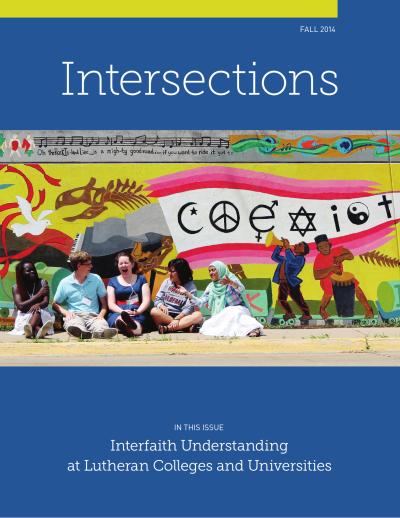
Why Interfaith Understanding is Integral to the Lutheran Tradition
Jason A. Mahn
No. 40 · Fall 2014
Mahn returns to the root of the Lutheran tradition — church, theology, and pedagogy — to argue that interfaith encounter is not the vanishing point of Lutheran identity but central to it, beginning with confession of Luther’s anti-Judaic legacy, working through the typology of exclusivism / inclusivism / pluralism, and showing how the kenotic Christ and the theologian of the cross open Lutherans to authentic encounter with religious others.
-
 Article
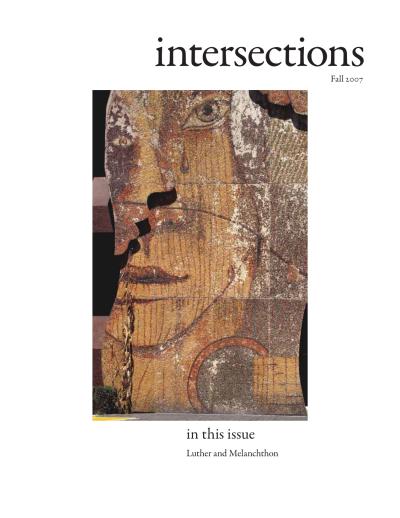
The Vocation of a Lutheran College—Living the Legacy of the Reformation in the Twenty-first Century
Sabine U. O'Hara
No. 26 · Fall 2007
O’Hara reflects on Luther’s understanding of education as Bildung — “becoming in the image of God” — through four key aspects: education must be relevant, education demands engagement with the community, education requires attention to place, and education demands engagement with the world. Drawing on her German upbringing, her work as president of Roanoke College, and on Darrell Jodock and Dietrich Bonhoeffer, she argues that Luther’s vision of a well-educated citizenry as the priesthood of all believers calls Lutheran colleges to messy, interdisciplinary, communal scholarship in service to the neighbor.
-
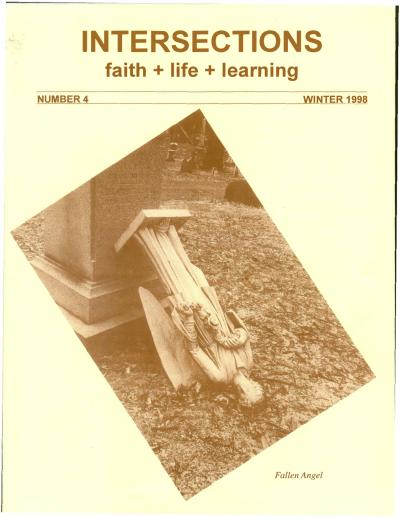 Article
The University in the City of God: Beyond Dialectics and Rhetoric
Gregory A. Clark
No. 4 · Winter 1998
Clark, drawing on Alasdair MacIntyre’s Three Rival Versions of Moral Enquiry, distinguishes the preliberal, liberal, and postliberal university and argues that the liberal university’s pretense of dialectical neutrality has masked a particular rhetoric of its own. Following John Milbank’s Theology and Social Theory, he holds that every philosophy and institution is finally a rhetoric and that the church’s task is not to win on the secular university’s terms but to proclaim and embody an alternative city. The Christian college, then, should give up the apologetic pose of meeting secular reason halfway and instead practice the rhetoric of the gospel: a proclamation of Jesus, an enactment of Christian friendship and peace, and a willingness to be vulnerable to the violence of the world as Jesus was vulnerable to his own. Clark commends this stance to colleges related to the church.
-
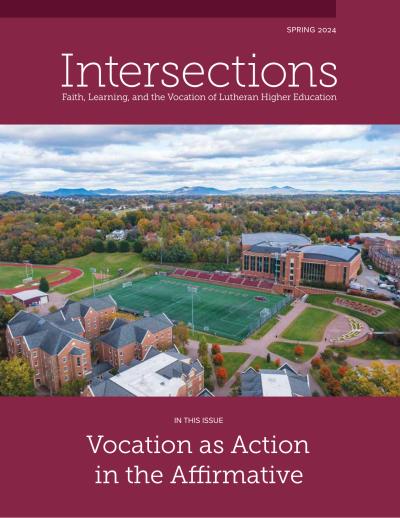 Article
On Recruiting Diverse Students, Rooted in Mission
Eric Rowell, Jason A. Mahn
No. 59 · Spring 2024
Jason Mahn interviews Eric Rowell, Assistant Director of Admissions and Diversity Outreach at Augustana College, about how recruiting students from a wide variety of backgrounds — rooted in Augustana’s Lutheran commitment to vocation and educating across difference — remains essentially unchanged in the wake of the Supreme Court’s 2023 decisions on affirmative action.
-
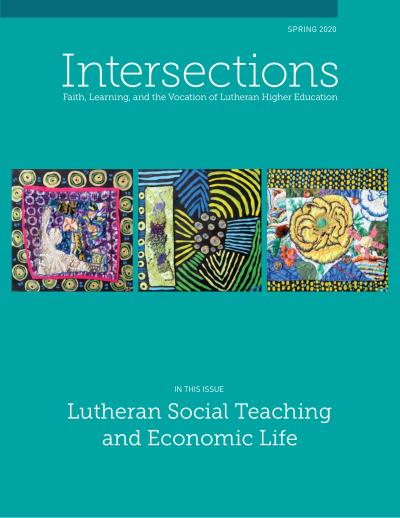 Article
ELCA Social Teaching for the Classroom?
Roger A. Willer
No. 51 · Spring 2020
Willer argues that the body of ELCA social teaching, taken as a whole, constitutes an actual social ethic — relatively comprehensive, responsibly consistent, and remarkably cogent — whose mode of responsibility ethics commends it as a classroom resource for any discipline that wrestles with moral questions.
-
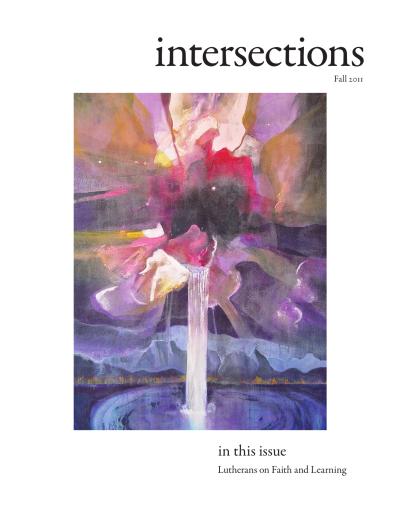 Editorial
From the Publisher
Mark Wilhelm
No. 34 · Fall 2011
Wilhelm bids farewell to Robert D. Haak, who is leaving the editorship of Intersections and the Augustana College Center for Vocational Reflection for a chief-academic-officer post at Hiram College in Ohio, and welcomes Jason A. Mahn as the incoming editor. He celebrates Haak’s tireless work to integrate the Lutheran concept of vocation into the practices and rhetoric of Augustana and ELCA higher education through six years of Intersections, and frames the journal as a vital tool for sustaining the conversation about education in a Lutheran key—even at colleges and universities where most students, faculty, and staff are not Lutheran themselves.