About Rooted and Open: The Common Calling of the Network of ELCA Colleges and Universities
Intersections No. 49 · Spring 2019
Rooted and Open is the Network of ELCA Colleges and Universities’ statement on Lutheran identity (or institutional vocation) in higher education. The full text is between pages 30-31 of this special issue of Intersections.
The development of this articulation of the “common calling” of our 27 institutions was a major project of NECU in its first years as our collegiate association in the ELCA. The statement was written to serve as a resource for NECU institutions. Since its adoption in January 2018, many NECU institutions have found Rooted and Open to be a helpful tool. We hope this issue of Intersections will encourage further use of this foundational document and assist with its interpretation.
Thank you to the faculty working group who donated their knowledge, wisdom, and time in the development and drafting of Rooted and Open in an 18-month period during 2016-17. Its members are listed below. Asterisks denote the persons who formed the writing team for Rooted and Open:
- Marcia Bunge, Gustavus Adolphus College
- Jacqueline Bussie. Concordia College
- Wanda Deifelt, Luther College
- *Darrell Jodock, Gustavus Adolphus College (emeritus faculty)
- Kathryn (Kit) Kleinhans, Wartburg College, now at Capital University
- *Jason Mahn, Augustana College
- *Martha (Marty) Stortz, Augsburg University
- Samuel Torvend, Pacific Lutheran University
- *Mark Wilhelm, NECU
- Ned Wisnefske, Roanoke College
By providing comments on a draft in the summer of 2017, NECU presidents gave further shape to Rooted and Open. A penultimate version was revised by Darrel Colson, President of Wartburg College, in collaboration with Mark Wilhelm, Executive Director of NECU, and members of NECU’s Executive Committee. The presidents of NECU institutions unanimously adopted the document as an accurate and aspirational articulation of our shared institutional calling in January 2018.
This issue of Intersections begins with an essay by Mark Wilhelm that further elaborates on the background and goals of Rooted and Open. The other three members of the writing team offered additional context and analysis when presenting a draft to the NECU presidents in summer of 2017; revised versions of their remarks are included here as well. The remainder of the essays mark a variety of ways that Rooted and Open is being discussed and employed on NECU campuses—from a deep dive into its major claims with one university board of regents, to a case for moving from common calling to the particular callings of each institution (and back again), and again to the ways that our unique institutional callings can help us better support the “faithful nones” in our classrooms and to teach self-care to our students so that they might more reflectively and intentionally live out their own callings. May the issue be informative and inspirational as you live out your part of the shared vocation of Lutheran higher education.
-
 Institutional Focus
About the Cover and Artist
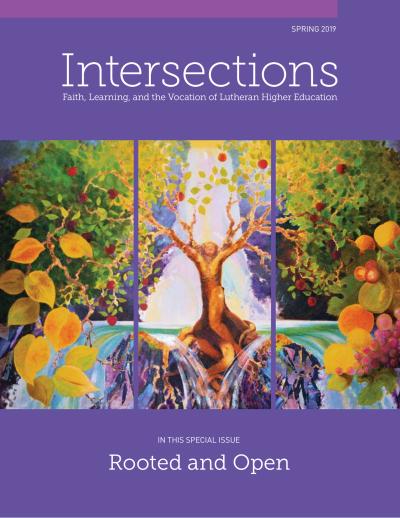
Kristen Gilje, a Bellingham, Washington artist who spent nine years as Artist in Residence at Holden Village, recounts the “Tree of Life” she painted for the Holden Village 1999 summer theme and the unexpected interpretation Lapidary Fred offered of Yggdrasol, Prometheus, the Druid Tree Spirit, and the crucifix all at once.
-
Article
Rooted and Open: Background, Purpose, and Challenges
Mark Wilhelm
Wilhelm traces Rooted and Open’s seventy-year backstory — from Conrad Bergendoff’s 1948 call for a Lutheran philosophy of education through the recovery of the vocation tradition — and describes the document’s process, purpose as a teaching and study resource, and the embodiment, contextual, and cultural challenges it implies for NECU institutions.
-
Article
In a Diverse Society, Why Should Lutheran Colleges/Universities Claim their Theological Roots?
Darrell Jodock
Jodock develops his “third path” account of the Lutheran college — neither sectarian nor non-sectarian but both rooted and open — analogizing the college to a bridge whose deck of daily activities rests on pillars of shared educational priorities, which in turn rest on theological footings; he then answers six common objections to claiming Lutheran roots and explains why those footings still matter.
-
Article
Roots and Shoots: Tending to Lutheran Higher Education
Jason A. Mahn
Mahn revisits why “education-for-vocation” has become a leitmotif for the 27 NECU schools, distinguishes institutional vocation from individuals’ religious identities and educational priorities from their theological grounding, and offers a friendly critique of Jodock’s bridge metaphor: Lutheran colleges grow in two directions like plants — deep roots and wide branches alike require constant tending.
-
Article
Marked by Lutheran Higher Education
Martha E. Stortz
Stortz offers an “operating manual” to Rooted and Open by tracing how the writing team moved from descriptive marks of the institutions to aspirational verbs that mark people — “called and empowered, to serve the neighbor, so that all may flourish” — and shows how each mark generates educational priorities theologically grounded in the radical mystery of God, the wild generosity of God, and the God who became one of us.
-
Article
Deep Roots, Big Questions, Bold Goals
Colleen Windham-Hughes
Adapted from a presentation to the California Lutheran University Board of Regents, Windham-Hughes reads the title Rooted and Open as both reaching back into the Lutheran tradition and opening forward into a shared future, then unpacks the document’s “called and empowered — to serve the neighbor — so that all may flourish” through the lenses of freedom of inquiry as a third path, vocation-centered education, radical hospitality, and civil discourse oriented toward the common good.
-
Article
Rooted and Open as Resource for Expanding Opportunities on Your Own Campus
Katherine A. Tunheim, Marcia Bunge
Bunge and Tunheim describe how Gustavus Adolphus College has paired Rooted and Open with its own companion volume Rooted in Heritage, Open to the World — in board workshops, new-faculty orientation, and classroom assignments — and survey several Network-wide opportunities (the Vocation of a Lutheran College Conference, the LECNA Fellows Program, the Association of Lutheran College Faculties, the Tuition Exchange Program, and international partnerships) that give the common calling tangible institutional form.
-
Article
"Faithful Nones" and the Importance of a Rooted and Open Pedagogy
John Eggen
Drawing on a student survey from his D.Min. thesis at Midland University, Eggen identifies a distinctive subset of religious “nones” — the “faithful nones” — who reject institutional religion yet retain substantive beliefs and practices, and argues that the non-binary, third-path pedagogy commended by Rooted and Open is uniquely positioned to engage a generation that has disambiguated faith, religion, and spirituality.
-
Article
Finding Flourishing: Teaching Self-Care as Course Content
Emily Kahm
Kahm argues that teaching self-care, self-awareness, and stress-coping as explicit classroom content embodies the “radical hospitality” of Rooted and Open and supports vocational formation against a consumerist culture, then offers concrete classroom techniques — a one-to-five energy check-in, ninety-second silence exercises, and full-day spiritual practices — that can be adapted across disciplines at NECU institutions.
-
 Article
Reforming Our Visions of City Nature
Lea F. Schweitz
No. 46 · Fall 2017
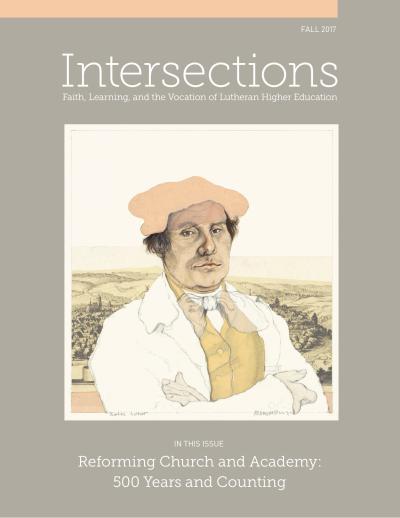
Through a Chicago story of Canada geese at North Pond, Schweitz takes up two Reformation-era ways of reading the “Book of Nature” — Konrad Rosbach’s moral readings and Philip Melanchthon’s scientific ones — and proposes a third: Luther’s sacramental principle that the finite is capable of the infinite, worn as “reading glasses” for an urban planet.
-
 Editorial
From the Editor
Robert D. Haak
No. 30 · Fall 2009
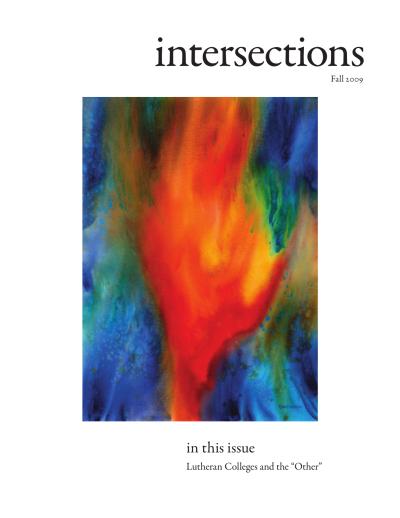
Haak frames the issue around the question of Lutheran college identity as formed in distinction from some “other,” introducing essays by Witherup on the Joint Declaration, Reuther on Holden Village, Afzaal on Christian-Muslim dialogue, Dovre on the history of Midwestern Lutheran colleges, Radecke on service-learning, and Ratke on Wilhelm Löhe — each making the claim that the “other” is an essential partner in conversation who helps us know who we are and shape who we will become.
-
 Article
Reflections on Our Shared Commitments
Mark S. Hanson
No. 25 · Spring 2007
Originally delivered to the Lutheran Educational Conference of North America in March 2007, Hanson’s address describes the ELCA as “an ecology of interdependent ecosystems” and locates the church’s relationship to its twenty-eight colleges and universities in a shared mission rather than in older anxieties about church-relatedness. Drawing on Wittenberg’s Lutheran Identity Study, Augustana’s “Five Faith Commitments,” Pamela Jolicoeur’s Concordia address, W. Robert Connor on “big questions,” Joseph Sittler on grace, Walter Brueggemann on fear, Jonathan Strandjord on being “other-wise,” and Cynthia Moe-Lobeda’s Public Church for the Life of the World, he names four marks of shared mission: communities of free inquiry, encouragement of religious expression in a diverse society, education for the common good, and the formation of leaders for church and religious communities worldwide.
-
 Reflection
VLHE—Wednesday Morning Sacred Pause
Ann Rosendale
No. 62 · Fall 2025
8 min audio
Rosendale draws on Esther 4:14 and the Lutheran practice of holding death and resurrection together — with “and” as the hardest word — to argue that the calling of Lutheran higher education for “just such a time as this” requires us to remember and name out loud that ours are places where God is at work.
-
 Article
Hope in the Face of Ecological Decline
Jason Peters
No. 32 · Spring 2010
Peters reads our ecological crisis—a campus “Birth Control Tree,” feminized fish, population, climate, water, and soil—through Alexander Pope, William Blake, Søren Kierkegaard, and C. S. Lewis’s The Abolition of Man, and argues that the modern project of mastering nature has made despair (the unconscious form Kierkegaard named) our condition. He calls for three reorientations: practical (assigning value to domestic arts and place over disciplinary specialization), philosophical (dismantling the Baconian/Machiavellian/Cartesian project of control), and theological (recovering the Church’s rejection of Gnosticism so that grace comes to us by means of nature, not in contempt of it).
-
 Article
Who Said You Have Only One Calling?
Peter Marty
No. 27 · Spring 2008
Marty argues that our normal practice of thinking singularly about vocation must be enlarged: God has not limited any of us to one expression or gift, and Martin Luther never spoke of individuals as having only one calling. Drawing on Max DePree’s parable of the millwright-poet, William May on the etymology of “career,” Evelyn Underhill on the verb “to Be,” James VanOosting, Scot McKnight’s “Jesus Creed,” and a Golden Gate Bridge patrolman who has saved hundreds of lives, he identifies four features common to every story of vocation in scripture: special purpose, special gifts, a caller from outside, and the requirement of sacrifice and generosity.