“A Decolonizing Conversation”: Indigenous Engagement at Luther College at the University of Regina
Marc Jerry
Luther College at the University of Regina
Sarah Dymund
Luther College at the University of Regina
Intersections No. 58 · Fall 2023
It was an honour and a delight to be able to participate in the Vocation of Lutheran Higher Education conference in Minneapolis this past summer. It was also a privilege for us to be able to share the stage with Dr. Monica Smith, presenting on the subject of “Reconciliation, Restorative Justice, and the Flourishing of Black, Indigenous, and Other People of Color.” As people of White European Settler descent, we were very cognizant of both the challenges and responsibilities of presenting on this subject. We hoped, with this presentation and the following workshop, both to centre Indigenous stories and voices, and to use our positions and platforms to do the anti-racist work of naming systemic injustices that benefit us.
In our Canadian context, the lasting legacy of European colonization is still creating and contributing to challenges for BIPOC members of our communities across all sectors, including education. A particular aspect of our Canadian history that contributes to this legacy is the former Indian Residential School System. From 2009-2015, the Truth and Reconciliation Commission (TRC) worked across Canada, gathering and sharing stories of the experiences thousands of Indigenous children, their families, and communities had during the years of the Residential School System. In 2015, the TRC published 94 Calls to Action for all levels of government in Canada to make strides towards righting these historic and persistent systemic wrongs. The Calls to Action are informed by the United Nations Declaration on the Rights of Indigenous Peoples. Given the terrible legacy of the Residential School System, several of the Calls to Action pertain directly to education, in both the “Addressing the Legacy,” and “Towards Reconciliation” sections of the document. Luther College, on both its high school and university campuses, is striving to be attentive to these education-based calls to restorative justice initiatives.
As is becoming more and more common in our area of the country, both our campuses are making conscious efforts to begin gatherings with Land Acknowledgments which name the peoples whose first home we are on, as well as naming the need for all people to embrace and embody our shared responsibilities as Treaty People. Our presentation at the VLHE conference this year incorporated such acknowledgments for both our home in Regina, Saskatchewan, and Minneapolis, where we gathered for the conference.
Some concrete activities and steps towards reconciliation have taken place recently on our high school campus including the direct involvement, initiation, and leadership of our Indigenous students. One such activity was the removal of banners from our gymnasium which bear names and logos of sports teams which are derogatory or appropriative. This removal was done with due respect and ceremony, and accompanied by sacred drumming. This past year’s graduation celebration at Luther College High School also included the addition of a Starblanket ceremony to the proceedings. Each Indigenous graduate from our high school received a beautiful handcrafted Starblanket to mark this milestone in their life, and local Indigenous community leaders facilitated this event and provided a drum circle to accompany the ceremony.
On our campus at the University of Regina, Luther has an active committee working towards elements of Indigenous Engagement, or “Indigenization.” This committee has collected resources for faculty and staff on guidelines for appropriate and respectful protocols in seeking input from Indigenous Elders, and other scholarly resources for various aspects of Indigenous engagement. Our university campus has also sponsored and supported an award-winning initiative called Project of Heart, which invites participants to engage with and learn from the stories of specific children who attended the Residential School System. To help guide our committee, and to provide an opportunity for students, staff and faculty to truly learn from Indigenous wisdom, Luther College at the University of Regina has contracted an Elder in Residence for this year.
Sharing the words and wisdom of Elder Lorna Standingready was the heart of our presentation at the NECU VLHE conference this summer. Preparing for this conference presentation opportunity with the desire to centre Indigenous voices from our White settler perspective was a challenge we wrestled with alongside our Indigenization committee, and Elder Lorna. The central questions for us, as we discerned our path for this keynote address, became, “What is our work to do in this area? How can we use the privilege of this opportunity to centre an Indigenous voice, rather than our own? And, perhaps most importantly, “How can we seek and centre Indigenous guidance without simultaneously asking the person we ask to teach us to take responsibility for our learning?”
One significant challenge in learning and listening to voices from the margins of our society is that the central, dominant culture often expects, or even demands, that marginalized voices conform to the dominant norms of address and delivery in order for their contributions to be recognized as valid and worthy of attention and consideration. This is a particularly relevant concern when considering bringing Indigenous teachings into colonial academic systems.
An area where we can face obstacles in making space for Indigenous teachings in academic settings centers on how we view and manage time from our cultural perspectives. European-influenced academia is very strongly structured to run by the clock, and punctuality and brevity are valued attributes, which are often cited as examples of being respectful of another person’s time. In many Indigenous cultures, placing time limits or constraints on communication is, in contrast, seen as a mark of disrespect, especially when considering the wisdom of an Elder. A challenge some of our staff and faculty face at Luther is how to navigate the desire to bring the voice, stories, and teachings of an Indigenous Elder into their classroom settings, when to do so inevitably involves asking the Elder to conform to the time constraints of the class structure.
This challenge was at the forefront of our minds as we prepared to join the VLHE conference this year. How, we wondered, could we use our privilege and platform to allow Elder Lorna to bring her own teachings to the conference without asking her to make her own story small enough to fit into the allotted time for the presentation? In other words, how could we do the work of making a respectful space in which Elder Lorna’s voice could share her own story in her own way?
What we brought to the conference was a video entitled A Decolonizing Conversation. With Elder Lorna’s permission and consent we recorded a video of a conversation between her and Rev. Dr. Sarah Dymund, Luther’s interim chaplain. This conversation had no time constraints placed upon it, and Elder Lorna was invited to share whatever teachings and medicine she felt moved to bring to the conference. Elder Lorna’s Cree name means Old Woman Who Brings Good Medicine, and the teachings and wisdom she bestows on those blest to hear her are indeed healing. This conversation between Elder Lorna and Pastor Sarah took about an hour. From this hour-long conversation, Pastor Sarah created an edited version of the video that fit into the 20-minute time allotted for this portion of the presentation.
The video that we shared as A Decolonizing Conversation followed the story of Elder Lorna’s name as it has changed and evolved throughout the stages of her life, including conforming to colonial naming conventions, traditional Indigenous naming, changing names with marriage, and being known only by a number in Residential Schools. As moving and powerful as many in the audience found this story to be, perhaps the most important learning from this experience and the message we hoped to convey in the presentation is how much we were not able to share. Approximately two-thirds of what Elder Lorna gave as a gift to Pastor Sarah and our student videographer has been unheard by anyone else. How much do we miss out on learning from the margins when there is no time and space in the centre for those who can’t or won’t conform to the norm?
-
 Editorial
From the Editor: So That We, Too, May Flourish
Colleen Windham-Hughes
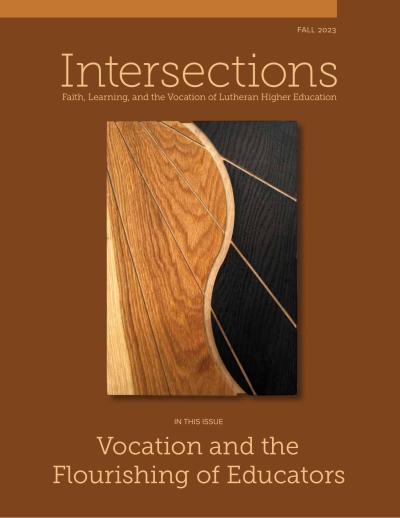
Windham-Hughes introduces the 2023 VLHE conference theme of educator flourishing, drawing on Dr. Monica Smith’s plenary challenge — “How can we flourish if only some are centered and others are at the margins?” — and invites readers to ground themselves in Us/We, the cover art by Augustana graduate William Hatchet, and join the conversation.
-
Editorial
Maintaining Our Lutheran Identity: A Source of Strength
Lamont Anthony Wells
Wells reflects on the well-being of staff, faculty, and administration in Lutheran higher education across four pillars — rest, creativity and innovation, religious diversity and pluralism, and the preservation of Lutheran identity — and addresses the painful reality of Finlandia University’s closure as a reminder of the network’s shared mission.
-
Article
A Lutheran Call for Educator Flourishing
Krista E. Hughes
Hughes argues that without educator flourishing there is no student flourishing, traces how an exploitative “passion tax” can distort vocation, and offers seven Lutheran “third-way” value pairings — including Metrics/Grace, Efficiency/Kairos, and DEI/Priesthood of All Believers — to reframe institutional success at NECU campuses.
-
Article
Do One Thing: Academic Vocation in the Age of Burnout
Jonathan Malesic
Malesic draws on Oliver Burkeman’s 4,000 Weeks and Søren Kierkegaard’s Purity of Heart is to Will One Thing to argue that academic burnout is fundamentally institutional — a widening gap between mission ideals and working conditions — and urges colleges to resist “projectitis” by focusing on the one thing that matters most.
-
Article
Cultivating Staff Flourishing in Lutheran Higher Education: A Framework for Advocacy and Engagement
Laree Winer
Winer narrates her own “love affair” with Lutheran Higher Education to argue that the heart of the tradition — vocation, de-emphasized hierarchy, and shared humanity — equips NECU institutions to advocate for staff flourishing through data collection, professional development, and ongoing relational commitment.
-
Article
Staff Governance at St. Olaf College, Northfield, MN
Don Ezra Cruz Plemons
Cruz Plemons describes how staff at St. Olaf, in the wake of a decade of difficult events, have built a three-year, glacier-paced effort toward a Staff Governance model — through affinity groups, the Council for Equity and Inclusion, and the Task Force to Confront Structural Racism — that gives staff a voice alongside faculty and students.
-
Article
Vocare: A Spiritual Practice for the Spaces Between
Charlene Rachuy Cox
Cox introduces Vocare, a six-word spiritual practice developed through the Nourishing Vocation Project at St. Olaf, that uses the acronym V-O-C-A-R-E to help individuals and communities honor the spaces “between no longer and not yet” and discern their callings for the common good.
-
Reflection
The Importance of Connection
Alex Piedras
Piedras reflects on the 2023 “So that We, Too, May Flourish” Conference at Augsburg as a refreshing space for a weary DEI advocate — surfacing burnout, the Talking Circle on Indigenous Issues, and Dr. Monica Smith’s Racial Healing Circle as opportunities to recharge the soul and build authentic connections for the long journey.
-
Article
Beyond Deep Gladness: Coming to Terms with Vocations We Don’t Choose
Deanna Thompson
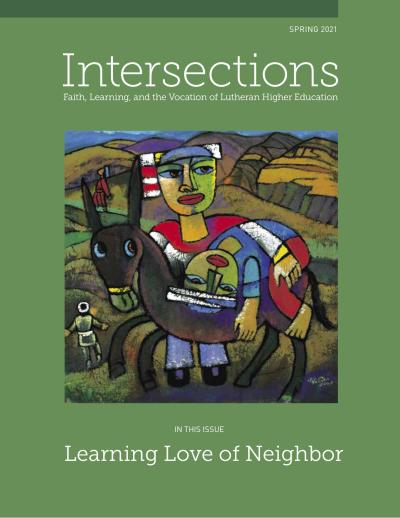
Thompson, living with incurable cancer, expands Frederick Buechner’s definition of vocation to make room for deep sadness — drawing on Arthur Frank, Shelly Rambo, Beverly Wallace, and Ross Gay to argue that practices of lament, including the public lament of Friday Flowers at St. Olaf, open space for gladness, joy, and even flourishing to emerge.
-
 Article
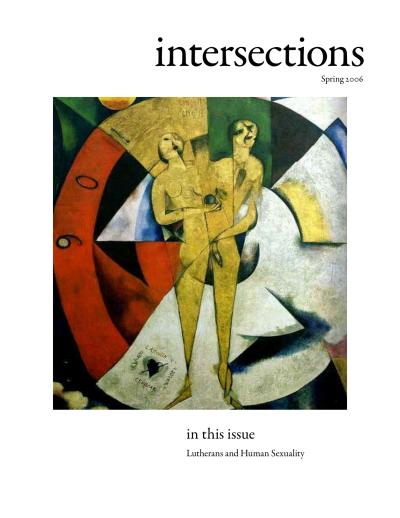
Sexuality over the Lifespan—Social Trends Pose Moral Dilemmas for Communities of Faith
Adina Nack
No. 22 · Spring 2006
Nack, a sociologist who presented to the ELCA Task Force for Studies on Sexuality, surveys empirical research on three life-stages flagged by the Task Force as particularly contested—premarital sexuality among adolescents and young adults, sexuality after divorce and within single parenting, and sexuality in late adulthood. Drawing on the Alan Guttmacher Institute, the Office of the Surgeon General, AARP, National Council on the Aging, and the World Health Organization’s 2002 definition of sexual health, she closes each section with questions about the church’s role in education, blessing of committed nonmarital relationships, and dismantling stereotypes about aging and sexuality.
-
 Article
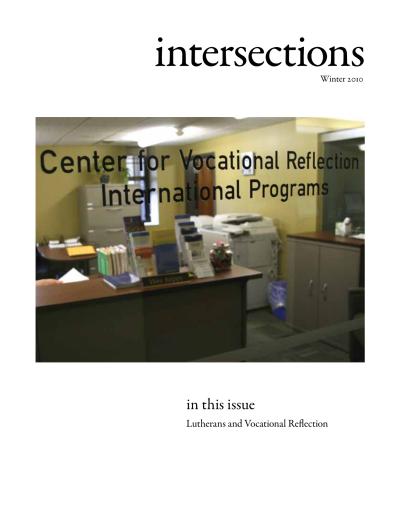
Called for Life — Affirming Vocational Discernment
Richard L. Torgerson
No. 31 · Winter 2010
Torgerson introduces the “Called for Life” project, a three-year, $278,437 Lilly Endowment-funded collaboration among Luther, Augsburg, and Augustana that—in partnership with Luther Seminary’s Centered Life initiative and Wilder Research—rigorously assessed the effectiveness of campus vocation programs, examining whether students’ exposure to and understanding of calling had increased, and what program elements were most effective in shaping discernment.
-
 Article
Take Heart: Is Neutrality Really What We Need Right Now?
Abbylynn Helgevold
No. 57 · Spring 2023
Helgevold, an ethicist at Wartburg College, argues that calls for faculty neutrality on abortion in the post-Roe classroom stifle the courageous conversations Lutheran higher education is uniquely positioned to host — conversations grounded in “Rooted and Open” and the ELCA’s 1991 Social Statement on Abortion.
-
 Response
Response to Robert Benne
Baird Tipson
No. 17 · Summer 2003
Tipson responds to Robert Benne’s comments in the previous issue about his review essay of The Future of Religious Colleges, affirming their fundamental agreement that the Enlightenment epistemology dominant in higher education poses the most serious threat to the vitality of Lutheran colleges. Using the example of lecturing on early Mormon history and the Book of Mormon, he concedes that the methodological “solvent” of Enlightenment historiography acts on Christian as well as Mormon faith claims, and concludes that while H. Richard Niebuhr’s “inner” and “outer” history and Walter Brueggemann’s approach in The Theology of the Old Testament are comforting to believers, they do not offer an epistemology that can stand alongside the Enlightenment model in evaluating truth claims in the academy.
-
 Book Review
A College Degree or a College Experience? Reflecting on Selingo's College (Un)Bound
Laurie Brill
No. 39 · Spring 2014
Brill reads Jeff Selingo’s College (Un)Bound from inside the Lutheran Educational Conference of North America, drawing on LECNA’s alumni research with Hardwick-Day and on Brandon Busteed’s Gallup data to argue that, in an age of competency-based degrees and college-as-commodity, Lutheran colleges must speak more clearly about the transformational, vocational impact of a college experience that develops the whole person.
-
 Editorial
From the Publisher
James M. Unglaube
No. 1 · Summer 1996
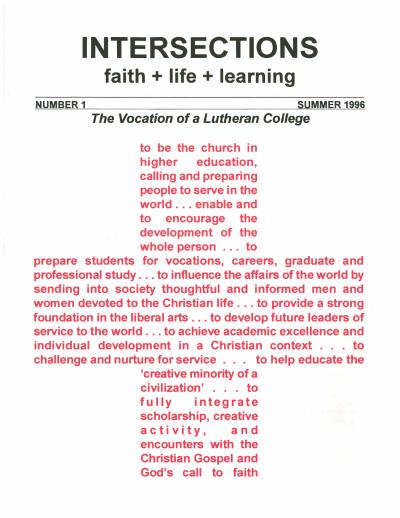
Unglaube welcomes readers to the inaugural issue of Intersections, crediting Editor Tom Christenson and Capital University, and announces the new annual Vocation of a Lutheran College Conference whose continuing dialogue the journal exists to enhance. He gives thanks to the Lilly Endowment for a sizable grant supporting the 1996 conference, campus dialogues, and the birth of the publication.