I admit that I was surprised when I first noticed Norman Wirzba in his magnificent book, The Paradise of God: Renewing Religion in an Ecological Age (Oxford, 2003), using the word vocation to connect human ecological practices to the nature and role of God in the created world. Doesn’t vocation largely designate professional or at least interpersonal and “societal” work—even after Luther released it from the domain of professional churchmen? Can vocation be stretched to cover our work in and for the natural world?
I had confused the center with periphery—the heart of vocation with its encasing skeleton. As Wirzba gently reminds us, care for the earth and especially its soil (adamah) was the vocation given to Adam (Gen. 2:15), and remains the quintessential vocation of us all (Wirzba 22, 31). Such care must itself be “grounded.” It is not firstly by developing eco-industries or by using food for fuel but by gardening that we take up our authentic vocation (118). Just as God creates and redeems by “making room” for the flourishing of Creation, so too humanity is called to the hospitality of “welcoming and enabling the whole of creation to share in the peace and joy of the divine life” (21).
Martin Luther wrote, preached, and taught largely with the aim of reversing the gnostic flight of Christians from the world. He sought to ground us, as it were, in the earth that is created and loved by God. “Vocation” is but one way of naming the heart of this incarnational and creation-centric theology. Moreover, Luther’s primary way of describing God’s Incarnation and Christian discipleship was through kenosis or self-withdrawal: Humans, like God, make room for others so that they, too, might enjoy fullness of life. More radical still, we often come to learn the scope and shape of such self-emptying hospitality from those we think we are serving—including good Samaritans and perhaps now nature itself. Topsoil, in the words of Wendell Berry, “is very Christlike in its passivity and beneficence, and in the penetrating energy that issues out of its peaceableness” (quoted in Wirzba 22). In other words, we might learn how to care for nature by attending to its care for us.
As Jim Martin-Schramm and Cynthia Moe-Lobeda acknowledge in this issue, Lutherans and the faculty, administrators, and staff who work at Lutheran colleges and universities have no absolutely unique perspectives on the vocation of caring for creation. But it would seem that we do bring quite a lot. Do our deeply grounded Lutheran identities support and sustain our more recent, and sometimes frantic, environmental concerns and efforts? If so, how might we name, celebrate, and further cultivate that theological spring? If not, could the rising danger of depleting and devastating the natural world prompt us to reexamine our religious roots, asking again what difference it makes that we called to serve through Lutheran higher education?
Besides four feature essays that think through sustainability, creation, and Lutheran higher ed, this issue of Intersections includes interviews with four leaders of environmental initiatives on our campuses, as well as a report about the vocation of our alumni. Each of the authors first presented his/her ideas at the 2012 Vocation of a Lutheran College Conference at Augsburg College, Minneapolis, Minnesota. I hope that the entire issue helps sustain a conversation that involves many voices, especially the groaning of earth our home.
-
 Editorial
From the Publisher
Mark Wilhelm
Wilhelm argues that the rhetoric framing ELCA higher education as a binary between “secular” and “religious” is “hokum”: there is a third way of doing higher education from a Christian perspective that is religious in motivation and practice but on the ground looks secular. After more than half a century of debates, he calls on ELCA presidents to “do something” in 2013 to move forward in shared mission and vocation.
-
Institutional Focus
Vocation for Life: A Report on a New Initiative for Alumni
A report on “Vocation for Life,” a collaborative initiative of ELCA-related colleges and universities to make vocational exploration available to alumni across the country regardless of which school they attended. The first pilot retreat—“Explore Your Life’s Calling,” in Rochester, Minnesota in November 2011, facilitated by Tom Morgan of Augsburg, Chris Johnson of Gustavus, and Tom Scholtterback of Concordia using the Circles of Trust approach—is described.
-
Article
A Traveler's Manifesto for Navigating the Creation
Ann Pederson
Pederson asks who we are, where we are, and how then we shall live within the Epic of Evolution and the doctrines of creation, incarnation, and imago dei. Drawing on John 3:16 (“For God so loved the cosmos…”), Luther on God’s presence “in the veins of a leaf,” Augustine’s City of God, Phil Hefner’s “created co-creator,” Joseph Sittler’s “Called to Unity,” and Norman Maclean’s Young Men and Fire, she argues for a cosmic reading of incarnation in which all of creation—not only the human—bears the image of God.
-
Institutional Focus
Facing Tornados and Climate Change: An Interview with Jim Dontje about Environmental Innovation at Gustavus
Jim Dontje
Dontje, director of the Johnson Center for Environmental Innovation at Gustavus Adolphus College, describes the Center’s work with solar thermal and photovoltaic systems, LEED certification of Beck Hall, recycling and conservation initiatives, the Linnaeus Arboretum, and the difficult work of building consensus around climate response—reflecting on how Gustavus’s 1998 tornado recovery shaped a community capable of collective action, and on how the “Lutheran identity” both restrains and energizes the college’s environmental ethos.
-
Article
A Lutheran Ethic of Environmental Stewardship
Jim Martin-Schramm
Martin-Schramm sketches a Lutheran ethic of environmental stewardship organized around four moral norms inherited from World Council of Churches discussions and developed by Presbyterian and ELCA social statements: sustainability, sufficiency, participation, and solidarity. He grounds each norm in scripture and the Lutheran tradition—the theocentric doctrine of creation against rampant anthropocentrism, the incarnation against destructive dualisms, Christ in community against modern individualism, and accountability to God for future generations—arguing that this “ethic of ecological justice” offers a common moral vocabulary for engaging environmental policy debates that would otherwise collapse into cost-benefit analysis.
-
Institutional Focus
Putting Principles into Practice: An Interview with Kenneth Foster about Concordia's Sustainability Council
Kenneth Foster
Foster, chair of Concordia College’s President’s Sustainability Council, describes the Council’s formation under President William Craft in 2011 as a re-energization of stalled task-force work, its coordination with grass-roots campus initiatives, and its strategy of moving from principles to practice in stewardship of natural resources at a Lutheran liberal arts college.
-
Article
Climate Justice, Environmental Racism, and a Lutheran Moral Vision
Cynthia Moe-Lobeda
Moe-Lobeda argues that the vocation of a Lutheran college is to prepare students for Thomas Berry’s “great work”: forging a sustainable relationship between the human species and the planet while diminishing the gap between those who have too much and those who have not enough. She develops a three-fold “moral vision” rooted in Luther’s theology of the cross—seeing what is (climate injustice and environmental racism for what they are), seeing more just and sustainable alternatives, and seeing God’s saving presence at work—and offers it as a distinctive Lutheran contribution to the panhuman and interfaith challenge of our day.
-
Institutional Focus
Farming and Eating Locally: An Interview with Garry Griffith about Augustana's Farm2Fork Program
Garry Griffith
Griffith, Director of Dining at Augustana College (Rock Island), describes the Farm2Fork program’s shift from pre-packaged food to fresh produce sourced from local farms (beginning with Jim Johansen of Wesley Acres in Moline), the Augie Acres campus garden tended by students in learning-community courses, the bio-diesel conversion of used fryer oil for greenhouse heat and farm equipment, and the stewardship calling that grounds these efforts in Augustana’s Lutheran identity.
-
Article
Sustaining Sustainability
Baird Tipson
Tipson—former Provost of Gettysburg College, President of Wittenberg University, and President of Washington College—reads Romans 12:2 (“be not conformed to this world…”) against Victor Ferrall’s Liberal Arts at the Brink and the contemporary financial reality of small Lutheran colleges. He tells three case-study stories from Washington College’s Center for the Environment and Society—the Chino Farms partnership, the Chesapeake Semester, and the acquisition of the work boat Callinectes—to show how presidents must engage “the world” to secure resources for sustainability work without being conformed to it.
-
Institutional Focus
Health Food in the Inner City: An Interview with Brian Noy about Augsburg's Campus Kitchen
Brian Noy
Noy, Director of Campus Kitchen at Augsburg College in Minneapolis, describes the Kitchen’s four-fold program—Food to Share (2,000 meals per month from surplus dining-services food and Campus Cooking Classes), Food to Grow (an 80-plot community garden), Food to Buy (two farmers markets that accept EBT/food stamps), and Food to Know (educational programming)—and the deep history of Augsburg’s service to the immigrant communities of the Cedar Riverside neighborhood, now Somali and Mexican as well as historically Norwegian.
-
 Article
Vocation at Full Stretch: Reflections on Follow Your Bliss and Other Lies about Calling and its Use among College Students
Jason A. Mahn
No. 61 · Spring 2025
43 min audio
Mahn engages Bonnie Miller-McLemore’s Follow Your Bliss and Other Lies about Calling as required reading in a sophomore religion course, showing how her categories of missed, blocked, conflicted, fractured, unexpected, and relinquished callings empower young adults to perceive embodied, unplanned, and often painful dimensions of life as essential parts of vocation — and help close the gap between mission-driven and tuition-driven realities.
-
 Article
On Recruiting Diverse Students, Rooted in Mission
Eric Rowell, Jason A. Mahn
No. 59 · Spring 2024
Jason Mahn interviews Eric Rowell, Assistant Director of Admissions and Diversity Outreach at Augustana College, about how recruiting students from a wide variety of backgrounds — rooted in Augustana’s Lutheran commitment to vocation and educating across difference — remains essentially unchanged in the wake of the Supreme Court’s 2023 decisions on affirmative action.
-
 Editorial
From the Outgoing Editor
Jason A. Mahn
No. 55 · Spring 2022
Mahn closes out a decade of editing Intersections, passes the duties to Colleen Windham-Hughes, gives thanks to Mark Wilhelm and Augustana College, and introduces an issue largely drawn from comments by Lutheran faculty, staff, and administrators at the 2022 NetVUE national gathering.
-
 Editorial
From the Editor
Jason A. Mahn
No. 54 · Fall 2021
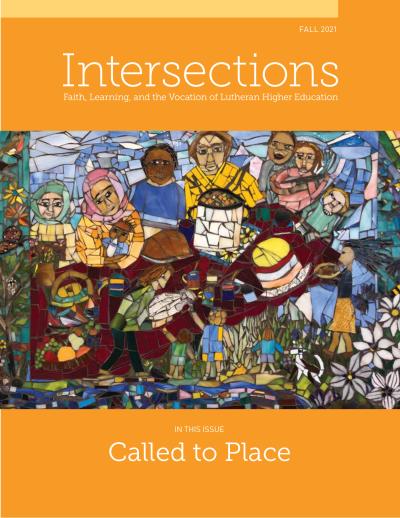
Mahn introduces the “Called to Place” theme of the 2021 VLHE Conference, arguing that Lutheran higher education’s emphasis on vocation must be grounded in particular geographies and embodied communities — for, as Wallace Stegner put it, “If you don’t know where you are, you don’t know who you are.”
-
 Reflection
Shelter in Place: Reflections from March 22, 2020
Jason A. Mahn
No. 53 · Spring 2021
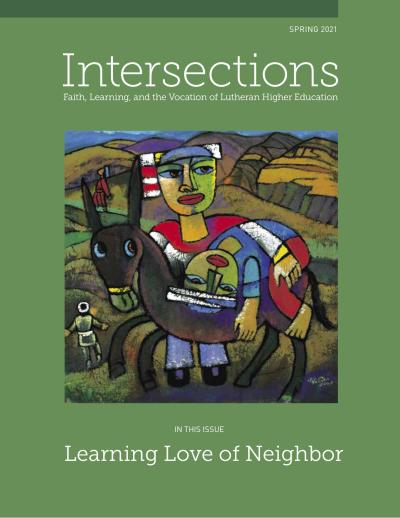
On the fourth Sunday of Lent in 2020, Mahn meditates on the etymology of “shelter” (from shield) and on an email from a former student in Boston whose mutual-aid organizing models a Lutheran understanding of vocation: the upending of ego by divine love that frees us, finally, to see and serve the neighbor.
-
 Editorial
From the Editor
Jason A. Mahn
No. 52 · Fall 2020
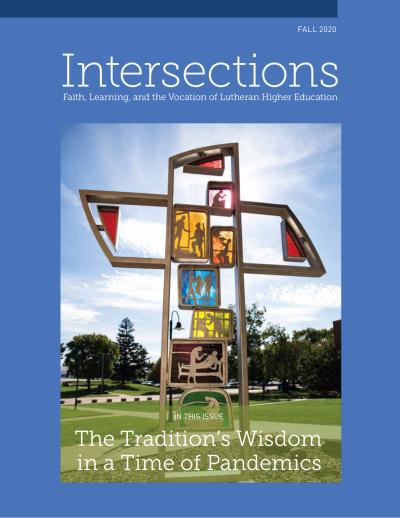
Mahn narrates a year of crisscrossing pandemics — Covid-19, economic collapse, partisan politics, and the long pandemic of white supremacy revealed anew by the murder of George Floyd — and argues that Lutheran liberal arts schools, by educating for vocation, are uniquely poised to help students respond with character and capable callings.
-
 Article
The Dangers of "Vocation" for Students Thinking about Career
Carl Hughes
No. 41 · Spring 2015
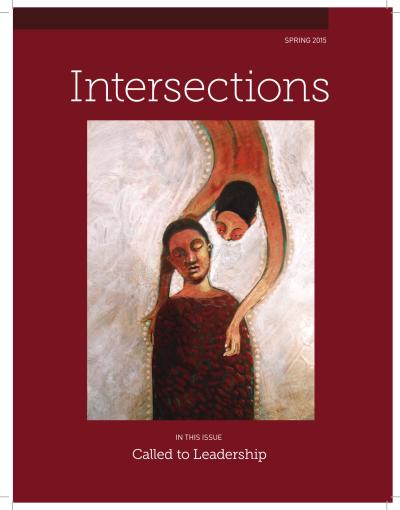
Hughes warns that Lutherans too often use “vocation” as a theologically glorified synonym for a fulfilling career — a misuse that constricts God’s call to our jobs and excludes minimum-wage workers, caregivers, and others from the dignity of calling. Recovering Luther’s expansive understanding, he argues that vocation refers first to people, not professions, and must always be bigger than any one aspect of our lives.
-
Article
Called to the Moment: A New Vocation for Lutheran Colleges
W. Kent Barnds
No. 52 · Fall 2020
After a derecho ravaged Iowa in August 2020 and Pastor Katy Warren preached on 1 Peter 4, Barnds watched line workers, neighbors, and Augustana colleagues simply show up where they were needed — and proposes that the true vocation of a Lutheran college may be making the case for “meeting immediate need with a deep willingness” alongside the longer work of vocational discernment.
-
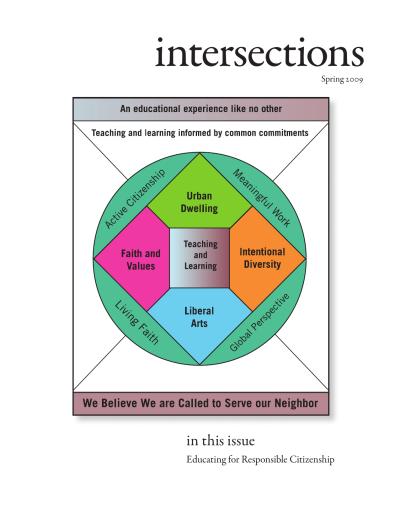 Editorial
From the Publisher
Mark Wilhelm
No. 29 · Spring 2009
Wilhelm introduces essays from the 2008 Vocation of a Lutheran College Conference held at Luther College under the theme “Educating for Responsible Citizenship,” previewing contributions from Paul Pribbenow on dual citizenship at Augsburg, Wanda Deifelt on Luther College’s engagement with civic vocation, Jose Marichal on the promise and peril of digital citizenship, and Arne Selbyg on his three experiences of being educated for citizenship.
-
 Article
Reclaiming Grundtvig at Grand View College
Mark C. Mattes
No. 27 · Spring 2008
Mattes traces the Grundtvigian heritage of Grand View College — the only North American institution founded by Grundtvigian Danes — from its origins in the 1880s split between Pietist Inner Mission and Grundtvigian Danish Lutherans through its golden years of folk dancing, gymnastics, and the weekly lecture, to the demographic and curricular changes of the 1950s through 1990s. He describes recent tangible initiatives, including the Grand View College Reader, Imaging the Journey, and the 2007 Strategic Planning Commission’s “Faith Foundations” statement, that seek to recover the “Human first, then Christian” mantra of Grand View’s ancestors for a generation of students whose “ship” has had not only its planks but its very model replaced.
-
 Editorial
From the Editor
Tom Christenson
No. 3 · Summer 1997
Christenson explains that this issue breaks from the first two issues’ single-focus pattern to feature three principal papers on the environment, the education of desire, and hiring and personnel policies, plus two poems and a piece of reflective bemusement. He then commends George Marsden’s The Outrageous Idea of Christian Scholarship (Oxford, 1997) and challenges Lutheran scholars to articulate how the particulars of their faith inform their scholarship—in conversation with Calvinist work like Nicholas Wolterstorff’s Reason Within the Bounds of Religion and Art in Action—rather than remaining silently complicit in the view that faith has no place in the academy.
-
 Article
Reforming Our Visions of City Nature
Lea F. Schweitz
No. 46 · Fall 2017
Through a Chicago story of Canada geese at North Pond, Schweitz takes up two Reformation-era ways of reading the “Book of Nature” — Konrad Rosbach’s moral readings and Philip Melanchthon’s scientific ones — and proposes a third: Luther’s sacramental principle that the finite is capable of the infinite, worn as “reading glasses” for an urban planet.