The Vocation of a Lutheran College conferences have been possible because of generous support from Lutheran Brotherhood and the Lilly Endowment, and the Lutheran Brotherhood Foundation has also provided funding for the printing cost of INTERSECTIONS. When the vocation conferences had become established the ELCA Division for Higher Education and Schools began to seek funding for a more select faculty development project, “The Lutheran Academy of Scholars in Higher Education.” Again the Lutheran Brotherhood Foundation and the Lilly Endowment came through. Thanks to their generosity, each year since 1999 ten to twelve scholars from Lutheran colleges and universities and Lutheran scholars from other institutions have been selected to participate in a two week seminar during the summer, and to meet for a couple of days the following winter and the following summer. During the opening seminar they spend the mornings under the leadership of an eminent scholar in conversations about topical issues where faith and learning intersect. In the afternoons and evenings they work on their own scholarly projects, and study hard for the remaining seminar sessions. During the follow up sessions they hear from each other about the progress they have made on their scholarly projects, and give each other critique, ideas and encouragement.
The first three years the opening seminars have been held at Harvard University, under the leadership of Dr. Ronald Thiemann, the John Lord O’Brian Professor of Divinity. In 1999 and 2000 the theme was “Finding Our Voice — Christian Faith and Critical Vision.” This year the theme has been “The Lutheran Public Intellectual: Faith, Reason and the Arts.” There is no question in my mind that it is both because of the leadership of professor Thiemann and because of the excellence of the participants that the academies have been a success. Since I had the privilege of sitting in on the first of these two-week sessions in 1999, I can tell you that the seminars had the kind of academic intellectual exchanges that we most of the time only dream about having at our own institutions.
In 2002 the academy will move to the University of California, Berkeley, and the scholarly leadership will be provided by professor Ted Peters. The theme will deal with the intersection of faith and science, but the exact title has not yet been selected. But if you want to be part of a great academic experience, look for our announcement, or contact me now to get on our mailing list so you receive a copy of it, and then send in a well-supported application.
Arne Selbyg
Director for Colleges and Universities
-
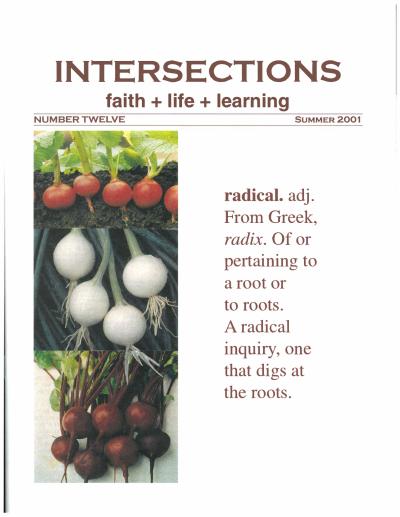 Editorial
From the Editor
Tom Christenson
Christenson introduces three pieces from the summer 2000 Vocation of a Lutheran College Conference at Dana College—noting that Leonard Schulze was asked to keynote before becoming executive director of DHES—and recommends Peter C. Hodgson’s God’s Wisdom: Toward a Theology of Education and Douglas Sloan’s Faith and Knowledge: Mainline Protestantism and American Higher Education for their accounts of how faith and knowledge have been dissociated in modern higher education and what it might take to recover their connection.
-
Article
Teaching as a Form of Servant Leadership
Leonard G. Schulze
Schulze defines teaching as a paradoxical “servant leadership” rooted in the etymology of educare, e-ducere, Erziehung, and Bildung, surveys representative models of the teacher (Plato’s cave, the Theatetus midwife, Socrates of the Apology, and Freire’s Pedagogy of the Oppressed), and proposes a four-fold taxonomy of learning—information, critical thinking, praxis, and teleology—each requiring its own form of teacherly leadership. He closes with ten Wittenberg-style theses for teachers at Lutheran colleges, including that the Gospel liberates us from using knowledge as power, that disputatio is an expression of faith, and that we are called to lead students from the tyrannies of ignorance, rote knowledge, incompetence, and anomy to the freedoms of awareness, critical understanding, skillful action, and purposive lives in community.
-
Article
The Vocation of a Lutheran College
L. DeAne Lagerquist
Lagerquist places the twenty-eight ELCA-affiliated colleges in the context of American higher education from Harvard (1636) through the “old time college,” the post-Civil-War research university, and the postwar expansion—drawing on Christopher Lucas, Philip Schaff’s Neo-Lutheran/moderate/Old Lutheran categorization, Sydney Ahlstrom’s scholastic/pietistic/critical currents, Luther’s appeal to the German nobility, Lewis Hyde’s gift economy, and Alasdair MacIntyre’s After Virtue. She proposes five characteristic practices (the school as learning community, study of Bible and Christian tradition, participation in the arts as makers and audience, application of learning in service, and on-campus Christian worship) grounded in Lutheran teaching about grace, image-and-fall, gratitude, and revelation through created “masks,” and four virtues these practices engender in graduates—loving gratitude, faithful wisdom, bold freedom, and hopeful humility.
-
Article
Perspectives on Institutional Service: All Hands on Deck
Ruth Henricks
Henricks, President and CEO of Lutheran Family Services of Nebraska, uses Annie Dillard’s image of Christians tourist-like on Deck C to call colleges and social ministry organizations to “all hands on deck” in a church standing at a threshold of shifting demographics—a growing rich-poor gap, a coming Hispanic majority, an aging baby-boom, dual-career families, contingency workers, and for-profit Lockheed Martin-style competitors entering human services. Drawing on Foster McCurley, Andrew Grove’s Only the Paranoid Survive, Justo Gonzales’s Manana, Arthur Becker, Bob Bacher, David Tiede, and the ELCA constitution, she argues that SMOs and colleges are the “hands” of the body of Christ and asks whether we have courage to require Spanish, partner ecumenically, cut services to Caucasian clients, and lead the church from the front rather than the rear.
-
Article
A River Runs Through It: CLU as a Church-Related University
A. Joseph Everson
Everson borrows Norman Maclean’s A River Runs Through It and the small creek that flows through California Lutheran University’s Kingsman Park as images for the quiet stream of Christian tradition on campus, describes the dialectic of faith and reason (with a “Lord of Life” student congregation, two required religion courses, and a voluntary Wednesday chapel) as the “theology of paradox” that runs from Luther’s simul justus et peccator through Richard Solberg and Richard Hughes, and names six commitments that constitute the CLU ethos—academic freedom (Jeremiah 29:7 and John 8:32), vocation, service (Amos and Habitat for Humanity), grace and graciousness (Portia’s “quality of mercy” speech from The Merchant of Venice), diversity, and reverence (Proverbs 9 as awe and wonder).
-
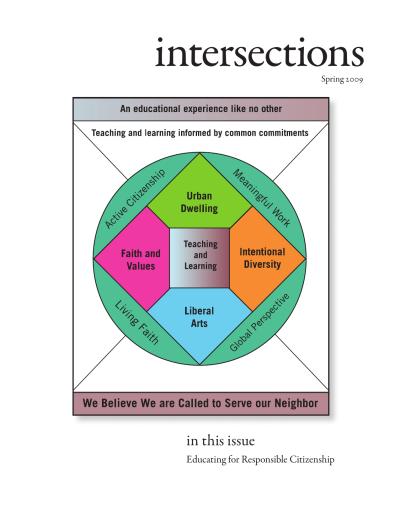 Article
From Alien to Citizen
Arne Selbyg
No. 29 · Spring 2009
Selbyg reflects on three experiences of being educated for citizenship—growing up in Norway under the legacy of Lutheran pastors and public school teachers who resisted the Nazi occupation, arriving in America as a resident alien, and becoming a naturalized American citizen—and proposes the jazz ensemble as a better metaphor for American society than the melting pot, one in which different citizens learn skills, study other instruments, and dialog with one another in service to the common music.
-
 Editorial
From the Publisher
Arne Selbyg
No. 27 · Spring 2008
Selbyg, retiring this summer as Director for ELCA Colleges and Universities, reflects on his decade serving as spokesperson between the church and its twenty-eight colleges and universities, and argues that the link between the colleges and the church has grown stronger over the last ten years — sustained by supportive church leaders like Presiding Bishop Mark Hanson, the annual Vocation of a Lutheran College conference, and a Lutheran theology of higher education whose principles (questioning authority, returning to the sources, including the excluded, serving the neighbor) remain a strong basis for operating colleges and universities in the twenty-first century.
-
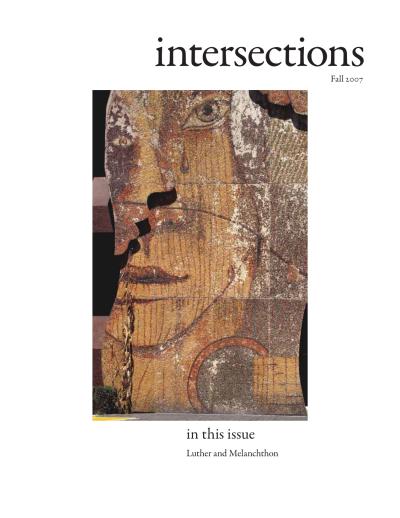 Editorial
From the Publisher
Arne Selbyg
No. 26 · Fall 2007
Selbyg notes that, while a stated purpose of Intersections over its twelve years and twenty-six issues has been the intersection of faith, learning, and teaching, surprisingly few articles have addressed how Lutheran faculty teach and why — and credits the editor for assembling essays from authors whose teaching has benefited from the ELCA Wittenberg Center, on the eve of the City of Wittenberg’s “Luther Decade” leading up to the 2017 Reformation anniversary.
-
 Editorial
From the Publisher
Arne Selbyg
No. 25 · Spring 2007
Selbyg notes that most papers in this issue grew out of a pan-Lutheran conference organized by the Association of Lutheran College Faculties in fall 2006 rather than the annual Vocation of a Lutheran College conference, and argues that the ELCA’s ecumenical posture—truthful but open to learning from others—is a good foundation for institutions of higher education whose faculty likewise profess while remaining subject to change based on new research and insights.
-
 Editorial
From the Publisher
Arne Selbyg
No. 24 · Fall 2006
Selbyg situates this issue in the ongoing ELCA conversation about education that began with the 2005 conference and is feeding into the second draft of the ELCA Social Statement on Education, previews the 2007 conference (“The Vocation of a Lutheran College — Engaging the World”) at Augustana College, Rock Island, and lifts up Luther’s insistence that the church and its members contribute to their wider communities rather than retreat into self-centered enclaves.
-
 Editorial
From the Publisher
Arne Selbyg
No. 23 · Summer 2006
Selbyg features articles based on presentations at the 2005 Vocation of a Lutheran College conference focused on the upcoming ELCA Social Statement on Education, and urges members of the ELCA higher-education community to download the first draft (“Our Calling in Education”) from the ELCA website and submit feedback to the Task Force on Education before the October 15 deadline. He worries that the sexuality social statement on a 2009 timeline will draw more attention than the education statement, but reminds readers that, for Martin Luther and for those who work in Lutheran higher education, education is as important as sex.
-
 Article
You Don't Seem Angry: Methodological Confessions Of A Lutheran Lay-Woman
L. DeAne Lagerquist
No. 5 · Summer 1998
Lagerquist, opening from a colleague’s 1981 observation about her M.A. thesis on four female abolitionists, traces her path from feminist historian and battered women’s shelter advocate through the University of Chicago’s obsession with method to a more self-conscious account of her own. The method grows out of four Lutheran themes—original sin (caution and humility), the eighth commandment against bearing false witness (generosity and forgiveness), the neighbor as “little Christ” (cooperative interpretation), and vocation (interpretation as calling, located alongside feeding the hungry and visiting the lonely)—and shapes her ongoing work on a history of Lutherans in the United States with a plot about learning to live with diversity.
-
 Article
Assessing Self-Assessment Instruments at Finlandia University
René Johnson
No. 55 · Spring 2022
Johnson surveys three self-assessment instruments presented at the NetVUE conference — PathwayU at Colorado State, the Intercultural Development Inventory at Friends University, and Mark Savickas’s Career Construction Counseling Manual at Union College — and describes Finlandia’s use of the CliftonStrengths© assessment to link students’ personhood to “behaviors that benefit the community.”
-
 Institutional Focus
Vocation for Life: A Report on a New Initiative for Alumni
No. 36 · Fall 2012
A report on “Vocation for Life,” a collaborative initiative of ELCA-related colleges and universities to make vocational exploration available to alumni across the country regardless of which school they attended. The first pilot retreat—“Explore Your Life’s Calling,” in Rochester, Minnesota in November 2011, facilitated by Tom Morgan of Augsburg, Chris Johnson of Gustavus, and Tom Scholtterback of Concordia using the Circles of Trust approach—is described.
-
Editorial
From the Publisher
Mark Wilhelm
No. 29 · Spring 2009
Wilhelm introduces essays from the 2008 Vocation of a Lutheran College Conference held at Luther College under the theme “Educating for Responsible Citizenship,” previewing contributions from Paul Pribbenow on dual citizenship at Augsburg, Wanda Deifelt on Luther College’s engagement with civic vocation, Jose Marichal on the promise and peril of digital citizenship, and Arne Selbyg on his three experiences of being educated for citizenship.
-
 Article
Negotiating Legitimate and Conflicting Values
Eboo Patel, Katie Bringman Baxter, Mark S. Hanson
No. 44 · Fall 2016
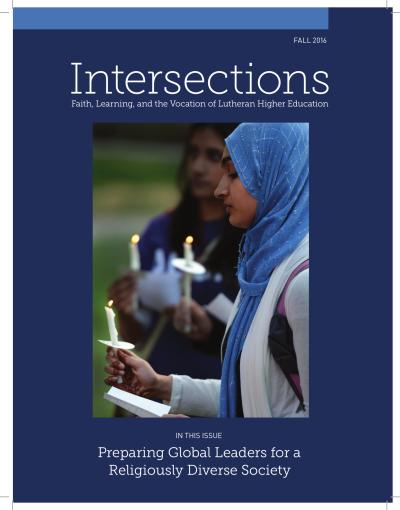
In a closing-day conversation at the 2016 Vocation of a Lutheran College Conference, Mark Hanson and Eboo Patel — moderated by Katie Bringman Baxter of Interfaith Youth Core — share case studies in which legitimate religious values come into tension with one another, and make the case that Lutheran colleges should teach interfaith leadership through the hard cases rather than the easy ones.
-
 Article
Honesty of Mind: On the Uses and Abuses of Socratic Ignorance in Environmental Studies, Religion, and the Classroom
Don Braxton
No. 15 · Winter 2002
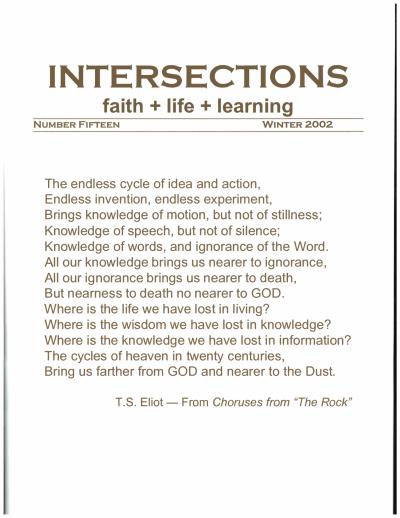
Braxton, taking his cue from David James Duncan’s defense of ignorance as a fly-fisher’s most crucial tool and from Socrates’ midwife’s art in the Theaetetus, defends a doctrine of “honesty of mind” resting on four premises—knowledge is constructed, judgments are wagered amid imperfect knowledge, expertise can disable learning, and we are encumbered by other ways of knowing. He field-tests the disposition against three domains: the climate-change and creationism debates in environmental studies, the post-September 11 turn toward religious pluralism (engaging Union Seminary’s Joseph Hough and Hauer and Young’s “three-world” approach to the Bible), and the liberal arts classroom where students “become democrats of the mind” through Reinhold Niebuhr’s balance of conviction and contrition.