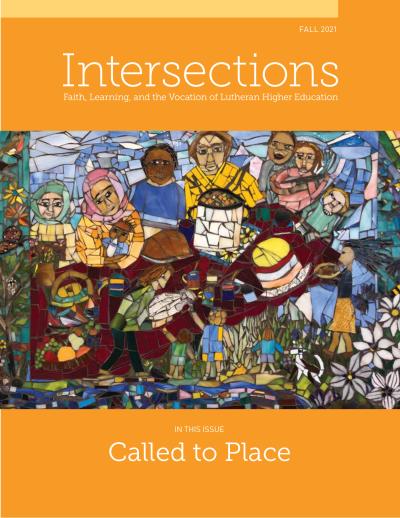
The theme of the 2021 Vocation of Lutheran Higher Education conference, hosted by Augsburg University, was “Called to Place: Community-Responsive Education.” Presentations and conversations over four days took stock of the importance of particular settings, including the physical and cultural geographies of campuses and the surrounding communities, for the deep learning of our students, and for us as educators. Participants considered how local landscapes and neighborhoods shape the missions, identities, and institutional callings of our schools, along with the individual vocations of those so emplaced, including our central callings to become anti-racisit as we work toward the belonging of all.
In my opening address, I emphasized the importance of the everyday, quite literal sense of “place” and “neighbor” and “neighborhood.” In a world that is digitally interconnected virtually everywhere, but where our students and sometimes we ourselves increasingly feel rootless, alienated, without a sense of home and real belonging—indeed, in a world where an increasing number of our students grieve the loss of home, either because they have migrated (by choice or by force) from other places, or have been displaced and marginalized through racial and economic powers—we need to think creatively about how actual physical geographies and the particular, embodied people inhabiting them are essential to understanding oneself and one’s meaning and purpose and place in the world.
We need to think creatively about how actual physical geographies and the particular, embodied people inhabiting them are essential to understanding oneself and one’s meaning and purpose and place in the world.
The foundational NECU document, Rooted and Open, describes the “common calling” of our network of 27 Lutheran colleges and universities. Despite this shared work, the document notes that each school also has its own particular intuitional calling, which responds to its particular location. It claims that “Lutheran higher education calls students beyond the rewards of upward mobility and financial security so that their lives will also be attentive to people who need them most and places that call out for healing” (6). More centrally, Rooted and Open makes the bold claim that our students are “called and empowered—to serve the neighbor—so that all may flourish.”
Of course, this attention to vocation or calling is not absolutely unique to Lutheran higher education. Beyond NECU you have NetVUE, the Network of Vocation in Undergraduate Education, a looser consortium of almost 300 schools that also identifies education-for-vocation as of central importance to independent, especially church-related, colleges and universities.
But what is distinctive, if not unique, is what Lutheran schools emphasize when they educate for vocation, how they do so in particular ways, and why particular geographical and cultural landscapes here matter. Let me try to explain.
In some more secular contexts, vocation is likened to the meanings, purposes, and passions of individuals. It’s said that, when one finds one’s true calling, a job will become work that one would do for free. Careers become callings when they tap into individual’s deepest commitments and draw forth their deepest passions.
This emphasis on the individual’s passions and feeling of purposefulness is frequently (and rightfully) tempered by colleges and universities that value their religious-affiliations—whether Lutheran, Jesuit, Presbyterian, Jewish, or something else. According to them, an individual’s sense of her capabilities and interests, her gifts and passions, take the form of callings when and only when they become responsive to the needs of others. In the words of Frederick Buechner, vocation is where your own deep gladness meets the world’s deep hunger. Without becoming responsive to what the world needs of you, you might have ample ambition and career opportunities, but you do not yet have a calling.
Lutheran higher education, at best, goes one step further. It is aware of all the ways that “the world’s hunger” or “the needs of the world” can also become abstract and vacuous—at best ciphers for, and at worst ideological justifications of, what turns out to be individual ambition after all. For example, if I’m gifted in developing flavors of e-cigarettes that appeal to minors, I am probably able to justify the “need” for that work insofar as it grows an industry, creates jobs, maybe even respects the decision-making capabilities of 13 year-old “consumers.”
We can see here how “the world’s need” can mean just about anything whenever people wants to justify their ambition by calling it a vocation. Even more abstract and vacuous than “need” are appeals to “the world.” Indeed, in a late-industrial capitalist economy driven by consumer spending, “the world” can become almost synonymous with “the Market” (another abstraction—and one often deified).
If we are to guard against such abstractions and self-justifications, we must understand “the world’s need” in particular ways. It is never simply the theoretical need of an abstract world. Rather, it must be what, for example, particular small business owners in a particular Cedar-Riverside neighborhood in Minneapolis need from Augsburg University as an anchor institution. Or (in my own context), what particular Spanish-speaking tutoring programs in the Floreciente neighborhood need from Augustana students and educators. Or what the Driftless landscape of Northeaster Iowa and the town of Decorah needs from Luther’s College’s initiatives in renewable energy.
‘What’ and ‘who’ questions also depend on questions of place: Where are you? Where do you come from?’
Many if not most students at NECU institutions are by now familiar with the idea of vocation or of being called to purposeful work in the world. They learn that the question, “What are you going to do?” is preceded by the question “Who are you?” or, “What is your story?” What I am trying to suggest here is that “what” and “who” questions also depend on questions of place: Where are you? Where do you come from? Which particular communities sustain you and how do you become grateful and responsive to them? Where—quite literally—are you heading? In other words, in order to discern both personal identity and the purposeful work to which one is called, students and those who teach them need a sense of the places and peoples that serve and are served by them. In the words of Wallace Stegner, “If you don’t know where you are, you don’t know who you are.”
There are at least 27 different ways that NECU institutions are at work engaging surrounding places and communities and otherwise educating our students for a sense of rootedness and belonging. This issue of Intersections showcases some powerful examples, which I commend to you and others in your place.
-
 Article
Where Your Feet are Standing: Institutional Engagement and Place
Melissa Maxwell-Doherty
Maxwell-Doherty draws on Cal Lutheran’s Hispanic-Serving Institution designation and its location on Chumash, Fernandino Tataviam, and Ohlone lands to ask how the university’s mission might shift if it depended on where its students are standing — not just where the institution sits.
-
Article
Community-Building On Campus and Beyond
Krista E. Hughes
Hughes describes Newberry College’s effort to build a “culture of community” that mirrors South Carolina’s demographics while reckoning with the institution’s founding ties to slavery — and names the challenges and promising city-college collaborations that shape this ongoing work.
-
Article
Just Communities: From Liberal Arts in Prison to Racial Healing over Zoom
Monica Smith
Smith showcases how Augustana College’s commitment to social justice extends into the Quad Cities through two initiatives: the Augustana Prison Education Program at East Moline Correctional Center, and Racial Healing conversations developed through the Truth, Racial Healing and Transformation framework.
-
Reflection
Caught in a Place Between Caesar and God
Darrel D. Colson
Colson reflects on his anguish, as Wartburg’s president, over an Iowa law that prevents him from requiring student COVID-19 vaccinations — reading Luther’s “Whether One May Flee From a Deadly Plague” alongside the conflict between obeying the law and serving neighbor.
-
Article
Hospitality to the Wild
Laura M. Hartman
Drawing on research with a Wild Ones Native Landscaping chapter and Marilyn Matevia’s ethic of “creature comfort,” Hartman argues that Christian hospitality must extend to non-human animals and plants — and asks whether college campuses can foster not just human diversity but biodiversity.
-
Article
Return to Purpose: Learning in an Age of Collapse
Ahmed Afzaal
Afzaal argues that the cascading crises facing higher education are not temporary glitches but symptoms of planetary and civilizational collapse — and that colleges must embrace “double-loop” learning and return to a shared sense of purpose if they are to help humanity descend gradually rather than catastrophically.
-
 Article
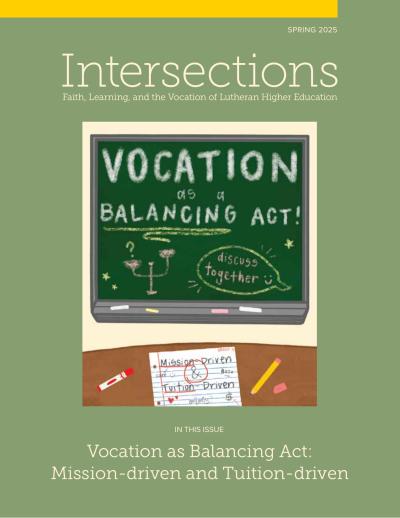
Vocation at Full Stretch: Reflections on Follow Your Bliss and Other Lies about Calling and its Use among College Students
Jason A. Mahn
No. 61 · Spring 2025
43 min audio
Mahn engages Bonnie Miller-McLemore’s Follow Your Bliss and Other Lies about Calling as required reading in a sophomore religion course, showing how her categories of missed, blocked, conflicted, fractured, unexpected, and relinquished callings empower young adults to perceive embodied, unplanned, and often painful dimensions of life as essential parts of vocation — and help close the gap between mission-driven and tuition-driven realities.
-
 Article
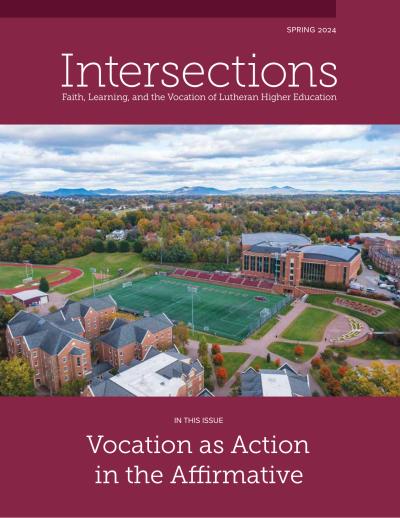
On Recruiting Diverse Students, Rooted in Mission
Eric Rowell, Jason A. Mahn
No. 59 · Spring 2024
Jason Mahn interviews Eric Rowell, Assistant Director of Admissions and Diversity Outreach at Augustana College, about how recruiting students from a wide variety of backgrounds — rooted in Augustana’s Lutheran commitment to vocation and educating across difference — remains essentially unchanged in the wake of the Supreme Court’s 2023 decisions on affirmative action.
-
 Editorial
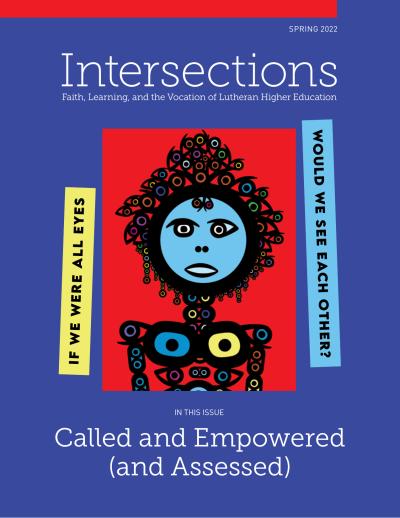
From the Outgoing Editor
Jason A. Mahn
No. 55 · Spring 2022
Mahn closes out a decade of editing Intersections, passes the duties to Colleen Windham-Hughes, gives thanks to Mark Wilhelm and Augustana College, and introduces an issue largely drawn from comments by Lutheran faculty, staff, and administrators at the 2022 NetVUE national gathering.
-
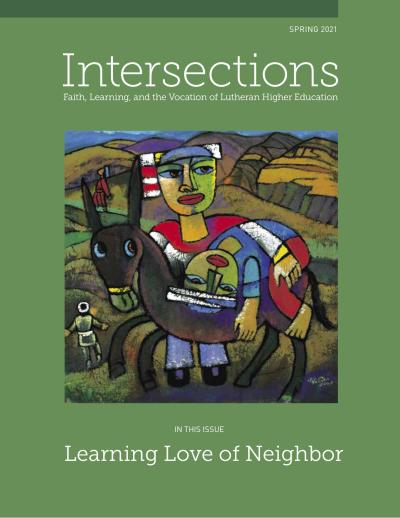 Reflection
Shelter in Place: Reflections from March 22, 2020
Jason A. Mahn
No. 53 · Spring 2021
On the fourth Sunday of Lent in 2020, Mahn meditates on the etymology of “shelter” (from shield) and on an email from a former student in Boston whose mutual-aid organizing models a Lutheran understanding of vocation: the upending of ego by divine love that frees us, finally, to see and serve the neighbor.
-
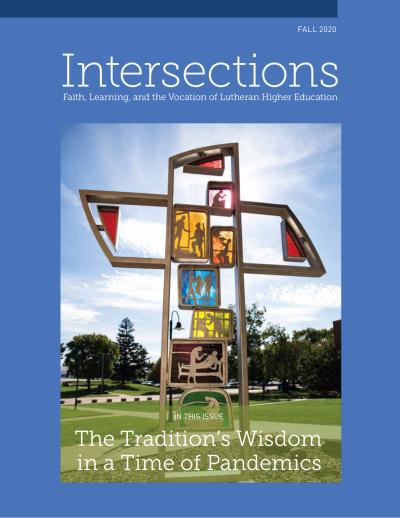 Editorial
From the Editor
Jason A. Mahn
No. 52 · Fall 2020
Mahn narrates a year of crisscrossing pandemics — Covid-19, economic collapse, partisan politics, and the long pandemic of white supremacy revealed anew by the murder of George Floyd — and argues that Lutheran liberal arts schools, by educating for vocation, are uniquely poised to help students respond with character and capable callings.
-
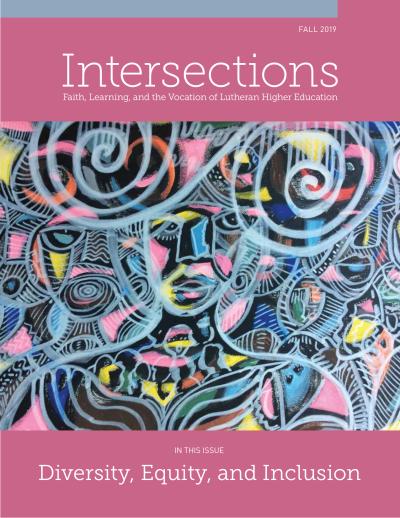 Editorial
From the Editor
Jason A. Mahn
No. 50 · Fall 2019
Mahn opens with Lenny Duncan’s observation that the ELCA is 96 percent white — the whitest denomination in the U.S. — and asks how teachers and administrators at historically, predominantly, and persistently white institutions can turn from white privilege and white supremacy toward spaces where people of color thrive and white people are re-formed into antiracist allies.
-
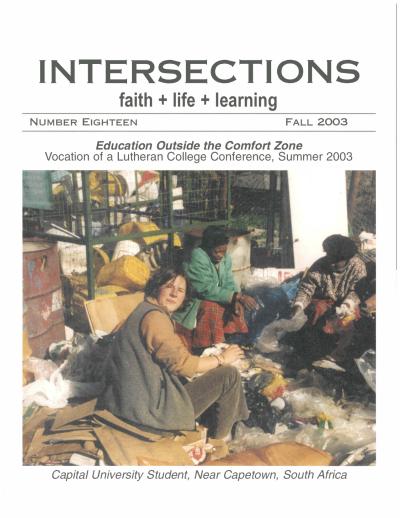 Article
The Search for a Just Peace in a Globalized World
Munib A. Younan
No. 18 · Fall 2003
Younan, Lutheran Bishop in Jerusalem, grounds Palestinian Christian identity in Incarnation theology and a Lutheran theology of grace and the cross, then surveys the Evangelical movement’s nineteenth-century legacy in the Middle East—the 1864 Arabic Bible, ELCJ schools, women’s ordination, and the Middle East Council of Churches. Engaging Edward Said’s critique of Samuel Huntington, he calls for international and local mutual-recognition agreements (including the Jerusalem Lutheran-Anglican agreement and a Lutheran-Reformed agreement in the Middle East), four marks of interfaith dialogue, and a sharp distinction between Lutheran “Evangelical” identity and the Dispensationalist evangelistic Right whose Israel-Palestine scenarios he names a heresy. He closes by proposing concrete scholarship, faculty exchange, and sabbatical partnerships between U.S. Lutheran colleges and the ELCJ’s churches, schools, and Dar al-Kalima Lutheran Academy.
-
 Article
Cultivating Staff Flourishing in Lutheran Higher Education: A Framework for Advocacy and Engagement
Laree Winer
No. 58 · Fall 2023
Winer narrates her own “love affair” with Lutheran Higher Education to argue that the heart of the tradition — vocation, de-emphasized hierarchy, and shared humanity — equips NECU institutions to advocate for staff flourishing through data collection, professional development, and ongoing relational commitment.
-
 Book Review
Learning Across Campus: Hearing Bok's Call to Conversation
David Ratke
No. 39 · Spring 2014
Ratke reads Derek Bok’s Our Underachieving Colleges from Lenoir-Rhyne and argues that Bok’s call to think holistically about undergraduate education and to dialogue across disciplinary boundaries names the work already underway at ELCA colleges. He weighs faculty attitudes, the role of skills in the core curriculum and the major, and the importance of the extracurriculum for student formation.
-
Book Review
The Prophetic Vocation and the Nature(s) of College: Reimagining College with Jim Farrell
Peder Jothen
No. 39 · Spring 2014
Jothen reads the late Jim Farrell’s The Nature of College as a prophetic critique of the dual nature(s) of college—its socio-cultural “normal” and its ecological habitat—and argues that Farrell’s call to model an “Anthropocene Responsibility” resonates with the prophetic dimension of Lutheran higher education. He proposes a re-imagined “About St. Olaf” that names vocation, ecological dependence, and personal involvement as the operative goods of college.
-
 Response
Hitting a Moving Target
Harry Jebsen
No. 3 · Summer 1997
Jebsen, former Provost of Capital University, responds to Reichenbach by arguing that the institutions, the ELCA, congregations and pastors, students, and curriculum are all moving targets. Drawing on Alvin Toffler’s Future Shock and his own fifteen years of hiring as Dean and Provost (a candidate who hoped the cross out front didn’t mean anything), he traces the drift from the “Mr. Chips” faculty who personified Dana and Midland Lutheran to a campus culture where “everybody is nice to each other” has replaced theological substance, and where MBA programs, conservatories, law schools, and adult-education programs further dilute the focus of the residential Lutheran college.
-
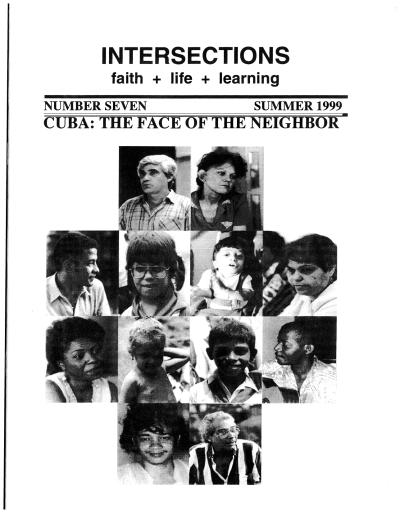 Article
The Face of the Neighbor: An Interview with Four Capital University Faculty About Their Recent Visit to Cuba
Brian Forry Wallace, Michael Yosha, Reg Dyck, Susan Narita
No. 7 · Summer 1999
Four Capital University faculty—political scientist Brian Wallace (returning to Cuba a third time after the 1994 boat lift), English professor Reg Dyck, ESL teacher Susan Narita, and political scientist Michael Yosha—recount their summer 1998 trip with Pastors for Peace, describing Cuban priorities of education, health care, and military (in that order), the cultural richness of Havana from sixteenth-century cloisters to Miramar, the Cuban Foreign Service’s vision of a Scandinavian-style democratic socialism, the counter-productive U.S. embargo (including its effect on kidney dialysis machines), Castro’s 1991 reconciliation with religious communities, and a recurrent image of a little girl named Marguerite singing at a school for amputee and terminally ill children. The interview was conducted by Capital senior Jessica Brown and Tom Christenson.