Jason Mahn interviewed Eric Rowell earlier this spring to discuss the recruitment of diverse students at Augustana College (Rock Island, IL), the college’s response to the Supreme Court decisions on affirmative action this past summer, and how this important work is rooted in Augustana’s commitment to its Lutheran identity and to educating for vocation.
Jason: How long have you been working at Augustana?
Eric: I have been at Augustana College now almost 22 years.
Jason: And you were a student here before that, correct?
Eric: Yes—class of 1993.
Jason: And so, you’re a black man going to Augustana at a time when Augustana was far less diverse (ethnically, racially, and otherwise) than we are today. What was your experience in the late 80s and early 90s like?
Eric: One of the most relevant things is how I was recruited to Augustana College. I’m from Chicago. I grew up on the south side in a predominantly African American community. There was an Augustana representative that came to visit my high school during a college fair. I wanted to play basketball, so he told our head coach about me, and the coach came to Chicago to see me play. But I was also senior class president and captain of the basketball team, and those leadership positions mattered to Augustana.
Augie, at that time, was about 95 percent white. But it was also very interested in bringing kids from a variety of different backgrounds to Augustana. And now we’ve expanded that by searching beyond the region of the Midwest to the rest of the nation and the world.
Jason: Why is recruiting a diverse set of students so important to schools such as Augustana?
Eric: One of the reasons that we do so is because there’s a lot of competition in the Chicagoland area (our traditional “market”) and so now we recruit students from all over the country. But beyond the fact that we need a certain number of students, we also need a certain blend of student backgrounds and experiences. Having a diverse classroom is really important. Not only do the students get to learn the subject matter, they also get to learn from each other. What’s so wonderful is the opportunity to learn beside and from students who come from a variety of different backgrounds so that you, as a person, can feel comfortable with those individuals now and in the future. That comfort and ability to work across lines of difference leads to greater opportunities, both personally and professionally. That comfort, in turn, allows students to contribute more to society as well because they have formed new skill sets.
Jason: As I remember it, one way that advocates of affirmative action during last summer’s (2023) Supreme Court cases argued their point was to say that colleges and universities depend on a diverse student body in order to deliver the kind of deep, holistic education they promise. Is that true in Augustana’s case?
Eric: Absolutely.
Jason: What was the conversation like around the Admissions Office at Augustana when these Supreme Court cases restricting affirmation action were coming down the pipeline?
Eric: I think we realized that not much was going to change with us here at Augustana. We really focus on the academic attributes of the students that we admit to Augustana. We just believe that academically talented and promising students come from all parts of the nation and world—from rural Illinois to inner city Chicago, from Pakistan and California—and so we need to go far and wide to find them. So we didn’t and don’t have to change anything in terms of any sort of “race-conscious” admittance. We focus on offering admissions to all promising and deserving applicants. We are certainly not going to bring in fewer students or a more monolithic student body because of those court decisions. We continue to go out to a variety of communities—as Augustana did when I was recruited 35 years ago.
Jason: Is affirmative action a word that you use in admissions?
Eric: Not very often. And not when I was a student here. I think what’s important is, again, just being an institution that really works hard to create a classroom where kids get to learn from one another. This means you have to go out and find kids from a variety of backgrounds. We are now competing on a national level for our students, but our practices are still the same in terms of finding kids that are eager to have a great education and will value what they experience at Augustana.
Jason: Does having more students of color help us increase our diversity even more?
Eric: Absolutely. Oftentimes students of color want to go someplace where there’s representation of themselves. But again, we live in an era where the world is smaller. All students and people are much more comfortable with people that are different through their experiences with social media, arts and entertainment, and athletics. So there is a snowball effect when it comes to recruiting and admitting diverse students, when you already possess a variety of different cultures. Having diversity definitely makes enhancing diversity easier, but you still have to reach out.
Jason: Is there a link between the Lutheran values of Augustana and the fact that we’re a Lutheran liberal arts school, on the one hand, and the goals that you’ve articulated in terms of recruiting a diverse student body, on the other hand?
Eric: Definitely there’s a connection. As a Lutheran College, we talk about vocation. We talk about being able to find meaningful work and your purpose in life. We talk about being proud of the reflection you want to have staring back at you in the mirror. We help our students find something that allows them to feel whole, and to be able to contribute to the good of society. I saw this Lutheran emphasis on vocation already in the early 90s, when I was a student. I also saw it when I worked in the Advancement Office and got to meet alumni who graduated 50 years before I did. So much has changed, but that Lutheran ethos—this calling to do good work in the world—has remained the spirit of this place for the whole history of our school. We don’t have nearly as many Lutherans now, and that also has something to do with becoming much more ethnically and racially and religiously diverse. But the conditions that were set forth in 1860 still remain at Augustana. This is a place that I’m extremely proud of. I enjoy working here and trying to find those kids I believe will be great fits, and then help shape their minds, bodies, and spirits so that they can go out there and make the world a better place.
Jason: Thank you, Eric.
Eric: My pleasure.
-
 Editorial
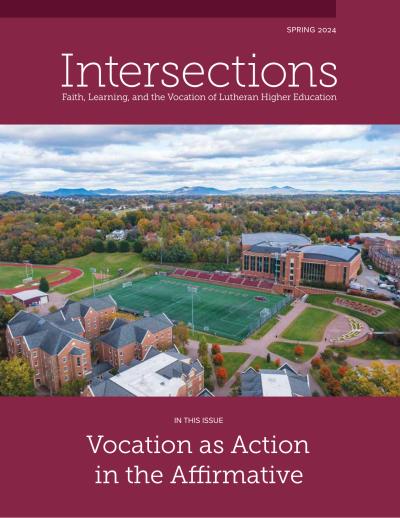
From the Editor: Vocation as Action in the Affirmative
Colleen Windham-Hughes
Windham-Hughes frames vocation as practicing “at the borders of our incompetence” — every small yes to the callings we experience, every effort made in the direction of life, is action in the affirmative — and previews the issue’s essays on diversity, transformation, AI, championship team culture, and dreaming big within and beyond our limitations.
-
Editorial
From the Publisher: Navigating Affirmative Action, DEI Policies, and Lutheran Vocational Identity
Lamont Anthony Wells
Wells surveys the converging pressures on NECU institutions — the unsettled landscape of affirmative action, political and academic scrutiny of DEI work, and the preservation of distinctively Lutheran vocational identity — and previews how the issue draws on affirmative practices, sociological viewpoints, and theological responses to navigate a path forward.
-
Article
Forming the Division for Access, Equity & Belonging at Susquehanna University
Amy Davis, Dena Salerno, María L. O. Muñoz, Nina Mandel, Scott Kershner
Five Susquehanna University colleagues trace the institution’s 166-year arc from a Missionary Institute founded to remove barriers to education through the formation of a new Division for Access, Equity & Belonging in 2023, arguing that access rooted in Lutheran origins must continue to drive policy revision, infrastructure, and belonging for minoritized communities today.
-
Article
What Our Lutheran Heritage Entails for Lutheran Colleges and Affirmative Action
Mark Ellingsen
Ellingsen argues that the Lutheran Two-Kingdom Ethic — far from leading to political reaction — supports the church-relatedness of ELCA colleges and obligates them to keep affirmative action alive, even reading a Chief Justice Roberts “loophole” in Students for Fair Admissions v. Harvard as an open door for Black community partnerships, ELCA congregations, and Lutheran colleges to act in the affirmative.
-
Reflection
On the Power of Transformation and Becoming Human
Ken Yanai Flores
Flores, a Cal Lutheran sophomore, reflects on personal and institutional transformation as the slow work of shedding the armor of trauma responses, engaging discomfort rather than turning away, and trusting that the work of becoming more human — more empathetic, knowledgeable, and free — will be reflected in our institutions as well.
-
Article
The Critical Role of Lutheran Higher Education in the Age of Artificial Intelligence
Jose Marichal, Maya Goehner, Tyler Haug
A Cal Lutheran political science professor and two of his students draw on Rooted and Open to argue that Lutheran higher education is uniquely positioned to stake out a middle path between AI utopianism and AI doom — cultivating a “healthy sense of human limit,” resisting data colonialism, and forming students to see the neighbor rather than the enemy as the world becomes increasingly synthetic.
-
Article
Team Culture is Key to Success: Learning from Student-Athletes
Colleen Windham-Hughes
On a December weekend in “Championship City” Salem, Virginia, both California Lutheran’s Women’s Soccer Team and St. Olaf College’s Men’s Soccer Team won NCAA Division III national titles. Windham-Hughes talks with coaches, faculty mentors, and student-athletes about how off-the-field team culture — built on trust, relationships, and shared why — translates onto the pitch and into liberal arts and sciences education.
-
Article
Low-Hanging Fruit, Moonshots, and Coffee: Dreaming Big Within and Beyond Our Limitations
Jeremy Myers
Myers shares the process used by Augsburg’s Christensen Center for Vocation to help teams move from a shared experience to next steps — an Ignatian-rooted Awareness Examen followed by naming low-hanging fruit, moonshots, and the coffee conversations that build the coalition to make it all happen.
-
 Article
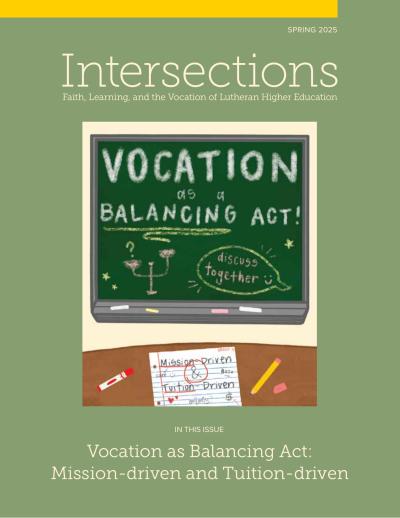
Vocation at Full Stretch: Reflections on Follow Your Bliss and Other Lies about Calling and its Use among College Students
Jason A. Mahn
No. 61 · Spring 2025
43 min audio
Mahn engages Bonnie Miller-McLemore’s Follow Your Bliss and Other Lies about Calling as required reading in a sophomore religion course, showing how her categories of missed, blocked, conflicted, fractured, unexpected, and relinquished callings empower young adults to perceive embodied, unplanned, and often painful dimensions of life as essential parts of vocation — and help close the gap between mission-driven and tuition-driven realities.
-
 Editorial
From the Outgoing Editor
Jason A. Mahn
No. 55 · Spring 2022
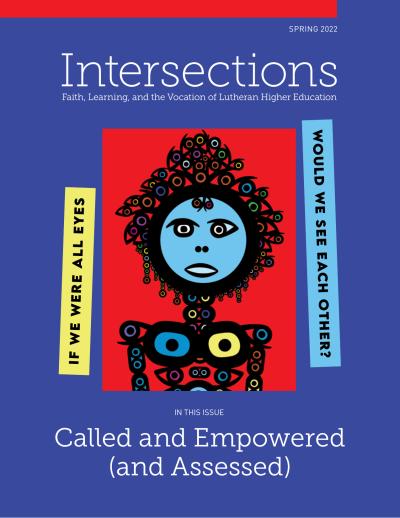
Mahn closes out a decade of editing Intersections, passes the duties to Colleen Windham-Hughes, gives thanks to Mark Wilhelm and Augustana College, and introduces an issue largely drawn from comments by Lutheran faculty, staff, and administrators at the 2022 NetVUE national gathering.
-
 Editorial
From the Editor
Jason A. Mahn
No. 54 · Fall 2021
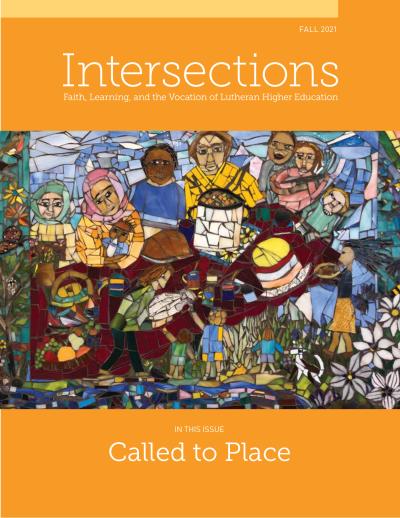
Mahn introduces the “Called to Place” theme of the 2021 VLHE Conference, arguing that Lutheran higher education’s emphasis on vocation must be grounded in particular geographies and embodied communities — for, as Wallace Stegner put it, “If you don’t know where you are, you don’t know who you are.”
-
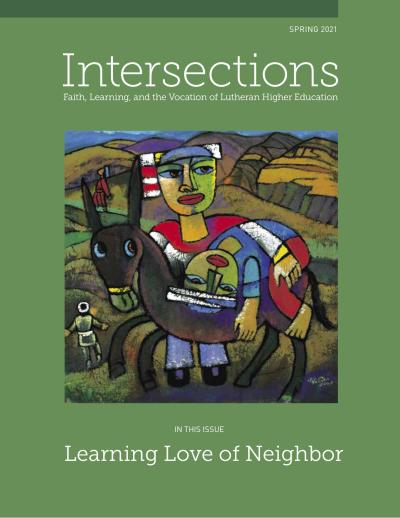 Reflection
Shelter in Place: Reflections from March 22, 2020
Jason A. Mahn
No. 53 · Spring 2021
On the fourth Sunday of Lent in 2020, Mahn meditates on the etymology of “shelter” (from shield) and on an email from a former student in Boston whose mutual-aid organizing models a Lutheran understanding of vocation: the upending of ego by divine love that frees us, finally, to see and serve the neighbor.
-
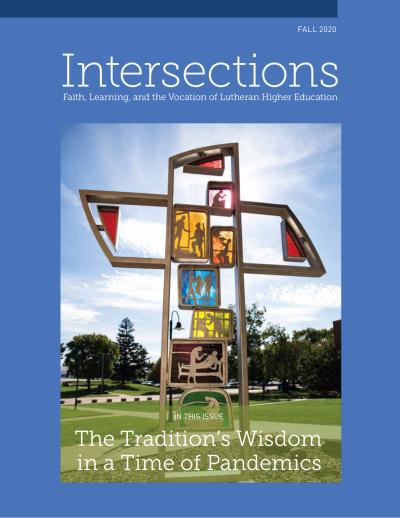 Editorial
From the Editor
Jason A. Mahn
No. 52 · Fall 2020
Mahn narrates a year of crisscrossing pandemics — Covid-19, economic collapse, partisan politics, and the long pandemic of white supremacy revealed anew by the murder of George Floyd — and argues that Lutheran liberal arts schools, by educating for vocation, are uniquely poised to help students respond with character and capable callings.
-
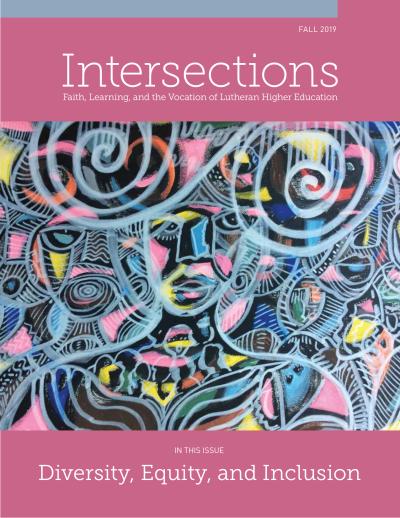 Editorial
From the Editor
Jason A. Mahn
No. 50 · Fall 2019
Mahn opens with Lenny Duncan’s observation that the ELCA is 96 percent white — the whitest denomination in the U.S. — and asks how teachers and administrators at historically, predominantly, and persistently white institutions can turn from white privilege and white supremacy toward spaces where people of color thrive and white people are re-formed into antiracist allies.
-
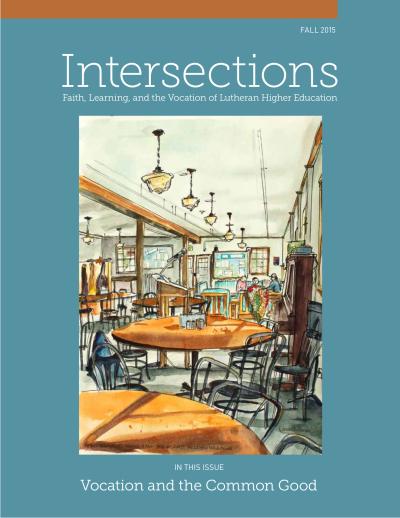 Article
Say Something Theological: A Meditation on the Vocation of Lutheran Colleges and Universities to Serve the Common Good
Paul C. Pribbenow
No. 42 · Fall 2015
Pribbenow expands Luther’s “priesthood of all believers” into a meditation on doing theology with the Bible in one hand and the New York Times in the other — reading Luke 14 alongside walls, immigration, and hunger in his Minneapolis neighborhood — and argues that the leadership of Lutheran colleges demands a willingness to engage the theological issues at the heart of their public vocation.
-
 Article
Why Martin Luther and the Reformation Matter 500 Years Later
Kathryn A. Kleinhans
No. 46 · Fall 2017
Adapted from a 2017 address to Wartburg College’s entering class, Kleinhans surveys Luther’s lasting impact in vocation, education, social service, and the necessary work of repentance — closing with the Lutheran World Federation’s Windhoek assembly and the Reformation World Exhibition’s call to live reform forward into the next 500 years.
-
 Editorial
From the Editor: Why All This Talk About Vocation?
Colleen Windham-Hughes
No. 56 · Fall 2022
Windham-Hughes introduces the Fall 2022 issue built around Mark Wilhelm’s keynote “Why all this talk about vocation?” and previews five panel responses, two first-time conference reflections, and companion pieces on Womanist theology — framing vocation as a call not to privilege but to constructive and corrective work that undoes unjust systems.
-
 Article
Liberal Arts and Professional Education: A Call for Philosopher-Servants
Steven C. Bahls
No. 24 · Fall 2006
Bahls, President of Augustana College (Rock Island), calls for a renewed commitment at Lutheran colleges to form “philosopher-servants” — graduates whose grounding in the liberal arts and the liberating gospel equips them for thoughtful service in business, education, nursing, and the other professions. Their impact, he argues, is “a good thing and a fact that we can be proud of as those who labor in Lutheran higher education.”
-
 Article
A Fifth Teat on a Cow: The Irrelevance of the Lutheran Doctrine of the Two Kingdoms for Academic Life
Richard VonDohlen
No. 9 · Summer 2000
VonDohlen, responding to Richard Hughes, Carol LaHurd, David Ratke, Philip Nordquist, and Robert Benne, argues that the Lutheran doctrine of the two kingdoms as commonly deployed in recent discussions of Lutheran higher education rests on a faulty sociology (taking Luther’s sixteenth-century structure for our highly differentiated society) and an epistemological monism (assuming a single neutral reason against the pluralism described by Alasdair MacIntyre and others), making it anti-intellectual, hostile to interdisciplinary dialogue and Christian social ethics, and ultimately as a defense of theology’s relevance about as useful as “a fifth teat on a cow.” Drawing on his experience on the Catawba Valley Hospice Ethics Committee, his Dutch Reformed and dispensationalist background, and the ELCA social statement “Sufficient, Sustainable Livelihood for All,” he calls for an “intellectually ecumenical” dialogue between Lutherans and non-Lutherans willing to take each other’s paradigms seriously.
-
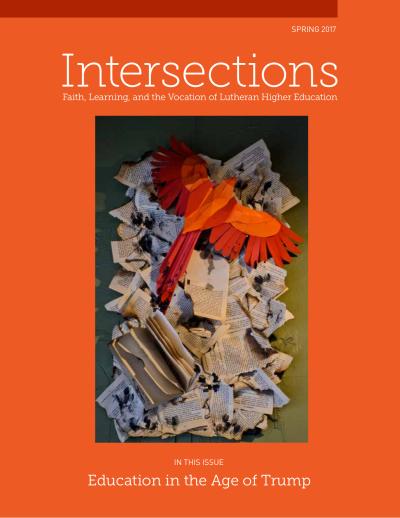 Article
Higher Education in the Age of Trump
Daniel B. Braaten
No. 45 · Spring 2017
Braaten surveys what the Trump administration has and has not done on higher education — from the selection of Betsy DeVos and a rumored Falwell-led task force to the travel ban and expanded deportation priorities — and argues that Lutheran colleges, guided by the ELCA’s social message on immigration, have a special obligation to consider what they will do to protect their most vulnerable students.