In December, 2010 representatives from several ELCA-related colleges and universities gathered on the campus of Gustavus Adolphus College in Saint Peter, Minnesota to talk about strategies for engaging alumni and friends in the work being supported by the Lilly Endowment, Inc., through its Programs for the Theological Exploration of Vocation (PTEV). In the midst of an old-fashioned Minnesota snowstorm, these leaders came up with the idea of “Vocation for Life”—a set of opportunities and resources that all the ELCA schools could make available to alumni to help them address vocational questions that arise after college and across the lifespan.
The primary objective of the project is to offer our graduates the gift of ongoing vocational exploration, through workshops available to alumni in locations throughout the country, regardless of which of our schools they attended. A second objective is to foster collaborative work among ELCA colleges and universities, as we seek to explore and lift up vocation as the unique hallmark of Lutheran Higher Education. In working together with our graduates, we hope to reach a clearer understanding of the distinctive gifts we bring to the world and the ways these gifts influence our common calling as Lutheran colleges and universities. Finally, connecting with alumni in this way not only helps them in their vocational journeys, but also helps us all to see that vocational exploration and discernment is a life-long activity.
Project leaders decided to develop several “pilot” events, each of which would be planned by local teams consisting of alumni and representatives from a minimum of three of the colleges involved in the project. The first Vocation for Life retreat, called “Explore Your Life’s Calling,” took place in Rochester, Minnesota in early November, 2011. The retreat was facilitated by Tom Morgan of Augsburg College, Chris Johnson of Gustavus Adolphus College, and Tom Scholtterback of Concordia College, Moorhead, utilizing the Circles of Trust approach developed by educator and author Parker J. Palmer and the Center for Courage and Renewal. It was an opportunity for participants to step with intention into a place apart, to pause from the frenetic pace of their regular days, and to explore in fresh ways the big questions of their lives—questions of identity, meaning, purpose, and calling.
The day was designed to nourish deep connection between “soul and role” and to renew participants’ capacity to live, work, and lead from a place of wholeness and authenticity. Participants experienced the rare gifts of renewal, deep listening, and safe, courageous space to consider things that matter. They expressed appreciation for:
- “the time, space and permission to attend to questions that matter, to be held in a circle of people who were present enough to care for the depths, pains, and joys of my soul”
- “the experience of community as we learned from one another”
- “the sense that my value lies not in doing but in being the person God and my community call me to be”
- “a wonderful experience that has strengthened me for the journey ahead”
A second Vocation for Life workshop was presented to the Pacific Lutheran University alumni board by Lynn Hunnicutt and Samuel Torvend. This half-day retreat used Mary Catherine Bateson’s essay “Composing a Life Story” as the thread tying activities together. Participants received an introduction to the concept of vocation—both Luther’s understanding of the term (what vocation is) and current popular senses of the word (what vocation is not). They then participated in two exercises designed to help them think about the various callings they have discerned throughout their lives, and to use these insights to pay attention to their current vocation.
Recently, several members of the Vocation for Life planning team met at the Vocation of a Lutheran College Conference in Minneapolis. We have five events at various stages of planning, with a second day-long event on November 8 in Rochester, MN, and a longer retreat November 18-20 in Carefree, AZ. Other workshops in Eau Claire, WI; Fargo-Moorhead; Rockford, IL; and Portland, OR are being planned but have not yet been scheduled. For more information on Vocation for Life or any of these events, please feel free to contact Tom Schlotterback at Concordia College, or the any of the three authors of this report.
-
 Editorial
From the Publisher
Mark Wilhelm
Wilhelm argues that the rhetoric framing ELCA higher education as a binary between “secular” and “religious” is “hokum”: there is a third way of doing higher education from a Christian perspective that is religious in motivation and practice but on the ground looks secular. After more than half a century of debates, he calls on ELCA presidents to “do something” in 2013 to move forward in shared mission and vocation.
-
Editorial
From the Editor
Jason A. Mahn
Mahn introduces the issue through Norman Wirzba’s The Paradise of God and the Genesis 2 vocation given to Adam to care for adamah—arguing that “vocation” is the Lutheran name for an incarnational, creation-centric theology of kenosis and that Lutherans bring distinctive theological gifts to environmental work even if no absolutely unique perspective on caring for creation.
-
Article
A Traveler's Manifesto for Navigating the Creation
Ann Pederson
Pederson asks who we are, where we are, and how then we shall live within the Epic of Evolution and the doctrines of creation, incarnation, and imago dei. Drawing on John 3:16 (“For God so loved the cosmos…”), Luther on God’s presence “in the veins of a leaf,” Augustine’s City of God, Phil Hefner’s “created co-creator,” Joseph Sittler’s “Called to Unity,” and Norman Maclean’s Young Men and Fire, she argues for a cosmic reading of incarnation in which all of creation—not only the human—bears the image of God.
-
Institutional Focus
Facing Tornados and Climate Change: An Interview with Jim Dontje about Environmental Innovation at Gustavus
Jim Dontje
Dontje, director of the Johnson Center for Environmental Innovation at Gustavus Adolphus College, describes the Center’s work with solar thermal and photovoltaic systems, LEED certification of Beck Hall, recycling and conservation initiatives, the Linnaeus Arboretum, and the difficult work of building consensus around climate response—reflecting on how Gustavus’s 1998 tornado recovery shaped a community capable of collective action, and on how the “Lutheran identity” both restrains and energizes the college’s environmental ethos.
-
Article
A Lutheran Ethic of Environmental Stewardship
Jim Martin-Schramm
Martin-Schramm sketches a Lutheran ethic of environmental stewardship organized around four moral norms inherited from World Council of Churches discussions and developed by Presbyterian and ELCA social statements: sustainability, sufficiency, participation, and solidarity. He grounds each norm in scripture and the Lutheran tradition—the theocentric doctrine of creation against rampant anthropocentrism, the incarnation against destructive dualisms, Christ in community against modern individualism, and accountability to God for future generations—arguing that this “ethic of ecological justice” offers a common moral vocabulary for engaging environmental policy debates that would otherwise collapse into cost-benefit analysis.
-
Institutional Focus
Putting Principles into Practice: An Interview with Kenneth Foster about Concordia's Sustainability Council
Kenneth Foster
Foster, chair of Concordia College’s President’s Sustainability Council, describes the Council’s formation under President William Craft in 2011 as a re-energization of stalled task-force work, its coordination with grass-roots campus initiatives, and its strategy of moving from principles to practice in stewardship of natural resources at a Lutheran liberal arts college.
-
Article
Climate Justice, Environmental Racism, and a Lutheran Moral Vision
Cynthia Moe-Lobeda
Moe-Lobeda argues that the vocation of a Lutheran college is to prepare students for Thomas Berry’s “great work”: forging a sustainable relationship between the human species and the planet while diminishing the gap between those who have too much and those who have not enough. She develops a three-fold “moral vision” rooted in Luther’s theology of the cross—seeing what is (climate injustice and environmental racism for what they are), seeing more just and sustainable alternatives, and seeing God’s saving presence at work—and offers it as a distinctive Lutheran contribution to the panhuman and interfaith challenge of our day.
-
Institutional Focus
Farming and Eating Locally: An Interview with Garry Griffith about Augustana's Farm2Fork Program
Garry Griffith
Griffith, Director of Dining at Augustana College (Rock Island), describes the Farm2Fork program’s shift from pre-packaged food to fresh produce sourced from local farms (beginning with Jim Johansen of Wesley Acres in Moline), the Augie Acres campus garden tended by students in learning-community courses, the bio-diesel conversion of used fryer oil for greenhouse heat and farm equipment, and the stewardship calling that grounds these efforts in Augustana’s Lutheran identity.
-
Article
Sustaining Sustainability
Baird Tipson
Tipson—former Provost of Gettysburg College, President of Wittenberg University, and President of Washington College—reads Romans 12:2 (“be not conformed to this world…”) against Victor Ferrall’s Liberal Arts at the Brink and the contemporary financial reality of small Lutheran colleges. He tells three case-study stories from Washington College’s Center for the Environment and Society—the Chino Farms partnership, the Chesapeake Semester, and the acquisition of the work boat Callinectes—to show how presidents must engage “the world” to secure resources for sustainability work without being conformed to it.
-
Institutional Focus
Health Food in the Inner City: An Interview with Brian Noy about Augsburg's Campus Kitchen
Brian Noy
Noy, Director of Campus Kitchen at Augsburg College in Minneapolis, describes the Kitchen’s four-fold program—Food to Share (2,000 meals per month from surplus dining-services food and Campus Cooking Classes), Food to Grow (an 80-plot community garden), Food to Buy (two farmers markets that accept EBT/food stamps), and Food to Know (educational programming)—and the deep history of Augsburg’s service to the immigrant communities of the Cedar Riverside neighborhood, now Somali and Mexican as well as historically Norwegian.
-
 Editorial
From the Editor
Robert D. Haak
No. 27 · Spring 2008
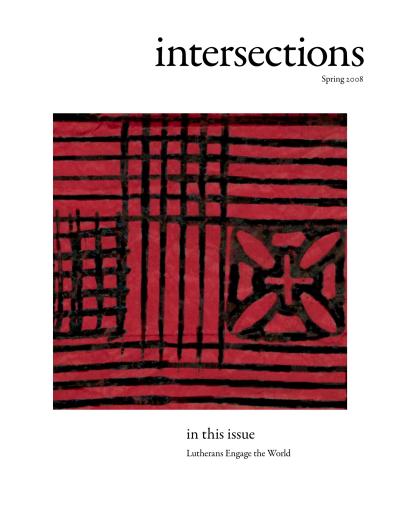
Haak frames the issue around the question of why Lutherans engage the world rather than retreat from it, locating the answer in the doctrines of creation and incarnation, and introduces essays by Erwin on globalism, Carlsen on local community engagement, Marty on multiple callings, and Mattes on the Grundtvigian heritage at Grand View. He also bids farewell to publisher Arne Selbyg, noting the fittingness of the Adinkra (“farewell”) cloth on the cover of this final issue under Selbyg’s leadership.
-
 Editorial
From the Publisher
Arne Selbyg
No. 11 · Spring 2001
Selbyg admits that promoting Lutheran colleges and universities can feel Sisyphean—clueless faculty or staff, fundraising treadmills, students and parents treated poorly by admissions, pastors with no sense of the colleges’ mission—but reports that alumni satisfaction surveys, ELCA-college faculty seminars, an engaging bishop, Ernie Simmons’s Lutheran Higher Education: An Introduction, and renewed reader interest in Intersections all show the stone is not at the bottom of the hill.
-
 Editorial
From the Incoming Editor
Colleen Windham-Hughes
No. 55 · Spring 2022
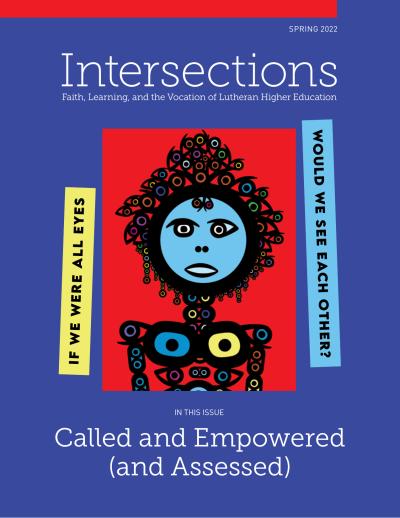
Windham-Hughes introduces herself as incoming editor by reclaiming the root of assess — “to sit by” — and committing to the question “What does this mean?” as she sits with readers in the worth of our work and the universality of vocation.
-
 Article
Called for Life
Brian Pittman, Ellen Shelton, Greg Owen
No. 31 · Winter 2010
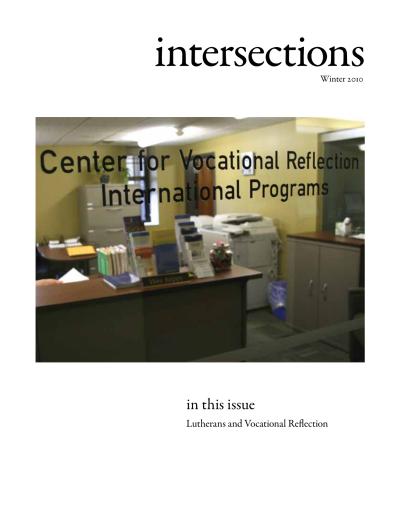
Owen, Shelton, and Pittman of Wilder Research present the key findings of the Called for Life study, comparing the class of 2007 “Lilly graduates” from Luther, Augsburg, and Augustana to a pre-Lilly cohort from the class of 2001. They report that Lilly graduates were more than twice as likely to associate vocation with “calling” rather than “just a job,” and they identify four common ingredients of effective programming: relationships with caring adults, experiential learning outside the classroom, vocation-infused courses, and peer relationships within a pervasive campus culture of vocational exploration.
-
 Article
The Marks of an ELCA College: One Bishop's Reflections
Stanley Olson
No. 15 · Winter 2002
Olson, speaking as a bishop and “Harness Boy” whose job is to keep the church’s connections working, replaces his original four-noun outline (fealty, ingenuity, insouciance, focus) with eight marks the ELCA should be able to observe in its colleges: intentional Lutheran identity, significant Lutheran presence, Christian faith at every table, freedom of inquiry, coaching toward vocation, gravity and grace, nurtured community, and excellence by its own standards. Drawing on his survey of all twenty-eight ELCA college mission statements (two tables) and on Darrell Jodock and Mark Edwards, he argues that the Lutheran connection must be made explicit in mission, marketing, and faculty searches, and closes with six reciprocal expectations the colleges should hold of the ELCA—commissioner, mature parent, supporter of adventurous teenagers, advocate, steward of graduates, and a church faithful to its own Lutheran mission.
-
 Article
Writing Toward the Night Complete: Teaching and Working at the Public, Secular Institution
Bruce Allen Heggen
No. 16 · Winter 2003
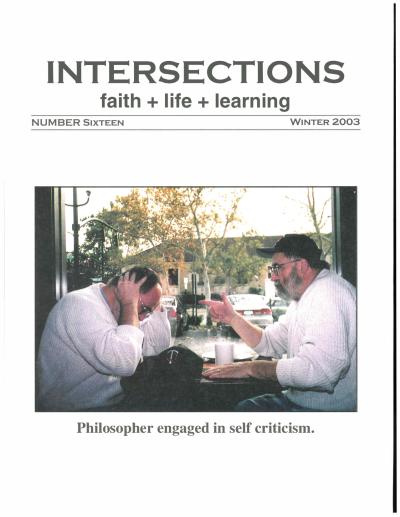
Heggen, Lutheran Campus Ministry pastor and adjunct English professor at the University of Delaware, builds on a freshman’s essay closing line—“All in all our night was complete”—to argue that even in the secular public university one can “teach hope” as a critical principle by drawing on Douglas John Hall’s Heideggerian distinction between calculative and meditative thought, the Frankfurt School’s instrumental versus substantialist reason, Luther’s theology of the cross, Parker Palmer’s “obedience to truth,” bell hooks, Lionel Basney, Shelley Shaver, and Donald Sheehan’s Frost Place “principle of compassion.” The classroom and Lutheran campus ministry together can become “communities of memory and hope” that, like the artist student’s Fourth of July, hold together danger, people getting together, explosions, and lots of fun.