Farming and Eating Locally: An Interview with Garry Griffith about Augustana's Farm2Fork Program
Intersections No. 36 · Fall 2012
What was food service like when you first came to Augustana? How have things changed?
I was a little bit shocked, actually. Almost all the vegetables, soups, and even the meats were pre-cooked and pre-packaged. We weren’t making much of anything from scratch. In our kitchens at that time you could find dozens of pairing knives but no chef knives. Why? Because the knives were only used to open packages. It didn’t take us long to start getting all of our vegetables, potatoes, and even meats fresh from local farmers. I and others started working extensively with our staff in the summers, giving them a set of skills for choosing and preparing quality foods. We’ve really come a long way.
What we call our “Farm2Fork” program is a significant investment into the health of our community, helping to build regional and local food systems. Local farms and ranches provide our campus with a direct and reliable food source, thereby making us less dependent on food sources that are thousands of miles away. Jim Johansen of Wesley Acres in the neighboring town of Moline was our first partner, but there are now a number of others that we work with closely.
Is it hard to find farmers to work with?
It wasn’t in the case of Johansen. He recognized that our vision for local food systems was the near equivalent of his own. We share a vision of what local, sustainable food production and consumption should look like. But there are many barriers. It’s hard to get farmers to give up their high yields of corn and soy bean production to grow a diversity of crops—especially vegetables that need to be tended and that aren’t sold to a corporation. The really scary part is how high grain prices are. There are many disincentives for farmers to grow crops for local consumption. We’re still not sure how we can sustain this model, although national trends toward farmer’s markets and sustainable agriculture are encouraging.
How do students get involved?
Augustana has a small vegetable farm and orchard on campus called Augie Acres. Students tend the gardens; dining services uses a good deal of the produce and the students sell the rest in an on-campus farmers market. Much of the student work is through team-taught “learning-community” courses. Since many of our students are from the Chicago sprawl and have never gotten dirty in a garden before coming to college, growing their own food seems like something we ought to be teaching them.
How else does Dining Services contribute to the health of the area?
We do all we can do with recycling and minimizing waste, including a program that provides students with washable “to-go” containers. We use compostable materials and compost locally.
Our most exciting venture is probably working with Wesley Acres to recycle our used fryer oil which they convert to bio-diesel to heat their green houses to extend the growing season and run farm equipment. Last spring, Augustana purchased their own bio-diesel converter and an Alternative Fuels class will help convert our cooking grease to usable fuel. Meanwhile, we’re adding utility vehicles on campus that can use bio-diesel fuel. We hope we can produce 2500–3000 gallons per year at 68 cents per gallon. (Compare that to $4 per gallon for gas!) And so, the very programs that help local growers also help Augustana to be energy independent and help teach our students to be citizens of the local economy, which includes the health of soil and water.
Does Augustana’s Lutheran identity matter to these efforts?
As a Lutheran school and a place where students and staff take many religious traditions seriously, we feel as though being good stewards of the earth has been put in our charge. It is the responsibility of any church or religious organization to understand that resources are limited and that stewardship is our collective calling. Anything we can do to teach that stewardship is well worth it.
-
 Editorial
From the Publisher
Mark Wilhelm
Wilhelm argues that the rhetoric framing ELCA higher education as a binary between “secular” and “religious” is “hokum”: there is a third way of doing higher education from a Christian perspective that is religious in motivation and practice but on the ground looks secular. After more than half a century of debates, he calls on ELCA presidents to “do something” in 2013 to move forward in shared mission and vocation.
-
Editorial
From the Editor
Jason A. Mahn
Mahn introduces the issue through Norman Wirzba’s The Paradise of God and the Genesis 2 vocation given to Adam to care for adamah—arguing that “vocation” is the Lutheran name for an incarnational, creation-centric theology of kenosis and that Lutherans bring distinctive theological gifts to environmental work even if no absolutely unique perspective on caring for creation.
-
Institutional Focus
Vocation for Life: A Report on a New Initiative for Alumni
A report on “Vocation for Life,” a collaborative initiative of ELCA-related colleges and universities to make vocational exploration available to alumni across the country regardless of which school they attended. The first pilot retreat—“Explore Your Life’s Calling,” in Rochester, Minnesota in November 2011, facilitated by Tom Morgan of Augsburg, Chris Johnson of Gustavus, and Tom Scholtterback of Concordia using the Circles of Trust approach—is described.
-
Article
A Traveler's Manifesto for Navigating the Creation
Ann Pederson
Pederson asks who we are, where we are, and how then we shall live within the Epic of Evolution and the doctrines of creation, incarnation, and imago dei. Drawing on John 3:16 (“For God so loved the cosmos…”), Luther on God’s presence “in the veins of a leaf,” Augustine’s City of God, Phil Hefner’s “created co-creator,” Joseph Sittler’s “Called to Unity,” and Norman Maclean’s Young Men and Fire, she argues for a cosmic reading of incarnation in which all of creation—not only the human—bears the image of God.
-
Institutional Focus
Facing Tornados and Climate Change: An Interview with Jim Dontje about Environmental Innovation at Gustavus
Jim Dontje
Dontje, director of the Johnson Center for Environmental Innovation at Gustavus Adolphus College, describes the Center’s work with solar thermal and photovoltaic systems, LEED certification of Beck Hall, recycling and conservation initiatives, the Linnaeus Arboretum, and the difficult work of building consensus around climate response—reflecting on how Gustavus’s 1998 tornado recovery shaped a community capable of collective action, and on how the “Lutheran identity” both restrains and energizes the college’s environmental ethos.
-
Article
A Lutheran Ethic of Environmental Stewardship
Jim Martin-Schramm
Martin-Schramm sketches a Lutheran ethic of environmental stewardship organized around four moral norms inherited from World Council of Churches discussions and developed by Presbyterian and ELCA social statements: sustainability, sufficiency, participation, and solidarity. He grounds each norm in scripture and the Lutheran tradition—the theocentric doctrine of creation against rampant anthropocentrism, the incarnation against destructive dualisms, Christ in community against modern individualism, and accountability to God for future generations—arguing that this “ethic of ecological justice” offers a common moral vocabulary for engaging environmental policy debates that would otherwise collapse into cost-benefit analysis.
-
Institutional Focus
Putting Principles into Practice: An Interview with Kenneth Foster about Concordia's Sustainability Council
Kenneth Foster
Foster, chair of Concordia College’s President’s Sustainability Council, describes the Council’s formation under President William Craft in 2011 as a re-energization of stalled task-force work, its coordination with grass-roots campus initiatives, and its strategy of moving from principles to practice in stewardship of natural resources at a Lutheran liberal arts college.
-
Article
Climate Justice, Environmental Racism, and a Lutheran Moral Vision
Cynthia Moe-Lobeda
Moe-Lobeda argues that the vocation of a Lutheran college is to prepare students for Thomas Berry’s “great work”: forging a sustainable relationship between the human species and the planet while diminishing the gap between those who have too much and those who have not enough. She develops a three-fold “moral vision” rooted in Luther’s theology of the cross—seeing what is (climate injustice and environmental racism for what they are), seeing more just and sustainable alternatives, and seeing God’s saving presence at work—and offers it as a distinctive Lutheran contribution to the panhuman and interfaith challenge of our day.
-
Article
Sustaining Sustainability
Baird Tipson
Tipson—former Provost of Gettysburg College, President of Wittenberg University, and President of Washington College—reads Romans 12:2 (“be not conformed to this world…”) against Victor Ferrall’s Liberal Arts at the Brink and the contemporary financial reality of small Lutheran colleges. He tells three case-study stories from Washington College’s Center for the Environment and Society—the Chino Farms partnership, the Chesapeake Semester, and the acquisition of the work boat Callinectes—to show how presidents must engage “the world” to secure resources for sustainability work without being conformed to it.
-
Institutional Focus
Health Food in the Inner City: An Interview with Brian Noy about Augsburg's Campus Kitchen
Brian Noy
Noy, Director of Campus Kitchen at Augsburg College in Minneapolis, describes the Kitchen’s four-fold program—Food to Share (2,000 meals per month from surplus dining-services food and Campus Cooking Classes), Food to Grow (an 80-plot community garden), Food to Buy (two farmers markets that accept EBT/food stamps), and Food to Know (educational programming)—and the deep history of Augsburg’s service to the immigrant communities of the Cedar Riverside neighborhood, now Somali and Mexican as well as historically Norwegian.
-
 Article
Building a Third Space in the Age of AI: A Conversation with Dr. Walter Earl Fluker
Elizabeth Kubek
No. 62 · Fall 2025
11 min audio
Prompted by AI chatbots being marketed to students as a safer alternative to messy human relationships, Kubek interviews Fluker on how Howard Thurman’s vision of common consciousness, somaesthetics, and nature-rooted learning offers educators a “third space” alternative to AI’s hall of mirrors.
-
 Editorial
From the Publisher
Mark Wilhelm
No. 50 · Fall 2019
Wilhelm frames the issue by noting that a federal court’s vindication of Harvard’s race-conscious admissions process is a win for higher education’s commitments to diversity, equity, and inclusion — and argues that for Lutheran higher education, the commitment to diversity is an old and foundational claim, rooted in Christianity’s openness to all and reflected in the four diverse gospels of the New Testament.
-
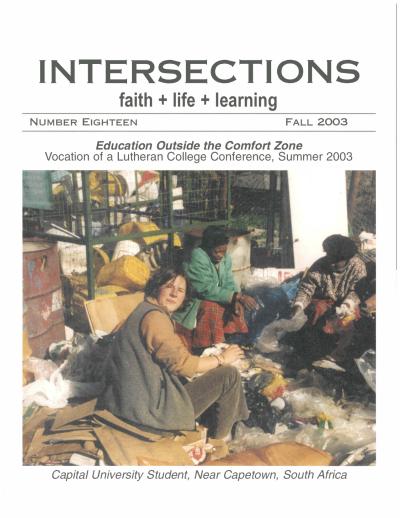 Article
Service Beyond the Comfort Zone
Kathryn Wolford
No. 18 · Fall 2003
Wolford names economic globalization and the growth of civil society as the two issues shaping Lutheran World Relief’s mission, illustrating with the Guatemalan storekeeper undercut by subsidized “gringo” chickens, fair-trade coffee and chocolate campaigns, and Charles Onyango-Obbo’s warning about anti-terrorism laws in fragile African democracies. Drawing on Darrell Jodock, Art Simon, and the Good Samaritan, she frames the global vocation of Lutheran colleges as inviting students past comfort zones of race, class, ethnicity, and ideas through service-learning that links mercy and justice, and closes with a concrete LWR partnership invitation including site visits, internships, fair-trade campus campaigns, and the “A Place for Peace in Colombia” advocacy program.
-
 Article
Luther's Theology of Learning: Discovering the Vocation of Today's Small Lutheran Liberal Arts College
Eric Childers
No. 20 · Fall 2004
In an excerpt from his Wake Forest University Divinity School senior thesis, Childers profiles six students hand-picked by presidents and chaplains at Concordia College (Moorhead), Lenoir-Rhyne College, and Muhlenberg College—Nathan Gossai, Amy Nelson, Alison Schmidt, Ryan Sigmon, Julie Christianson, and Jeffrey Slotterback—as a living testament to Luther’s theology of learning. He then draws on Solberg, Mark R. Schwehn (in Paul J. Dovre’s The Future of Religious Colleges), Robert Benne, Ernest Simmons, Mark Noll, Richard Hughes, and James Burtchaell to argue that Lutheran colleges have not yet fully articulated their own theology of education and that their vocation is to embrace, engage, and galvanize a Lutheran tradition of learning rooted in the liberal arts, Scripture, the Confessions, and confident ecumenism.
-
 Article
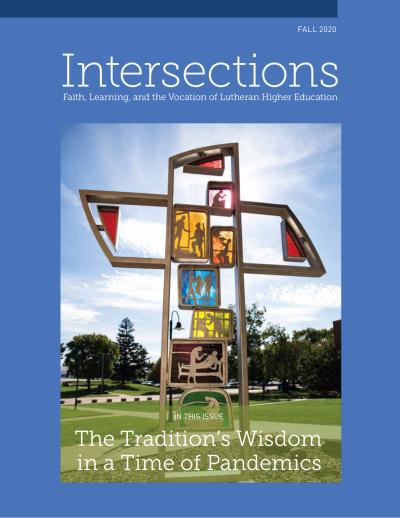
Leadership in Lutheran Key at a Time of Pandemics
Deanna Thompson
No. 52 · Fall 2020
Thompson draws on Luther’s theology of the cross and Shelly Rambo’s theology of trauma to sketch a Lutheran model of leadership for a season of pandemics — one that is attentive to pain, responsive to need, and intentionally nourished by food, friends, and deep conversation.
-
 Editorial
From the Publisher
Mark Wilhelm
No. 53 · Spring 2021
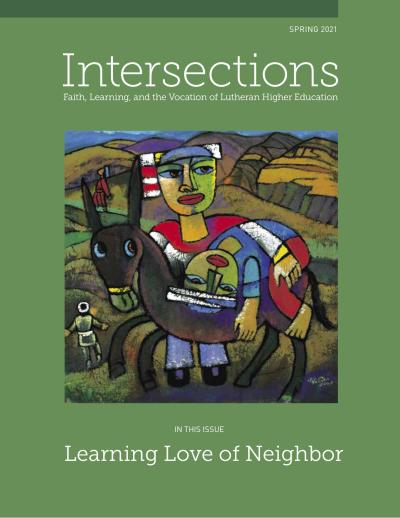
Wilhelm reflects on an NPR report of teenagers’ pandemic diaries and the fraught Christian history of struggling to live out Jesus’s ethic of love, framing the issue as a record of NECU institutions working out how to act for the common good through the pandemic of 2020–2021.