This journal, INTERSECTIONS, was started because of a concern that general awareness of the philosophy and theology behind Lutheran higher education was not high, and could become lost due to retirements and preoccupation with other issues. The Division for Higher Education and Schools in the Evangelical Lutheran Church in America, and some administrators and faculty members at colleges and universities related to the ELCA thought that the issues that had been debated through the years needed to be revisited and brought forward. New deliberations needed to take place, and the arguments that were put forth needed to be published so that many of us could learn from the arguments and continue the discussion.
Among the key people behind the resumption of that debate were two people who now have retired or soon will be retired: Paul Dovre, the former president of Concordia College in Moorhead, Minnesota, and Robert Sorensen, the Executive Director of the ELCA Division for Higher Education and Schools. I know that it gives them great pleasure and satisfaction to see how active the discussion has become over the last few years, and how many people now contribute to it. Not only does “The Vocation of a Lutheran College,” the conference on which this journal is based, continue to draw more than a hundred participants each year, most of whom leave it highly enthusiastic, and charged up to take the discussion of the issues to their individual campuses. Not only has the discussion become active on many of the ELCA college and university campuses, but over the last two years three new books were published that added to the debate: Ernest Simmons, Lutheran Higher Education—An Introduction for Faculty, Augsburg Fortress, 1998; Paul Contino and David Morgan (eds), The Lutheran Reader, Valparaiso University, 1999; and Pamela Schwandt (ed), Called to Serve—St. Olaf and the Vocation of a Church College, St. Olaf College, 1999. The Simmons book has been used so widely that it quickly sold out. Now it is being represented as simply An Introduction, not meant for faculty use only.
More publications can be expected, based on the parallel initiative started in 1999, The Lutheran Academy for Scholars in Higher Education. And as you can see from this issue of Intersections, the debate continued last year at the “Vocation” conference at Susquehanna University. Next August the conference will take place at Dana College in Blair, Nebraska, just outside of Omaha. The focus will be on what differentiates Lutheran colleges and universities within American higher education, in educational philosophy, in teaching and learning, in research and scholarly endeavors, and in service activities. Welcome to that event.
December 1999
Arne Selbyg
Director for Colleges and Universities
ELCA-DHES
-
 Editorial
From the Editor
Tom Christenson
Christenson marks the eighth edition of Intersections, expresses gratitude to the ELCA Division for Higher Education and Schools and especially to the soon-retiring Bob Sorenson for backing the journal, the Vocation of a Lutheran College Conferences, and the Lutheran Academy of Scholars, and introduces an issue that gathers analyses and arguments from both insiders to Lutheran theology and outsiders, from veterans of the institutions and recent arrivals—voices that together remind us that what is and what ought to be need to inform each other.
-
Article
Integrity and Fragmentation: Can the Lutheran Center Hold?
Robert Benne
Benne answers the conference’s question pessimistically—“the Lutheran center cannot hold in many, if not most of our colleges, because it was never there in an articulated form in the first place”—and distinguishes “Christ of culture” colleges like the Midland Lutheran of his youth (Lutheran by ethno-religious ethos rather than by articulated theology) from James Burtchaell’s “confessional colleges” that operated from a theologically distilled Lutheran humanism. Drawing on Alasdair MacIntyre and Mark Schwehn’s First Things essay on Christian universities, he sketches what a Lutheran center looks like (unity, universality, integrity, a tradition of thought) and how its distortion—reducing the Gospel to justification and ceding everything else to autonomous reason—splits Christ and culture as dangerously as the German church separated Gospel and politics. For colleges that have lost their center, he proposes an “intentional, robust pluralism” that guarantees a Lutheran voice in every department and an “affirmative action for Christians” in hiring.
-
Article
From Pietism to Paradox: The Development of a Lutheran Philosophy of Education
Philip Nordquist
Nordquist traces a four-decade personal and institutional journey from the “Protestant triumphalism” and aggressive moralism of S. C. Eastvold’s 1950s Pacific Lutheran through the 1960 Ditmanson–Hong–Quanbeck volume The Christian Faith and the Liberal Arts, Gordon Lathrop’s 1972 PLU donor address grounding the university in two-kingdoms theology, the ALC’s 1975 Concordia workshop with Bill Narum, Bob Bertram, Harris Kaasa, and Sydney Ahlstrom’s case for the “critical” tradition over the scholastic and pietistic, the 1976 LCA statement distinguishing “Christian” from “church-related” education, and Richard Hughes’s 1997 Carthage address. He concludes that dialectical (two kingdoms) theology, Christian humanism alongside professional studies (the New American College model), Luther’s commitment to universal compulsory education, environmental and civic responsibility, and academic freedom together constitute the bequest of the Reformation—“Christ and culture in paradox” remains the best approach to education he knows.
-
Article
Diversity, Integrity, and Lutheran Colleges
Florence D. Amamoto
Amamoto—a sansei Jodo Shin Shu Buddhist who is “an inside outsider” at Gustavus Adolphus—argues that diversity and integrity belong together in Lutheran higher education, perhaps in a way unmatched by other church-related traditions. She affirms the importance of Gustavus’s 60% Lutheran student body and vibrant Christ Chapel under Richard Elvee and Brian Johnson while warning that numbers and chapel are not enough, draws on Tom Christenson, Patricia Gurin, Sylvia Hurtado, Anthony Carnevale, Martha Nussbaum, W. E. B. DuBois (the deaths of Matthew Shepard and Isaiah Shoels), Richard Hughes’s reading of finitum capax infiniti, Richard Solberg, and Mark Schwehn’s mutual hospitality model, and concludes that the real enemy is not diversity but indifference—and that Lutheran finitude grounds a theological commitment to keeping diversity and identity in creative conversation.
-
Poem
Things That Renew Hope
Sig Royspern
Inspired by Andrew Greeley’s Religion as Poetry, which defines religion as hope-renewing experiences and the stories, symbols, rituals, and images that preserve them, Rauspern offers a list-poem of small renewals of hope: lovers kissing in the street, the first snowfall of each year, compost and spring sprouts and Jewish humor, kids’ summer mischief, a mother nursing her baby on the bus, small jazz ensembles, two old men reconciling without remembering why, an unscheduled gift, the blues, a child taking him by the hand, and a gray-haired man who threw his cellular phone in the river.
-
Article
The Diversity Dilemma: Dealing With Difference
Kathy Fritz
Fritz reports from Newberry College—83% Caucasian, 16% African-American, 22% Lutheran, the smallest college in NCAA football—on a 1998–1999 year of crisis in which the Board of Trustees Executive Committee asked the president to resign over financial issues, the president fired three vice presidents, four trustees including the chair and treasurer resigned, and the controversial “veterinary technology” major became a flashpoint between the president’s recruitment-driven vision and the faculty’s commitment to “preparation for LIFE.” Turning to ethnic diversity, she frames three sociological approaches—“feed them all” to reduce conflict, the “3 A’s” (academics, athletics, arts) to create common identity, and Aguirre and Turner’s case for “weak ethnic identification” against the post-Yugoslavia failures of strong pluralism—and grounds the search for institutional unity in St. Paul’s body-of-Christ imagery from 1 Corinthians 12 and Ernest Simmons’s claim that diversity yields “creative adaptations that assist mutual survival.”
-
Reflection
A View From the Other Side
Daisybelle Thomas-Quinney
Thomas-Quinney—an ordained Church of God minister and adjunct in Religion at Thiel College—offers “a view from the other side” as a non-Lutheran African American “outsider and novice”: her bittersweet 1995 arrival at Thiel, her swift discovery (alongside one African American secretary, one Hispanic professor, and thirty-eight African American students recruited largely as athletes) of a “chilly” campus unprepared to nurture the very minority students it had recruited, her examination of Thiel’s 1875 founding and the Augsburg Confession Article IV right-hand/left-hand kingdoms, the parables of mustard seed and yeast from Matthew 13, and Bishop James Crumbly’s 1985 LCA manual Inclusiveness and Diversity: Gifts of God. Drawing on Bruce Reichenbach, Samuel Hazo, and Josephine D. Davis’s Coloring the Halls of Ivy, she concludes that the Lutheran center cannot hold “as is” but has “great possibility” when the mission statement is actually followed.
-
 Article
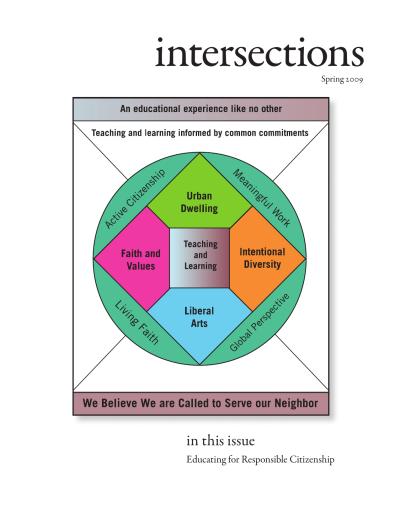
From Alien to Citizen
Arne Selbyg
No. 29 · Spring 2009
Selbyg reflects on three experiences of being educated for citizenship—growing up in Norway under the legacy of Lutheran pastors and public school teachers who resisted the Nazi occupation, arriving in America as a resident alien, and becoming a naturalized American citizen—and proposes the jazz ensemble as a better metaphor for American society than the melting pot, one in which different citizens learn skills, study other instruments, and dialog with one another in service to the common music.
-
 Editorial
From the Publisher
Arne Selbyg
No. 27 · Spring 2008
Selbyg, retiring this summer as Director for ELCA Colleges and Universities, reflects on his decade serving as spokesperson between the church and its twenty-eight colleges and universities, and argues that the link between the colleges and the church has grown stronger over the last ten years — sustained by supportive church leaders like Presiding Bishop Mark Hanson, the annual Vocation of a Lutheran College conference, and a Lutheran theology of higher education whose principles (questioning authority, returning to the sources, including the excluded, serving the neighbor) remain a strong basis for operating colleges and universities in the twenty-first century.
-
 Editorial
From the Publisher
Arne Selbyg
No. 26 · Fall 2007
Selbyg notes that, while a stated purpose of Intersections over its twelve years and twenty-six issues has been the intersection of faith, learning, and teaching, surprisingly few articles have addressed how Lutheran faculty teach and why — and credits the editor for assembling essays from authors whose teaching has benefited from the ELCA Wittenberg Center, on the eve of the City of Wittenberg’s “Luther Decade” leading up to the 2017 Reformation anniversary.
-
 Editorial
From the Publisher
Arne Selbyg
No. 25 · Spring 2007
Selbyg notes that most papers in this issue grew out of a pan-Lutheran conference organized by the Association of Lutheran College Faculties in fall 2006 rather than the annual Vocation of a Lutheran College conference, and argues that the ELCA’s ecumenical posture—truthful but open to learning from others—is a good foundation for institutions of higher education whose faculty likewise profess while remaining subject to change based on new research and insights.
-
 Editorial
From the Publisher
Arne Selbyg
No. 24 · Fall 2006
Selbyg situates this issue in the ongoing ELCA conversation about education that began with the 2005 conference and is feeding into the second draft of the ELCA Social Statement on Education, previews the 2007 conference (“The Vocation of a Lutheran College — Engaging the World”) at Augustana College, Rock Island, and lifts up Luther’s insistence that the church and its members contribute to their wider communities rather than retreat into self-centered enclaves.
-
 Editorial
From the Publisher
Arne Selbyg
No. 23 · Summer 2006
Selbyg features articles based on presentations at the 2005 Vocation of a Lutheran College conference focused on the upcoming ELCA Social Statement on Education, and urges members of the ELCA higher-education community to download the first draft (“Our Calling in Education”) from the ELCA website and submit feedback to the Task Force on Education before the October 15 deadline. He worries that the sexuality social statement on a 2009 timeline will draw more attention than the education statement, but reminds readers that, for Martin Luther and for those who work in Lutheran higher education, education is as important as sex.
-
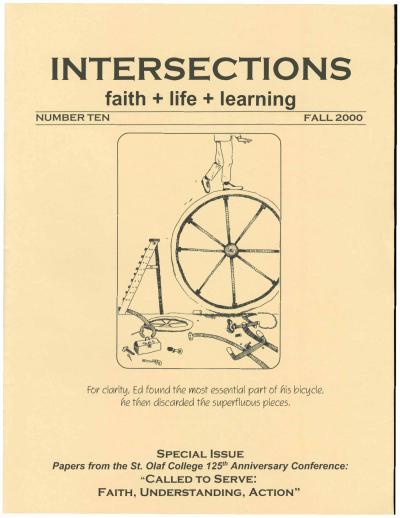 Editorial
From the Publisher
Arne Selbyg
No. 10 · Fall 2000
Selbyg explains that, while Intersections usually publishes papers from the annual Vocation of a Lutheran College conferences, this issue gathers presentations from a St. Olaf 125th-anniversary conference—a companion to the volume Called to Serve edited by Pamela Schwandt—because the theology and educational perspectives behind them apply to any Lutheran college and clarify what makes ELCA church-related colleges excellent institutions for students of any faith.
-
Article
Dual Citizenship: Reflections on Educating Citizens at Augsburg College
Paul C. Pribbenow
No. 29 · Spring 2009
Pribbenow argues that the vocation of Augsburg College is to educate “dual citizens”—those able to live within the messiness of common work rather than resolve every tension once and for all. Drawing on John Courtney Murray on democracy as “the intersection of conspiracies,” Bill Moyers, Jean Bethke Elshtain, Stephen Carter, and the Augsburg vision statement “We believe we are called to serve our neighbor,” he names four common commitments and five principles of civic education that ground Augsburg’s incarnational mission in its city neighborhood.
-
 Reflection
Reflecting on Belonging
Melissa Woeppel
No. 60 · Fall 2024
Woeppel, campus pastor at her own alma mater, wrestles with a Bethany student’s plea — “I want to feel like this is my home, like I belong” — and Mindy Makant’s reminder that we don’t choose the story of the past but do choose how we tell it forward, opening space for students from 35 faith traditions to find Lutheran institutions to be their home.
-
 Article
Practicing Hope: The Charisms of Lutheran Higher Education
Martha E. Stortz
No. 32 · Spring 2010
Stortz names four charisms—theological gifts of identity rather than commodities—that Lutheran higher education brings to a culture of fear: semper reformanda as flexible, responsive institutions; the freedom of a Christian as simul justus et peccator critical inquiry that holds opposites in creative tension; regard for the other as “neighbor” rather than friend or alien; and the priesthood of all believers as a public, civic calling to know the poor. Drawing on Augustine, George Lindbeck, Patricia Killen, James Clifford, Earl Shorris, Carter Lindberg, and Augsburg’s Center for Global Education, she argues that immersion trips, neighbor-regard, and welfare reform witness that the gift Lutherans bring is hope grounded in Christ in you, the hope of glory.
-
 Article
Higher Education in the Age of Trump
Daniel B. Braaten
No. 45 · Spring 2017
Braaten surveys what the Trump administration has and has not done on higher education — from the selection of Betsy DeVos and a rumored Falwell-led task force to the travel ban and expanded deportation priorities — and argues that Lutheran colleges, guided by the ELCA’s social message on immigration, have a special obligation to consider what they will do to protect their most vulnerable students.
-
 Article
Preaching in Christ Chapel on Yom HaShoah: Reflections on Interfaith Relations at a Lutheran College
Sarah Ruble
No. 53 · Spring 2021
Ruble shares her 2019 Holocaust Remembrance Day homily preached before the cross in Christ Chapel at Gustavus Adolphus, then reflects on whether “professional Christians” on Lutheran campuses might practice a non-mutual, witnessed confession before colleagues of other traditions as a check on Christian self-deceit.