In this issue of Intersections we continue our recent focus on the Lutheran view of education. The papers that form the basis for this issue were presented at the 2006 conference on “The Vocation of a Lutheran College,” where the theme was “Liberal Learning and Professional Preparation.” This continued the discussion from the 2005 conference where the theme was “The Lutheran Calling in Education.” All of these efforts were meant to contribute to the new ELCA Social Statement on Education. A second draft of that statement will be distributed in the spring of 2007, and come to the 2007 ELCA Churchwide Assembly for approval. We who work for the ELCA unit for Vocation and Education are very grateful for the many faculty members and administrators at the colleges and universities that are related to the ELCA who took this opportunity to contribute to this formal statement of what the ELCA stands for in the area of education.
The next conference will be held at Augustana College in Rock Island, Illinois in the first days of August 2007, and the theme will be “The Vocation of a Lutheran College—Engaging the World.” When this issue of Intersections is distributed there should still be time for you to contact your provost or academic dean to see whether you can be part of the delegation from your institution to that conference. Although the list of speakers is not yet finalized as I write these comments, I feel confident in predicting that we will have some great discussions of how the colleges that are related to the ELCA can avoid being caught in a bubble of inward looking self-centeredness. One of the reasons for the excellence of Lutheran colleges is that Martin Luther wanted the church and its members to contribute to their extended communities and not isolate themselves from their communities and their needs. One of the measures of the quality of Lutheran colleges should be the extent to which their students get rid of the blinders that most of us develop by growing up in a limited, even homogenous, environment. That is what the students need. That is what the colleges need. That is what the church needs.
Living in God’s Amazing Grace,
-
 Editorial
From the Editor
Robert D. Haak
Haak introduces the issue’s essays by Stanley N. Olson, Kathryn L. Johnson, Gail Summer, Lake Lambert, and Steven C. Bahls; argues that on Lutheran campuses, professional programs in business, education, and nursing are not “second-class citizens” but integral to the institution’s vocation; cites Olson’s mantra (“Because of Christ, the world; because of the world, vocation; because of vocation, education”); and thanks Matt Marohl for assisting with the editing.
-
Article
Vocation and the Vocation of a Lutheran College (Cows, Colleges and Contentment)
Stanley Olson
Drawing on a childhood image of contented cows on Lutheran-owned farmland in Northfield, Olson—Executive Director of the ELCA Vocation and Education unit—asks whether Lutheran colleges are content because they draw nourishment from the Lutheran tradition, or merely because they happen to be standing on Lutheran soil. He proposes the mantra “Because of Christ, the world; because of the world, vocation; because of vocation, education,” and traces what each clause demands of the colleges and universities of the ELCA.
-
Article
Freedom of a Christian-College: Looking through the Lens of Vocation
Kathryn L. Johnson
Johnson, Paul Tudor Jones Professor of Church History at Louisville Presbyterian Theological Seminary, re-reads Luther’s 1520 treatise The Freedom of a Christian as a paradigm for the “freedom of a Christian college” amid the pressures of professional preparation. She traces Luther’s paradoxical claim that a Christian is “a perfectly free lord of all, subject to none” and at the same time “a perfectly dutiful servant of all, subject to all,” and argues that the same dialectic frees a Lutheran college to engage the professions without being captured by them.
-
Article
Professional Education/Liberal Arts Education: Not a Case of Either-Or but Both-And
Gail Summer
Summer, Dean of Academic Programs at Lenoir-Rhyne College, traces the historical interweaving of liberal arts and professional education in American higher education (using the rise of engineering as a case study) and argues that the standard “either-or” framing of liberal arts versus professional preparation misreads both. At Lutheran colleges, the “both-and” relationship is shaped by a Lutheran understanding of vocation in which professional programs are integral to, not in tension with, the liberal arts.
-
Article
The Divide Within (Not Between) Liberal Arts and Professional Education
Lake Lambert
Lambert, then Board of Regents Chair in Ethics at Wartburg College and Project Director for the “Discovering and Claiming our Callings Initiative,” argues that the real divide in higher education runs not between the liberal arts and the professions but within each — between teaching that forms students for callings and teaching that merely transmits content or credential. He calls Lutheran colleges to recover, across both liberal arts and professional disciplines, a shared commitment to vocational formation grounded in the Lutheran tradition.
-
Article
Liberal Arts and Professional Education: A Call for Philosopher-Servants
Steven C. Bahls
Bahls, President of Augustana College (Rock Island), calls for a renewed commitment at Lutheran colleges to form “philosopher-servants” — graduates whose grounding in the liberal arts and the liberating gospel equips them for thoughtful service in business, education, nursing, and the other professions. Their impact, he argues, is “a good thing and a fact that we can be proud of as those who labor in Lutheran higher education.”
-
 Article
From Alien to Citizen
Arne Selbyg
No. 29 · Spring 2009
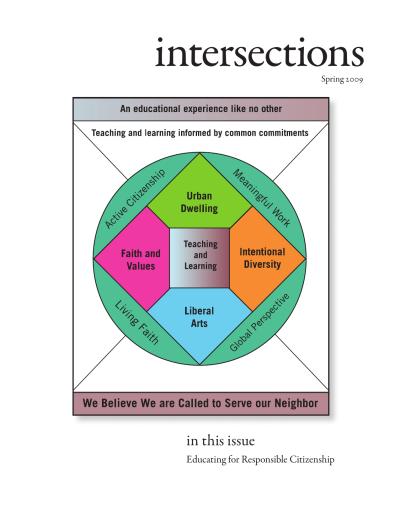
Selbyg reflects on three experiences of being educated for citizenship—growing up in Norway under the legacy of Lutheran pastors and public school teachers who resisted the Nazi occupation, arriving in America as a resident alien, and becoming a naturalized American citizen—and proposes the jazz ensemble as a better metaphor for American society than the melting pot, one in which different citizens learn skills, study other instruments, and dialog with one another in service to the common music.
-
 Editorial
From the Publisher
Arne Selbyg
No. 27 · Spring 2008
Selbyg, retiring this summer as Director for ELCA Colleges and Universities, reflects on his decade serving as spokesperson between the church and its twenty-eight colleges and universities, and argues that the link between the colleges and the church has grown stronger over the last ten years — sustained by supportive church leaders like Presiding Bishop Mark Hanson, the annual Vocation of a Lutheran College conference, and a Lutheran theology of higher education whose principles (questioning authority, returning to the sources, including the excluded, serving the neighbor) remain a strong basis for operating colleges and universities in the twenty-first century.
-
 Editorial
From the Publisher
Arne Selbyg
No. 26 · Fall 2007
Selbyg notes that, while a stated purpose of Intersections over its twelve years and twenty-six issues has been the intersection of faith, learning, and teaching, surprisingly few articles have addressed how Lutheran faculty teach and why — and credits the editor for assembling essays from authors whose teaching has benefited from the ELCA Wittenberg Center, on the eve of the City of Wittenberg’s “Luther Decade” leading up to the 2017 Reformation anniversary.
-
 Editorial
From the Publisher
Arne Selbyg
No. 25 · Spring 2007
Selbyg notes that most papers in this issue grew out of a pan-Lutheran conference organized by the Association of Lutheran College Faculties in fall 2006 rather than the annual Vocation of a Lutheran College conference, and argues that the ELCA’s ecumenical posture—truthful but open to learning from others—is a good foundation for institutions of higher education whose faculty likewise profess while remaining subject to change based on new research and insights.
-
 Editorial
From the Publisher
Arne Selbyg
No. 23 · Summer 2006
Selbyg features articles based on presentations at the 2005 Vocation of a Lutheran College conference focused on the upcoming ELCA Social Statement on Education, and urges members of the ELCA higher-education community to download the first draft (“Our Calling in Education”) from the ELCA website and submit feedback to the Task Force on Education before the October 15 deadline. He worries that the sexuality social statement on a 2009 timeline will draw more attention than the education statement, but reminds readers that, for Martin Luther and for those who work in Lutheran higher education, education is as important as sex.
-
 Editorial
From the Publisher
Arne Selbyg
No. 22 · Spring 2006
Selbyg notes that both the ELCA and Intersections have undergone major changes this year—the Division for Higher Education and Schools is gone, replaced by the Educational Partnerships and Institutions group within the Vocation and Education unit, and the journal has a new editor (Robert Haak), a new home at Augustana College, a new printer, and a new design. He commends the issue’s focus on human sexuality and points readers to the first draft of Our Calling in Education.
-
 Article
A Lutheran Call for Educator Flourishing
Krista E. Hughes
No. 58 · Fall 2023
Hughes argues that without educator flourishing there is no student flourishing, traces how an exploitative “passion tax” can distort vocation, and offers seven Lutheran “third-way” value pairings — including Metrics/Grace, Efficiency/Kairos, and DEI/Priesthood of All Believers — to reframe institutional success at NECU campuses.
-
 Editorial
From the Publisher
Arne Selbyg
No. 9 · Summer 2000
Selbyg reports on the “Reclaiming Lutheran Students” research by the Lutheran Education Conference of North America (partly funded by the Aid Association for Lutherans), which found that alumni of Lutheran colleges report higher satisfaction with the overall quality of their education than alumni of flagship public universities, with more than eighty percent affirming that their college helped them develop moral principles and benefit from spiritual development, while also noting that parents of Lutheran high school students remain largely unaware of both the magnitude of financial aid offered and the quality of the education provided.
-
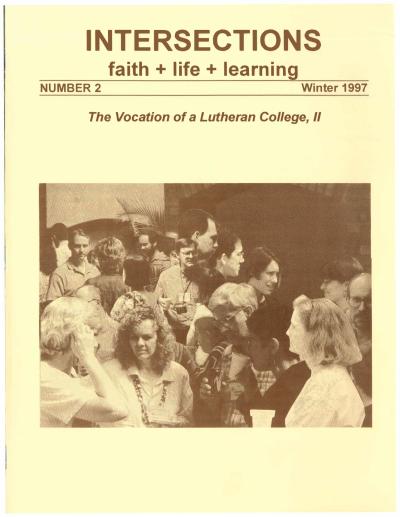 Response
Disputatio Pro Quo? The Search for Lutheran Education
Jon-David Hague, Kimberly Hague
No. 2 · Winter 1997
Kimberly and Jon-David Hague—both Luther College graduates completing graduate studies at Berkeley and Boston University respectively—respond to Bouman by offering Luther’s curriculum reform at Wittenberg University in the spring of 1518, only months after the 95 theses, as a model of the Lutheran voice in higher education. Inspired by humanistic principles, Luther introduced lectures on classical authors and the first instruction in Greek and Hebrew, giving students the tools to encounter scripture directly rather than receive dictated doctrine. The spirit of that reform—providing students with every possible tool while acknowledging that an instructor’s perspective is neither ultimate authority nor final word—remains useful for the search for Lutheran academia today.
-
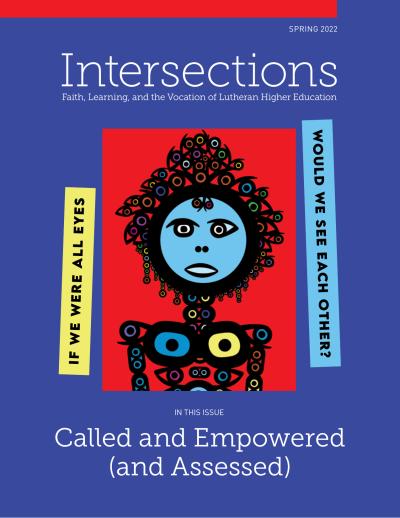 Editorial
From the Outgoing Editor
Jason A. Mahn
No. 55 · Spring 2022
Mahn closes out a decade of editing Intersections, passes the duties to Colleen Windham-Hughes, gives thanks to Mark Wilhelm and Augustana College, and introduces an issue largely drawn from comments by Lutheran faculty, staff, and administrators at the 2022 NetVUE national gathering.
-
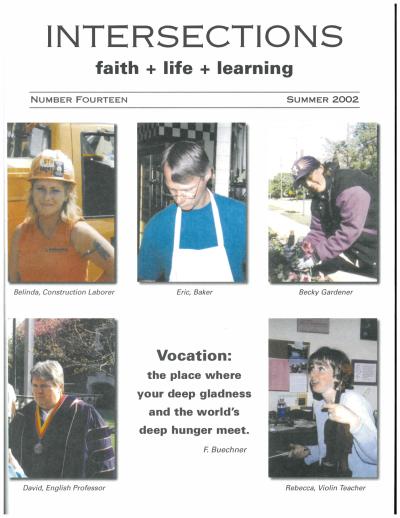 Article
Renewing a Sense of Vocation at Lutheran Colleges and Universities: Insights from a Project at Valparaiso University
Marcia Bunge
No. 14 · Summer 2002
Bunge, director of the process for writing Valparaiso’s nearly two-million-dollar Lilly grant on the Theological Exploration of Vocation, argues that contemporary culture’s reduction of vocation to either paid work or self-fulfillment requires Lutheran institutions to renew attention to a rich theological concept rooted in Luther’s expansion of vocation beyond the priesthood. She outlines eight low-cost “doorways”—caring adults, prayer, worship leadership, music and the arts, service, cross-cultural experience, church camps and wilderness, study and reflection—and describes Valparaiso’s two-program structure: a Campus-Wide Program weaving vocation into Freshman Core Courses and chapel life, and a Church Vocations Program for students considering full-time ministry. She closes with four troubling questions for any institution carrying out such a grant: what faith traditions can learn from one another, how to involve parents, whether faculty and staff have space to reflect on their own vocations, and whether daily institutional practices—family policies, treatment of low-paid staff, environmental responsibility, obligations to the wider community—actually reflect a commitment to love of neighbor.
-
 Editorial
From the Publisher: Introduction and Invitation
Lamont Anthony Wells
No. 57 · Spring 2023
Wells introduces himself as the new Executive Director of NECU, succeeding Rev. Dr. Mark Wilhelm, and frames this Spring issue as a passionate response to the crises facing higher education amid threats to academic freedom and the well-being of educators.