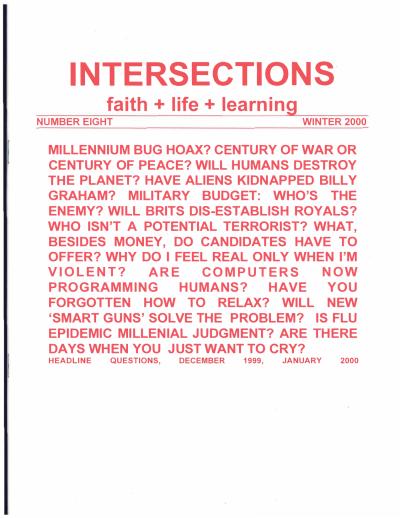
This is the eighth edition of INTERSECTIONS. When Bob Sorenson, at the ELCA Division for Higher Education and Schools endorsed the idea of such a publication a few years ago, there had been no Vocation of a Lutheran College Conferences and no Lutheran Academy of Scholars either. Bob, together with his staff, made a commitment to move forward with all of these efforts. Each of them has made a substantive contribution to the dialogue regarding the connection of church relatedness and academic calling at our institutions of higher learning. I think the conversations are livelier, the issues more fully informed and the voices in the discussion more diverse because of these developments. For all of these things we express our gratefulness to the DHES staff and especially to Bob Sorenson, since he has now announced his imminent retirement.
This issue of INTERSECTIONS is a good example of the kind of discussion that these efforts have generated. It includes analyses and arguments from people who are insiders to Lutheran theology and from those who are outside, from those who have spent many years at our institutions as well as those recently arrived. All of these voices are valuable, for they point out to us what we ought to be about, what we claim we are about, and what we are actually, in practice, about. What we discover is that these are not always the same thing. What I conclude from reading these essays is that what is can do well to be informed by what ought to be, and that what ought to be needs to be informed by what is. The livelier the dialogue between such voices, the better for all of us.
Tom Christenson
Capital University
-
 Editorial
From the Publisher
Arne Selbyg
Selbyg reflects on the origins of Intersections—begun out of concern that the philosophy and theology behind Lutheran higher education could be lost to retirements and other preoccupations—and credits Paul Dovre of Concordia and Robert Sorensen of the ELCA Division for Higher Education and Schools as key figures behind the resumption of the debate. He points to three recent books (Ernest Simmons’s Lutheran Higher Education, Paul Contino and David Morgan’s The Lutheran Reader, and Pamela Schwandt’s Called to Serve) and to the new Lutheran Academy for Scholars in Higher Education, and previews the next “Vocation of a Lutheran College” conference at Dana College in August on what differentiates Lutheran colleges within American higher education.
-
Article
Integrity and Fragmentation: Can the Lutheran Center Hold?
Robert Benne
Benne answers the conference’s question pessimistically—“the Lutheran center cannot hold in many, if not most of our colleges, because it was never there in an articulated form in the first place”—and distinguishes “Christ of culture” colleges like the Midland Lutheran of his youth (Lutheran by ethno-religious ethos rather than by articulated theology) from James Burtchaell’s “confessional colleges” that operated from a theologically distilled Lutheran humanism. Drawing on Alasdair MacIntyre and Mark Schwehn’s First Things essay on Christian universities, he sketches what a Lutheran center looks like (unity, universality, integrity, a tradition of thought) and how its distortion—reducing the Gospel to justification and ceding everything else to autonomous reason—splits Christ and culture as dangerously as the German church separated Gospel and politics. For colleges that have lost their center, he proposes an “intentional, robust pluralism” that guarantees a Lutheran voice in every department and an “affirmative action for Christians” in hiring.
-
Article
From Pietism to Paradox: The Development of a Lutheran Philosophy of Education
Philip Nordquist
Nordquist traces a four-decade personal and institutional journey from the “Protestant triumphalism” and aggressive moralism of S. C. Eastvold’s 1950s Pacific Lutheran through the 1960 Ditmanson–Hong–Quanbeck volume The Christian Faith and the Liberal Arts, Gordon Lathrop’s 1972 PLU donor address grounding the university in two-kingdoms theology, the ALC’s 1975 Concordia workshop with Bill Narum, Bob Bertram, Harris Kaasa, and Sydney Ahlstrom’s case for the “critical” tradition over the scholastic and pietistic, the 1976 LCA statement distinguishing “Christian” from “church-related” education, and Richard Hughes’s 1997 Carthage address. He concludes that dialectical (two kingdoms) theology, Christian humanism alongside professional studies (the New American College model), Luther’s commitment to universal compulsory education, environmental and civic responsibility, and academic freedom together constitute the bequest of the Reformation—“Christ and culture in paradox” remains the best approach to education he knows.
-
Article
Diversity, Integrity, and Lutheran Colleges
Florence D. Amamoto
Amamoto—a sansei Jodo Shin Shu Buddhist who is “an inside outsider” at Gustavus Adolphus—argues that diversity and integrity belong together in Lutheran higher education, perhaps in a way unmatched by other church-related traditions. She affirms the importance of Gustavus’s 60% Lutheran student body and vibrant Christ Chapel under Richard Elvee and Brian Johnson while warning that numbers and chapel are not enough, draws on Tom Christenson, Patricia Gurin, Sylvia Hurtado, Anthony Carnevale, Martha Nussbaum, W. E. B. DuBois (the deaths of Matthew Shepard and Isaiah Shoels), Richard Hughes’s reading of finitum capax infiniti, Richard Solberg, and Mark Schwehn’s mutual hospitality model, and concludes that the real enemy is not diversity but indifference—and that Lutheran finitude grounds a theological commitment to keeping diversity and identity in creative conversation.
-
Poem
Things That Renew Hope
Sig Royspern
Inspired by Andrew Greeley’s Religion as Poetry, which defines religion as hope-renewing experiences and the stories, symbols, rituals, and images that preserve them, Rauspern offers a list-poem of small renewals of hope: lovers kissing in the street, the first snowfall of each year, compost and spring sprouts and Jewish humor, kids’ summer mischief, a mother nursing her baby on the bus, small jazz ensembles, two old men reconciling without remembering why, an unscheduled gift, the blues, a child taking him by the hand, and a gray-haired man who threw his cellular phone in the river.
-
Article
The Diversity Dilemma: Dealing With Difference
Kathy Fritz
Fritz reports from Newberry College—83% Caucasian, 16% African-American, 22% Lutheran, the smallest college in NCAA football—on a 1998–1999 year of crisis in which the Board of Trustees Executive Committee asked the president to resign over financial issues, the president fired three vice presidents, four trustees including the chair and treasurer resigned, and the controversial “veterinary technology” major became a flashpoint between the president’s recruitment-driven vision and the faculty’s commitment to “preparation for LIFE.” Turning to ethnic diversity, she frames three sociological approaches—“feed them all” to reduce conflict, the “3 A’s” (academics, athletics, arts) to create common identity, and Aguirre and Turner’s case for “weak ethnic identification” against the post-Yugoslavia failures of strong pluralism—and grounds the search for institutional unity in St. Paul’s body-of-Christ imagery from 1 Corinthians 12 and Ernest Simmons’s claim that diversity yields “creative adaptations that assist mutual survival.”
-
Reflection
A View From the Other Side
Daisybelle Thomas-Quinney
Thomas-Quinney—an ordained Church of God minister and adjunct in Religion at Thiel College—offers “a view from the other side” as a non-Lutheran African American “outsider and novice”: her bittersweet 1995 arrival at Thiel, her swift discovery (alongside one African American secretary, one Hispanic professor, and thirty-eight African American students recruited largely as athletes) of a “chilly” campus unprepared to nurture the very minority students it had recruited, her examination of Thiel’s 1875 founding and the Augsburg Confession Article IV right-hand/left-hand kingdoms, the parables of mustard seed and yeast from Matthew 13, and Bishop James Crumbly’s 1985 LCA manual Inclusiveness and Diversity: Gifts of God. Drawing on Bruce Reichenbach, Samuel Hazo, and Josephine D. Davis’s Coloring the Halls of Ivy, she concludes that the Lutheran center cannot hold “as is” but has “great possibility” when the mission statement is actually followed.
-
 Article
The Vocation of Intersections on its Twentieth Birthday
Jason A. Mahn, Robert D. Haak, Tom Christenson
No. 43 · Spring 2016
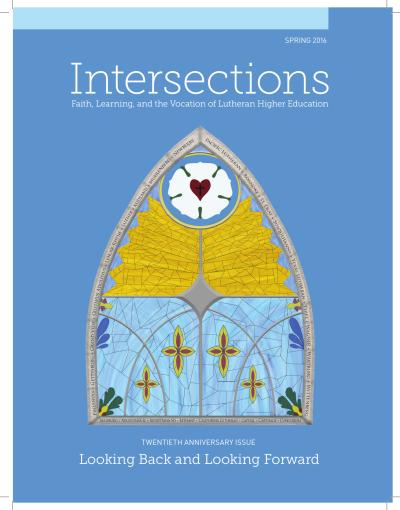
The three editors of Intersections — Bob Haak, Jason Mahn, and Tom Christenson (in spirit, following his death in 2013) — trace the twenty-year vocation of the journal itself: its 1996 birth at Capital University; its coming-of-age years of debate over institutional markers, two-kingdoms theology, and Lutheran identity; the ascendancy of “education for vocation” as the central marker of Lutheran higher education; and its ongoing identity in relation to a changing ELCA and to the broader cultural conversation about purpose, wholeness, and the vocation of higher education.
-
 Article
Point / Counterpoint: What It Means to be a "College of the Church"
Robert Benne, Tom Christenson
No. 28 · Fall 2008
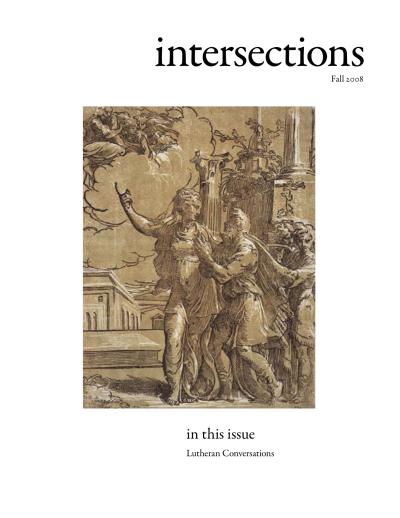
Moderated by Wartburg College pastor Larry Trachte and introduced by Kathryn Kleinhans, this Wartburg campus conversation between Robert Benne (Roanoke College) and Thomas Christenson (Capital University) probes what it means to be a college of the church—Benne emphasizing ethos, vocation, and the Christian intellectual tradition over against secularization and generic education, and Christenson lifting up persistent vocational questions, the gift of difference, and induction into a community of discourse—and finds large common ground around hiring for mission, pedagogy that asks deep questions, and the courage to claim a living religious tradition while inviting everyone to the banquet.
-
 Article
Education as a Christian (Lutheran) Calling
Tom Christenson
No. 21 · Summer 2005
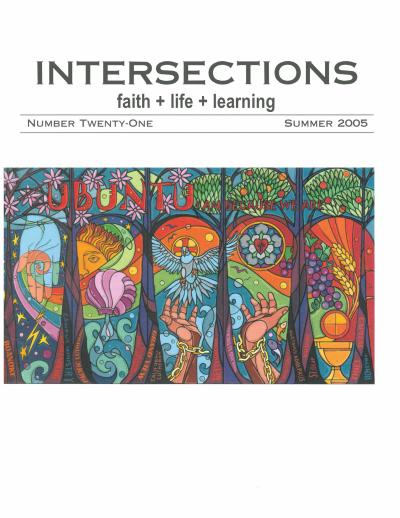
Christenson opens with an imaginative reconstruction of early Christian communities as radically egalitarian, pacifist, communitarian gatherings within the Roman Empire and argues that such communities are natural homes for the educational vocation. Naming two temptations for contemporary Christian higher education—the parochial Bible school and “Generic U”—he uses his friend Sig Rauspern’s tree metaphor to insist that a university is Christian in its trunk and roots rather than in grafted-on branches. Drawing on Wendell Berry, Jacob Bronowski, Walter Wink, Douglas John Hall, and his own Gift and Task of Lutheran Higher Education, he names faithful criticism, engaged suspiciousness, simul justus et peccator, and a fallible, love-related Lutheran epistemology as the particular gifts Lutherans bring to the Christian educational calling.
-
Editorial
From the Editor
Tom Christenson
No. 21 · Summer 2005
In his valedictory letter as outgoing editor, Christenson recounts the 1994 origins of Intersections, when he took the idea to Naomi Linnell and Jim Unglaube at DHES and persuaded the council of presidents to launch the journal on a shoestring with printing paid by DHES and everything else by Capital University. He summarizes the issue’s contents—papers from the 2004 Vocation of a Lutheran College Conference plus two commissioned pieces from former DHES directors Bob Sorensen and Leonard Schulze—and thanks the student copy editors and Capital’s presidents and provosts who sustained the publication.
-
 Book Review
Review of Educating for Shalom: Essays on Christian Higher Education
Tom Christenson
No. 20 · Fall 2004
Christenson reviews Nicholas Wolterstorff’s Educating for Shalom: Essays on Christian Higher Education (Eerdmans, 2004), edited by C.W. Joldersma and G.G. Stronks. After recounting his own early prejudice against Wolterstorff’s Reason Within the Bounds of Religion and his subsequent conversion through Art in Action, he focuses on two threads: Wolterstorff’s expansive reading of shalom—not merely peace but justice, community, communal responsibility, and delight—as the overall goal of Christian collegiate education, and the influence of Abraham Kuyper’s claim of “privileged cognitive access” for Christian inquirers, which Wolterstorff demonstrates rather than declares.
-
Editorial
From the Editor
Tom Christenson
No. 20 · Fall 2004
Christenson introduces an issue featuring “young and old, angry and encouraging, prophetic and hopeful” voices unified by the assumption that Christians engaged in thinking and educating will ask hard questions: how to raise concerns about militarism and the new American “imperialism,” what a Lutheran law school will say about training a new generation of attorneys, and what Lutheran colleges communicate to undergrads about vocation. Such faithful criticism, he argues, is part of who Lutheran institutions are.
-
 Response
Of Imaginary Cows and a White Toy Sheep: The Freedom of a Christian College
Ryan La Hurd
No. 6 · Winter 1999
La Hurd, president of Lenoir-Rhyne and a former Thiel English professor and Augsburg academic dean, responds to Christenson by insisting (with Robert Kegan’s story of Tommy’s imaginary cattle farm) that a college is composed of people but is not itself a person, and so cannot share in Luther’s freedom of the Christian. Drawing on Benedict Anderson’s Imagined Communities, Lewis Hyde’s The Gift, George Marsden, Mark Schwehn, Jacques Barzun, and the Pew Higher Education Roundtable, he distinguishes the “imagined college” (the gift-economy realm of teaching and the alma mater) from the “real college” (the commodity-economy realm of fund-raising, deferred maintenance, and federal aid reconciliation that does not have such freedom)—and ends with Pablo Neruda’s “Childhood and Poetry” and the marvelous white toy sheep offered through a hole in a fence.
-
 Editorial
From the Incoming Editor
Colleen Windham-Hughes
No. 55 · Spring 2022
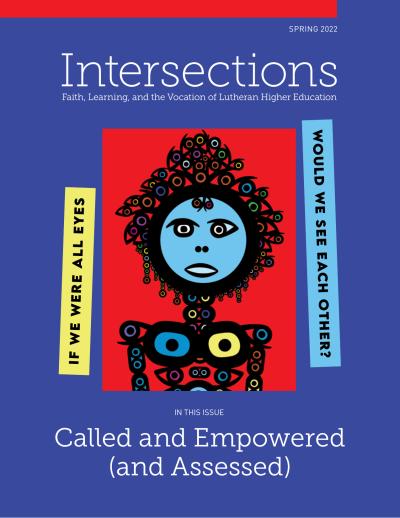
Windham-Hughes introduces herself as incoming editor by reclaiming the root of assess — “to sit by” — and committing to the question “What does this mean?” as she sits with readers in the worth of our work and the universality of vocation.
-
 Response
Response to Mark Wilhelm: Adopting the Framework of ‘Because’ and ‘Therefore’
Paul C. Pribbenow
No. 56 · Fall 2022
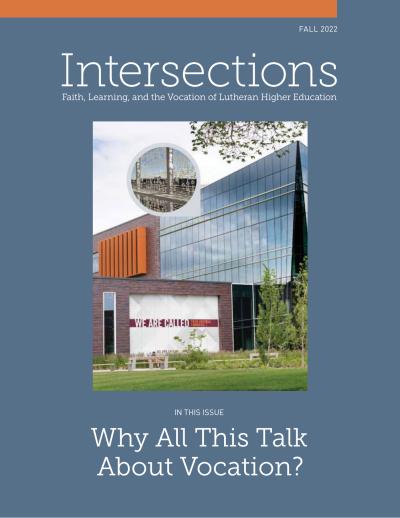
Pribbenow describes how Augsburg University responded to its dramatic demographic transformation (from 18% to nearly 70% BIPOC entering students over sixteen years) by adopting an institutional vocational statement and a simple “because/therefore” framework for translating particular Lutheran theological convictions into institutional programs, policies, and practices.
-
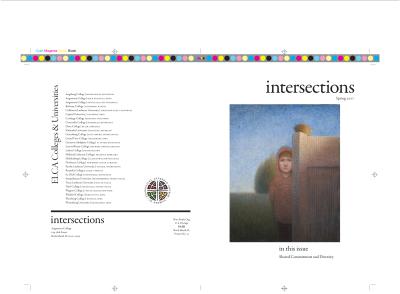 Editorial
From the Editor
Robert D. Haak
No. 25 · Spring 2007
Haak frames the issue around the question of what holds the twenty-eight ELCA colleges together amid their geographic, economic, and theological diversity, introducing Mark Hanson’s address to the assembled college presidents, Randall Balmer’s outsider perspective on the commonalities of Christian liberal arts, José Marichal and Pamela Brubaker on diversity rooted in community and globe, Storm Bailey’s argument that being Lutheran is precisely what makes us embrace diversity, and Jaime Schillinger’s St. Olaf chapel reflection on the formative power of worship and liturgy.
-
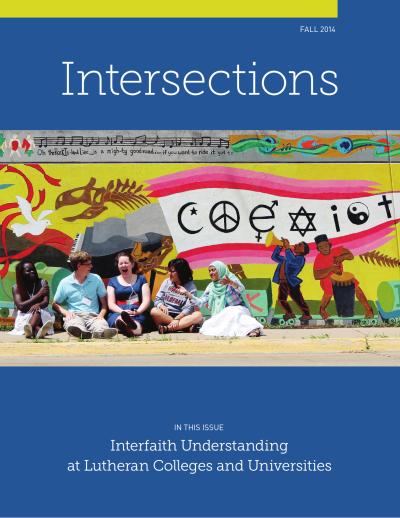 Editorial
From the Publisher
Mark Wilhelm
No. 40 · Fall 2014
Wilhelm draws a parallel between the rediscovery of vocation and the rediscovery of interfaith understanding in Lutheran higher education, arguing that previously under-emphasized aspects of the Lutheran tradition point us to interfaith work and that an authentic Lutheran college or university will make interfaith understanding a feature of its mission.
-
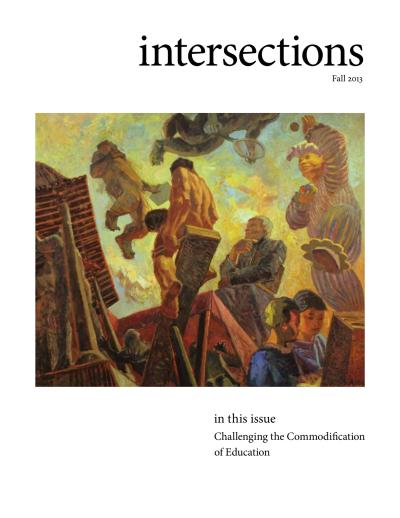 Article
Reinventing Lutheran Liberal Arts: A Preliminary Report on Project DAVID
Ann Hill Duin, Eric Childers
No. 38 · Fall 2013
Duin and Childers introduce Project DAVID—Distinction, Analytics, Value, Innovation, Digital opportunity—as a framework for showcasing strategic reinvention across ELCA liberal arts institutions. Building on Childers’ College Identity Sagas and reading Selingo, Norris, and Popenici alongside the AAC&U, Adrian College, NITLE, and the Delta Cost Project, they pose framing questions about distinction, vocation, affordability, value propositions, two-track innovation, and BYOE technology that ELCA campuses can use to face their own “Goliath” moments.