This is the twenty-sixth issue of Intersections published over a twelve year span. It is a journal primarily by and for the faculty at the colleges and universities that are related to the ELCA. These colleges say that while research and scholarship are important, their primary mission is teaching and learning. Throughout this time we have said that one of the purposes of the journal is to deal with the intersections of faith, learning and teaching at Lutheran colleges and universities. So it is surprising how few of the articles have addressed how our faculty members teach, and why. Other issues have dealt with the principles behind Lutheran higher education, but not necessarily with teaching principles. Therefore we are grateful to the editor for including in this issue several articles about the Lutheran roots of some of the principles behind good teaching.
We are also reminded again that we have not reached the rest of the world when we describe and discuss what those principles are. For outsiders, and even for Lutherans, going off to teach in a Lutheran college may be scary. Most people are much more familiar with other models of faith-based college education. That is why many faculty members come to conferences like “The Vocation of a Lutheran College” full of apprehension, and why they leave relieved and enthusiastic. And that is why faculty development efforts like the Wartburg College example described in this issue are so important.
The ELCA Wittenberg Center helped arrange the experience of “Lutherland” for the faculty and staff from Wartburg College, as it has done for other groups of Lutheran college administrators, faculty and students. In fact, all the authors of the articles in this issue have benefited from the services of the ELCA Wittenberg Center. This year the City of Wittenberg starts the “Luther Decade,” leading up to the five hundredth anniversary of the reformation in 2017. We invite every Lutheran college and university to consider how it can help its faculty, staff, and administrators connect with the Lutheran heritage, to improve their teaching and service, to serve God and their neighbors.
-
 Editorial
From the Editor
Robert D. Haak
Haak introduces the issue with the question of whether “our Lutheranism” should have any discernible effect on how we operate as Lutheran colleges, and proposes a working list of “Lutheran” values that characterize our institutions — complexity, real evil, suffering as part of human experience, the centrality of discourse, transcendent values, attention to place, institutional self-criticism, and unity over division — inviting campuses to extend the conversation begun by Simmons, O’Hara, and the Wartburg colleagues.
-
Article
Lutheran Higher Education and the Public Intellectual
Ernest L. Simmons
Simmons argues that college faculty and administrators are, like it or not, public intellectuals, and that Lutheran higher education’s dialectical understanding of Christ and culture is well suited to support four functions of the public intellectual: articulating constructive critique of received social explanation (especially the “collage identity” described by Renate Schacht); presenting a transcendent theological perspective through the theology of the cross that takes seriously God’s hiddeness, the presence of ambiguity, and the reality of suffering; pursuing the common good amid the demise of the “commons” through H. Richard Niebuhr’s “Christ and Culture in Paradox”; and educating for citizenship through Christian vocation by connecting the practical and existential dimensions of the question “Why are you here?”
-
Article
The Vocation of a Lutheran College—Living the Legacy of the Reformation in the Twenty-first Century
Sabine U. O'Hara
O’Hara reflects on Luther’s understanding of education as Bildung — “becoming in the image of God” — through four key aspects: education must be relevant, education demands engagement with the community, education requires attention to place, and education demands engagement with the world. Drawing on her German upbringing, her work as president of Roanoke College, and on Darrell Jodock and Dietrich Bonhoeffer, she argues that Luther’s vision of a well-educated citizenry as the priesthood of all believers calls Lutheran colleges to messy, interdisciplinary, communal scholarship in service to the neighbor.
-
Article
Lutheran Heritage Across the Curriculum: Reflections from a Faculty/Staff Development Seminar
Cynthia Bane, Fred Waldstein, Kathryn A. Kleinhans, Penni Pier
Four Wartburg College colleagues share fruits of the 2006 Lilly-funded “Discovering and Claiming Our Callings” faculty/staff development seminar in Wittenberg, Eisenach, and Neuendettelsau. Kleinhans frames the curriculum and books used; Bane (psychology) finds Lutheran convictions about the value of humans, the affirmation of creation, and the universality of sin congruent with her discipline; Pier (communication arts) reads Luther as a model of dialectical rhetoric that gives educators permission to challenge students with uncomfortable ideas; and Waldstein (political science) reflects on the paradox of humility and self-confidence in Luther and on the Luther-Melanchthon collaboration as a model for the seminar group’s own work.
-
Article
No Child Left Behind Meets Philip Melanchthon: A Reflective Conversation
Kathy Book
Inspired by Tim Lull’s My Conversations with Martin Luther, Book imagines an interview with Philip Melanchthon in the cobblestone courtyard of the University of Wittenberg, in which the Praeceptor Germaniae reflects on his pedagogy (Socratic questioning, brevity and example, declamations, repetition, and interdisciplinary connections), his graded curriculum from primer to university, and his collaboration with Luther on the responsibility of community, parents, and government for the education of all children — and finds his vision strikingly resonant with the No Child Left Behind legislation of 2006.
-
Book Review
Reviews
Matthew J. Marohl
Marohl reviews two 2006 Lutheran University Press volumes from Grand View College (Des Moines, IA). Mark C. Mattes and Ronald R. Darge’s Imaging the Journey … of Contemplation, Meditation, Reflection, and Adventure pairs Mattes’s Lutheran meditations on seven themes (from a spirituality of communication to Alpha and Omega) with Darge’s photographs and Ronald Taylor’s short prayers, with Mattes’s writing on vocation singled out as the volume’s finest. The Grand View College Reader, edited by Mattes, Evan A. Thomas, Kathryn Pohlman Duffy, and Ronald Taylor, surveys the college’s Foundations, Creativity, and Vocation through chapters by Thorvald Hanson, Kenneth Sundet Jones, Kevin Gannon, Ammertte C. Deibert, Steven Snyder, and President Kent Henning, tracing Grand View’s Grundtvigian and Danish Lutheran roots.
-
 Article
From Alien to Citizen
Arne Selbyg
No. 29 · Spring 2009
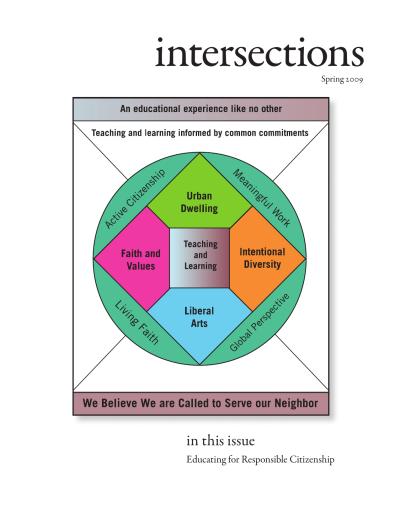
Selbyg reflects on three experiences of being educated for citizenship—growing up in Norway under the legacy of Lutheran pastors and public school teachers who resisted the Nazi occupation, arriving in America as a resident alien, and becoming a naturalized American citizen—and proposes the jazz ensemble as a better metaphor for American society than the melting pot, one in which different citizens learn skills, study other instruments, and dialog with one another in service to the common music.
-
 Editorial
From the Publisher
Arne Selbyg
No. 27 · Spring 2008
Selbyg, retiring this summer as Director for ELCA Colleges and Universities, reflects on his decade serving as spokesperson between the church and its twenty-eight colleges and universities, and argues that the link between the colleges and the church has grown stronger over the last ten years — sustained by supportive church leaders like Presiding Bishop Mark Hanson, the annual Vocation of a Lutheran College conference, and a Lutheran theology of higher education whose principles (questioning authority, returning to the sources, including the excluded, serving the neighbor) remain a strong basis for operating colleges and universities in the twenty-first century.
-
 Editorial
From the Publisher
Arne Selbyg
No. 25 · Spring 2007
Selbyg notes that most papers in this issue grew out of a pan-Lutheran conference organized by the Association of Lutheran College Faculties in fall 2006 rather than the annual Vocation of a Lutheran College conference, and argues that the ELCA’s ecumenical posture—truthful but open to learning from others—is a good foundation for institutions of higher education whose faculty likewise profess while remaining subject to change based on new research and insights.
-
 Editorial
From the Publisher
Arne Selbyg
No. 24 · Fall 2006
Selbyg situates this issue in the ongoing ELCA conversation about education that began with the 2005 conference and is feeding into the second draft of the ELCA Social Statement on Education, previews the 2007 conference (“The Vocation of a Lutheran College — Engaging the World”) at Augustana College, Rock Island, and lifts up Luther’s insistence that the church and its members contribute to their wider communities rather than retreat into self-centered enclaves.
-
 Editorial
From the Publisher
Arne Selbyg
No. 23 · Summer 2006
Selbyg features articles based on presentations at the 2005 Vocation of a Lutheran College conference focused on the upcoming ELCA Social Statement on Education, and urges members of the ELCA higher-education community to download the first draft (“Our Calling in Education”) from the ELCA website and submit feedback to the Task Force on Education before the October 15 deadline. He worries that the sexuality social statement on a 2009 timeline will draw more attention than the education statement, but reminds readers that, for Martin Luther and for those who work in Lutheran higher education, education is as important as sex.
-
 Editorial
From the Publisher
Arne Selbyg
No. 22 · Spring 2006
Selbyg notes that both the ELCA and Intersections have undergone major changes this year—the Division for Higher Education and Schools is gone, replaced by the Educational Partnerships and Institutions group within the Vocation and Education unit, and the journal has a new editor (Robert Haak), a new home at Augustana College, a new printer, and a new design. He commends the issue’s focus on human sexuality and points readers to the first draft of Our Calling in Education.
-
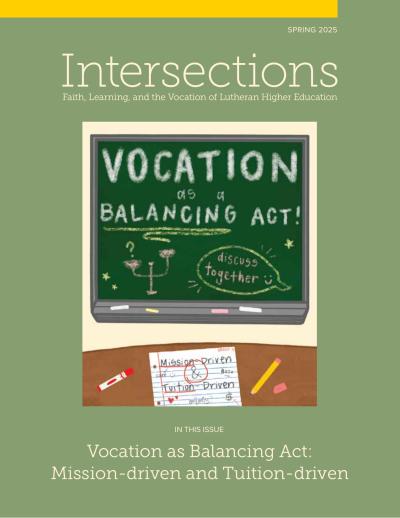 Institutional Focus
So That All May Belong: Lutheran Roots for Diversity, Equity, Inclusion, and Justice
Altheia Richardson, Angie Hambrick, Caryn Riswold, Colleen Windham-Hughes, Deanna Thompson, Marcia Bunge, Robert Clay
No. 61 · Spring 2025
22 min audio
The full NECU statement grounds DEIJ work in Luther’s 16th-century reforms and Lutheran theological claims about the image of God, equal dignity, and the limits of human knowing — offering definitions, Lutheran roots, and calls to action for diversity, equity, inclusion, and justice, with belonging as the outcome of DEIJ at work.
-
 Article
Hospitality is Not Enough: Claims of Justice in the Work of Colleges and Universities
Paul C. Pribbenow
No. 35 · Spring 2012
Pribbenow argues that Augsburg’s incarnational motto — “And the Word became flesh” — grounds a calling beyond hospitality to justice. Drawing on Stephen Carter on civility, Letty Russell on just hospitality, Henri Nouwen, Parker Palmer, Michael Sandel, Bonhoeffer, Niebuhr, and Teresa of Avila, he describes four components of Augsburg’s practice: education “off the main road,” co-created common life, abundance over entitlement, and the anchor-institution model in which colleges become economic and civic partners with their neighborhoods.
-
 Response
Of Imaginary Cows and a White Toy Sheep: The Freedom of a Christian College
Ryan La Hurd
No. 6 · Winter 1999
La Hurd, president of Lenoir-Rhyne and a former Thiel English professor and Augsburg academic dean, responds to Christenson by insisting (with Robert Kegan’s story of Tommy’s imaginary cattle farm) that a college is composed of people but is not itself a person, and so cannot share in Luther’s freedom of the Christian. Drawing on Benedict Anderson’s Imagined Communities, Lewis Hyde’s The Gift, George Marsden, Mark Schwehn, Jacques Barzun, and the Pew Higher Education Roundtable, he distinguishes the “imagined college” (the gift-economy realm of teaching and the alma mater) from the “real college” (the commodity-economy realm of fund-raising, deferred maintenance, and federal aid reconciliation that does not have such freedom)—and ends with Pablo Neruda’s “Childhood and Poetry” and the marvelous white toy sheep offered through a hole in a fence.
-
 Editorial
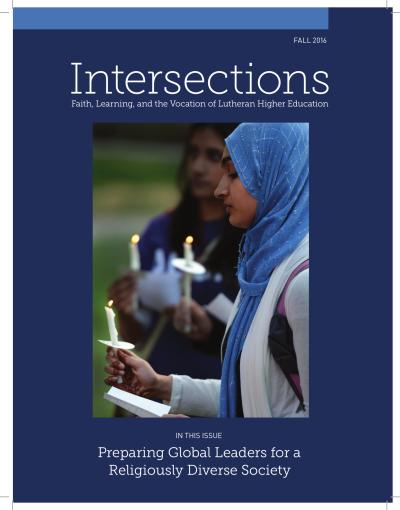
From the Publisher and Editor
Jason A. Mahn, Mark Wilhelm
No. 44 · Fall 2016
Writing weeks after the 2016 presidential election, Wilhelm and Mahn frame interfaith engagement as the urgent and ongoing work of ELCA colleges and universities, recap NECU’s growing commitments to inter-religious leadership, and introduce essays first delivered at the summer 2016 Vocation of a Lutheran College Conference under the theme “Preparing Global Leaders for a Religiously Diverse Society.”
-
 Editorial
From the Publisher
Mark Wilhelm
No. 34 · Fall 2011
Wilhelm bids farewell to Robert D. Haak, who is leaving the editorship of Intersections and the Augustana College Center for Vocational Reflection for a chief-academic-officer post at Hiram College in Ohio, and welcomes Jason A. Mahn as the incoming editor. He celebrates Haak’s tireless work to integrate the Lutheran concept of vocation into the practices and rhetoric of Augustana and ELCA higher education through six years of Intersections, and frames the journal as a vital tool for sustaining the conversation about education in a Lutheran key—even at colleges and universities where most students, faculty, and staff are not Lutheran themselves.
-
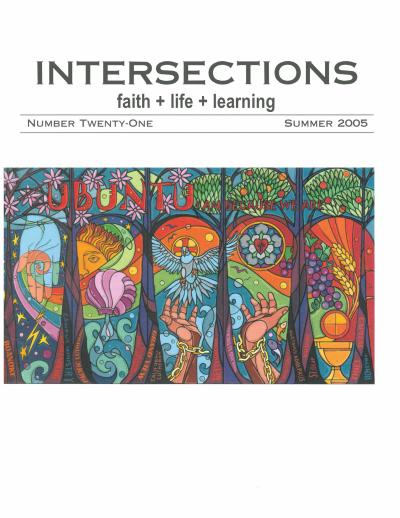 Article
Education as a Christian (Lutheran) Calling
Tom Christenson
No. 21 · Summer 2005
Christenson opens with an imaginative reconstruction of early Christian communities as radically egalitarian, pacifist, communitarian gatherings within the Roman Empire and argues that such communities are natural homes for the educational vocation. Naming two temptations for contemporary Christian higher education—the parochial Bible school and “Generic U”—he uses his friend Sig Rauspern’s tree metaphor to insist that a university is Christian in its trunk and roots rather than in grafted-on branches. Drawing on Wendell Berry, Jacob Bronowski, Walter Wink, Douglas John Hall, and his own Gift and Task of Lutheran Higher Education, he names faithful criticism, engaged suspiciousness, simul justus et peccator, and a fallible, love-related Lutheran epistemology as the particular gifts Lutherans bring to the Christian educational calling.