Robert Benne: Quality With Soul: How Six Premier Colleges and Universities Keep Faith With Their Religious Traditions
Intersections No. 13 · Winter 2002
Robert Benne, Quality With Soul: How Six Premier Colleges and Universities Keep Faith With Their Religious Traditions. Eerdman’s Publishing, Grand Rapids, MI; 2001
Individuals concerned with strengthening or recovering their college or university’s denominational connections and heritage will welcome Robert Benne’s recent book, Quality With Soul: How Six Premier Colleges and Universities Keep Faith with Their Religious Traditions (Grand Rapids, Michigan: Eerdmans, 2001). Benne, who serves as professor of religion and director for the Center for Religion and Society at Roanoke College, not only offers a general indictment of church-related schools for whom religious heritage has become merely “a flavor in the mix, a social ornament, or a fragile grace note” (p. 35), but he also provides strategies for reconnecting institutions with their sponsoring church bodies.
The first section of the book consists of Benne’s assessment of the current situation at church-related colleges and universities. Drawing in large part from other recent analyses, especially James T. Burtchaell’s The Dying of the Light: The Disengagement of Colleges and Universities from Their Christian Churches (Grand Rapids: Eerdmans, 1998), Benne describes schools’ having lost their religious moorings and have become detached from their denomination’s intellectual traditions. He cites the decreasing numbers of students, faculty, administrators, and board members who belong to the school’s sponsoring religious tradition. Benne also notes that in the past “members of the academic community were part of an ongoing narrative that was sharply etched in communal memory,” but now colleges no longer endeavor to “imprint their story” on faculty and students through celebration of the institution’s founders or retellings of the institutional history (p. 12). He laments the diminished role of chapel services. Once a public event that “defined the rhythm of life for the institution” and attended by most or all of the community, the chapel service is now only one among many voluntary activities (p. 11).
Benne identifies a number of factors for the erosion of institutions’ religious identity. Reaction to “market forces” and the competition for students brought about the tendency to dilute religious language in mission statements and other public discourse—out of fear (a mistaken fear, Benne believes) that fewer students will enroll if the school articulates a specific theological and religious vision. (Benne is highly critical of schools whose mission statements limit themselves to “first article”—Creator and creation—language, ignoring the second and third persons of the Trinity—Christ and the Holy Spirit.) For most faculty members, allegiance to the various professional guilds shaped by an Enlightenment paradigm takes priority over maintaining the school’s religious heritage or articulating a Christian intellectual position. Benne says that the roots of the problem can be found several generations in the past, as many schools in the middle decades of the twentieth century relied upon a “critical mass” of members of the denomination to carry the tradition. Instead, institutional leaders should have worked to shape and give voice to a theological vision arising from their respective traditions. In many cases, the fostering denominations share the blame because “the sponsoring traditions have to produce enough persons who intensely believe that the Christian account is pervasively relevant to the life of a college or university” (p. 179).
Benne names six institutions from differing religious traditions which he considers to be “bright lights” in an ever darkening landscape: Calvin College (Christian Reformed), Wheaton University (evangelical), Baylor University (Southern Baptist), the University of Notre Dame (Roman Catholic), Valparaiso University (Lutheran Church-Missouri Synod), and St. Olaf College (Evangelical Lutheran Church in America). These schools embody academic excellence (demonstrated by a high quality faculty and bright, engaged students) while maintaining faithfulness to the religious traditions that fostered the institutions.
Each of these institutions has a “critical mass” of community members who are adherents of the sponsoring religious body. Several of these schools (Calvin, Wheaton and Baylor) have maintained church connections through imposing certain confessional and/or behavioral requirements on their faculty and students. But these factors alone are not the reason for the institutions’ successes. Benne argues that each of these schools has benefited from visionary leaders who have had “enough confidence in the Christian account of life and reality to insist that it be the organizing paradigm for the identity and mission of the college” (p. 97). Mission statements, sometimes explicitly Trinitarian, reflect and embody the schools’ theological heritage. Required courses in religion, theology, and philosophy send strong signals about the schools’ commitments. Worship occupies a central place in the life of each school. In these schools “the Christian account of life and reality [is] made visible and relevant in all facets of each school’s activities—academic, extra-curricular, music and the arts, worship, atmosphere, and self-definition” (p. 95).
The book’s most compelling claim is that the specific intellectual content of an institution’s own denominational tradition should permeate public discourse and serve as a strong voice in the classroom and chapel. Benne insists that piety alone, or a “generic Christianity,” is not sufficient for conveying an institution’s religious identity. Within most denominational traditions there are intellectual and theological resources which should shape and invigorate the entire academic endeavor.
Benne’s penultimate chapter provides strategies for schools that desire to “keep the faith.” He counsels mutual accountability between institutions and their sponsoring religious traditions. He argues that there should be a “critical mass” of faculty, administrators, board members, and students who identify strongly with the college’s mission, with the ability to articulate this vision and provide leadership. There should also be “willing followers”—individuals sympathetic to the school’s mission even if they do not carry the banner. Both of these groups are acquired and maintained through a careful selection or hiring process monitored by the appropriate authority (president, provost, dean, board, etc.). Benne believes that faculty members hostile, unsympathetic, or indifferent toward the college’s theological tradition and vision may have some helpful things to offer (e.g., expertise in research, a critical counter voice, etc.), but should be outnumbered two to one by faculty who are firm proponents of or sympathetic toward the college’s religious tradition (p. 187).
Benne says that the schools’ vision should be inculcated in new members of the community, especially the faculty (p. 204). This can take place in faculty orientation and “faith and learning groups.” Crucial leaders are the president, chaplain, board members, and the theology department. Regarding the latter, Benne argues that “the animating vision has to be borne by a first-rate theology department willing to take up that burden. The theology department has to be the trustworthy guardian of the school’s particular tradition of thought” (p. 204).
Benne’s final chapter, a mere seven and a half pages, contains counsel for individuals at those schools which have experienced an too much of the “darkening trends” of secularization. He says that a handful of “true believers”—especially among the faculty—can begin to educate others about the institution’s traditions. The goal in this case may be to give the tradition an assured voice in the institution: “If the Christian account is not and cannot be the organizing paradigm, it can at least provide one voice in the larger array of voices that inhabit any college or university. Furthermore, that voice can be assured a role by intentionally placing it amid the key facets of the school’s life—faculty, administration, board, and student body” (p. 210).
One weakness in Benne’s study is the under-representation of student and faculty voices. In his description of the six premier institutions, Benne quotes extensively from mission statements, college catalogs, administrators’ speeches, and institutional websites. We do learn of chapel attendance figures and the numbers of Bible study groups in the dorms; however, missing are firsthand accounts from alumni and students. If students are the primary focus of educational efforts, quotes and anecdotal accounts from the student perspective could strengthen his arguments, demonstrating how students experience the results of the “top-down” approach enjoined by Benne. Furthermore, since Benne argues the need for integrating the school’s theological vision into its academic life, it would be helpful to hear about some specific instances where he has actually observed this occurring in the classroom.
This book should be required reading for all presidents and board members of church-related colleges and universities. It would also make for lively discussions at faculty seminars. Not all readers will agree with Benne’s approach to the faculty hiring process, such as his contention that at least one-third of the faculty should be communicant members of the sponsoring denomination. Many readers will certainly recognize in their own institutions the trends Benne describes, such as the move to let rhetoric about generic “values” and “service” carry most of the institution’s religious freight. Those who care about providing a quality education “with soul” will find much value in Benne’s challenging and provocative book.
-
 Editorial
From the Publisher
Arne Selbyg
Selbyg reports that Executive Director Leonard Schulze has challenged the ELCA Division for Higher Education and Schools to develop a comprehensive communications plan reaching high school students, college students, parents, pastors, and journalists, and invites Intersections readers to review the redesigned elcacolleges.org website, the “FREE STUFF” brochures, the journal’s advertisements in The Lutheran and related publications, Ernie Simmons’ new Augsburg-Fortress book Lutheran Higher Education: An Introduction, and the ELCA video magazine Mosaic—and to send in their own ideas.
-
Editorial
From the Editor
Tom Christenson
Christenson previews a varied issue—Darrell Jodock’s Bernhardson inaugural lecture, Ernie Simmons’ Valparaiso conference talk on student/parent attitudes, two South Africa travel pieces by Brian Wallace and Corin Wesner, and reviews of Richard Hughes’s and Robert Benne’s recent books—and tells the story of “the church lady from hell,” a mid-fifties returning student who condemned everyone in the class with “God and I think…,” to ask what a religious tradition without a sense of humor would look like.
-
Article
The Lutheran Theological Tradition and Recruiting Lutheran Students
Ernest L. Simmons
Simmons opens with an Abraham-and-Isaac “Windows 98” joke to illustrate the dialectic of faith and learning, then argues that in a new market era of limited religious background, intentional mission and marketing go together. Drawing on Levine and Cureton’s When Hope and Fear Collide for the Millennial Generation born in 1982 and Tom Beaudoin’s Virtual Faith for their GenX parents, he reads “Reclaiming Lutheran Students” survey results showing 86% strong community at ELCA colleges versus 54% at flagship publics and 61% alumni mentoring versus 39%. He then develops three areas where the Lutheran tradition uniquely equips its colleges—community, mentoring and vocation, and the integration of faith and values—using Luther’s “two kingdoms” image of the “Left Hand” (reason) and “Right Hand” (faith) of God, with academic freedom as a product of Ahlstrom’s “Critical Current” in the tradition, and closes with three challenges: recruiting and retaining mentoring faculty, educating church leaders, and reaching potential students and parents.
-
Article
Freedom, Humor, and Community: A Lutheran Vision for Higher Education
Darrell Jodock
Jodock’s inaugural lecture for the Bernhardson chair at Gustavus Adolphus develops three interlocking themes drawn from the Lutheran tradition as a deeper grounding for the liberal arts college than contemporary American assumptions. A sense of humor rests on Luther’s discovery that God takes the initiative—Luther could call himself a beggar, joke about the epistle of James, and credit Wittenberg beer for the Reformation—and underwrites the freedom of inquiry that John Updike traces to Grace Lutheran Sunday School in Shillington. Community, grounded in Augsburg Confession VII and Luther’s 1524 letter to the German city councils, makes the college a community of discourse pursuing wisdom rather than “the same old blockheads.” Freedom is both “freedom from” and “freedom for,” illustrated by Nechama Tec’s Polish Holocaust rescuers and by Jodock’s Holocaust-class corporate role-play in which students voted to build a factory in a death camp rather than risk losing their board seats—a vivid case for educating toward “a passion for justice.”
-
Reflection
Truth, Reconciliation, and Redemption in South Africa
Brian Forry Wallace
Wallace, a 24-year veteran political science professor at Capital University, recounts five weeks of post-apartheid peace-building travel-study with students living south of Cape Town—visiting townships, schools, day-care centers, a children’s AIDS hospital, Robben Island, and Nelson Mandela’s cell—and offers vivid sketches of his student companions Amy, Brian, Meghan, Karrie, Patrick, Meredith, Cheryl, Corin, Debbie, April, and Audra. He concludes that these students—atheists and agnostics and Buddhists and Methodists and Baptists, headed for social work, nursing, teaching, ministry, and parenthood—embody vocation by responding to a voice that calls them out of themselves to be present and to heal in this world, and that they are his link to the redemption of a lost and broken soul.
-
Reflection
Sweet on My Lips
Corin Wesner
A passage from Wesner’s travel journal during the same South Africa workshop. Walking into a wood-and-tin shack church where raindrops fall on already-soaked carpet and the service is in Xhosa, she remembers her painted, carpeted home church and her adolescent argument with her mother about wearing a dress to worship, and finds herself engulfed in warmth as the few women sing—welcomed by a stranger’s smile and opened up.
-
Book Review
Richard T. Hughes: How Christian Faith Can Sustain the Life of the Mind
Tom Christenson
Christenson reviews Richard Hughes’s How Christian Faith Can Sustain the Life of the Mind (Eerdmans, 2001), which argues, drawing on Tillich’s notion of “religion breaking through its own particularity,” that faith is a means to the open pursuit of truth rather than its enemy. Christenson reads the argument as a natural fit for a Lutheran tradition of semper reformanda but notes Luther’s own dogmatism toward fellow reformers, and wishes Hughes had drawn a sharper line between an absolute truth that relativizes all human truths and a postmodern abandonment of truth altogether. The book was the most-cited title at the November meeting of North American Lutheran academic officers.
-
 Article
Renewing a Sense of Vocation at Lutheran Colleges and Universities: Insights from a Project at Valparaiso University
Marcia Bunge
No. 14 · Summer 2002
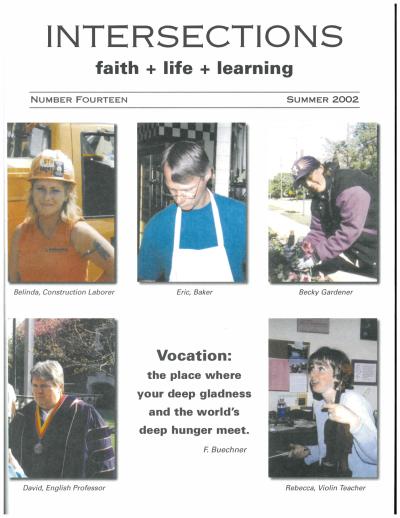
Bunge, director of the process for writing Valparaiso’s nearly two-million-dollar Lilly grant on the Theological Exploration of Vocation, argues that contemporary culture’s reduction of vocation to either paid work or self-fulfillment requires Lutheran institutions to renew attention to a rich theological concept rooted in Luther’s expansion of vocation beyond the priesthood. She outlines eight low-cost “doorways”—caring adults, prayer, worship leadership, music and the arts, service, cross-cultural experience, church camps and wilderness, study and reflection—and describes Valparaiso’s two-program structure: a Campus-Wide Program weaving vocation into Freshman Core Courses and chapel life, and a Church Vocations Program for students considering full-time ministry. She closes with four troubling questions for any institution carrying out such a grant: what faith traditions can learn from one another, how to involve parents, whether faculty and staff have space to reflect on their own vocations, and whether daily institutional practices—family policies, treatment of low-paid staff, environmental responsibility, obligations to the wider community—actually reflect a commitment to love of neighbor.
-
 Article
Engaging the Local Community: Why Bother?
Mary S. Carlsen
No. 27 · Spring 2008
Carlsen traces the often adversarial history of town-gown relations from the medieval universities through the Battle of St. Scholastica Day to the “ivory tower” pattern of American higher education, then argues that Lutheran colleges should engage their local communities for practical, educational, ecological, moral, and theological reasons. Drawing on her work in social work education at St. Olaf and on Ira Harkavy, Ernest Boyer, and the ELCA’s “Our Calling in Education,” she offers a recipe for engagement that is Passionate, Ethical (Needed, Welcomed, Mutual, Long-term, Attentive to diversity, Strengths-based, Respectful), and Reflective.
-
 Editorial
From the Publisher
Mark Wilhelm
No. 29 · Spring 2009
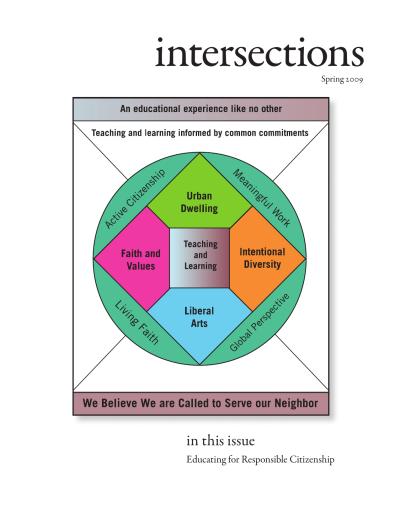
Wilhelm introduces essays from the 2008 Vocation of a Lutheran College Conference held at Luther College under the theme “Educating for Responsible Citizenship,” previewing contributions from Paul Pribbenow on dual citizenship at Augsburg, Wanda Deifelt on Luther College’s engagement with civic vocation, Jose Marichal on the promise and peril of digital citizenship, and Arne Selbyg on his three experiences of being educated for citizenship.
-
 Article
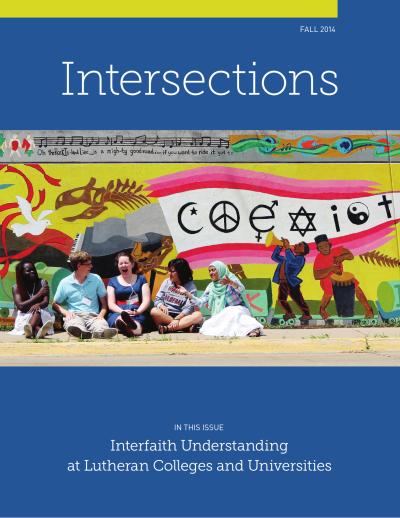
Journey Toward Pluralism: Reimagining Lutheran Identity in a Changing World
Jacqueline Bussie
No. 40 · Fall 2014
Bussie chronicles Concordia College’s Forum on Faith and Life initiative — assessing campus climate, building a President’s Interfaith Advisory Council, and drafting a one-sentence statement that Concordia practices interfaith cooperation “because of” (not “guided by”) its Lutheran identity — to argue that simul justus et peccator thinking equips Lutheran institutions to hold loyalty to tradition and reverence for others together as one piece.
-
 Article
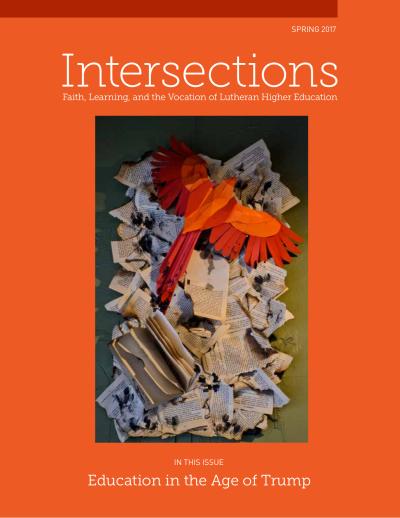
Jonah: The Anti-Hero of Vocation
Martha E. Stortz
No. 45 · Spring 2017
In a chapel talk first given at Augsburg College’s Vocation 2.0 series in September 2016, Stortz reads the prophet Jonah as the great anti-hero of vocation — one who tries to outrun God’s call to the great city of Nineveh — and argues that, in a season of urban violence and divisive election-year rhetoric, the story is less about public calling than about being called by the publics in our midst.
-
 Reflection
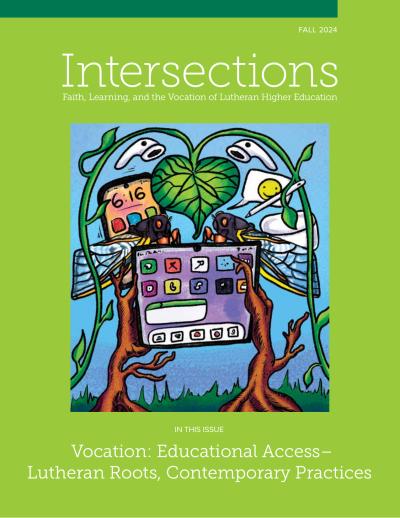
Reflecting on Belonging
Melissa Woeppel
No. 60 · Fall 2024
Woeppel, campus pastor at her own alma mater, wrestles with a Bethany student’s plea — “I want to feel like this is my home, like I belong” — and Mindy Makant’s reminder that we don’t choose the story of the past but do choose how we tell it forward, opening space for students from 35 faith traditions to find Lutheran institutions to be their home.