In his recent book, Dear Church: A Love Letter from a Black Preacher to the Whitest Denomination in the U.S., Lenny Duncan reminds us that the Evangelical Lutheran Church in America is 96 percent white—the whitest in the land. The colleges and universities affiliated with that church body are much more diverse, and are continuing to diversify quickly. And yet, most if not all of them remain historically, predominately, and persistently white institutions.
What is more, even if our student populations and (more slowly) faculty and administrator populations are increasingly “including” underrepresented groups, that “inclusion” is only the first step toward the full inclusion, the sense of belonging, and the equal justice that we want everyone on our campuses to experience. How do we teachers and administrators at historically, predominantly, and persistently white institutions turn from the white privilege and even the white supremacy (in the broadest sense) in which so many of us have been schooled, and from which we receive a legion of cultural and material benefits? How can our campuses become spaces in which people of color thrive and where white people get re-formed into antiracist allies?
These are difficult questions, and our responses must be courageous and ongoing. This summer, I was honored to join Dr. Monica Smith, Augustana’s inaugural Vice President for Diversity, Equity, and Inclusion, as part of a campus cohort attending the Truth, Racial Healing, and Transformation Institute at Villanova University. One lesson that I learned more deeply there is just how painful and recursive (a Christian might add, repentant) the healing of racial truth-telling is. There is no way of going forward toward full inclusion and equality without going back through the stories that we have told about our country, our religious heritage, and our institutions.
Leaders at my institution proudly speak of our founding as a Lutheran college for immigrants and others who did not have access to higher education. This year, we also commemorate a national Black Power Symposium that was held—not without controversy—on our campus fifty years ago. While we rightfully tell these positive stories, we also need to return to our blind spots, exclusions, and injustices, however unintentional they were and are. For example, while celebrating the fiftieth anniversary of our Black Student Union at homecoming last year, it became clear that a number of our alumni of color had little ongoing relationship with the college. Some graduates hadn’t set foot on campus since graduating fifty years ago, even though they still live just a few miles away. They came “home” for the special BSU homecoming event, but did not otherwise think of our college as a home for them. Why not? Our work is to keep asking and answering that question as truthfully as possible.
It is in that spirit that the planning committee organized the 2019 Vocation of a Lutheran College conference under the theme: “Beyond Privilege: Engaging Diversity, Inclusion and Equity” and that the authors put forward the following essays. They are written by faculty, diversity officers, chaplains, and provosts; by white folks and persons of color; by males and females and non-binary persons. We hope that together they inspire and structure the truth-telling work of moving from diversity to full inclusion and equity for everyone on our campuses.
-
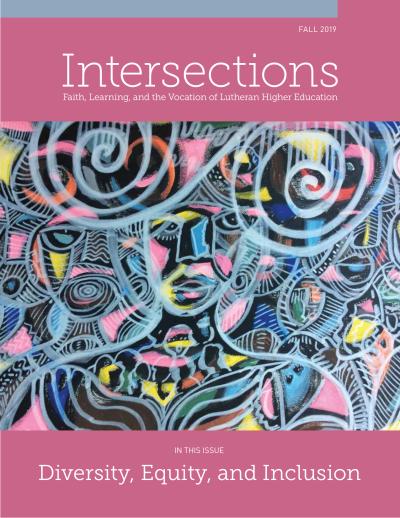 Editorial
From the Publisher
Mark Wilhelm
Wilhelm frames the issue by noting that a federal court’s vindication of Harvard’s race-conscious admissions process is a win for higher education’s commitments to diversity, equity, and inclusion — and argues that for Lutheran higher education, the commitment to diversity is an old and foundational claim, rooted in Christianity’s openness to all and reflected in the four diverse gospels of the New Testament.
-
Article
Making Diversity Matter: Inclusion is the Key
Monica Smith
Smith, Augustana’s inaugural Vice President for Diversity, Equity and Inclusion, frames the work of a Chief Diversity Officer as that of a disrupter and argues that while diversity in higher education is already happening, inclusion is a choice — one requiring a fundamental institutional transformation that diversifies faculty and staff, infuses diversity into the curriculum, invests in professional development, and draws on senior leadership to dismantle barriers.
-
Article
The Perils and Promise of Privilege
Guy Nave
Nave argues that privilege is always used in one of two ways — to preserve privilege by promoting inequity, or to challenge privilege by promoting diversity, inclusion, and equity — and uses examples from Indianapolis Catholic schools, Martin Luther, and equity-mindedness research to call Lutheran institutions to address the racist practices and policies that reproduce whiteness on their campuses.
-
Article
The Vocation of White People in a Racist Society
Caryn Riswold
Riswold proposes that whiteness is a weakness borne of apathy, atrophy, and ignorance — an atrophied muscle of race-consciousness — and offers concrete practices (reading, adjusting one’s gaze, consuming media differently, drawing on ELCA social statements like the repudiation of the Doctrine of Discovery) for exercising that muscle and naming the vocation of white people in a racist and white supremacist culture.
-
Article
Learning the Language of Inclusive Pedagogy
David Thompson
Thompson frames inclusive pedagogy as a foreign language with its own vocabulary, grammar, and cultural values, and reflects on a year of immersing himself in readings, conversations, and workshops — arguing that proficiency grows when instructors study and practice these languages repeatedly and atrophies when ignored.
-
Article
The "V" Word: Different Dimensions of Vocation in a Religiously Diverse Classroom
Martha E. Stortz
Stortz responds to a sea of blank stares when she used the word “vocation” in a religiously diverse required course by offering five metaphors — place, path, relationships, lens, and story — that point to different dimensions of vocation across the world’s religions and help students articulate their callings on their own terms.
-
Book Review
The American Myth of White Supremacy: A Review of Myths America Lives By
Susan VanZanten
VanZanten reviews Richard T. Hughes’s Myths America Lives By: White Supremacy and the Stories that Give Us Meaning, which argues that the United States grounds its identity in five myths — Chosen Nation, Nature’s Nation, Christian Nation, Millennial Nation, and Innocent Nation — all informed by the primal myth of white supremacy, and considers what Lutheran theological values can offer for resisting that myth.
-
Reflection
Seeing in a New Way: A Meditation
Kara Baylor
Baylor, the only Black campus pastor in the NECU, weaves Psalm 25, the parable of the Good Samaritan as re-read through Lenny Duncan, and the “crimson thread of divine justice” from Allen Dwight Callahan into a meditation that closes with the invitation she offered at the 2019 conference — to tie a crimson thread around the wrist as a symbol of collective commitment to moving beyond privilege toward inclusion and equity.
-
Article
Conciliatory and Queer: The Radical Love of Lutheran Higher Education
Kiki Kosnick, Sharon Varallo
Kosnick and Varallo reflect in conversation on how Augustana’s Five Faith Commitments and its conciliatory ecumenical roots in the Augsburg Confession have given them — a non-binary queer first-generation faculty member and a twenty-one-year veteran — the “street cred” to act on radical love, build bridges to imprisoned and non-binary communities, and discover that Augustana is welcoming not despite the fact that it is Lutheran, but because of it.
-
 Article
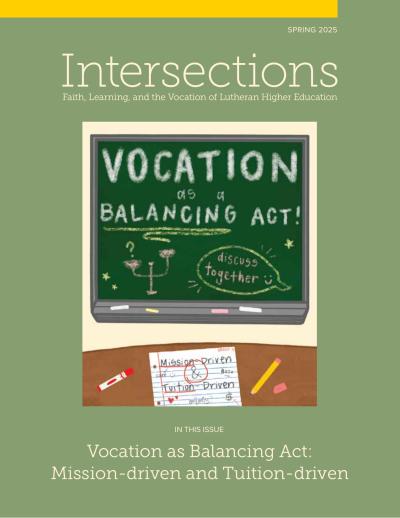
Vocation at Full Stretch: Reflections on Follow Your Bliss and Other Lies about Calling and its Use among College Students
Jason A. Mahn
No. 61 · Spring 2025
43 min audio
Mahn engages Bonnie Miller-McLemore’s Follow Your Bliss and Other Lies about Calling as required reading in a sophomore religion course, showing how her categories of missed, blocked, conflicted, fractured, unexpected, and relinquished callings empower young adults to perceive embodied, unplanned, and often painful dimensions of life as essential parts of vocation — and help close the gap between mission-driven and tuition-driven realities.
-
 Article
On Recruiting Diverse Students, Rooted in Mission
Eric Rowell, Jason A. Mahn
No. 59 · Spring 2024
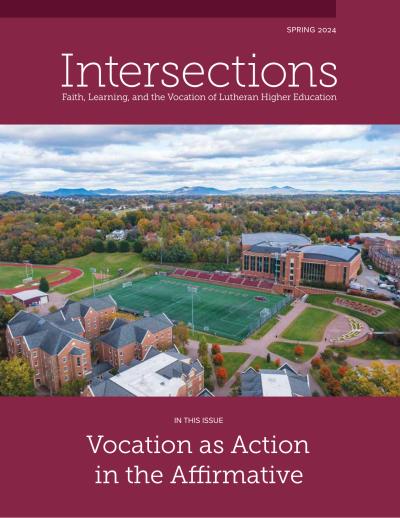
Jason Mahn interviews Eric Rowell, Assistant Director of Admissions and Diversity Outreach at Augustana College, about how recruiting students from a wide variety of backgrounds — rooted in Augustana’s Lutheran commitment to vocation and educating across difference — remains essentially unchanged in the wake of the Supreme Court’s 2023 decisions on affirmative action.
-
 Editorial
From the Outgoing Editor
Jason A. Mahn
No. 55 · Spring 2022
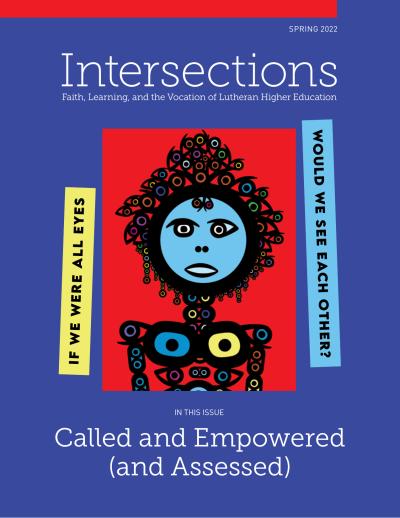
Mahn closes out a decade of editing Intersections, passes the duties to Colleen Windham-Hughes, gives thanks to Mark Wilhelm and Augustana College, and introduces an issue largely drawn from comments by Lutheran faculty, staff, and administrators at the 2022 NetVUE national gathering.
-
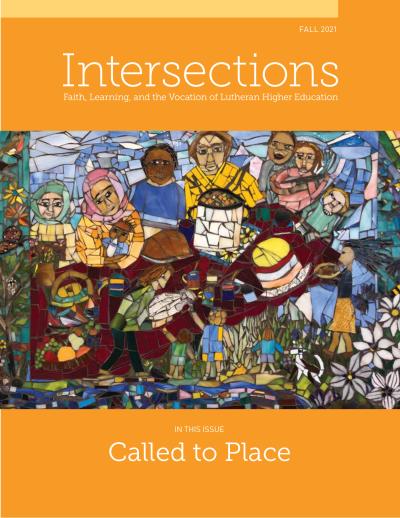 Editorial
From the Editor
Jason A. Mahn
No. 54 · Fall 2021
Mahn introduces the “Called to Place” theme of the 2021 VLHE Conference, arguing that Lutheran higher education’s emphasis on vocation must be grounded in particular geographies and embodied communities — for, as Wallace Stegner put it, “If you don’t know where you are, you don’t know who you are.”
-
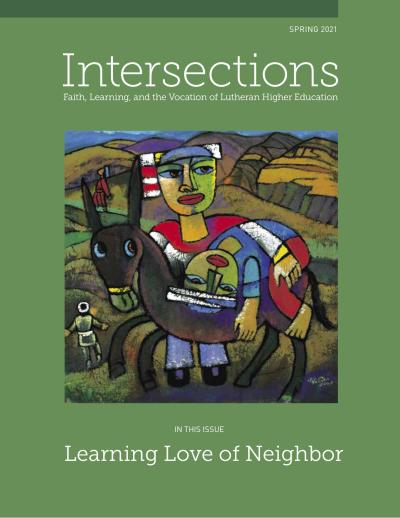 Reflection
Shelter in Place: Reflections from March 22, 2020
Jason A. Mahn
No. 53 · Spring 2021
On the fourth Sunday of Lent in 2020, Mahn meditates on the etymology of “shelter” (from shield) and on an email from a former student in Boston whose mutual-aid organizing models a Lutheran understanding of vocation: the upending of ego by divine love that frees us, finally, to see and serve the neighbor.
-
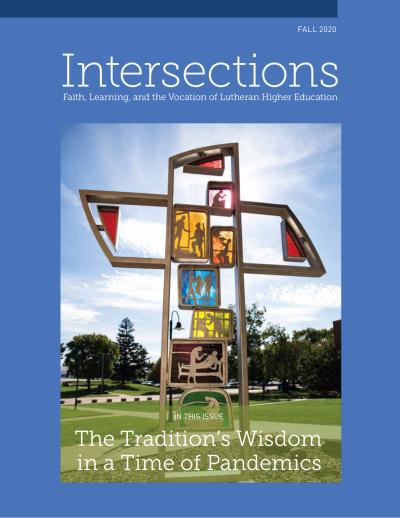 Editorial
From the Editor
Jason A. Mahn
No. 52 · Fall 2020
Mahn narrates a year of crisscrossing pandemics — Covid-19, economic collapse, partisan politics, and the long pandemic of white supremacy revealed anew by the murder of George Floyd — and argues that Lutheran liberal arts schools, by educating for vocation, are uniquely poised to help students respond with character and capable callings.
-
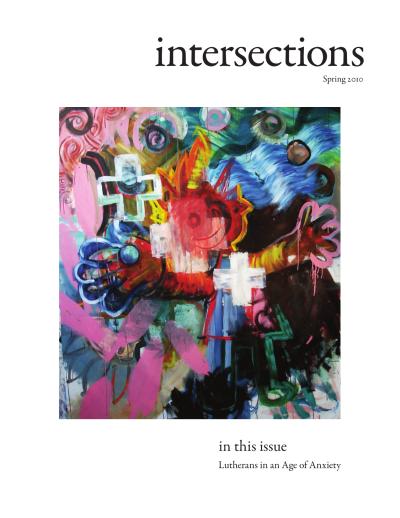 Article
Living at the Intersection of Fear and Hope
Mark S. Hanson
No. 32 · Spring 2010
Hanson draws on his January 2009 ELCA/ELCIC visit to Jordan, Israel, and Palestine—a Hebron Quran that did not burn, fifth graders dancing at the Hope School, a conversation with King Abdullah II—to frame the vocation of Lutheran higher education at the intersection of fear and hope. Engaging Brueggemann, Sittler, Buechner, Auden, Strandjord, Douglas John Hall, W. Robert Connor, Lewis Mudge, and Cynthia Moe-Lobeda, he argues that Lutheran colleges are called to critical inquiry that does not collapse into a hermeneutic of suspicion, to a “thinking faith” that resists religious fundamentalism, and to communities of discernment that work for the common good.
-
 Editorial
From the Publisher
Arne Selbyg
No. 22 · Spring 2006
Selbyg notes that both the ELCA and Intersections have undergone major changes this year—the Division for Higher Education and Schools is gone, replaced by the Educational Partnerships and Institutions group within the Vocation and Education unit, and the journal has a new editor (Robert Haak), a new home at Augustana College, a new printer, and a new design. He commends the issue’s focus on human sexuality and points readers to the first draft of Our Calling in Education.
-
 Article
The Ought
Ned Wisnefske
No. 19 · Summer 2004
Wisnefske observes that students and faculty raise contradictory objections to moral education—that students are already morally formed, and that teachers must not form them—and argues that both share the same fear of “the Ought.” He proposes that the Ought is best encountered not in front of us but behind us, nudging us, as we exercise impartiality, sympathy, and free will and discover that the persons participating in moral inquiry deserve respect; the Ought can then reform our past formations and transform our wants, so that it is never too late, or a mistake, to be shaped by it.
-
 Article
Women Presidents in Higher Education: How They Experience Their Calling
Aimee Goldschmidt, Gary McLean, Katherine A. Tunheim
No. 42 · Fall 2015
Drawing on in-depth interviews with fifteen women college presidents and a transformative-learning-theory framework, Tunheim, McLean, and Goldschmidt trace a three-stage journey — identifying, interpreting, and pursuing the call — and ask what the language of vocation contributes to the preparation and mentoring of women leaders in higher education.
-
 Response
Response to Mark Wilhelm: Distinguishing Between Identity and Vocation
Andrew Tucker
No. 56 · Fall 2022
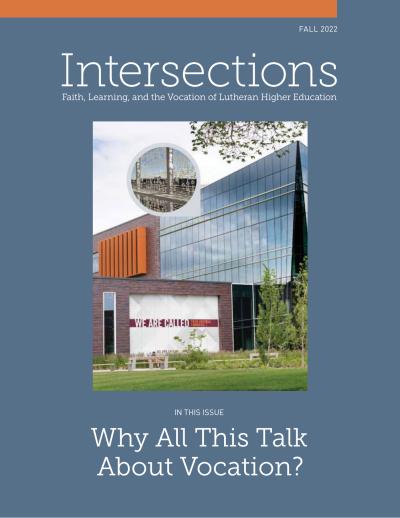
Tucker proposes that NECU’s next most faithful step is to faithfully and effectively differentiate vocations and identities — arguing that identity is who you are, vocation is what you do, and that recognizing the plurality of both helps Lutheran institutions name which work is theirs to take up and which is good work that belongs to someone else.
-
Article
Practicing Hope: The Charisms of Lutheran Higher Education
Martha E. Stortz
No. 32 · Spring 2010
Stortz names four charisms—theological gifts of identity rather than commodities—that Lutheran higher education brings to a culture of fear: semper reformanda as flexible, responsive institutions; the freedom of a Christian as simul justus et peccator critical inquiry that holds opposites in creative tension; regard for the other as “neighbor” rather than friend or alien; and the priesthood of all believers as a public, civic calling to know the poor. Drawing on Augustine, George Lindbeck, Patricia Killen, James Clifford, Earl Shorris, Carter Lindberg, and Augsburg’s Center for Global Education, she argues that immersion trips, neighbor-regard, and welfare reform witness that the gift Lutherans bring is hope grounded in Christ in you, the hope of glory.