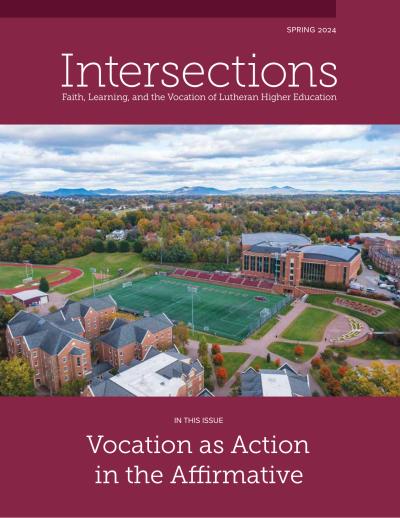
One of my professors in grad school sometimes said to us, “We are always practicing at the borders of our incompetence.” It was meant as an expression of kindness and compassion–a way to affirm the difficulties we would undoubtedly experience while simultaneously affirming the need to show up and continue to practice there at the borders, i.e., to commit to presence and action in the face of uncertainty and felt incompetence.
Life lived in the framework of vocation or calling often asks us to practice at the borders of our incompetence–trusting our experience, training, convictions, and commitments to each other as neighbors to guide us through various challenges. Every small yes to the callings we experience, every action toward good without security of success, every effort made in the direction of life, is action in the affirmative.
In this issue you will find many kinds of action in the affirmative. Colleagues at Susquehanna University have co-written a thoughtful and helpful piece that connects university history to current commitments. It narrates for us the work that goes into forming a new division that reflects the university’s mission and values. A piece by Mark Ellingsen makes the case that Lutheran reforms have always taken actions in the affirmative. And a piece co-written by a professor and two students at Cal Lutheran draws upon Rooted and Open, among other sources, to make the case that ELCA colleges and universities are uniquely equipped to respond to challenges like AI because of the qualities of service to neighbor, critical thinking, wisdom, humility, and hope.
Two of our colleagues at Augustana, Rock Island, sat down to talk about commitment to diversity as a necessary component of vocation-centered education. In the words of Eric Rowell, Assistant Director of Admissions and Diversity Outreach, “We help our students find something that allows them to feel whole, and to be able to contribute to the good of society.”
Two pieces focus on different kinds of contributions to the good of the society. Student Ken Flores writes of the slow work of reformation and transformation, connecting internal work to the work of institutions in society. Another piece showcases the team cultures of our soccer champions (Cal Lutheran Women’s and St. Olaf Men’s) and the contributions of student-athletes to liberal arts and sciences education.
And Jeremy Myers of the Riverside Innovation Hub at Augsburg University shares the practices they use with congregations in the ongoing work of discerning institutional vocation. Their adaptation of Ignatian Examen, along with the team processes to follow up with actions affirming low-hanging fruit, moonshots, and coffee conversations, will help groups on any campus sort through experiences and refocus shared work.
Here’s to large and small actions that affirm vocation in Lutheran higher education!
-
 Editorial
From the Publisher: Navigating Affirmative Action, DEI Policies, and Lutheran Vocational Identity
Lamont Anthony Wells
Wells surveys the converging pressures on NECU institutions — the unsettled landscape of affirmative action, political and academic scrutiny of DEI work, and the preservation of distinctively Lutheran vocational identity — and previews how the issue draws on affirmative practices, sociological viewpoints, and theological responses to navigate a path forward.
-
Article
Forming the Division for Access, Equity & Belonging at Susquehanna University
Amy Davis, Dena Salerno, María L. O. Muñoz, Nina Mandel, Scott Kershner
Five Susquehanna University colleagues trace the institution’s 166-year arc from a Missionary Institute founded to remove barriers to education through the formation of a new Division for Access, Equity & Belonging in 2023, arguing that access rooted in Lutheran origins must continue to drive policy revision, infrastructure, and belonging for minoritized communities today.
-
Article
On Recruiting Diverse Students, Rooted in Mission
Eric Rowell, Jason A. Mahn
Jason Mahn interviews Eric Rowell, Assistant Director of Admissions and Diversity Outreach at Augustana College, about how recruiting students from a wide variety of backgrounds — rooted in Augustana’s Lutheran commitment to vocation and educating across difference — remains essentially unchanged in the wake of the Supreme Court’s 2023 decisions on affirmative action.
-
Article
What Our Lutheran Heritage Entails for Lutheran Colleges and Affirmative Action
Mark Ellingsen
Ellingsen argues that the Lutheran Two-Kingdom Ethic — far from leading to political reaction — supports the church-relatedness of ELCA colleges and obligates them to keep affirmative action alive, even reading a Chief Justice Roberts “loophole” in Students for Fair Admissions v. Harvard as an open door for Black community partnerships, ELCA congregations, and Lutheran colleges to act in the affirmative.
-
Reflection
On the Power of Transformation and Becoming Human
Ken Yanai Flores
Flores, a Cal Lutheran sophomore, reflects on personal and institutional transformation as the slow work of shedding the armor of trauma responses, engaging discomfort rather than turning away, and trusting that the work of becoming more human — more empathetic, knowledgeable, and free — will be reflected in our institutions as well.
-
Article
The Critical Role of Lutheran Higher Education in the Age of Artificial Intelligence
Jose Marichal, Maya Goehner, Tyler Haug
A Cal Lutheran political science professor and two of his students draw on Rooted and Open to argue that Lutheran higher education is uniquely positioned to stake out a middle path between AI utopianism and AI doom — cultivating a “healthy sense of human limit,” resisting data colonialism, and forming students to see the neighbor rather than the enemy as the world becomes increasingly synthetic.
-
Article
Team Culture is Key to Success: Learning from Student-Athletes
Colleen Windham-Hughes
On a December weekend in “Championship City” Salem, Virginia, both California Lutheran’s Women’s Soccer Team and St. Olaf College’s Men’s Soccer Team won NCAA Division III national titles. Windham-Hughes talks with coaches, faculty mentors, and student-athletes about how off-the-field team culture — built on trust, relationships, and shared why — translates onto the pitch and into liberal arts and sciences education.
-
Article
Low-Hanging Fruit, Moonshots, and Coffee: Dreaming Big Within and Beyond Our Limitations
Jeremy Myers
Myers shares the process used by Augsburg’s Christensen Center for Vocation to help teams move from a shared experience to next steps — an Ignatian-rooted Awareness Examen followed by naming low-hanging fruit, moonshots, and the coffee conversations that build the coalition to make it all happen.
-
 Editorial
From the Publisher & Editor
Colleen Windham-Hughes, Lamont Anthony Wells
No. 63 · Spring 2026
6 min audio
Wells and Windham-Hughes frame vocation as “ground game” — the practical, public living-out of faith through civic engagement — and introduce the issue’s focus on how Lutheran higher education equips students to repair the world.
-
 Editorial
From the Editor
Colleen Windham-Hughes
No. 62 · Fall 2025
5 min audio
Windham-Hughes plays on the shared Latin root of “education” and “seduction” (ducere, to lead) to warn against the No-saying seductions of giving up or condemnation, and to call educators to the riskier Yes of showing up to build third-space communities of truth-telling and hope.
-
 Editorial
From the Editor
Colleen Windham-Hughes
No. 61 · Spring 2025
5 min audio
Windham-Hughes uses Fred Rogers’ neighborhood as a living embodiment of a Lutheran understanding of vocation — seeing dignity in each person, offering one’s gifts generously, and trusting that the well-being of the neighborhood is intrinsically connected to the well-being of every neighbor.
-
Institutional Focus
So That All May Belong: Lutheran Roots for Diversity, Equity, Inclusion, and Justice
Altheia Richardson, Angie Hambrick, Caryn Riswold, Colleen Windham-Hughes, Deanna Thompson, Marcia Bunge, Robert Clay
No. 61 · Spring 2025
22 min audio
The full NECU statement grounds DEIJ work in Luther’s 16th-century reforms and Lutheran theological claims about the image of God, equal dignity, and the limits of human knowing — offering definitions, Lutheran roots, and calls to action for diversity, equity, inclusion, and justice, with belonging as the outcome of DEIJ at work.
-
Institutional Focus
Scriptures That Inspire Work for Diversity, Equity, Inclusion, and Justice
Altheia Richardson, Angie Hambrick, Caryn Riswold, Colleen Windham-Hughes, Deanna Thompson, Marcia Bunge, Robert Clay
No. 61 · Spring 2025
9 min audio
A companion list of biblical verses — from Genesis 1:27 and Galatians 3:28 to Micah 6:8 and Luke 4:18-19 — that grounded NECU’s drafting of So That All May Belong, organized by the four DEIJ commitments and offered as an invitation to share other texts that ground and sustain the work.
-
Institutional Focus
So That All May Belong: Lutheran Roots for Diversity, Equity, Inclusion, and Justice [abridged]
Altheia Richardson, Angie Hambrick, Caryn Riswold, Colleen Windham-Hughes, Deanna Thompson, Marcia Bunge, Robert Clay
No. 61 · Spring 2025
8 min audio
A condensed version of the NECU statement that consolidates Lutheran theological grounding for DEIJ and a single combined call to action for Lutheran colleges and universities — offered as a shareable summary alongside the complete document.
-
Article
Fostering Moral Imagination and Inclusivity: The Role of Ethical Leadership in ELCA Colleges and Universities Amid Societal Challenges
Lamont Anthony Wells
No. 62 · Fall 2025
12 min audio
Wells argues that “moral imagination” — the capacity to envision ethical alternatives, empathize across difference, and respond creatively to injustice — is the heart of ethical leadership in NECU institutions, and that anchoring leadership in this principle positions Lutheran higher education to cultivate socially responsible citizens.
-
 Article
An Aristotelian Twist to Faith and Learning
Gregg Muilenberg
No. 3 · Summer 1997
Muilenburg, chair of Philosophy at Concordia, surveys the four traditional models for faith and reason—conflict, independence, dialogue, and integration—and argues that the Lutheran dialogical model is insufficient for wholeness. Drawing on the post-foundationalist epistemology of perspective and Aristotle’s account of knowing as desire-driven action, he proposes that faith is an ultimate value (an assessment belief of the form ‘x is better than y’), that learning is desire-directed action, and that the core of Christian education is the education of Christian desire—requiring both reflection and commitment, both integration and diversity.
-
 Article
Marked by Lutheran Higher Education
Martha E. Stortz
No. 49 · Spring 2019
Stortz offers an “operating manual” to Rooted and Open by tracing how the writing team moved from descriptive marks of the institutions to aspirational verbs that mark people — “called and empowered, to serve the neighbor, so that all may flourish” — and shows how each mark generates educational priorities theologically grounded in the radical mystery of God, the wild generosity of God, and the God who became one of us.
-
 Article
Mentoring in the Academy: Of Gurus, Coaches, and Sponsors
Faith Wambura Ngunjiri
No. 41 · Spring 2015
Ngunjiri urges faculty, staff, and administrators in faith-based institutions to assemble a “personal board of directors” of mentors — connectors, sponsors, taskmasters, motivators, dreamers, sages, and proofers — and reflects on how race and gender complicate mentoring in predominantly white, male-led ELCA institutions, where women and minorities must reach out to build the “cloud of witnesses” they need to thrive.
-
 Editorial
From the Editor
Robert D. Haak
No. 22 · Spring 2006
Haak introduces himself as the new editor inheriting the journal from Tom Christenson and frames the issue around the question of what ELCA colleges might contribute to conversations about human sexuality. He summarizes the contributions of Yeager, Benne, Williams, Bussie, and Nack, and shares previously uncollected National Study of Youth and Religion data on the sexual attitudes and behaviors of Lutheran teens—including that 25% of regularly-attending ELCA teens report the church has done nothing to help them with their sexuality.
-
 Article
Called for Life — Affirming Vocational Discernment
Richard L. Torgerson
No. 31 · Winter 2010
Torgerson introduces the “Called for Life” project, a three-year, $278,437 Lilly Endowment-funded collaboration among Luther, Augsburg, and Augustana that—in partnership with Luther Seminary’s Centered Life initiative and Wilder Research—rigorously assessed the effectiveness of campus vocation programs, examining whether students’ exposure to and understanding of calling had increased, and what program elements were most effective in shaping discernment.