“Everyone says they love Mother Nature, but they never invite her over to their houses!”
Niel Diboll’s comment was greeted with sympathetic laughter from the subjects of my research, members of an organization called Wild Ones Native Landscaping.1 These mostly retired homeowners joined the Wild Ones because they want to prioritize native plants in their landscaping efforts. Diboll was speaking at an annual conference which, to my eyes, also doubled as a kind of tent revival: an opportunity for members to reaffirm their commitments to a worldview and practice somewhat at odds with the mainstream (Diboll).
Most buildings feature lawns and bushes; not the houses of the Wild Ones. The Wild Ones members dig up their lawns and plant prairies; they eschew begonias and pansies for native flowers; they tirelessly dig up invasive species; they restore forests and wetlands, plant native “weeds,” and welcome wildlife to their land. It’s an effort towards sustainability, a piecemeal restoration of functioning ecosystems in the aftermath of human domination.
These people are the ones who do invite mother nature to their houses. Doing so is not easy. All landscaping takes time and effort, but native landscaping requires even more, particularly in its beginning phases.2 Why bother? They do it for the reasons you might expect—an attraction to the beauty of the plants, a desire to remedy problems of drainage or access, or an effort to un-do some of the harms perpetrated by human action on the land. But according to my interviews with members of the Fox Valley (WI) Area Chapter of the Wild Ones, I discovered another, surprising motivation: hospitality to insects and birds.
Douglas W. Tallamy, author of a Wild Ones’ favorite, Bringing Nature Home, clearly lays out a plan for hospitable native landscaping as follows: native birds require native insects, and native insects require native plants, so hospitality to native birds requires a garden of native plants (Tallamy 13-17). One member I interviewed boasted that owls had come to his property after following Tallamy’s advice. Another member gushed to me about her native butterfly garden, which attracts a panoply of native insects, including Monarchs. Clearly, hosting these insect visitors gave her deep joy.
At a gathering of the group, I asked if anyone was interested in native edible plants—plants that humans might forage and enjoy—but the answer was no. One member said that she would rather feed insects and birds than feed herself: she prioritized a posture of hospitality toward others through her landscaping (Hartman).Others agreed: their main concern was to host these “underdog” organisms who struggle to find a home in our all-too-human world.
Their main concern was to host these ‘underdog’ organisms who struggle to find a home in our all-too-human world.
At a recent conference, I heard an extraordinary paper: “Creature Comfort: Foundations for Christian Hospitality Toward Non-human Animals” by Marilyn L. Matevia. Matevia examines the plight of wild animals in a human-dominated landscape, and calls Christians to a “radical, kenotic, challenging, potentially costly kind of hospitality” towards animals (6). She draws on robust traditions of Christian hospitality to the stranger, rooted in norms from the Hebrew Bible and parables such as the Good Samaritan. Matevia concludes that we should, at the least, “protect existing habitat,” create “sanctuary spaces for animals that have been displaced,” build “wildlife corridors over highways,” find ways to help migratory animals deal with border walls, and similar basic measures to minimize harm to the wild animals with whom we share a home (18-19). Matevia is calling for humans to create safe, hospitable spaces for animals in our too-human contexts.3
In the discussion after the paper presentation, someone questioned this idea of human hospitality to non-humans. Isn’t God the true host, the real proprietor of wild spaces? Who are we to consider ourselves hospitable, as if we’re in charge here? I had wondered something similar about the Wild Ones—isn’t there some kind of false noblesse oblige or even grandiosity in the idea that it is up to us, the heroic humans, to extend a welcome to poor suffering plants and animals?
In spite of this critique, there is some truth to the implied power dynamic: we humans do have power over other creatures. Why do the Wild Ones members use their land to feed birds and insects rather than feeding themselves? Because these humans get their food from a grocery store. They have options; the Monarchs don’t. Wild nature is vulnerable in this situation. Indeed, nature’s vulnerability brings out the Wild Ones members’ heroic side when they participate in plant rescues. A plant rescue occurs when some patch of native vegetation is under threat from construction; word goes out among club members, and they converge on the site, spiriting the native plants to a location safe from the bulldozers. Humans are the heroes for the vulnerable vegetation in this tale.
Whether we should or not, humans do control—or at least influence—a very large proportion of the world’s ecosystems. We have the power to destroy it all; any bit of wildness that exists, exists because we have decided not to obliterate it. I want to believe that God is the true host and ultimate proprietor, but we have a vital role, too. We are the stewards, the gatekeepers, the bouncers at the doors to the club. We are the ones who can exercise hospitality to animals, or choose not to. What does the situation demand of us?
We are the ones who can exercise hospitality to animals, or choose not to. What does the situation demand of us?
Both Matevia and the Wild Ones represent an appeal to our “better angels,” asking us to embrace the virtue of hospitality as we help those who are worse off—the animals or plants seeking to live their lives in a world controlled by humans.
Some of my research subjects were descended from pioneers who they referred to as “sodbusters.” These ancestors came to the Midwestern prairies and imagined farmland; they enacted their vision by busting up the sod, plowing the prairie and planting row crops. Now, their descendants who are Wild Ones members both make excuses—“they had to make a living; they didn’t know how much damage they were causing”—and make changes, bringing the prairie back to the land once more.
Groups like the Wild Ones try to reverse human damage to the land, to go from desolation to community. They are like healers, restoring what was lost and conjuring vibrant interconnected ecosystems where there once were sterile lawns. They can do this, in part, because they are able to envision a world with no lawns, where the prairies are put back: a world in which “landscaping with native plants becomes the norm” (Wild Ones: About). There is a backward-looking nostalgia here, a longing for a time before colonization and civilization bent the wild toward pursuit of profit or narrow, cultivated versions of the beautiful.
Scholars like Matevia also deploy imagination. Matevia talks about hospitality to animals as “restorative justice,” implementing this virtue of hospitality in the service of habitat restoration (17). Our faith demands that in cases of injustice, or ruptured relationships, we put back what was lost: restore habitat, create wildlife corridors, build bridges and tunnels and ladders for wildlife to handle the roads and the dams. This, too, involves the imagination, as Matevia exhorts us to make manifest in this world something that ought to be, but is not yet here.
Hospitality should stretch and challenge us.
All of these represent the “ecological imaginary,” that is, the human vision of what a specific natural space should be, by contrast with what it is (Foster and Sandberg 196). That imagination holds tremendous transformative power. We can’t change something until we can imagine it changed. And the changes don’t stop with the Wild Ones members’ homes or Matevia’s dam ladders. Christian hospitality extends as far as Christian stewardship extends—over the whole earth, including our neighborhoods and farms, our parking lots and roads, our churches and our colleges. We are called to recognize what is, and what has been lost—and to imagine what should be restored or renewed.
There may be a downside to hospitality. Do we really want to welcome someone dangerous, offensive, or unpleasant into our homes? Maybe there’s a reason we don’t invite Mother Nature to our houses: if she brings dirt, disease, or disgust, she may be an unwelcome guest. For example, some churches in Great Britain have struggled with bats, which are protected by law and cannot be eradicated from church buildings, even if their presence disrupts the worship.4 This may present a very difficult conundrum, but Matevia wishes to challenge us: “the practice of hospitality privileges the stranger over the insider, and honors difference over sameness” (8). In other words, hospitality should stretch and challenge us.
There are mutually satisfactory solutions to the bat problem—and to other drawbacks of hospitality to the wild. In the spirit of this challenge, Matevia argues, we are called to exercise hospitality to non-human animals and in so doing, repair relationships we may not even realize had been ruptured. For the Wild Ones members, inviting the wild to live in their back yards is both sufficient challenge and groundwork for relationship repair. One member I interviewed referred to the birds and insects on her property as “neighbors,” proudly recounting her friendly interactions with them as they shared a prairie plot. “Whose earth is it anyway?” James Cone has rightly asked, pointing to racial disparities in environmental work. The answer to his question must include a diversity of people; it must also include the diverse tapestry of non-humans who also call these landscapes home:
Even the sparrow finds a home,
and the swallow a nest for herself,
where she may lay her young,
at your altars, O Lord of hosts,
my King and my God. (Psalm 84:3, NRSV)
If the psalmist can imagine birds finding a welcome in the temple, what about our other institutions? Can a desolate parking lot become host to a vibrant community, to an ecosystem? Can a college campus foster not just human diversity but biodiversity? What would a hospitable form of sustainability look like in our institutions? We may not even realize that a parking lot is stifling a floodplain, or that pesticide practices are threatening pollinators, or that bright lights at night are preventing fireflies from communicating well. But once we tap into an ecological imaginary, we see what has been lost, and we can see the possibilities for restoration and renewal all around us.
Can a college campus foster not just human diversity but biodiversity? What would a hospitable form of sustainability look like in our institutions?
With Matevia, I want to appeal to our “better angels” and ask how we might welcome the non-human in our lives, in our spaces, and in our institutions. It is time to reverse some of the damage done to the non-human world, to open our doors to Mother Nature’s knock. Whether God is the ultimate host or not, we are the gatekeepers. Let us imagine, and then implement, a hearty welcome to the diversity of God’s creatures, as we welcome strangers and friends.
Endnotes
1. The research of this essay was approved by the Institutional Review Board (IRB) of the University of Wisconsin Oshkosh.
2. A well-established native landscape may not require more maintenance than traditional landscaping. Unlike traditional landscaping, native plants rarely need extra water or fertilizer. But to establish a native landscape requires significant extra work in the beginning, to eradicate current invasives and continue to shield slow-growing native seeds from aggressive invasives over time.
3. She doesn’t get into the questions raised by farmed animals or domesticated animals. For some, these might indicate a kind of mutual hospitality in which we provide for the animals who also provide for us. At the same time, it seems to violate a standard of hospitality to kill one’s guest, which is the case for nearly all farmed animals.
4. Thankfully, the Bats In Churches partnership is seeking solutions so the bats can be unharmed and the worship can go on (see https://www.batsandchurches.org.uk/).
Works Cited
Cone, James H. “Whose Earth Is It Anyway?” CrossCurrents 50.1/2 (2000): 36-46.
Diboll, Neil. “The American Garden—A Life or Death Situation.” Wild Ones Fox Valley Area Conference: Toward Harmony With Nature. Oshkosh, WI. 27 January 2018.
Foster, Jennifer and Sandberg, L. Anders. “Friends or Foe? Invasive Species and Public Green Space in Toronto.” The Geographical Review 94 (2004): 178-98.
Hartman, Laura. “An Ethic of Restoration in the Fox River Watershed Or, What I Learned from the Wild Ones,” at Wild Ones Headquarters, the WILD Center, in Neenah, WI. 24 May 2018.
Matevia, Marilyn L. “Creature Comfort: Foundations for Christian Hospitality Toward Non-Human Animals.” Presentation at the Society of Christian Ethics conference, Washington, DC. 10 January 2020.
Tallamy, D.W. Bringing Nature Home: How You Can Sustain Wildlife With Native Plants. Portland: TimberA, 2009.
Wild Ones Wild Center. Accessed 1 Nov. 2021, http://wildoneswildcenter.org/about/
-
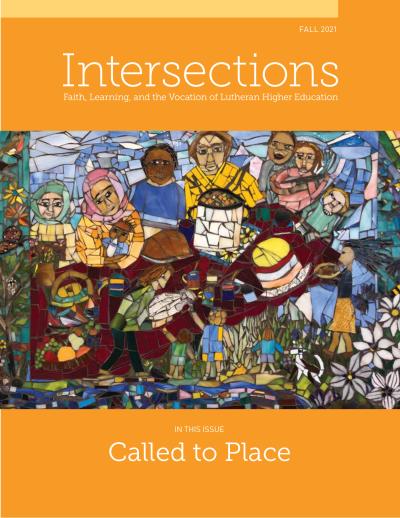 Editorial
From the Editor
Jason A. Mahn
Mahn introduces the “Called to Place” theme of the 2021 VLHE Conference, arguing that Lutheran higher education’s emphasis on vocation must be grounded in particular geographies and embodied communities — for, as Wallace Stegner put it, “If you don’t know where you are, you don’t know who you are.”
-
Article
Where Your Feet are Standing: Institutional Engagement and Place
Melissa Maxwell-Doherty
Maxwell-Doherty draws on Cal Lutheran’s Hispanic-Serving Institution designation and its location on Chumash, Fernandino Tataviam, and Ohlone lands to ask how the university’s mission might shift if it depended on where its students are standing — not just where the institution sits.
-
Article
Community-Building On Campus and Beyond
Krista E. Hughes
Hughes describes Newberry College’s effort to build a “culture of community” that mirrors South Carolina’s demographics while reckoning with the institution’s founding ties to slavery — and names the challenges and promising city-college collaborations that shape this ongoing work.
-
Article
Just Communities: From Liberal Arts in Prison to Racial Healing over Zoom
Monica Smith
Smith showcases how Augustana College’s commitment to social justice extends into the Quad Cities through two initiatives: the Augustana Prison Education Program at East Moline Correctional Center, and Racial Healing conversations developed through the Truth, Racial Healing and Transformation framework.
-
Reflection
Caught in a Place Between Caesar and God
Darrel D. Colson
Colson reflects on his anguish, as Wartburg’s president, over an Iowa law that prevents him from requiring student COVID-19 vaccinations — reading Luther’s “Whether One May Flee From a Deadly Plague” alongside the conflict between obeying the law and serving neighbor.
-
Article
Return to Purpose: Learning in an Age of Collapse
Ahmed Afzaal
Afzaal argues that the cascading crises facing higher education are not temporary glitches but symptoms of planetary and civilizational collapse — and that colleges must embrace “double-loop” learning and return to a shared sense of purpose if they are to help humanity descend gradually rather than catastrophically.
-
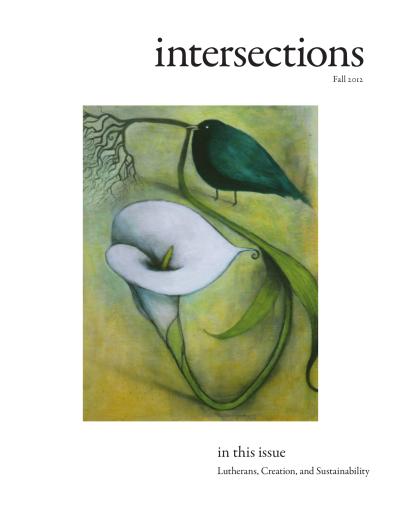 Article
Sustaining Sustainability
Baird Tipson
No. 36 · Fall 2012
Tipson—former Provost of Gettysburg College, President of Wittenberg University, and President of Washington College—reads Romans 12:2 (“be not conformed to this world…”) against Victor Ferrall’s Liberal Arts at the Brink and the contemporary financial reality of small Lutheran colleges. He tells three case-study stories from Washington College’s Center for the Environment and Society—the Chino Farms partnership, the Chesapeake Semester, and the acquisition of the work boat Callinectes—to show how presidents must engage “the world” to secure resources for sustainability work without being conformed to it.
-
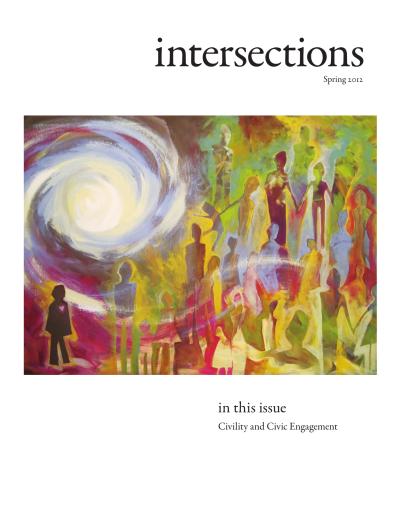 Editorial
From the Publisher
Mark Wilhelm
No. 35 · Spring 2012
Wilhelm describes the “four-legged stool” supporting ELCA higher education—the annual Vocation of a Lutheran College Conference, the Lutheran Academy of Scholars, the Thrivent Fellows program, and Intersections—and argues that the conversation about Lutheran mission and identity must now be extended beyond college and university personnel to the larger church and community before the gains of a generation are lost.
-
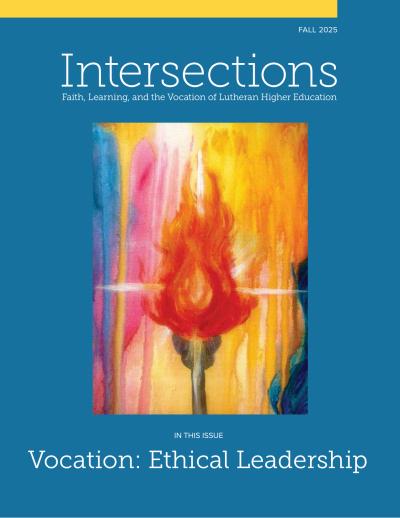 Article
Fostering Moral Imagination and Inclusivity: The Role of Ethical Leadership in ELCA Colleges and Universities Amid Societal Challenges
Lamont Anthony Wells
No. 62 · Fall 2025
12 min audio
Wells argues that “moral imagination” — the capacity to envision ethical alternatives, empathize across difference, and respond creatively to injustice — is the heart of ethical leadership in NECU institutions, and that anchoring leadership in this principle positions Lutheran higher education to cultivate socially responsible citizens.
-
 Book Review
Learning Across Campus: Hearing Bok's Call to Conversation
David Ratke
No. 39 · Spring 2014
Ratke reads Derek Bok’s Our Underachieving Colleges from Lenoir-Rhyne and argues that Bok’s call to think holistically about undergraduate education and to dialogue across disciplinary boundaries names the work already underway at ELCA colleges. He weighs faculty attitudes, the role of skills in the core curriculum and the major, and the importance of the extracurriculum for student formation.
-
 Editorial
From the Publisher
Mark Wilhelm
No. 45 · Spring 2017
Wilhelm describes how ELCA colleges and universities have shifted the definition of Lutheran higher education away from institutional markers toward alignment with educational values drawn from the Lutheran intellectual tradition — and previews a NECU-convened faculty working group whose recommendations will go to the ELCA college presidents at their June 2017 conference on Lutheran identity.
-
 Article
A New Image for an Ancient Call: Lutheran Higher Education Amidst Pandemics Today
Caryn Riswold
No. 52 · Fall 2020
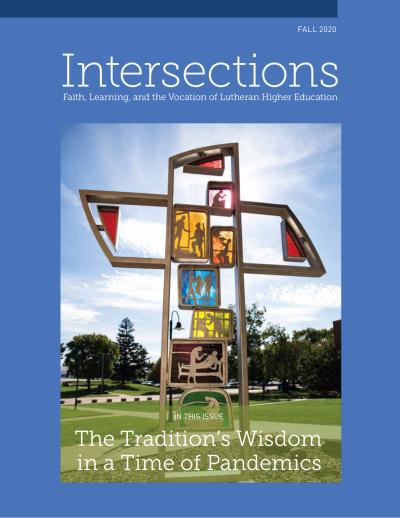
Pairing Wartburg’s Lebenskreuz sculpture with the Matthew 25 acts of mercy and the commitments of Rooted and Open, Riswold reads the calls to feed the hungry, welcome the stranger, and care for the sick as urgent summons for Lutheran higher education in a year of overlapping pandemics — and as a call to dismantle the structures that produced them.