“What Can We Learn From an Evolving & Complicated Biblical Depiction of Access?”
- The Bible is considered authoritative within Christianity in general and Lutheranism in particular. The Reformation doctrine of sola Scriptura affirms that Scripture should be understood as the sole source of divine revelation, the only inspired, infallible, final, and authoritative norm of faith and practice. While this doctrine has been used to promote the idea that there is a singular, consistent biblical perspective, the Bible reveals that human understanding is flawed and must always be open to change and evolution.
- The Bible is a mess. It is a collection of writings by dozens of authors and redactors spanning over 1000 years. You can find texts in the Bible that support virtually any perspective or position you can think of. Critics of the Bible often say it is useless because it is full of contradictions, and defenders of the Bible frequently deny its contradictions. Both critics and defenders are motivated by a belief that the Bible can only be meaningful if it presents a clear and consistent perspective that represents the unchanging will of God.
- However, both Bible critics and Bible defenders fail to understand what the Bible actually represents. The Bible is meaningful not because it presents a singular perspective but instead because it presents an ongoing evolution of thinking, which is always messy and complicated. Many books in the Bible are conversing with each other, and there is much we can learn from that conversation. When we learn to read the Bible as an ongoing conversation, we witness an evolution of thinking regarding various topics and issues. For our brief time together today, I want to look at the continuing conversation and evolution of thought regarding the issue of “accessibility.”
Deuteronomy 23:1-3
- Dating biblical texts is a challenging and, at times, contentious practice. There is rarely scholarly unanimity regarding the assigning of dates to biblical texts. The internal evidence of Deuteronomy indicates several stages of composition and editing. While the book of Deuteronomy refers to a much earlier time, most scholars date the stages of composition between the fall of the Northern Kingdom of Samaria (721 BCE) and the beginning of the Judean restoration (535 BCE). The text, therefore, spans an almost 200-year window. Let’s take a look at Deut 23:1-3.
- The explicit exclusionary perspective of this text is undeniable. Christians and people who embrace this text as part of their sacred collection of writings cannot ignore or deny the hatred and bigotry contained in the text. Trying to do so or making excuses for the text is “inexcusable.”
- The text comprises one of the many biblical texts that feminist biblical scholar Phyllis Trible calls “Texts of Terror.” The text proclaims a divine mandate to exclude people based on genital impairment, based on what was considered at that time to be improper [i.e., “illicit”] sexual unions, and based on ethnic identity. Descendants of such people were also excluded. While contemporary readers rightfully condemn this text, later biblical writers also condemned the text.
- While it is uncertain if the book of Ruth was written as a direct challenge to the prohibition against Moabites found in the book of Deuteronomy (as well as the prohibitions against foreign wives presented in the book of Ezra), it is clear that Ruth presents a competing and conflicting depiction. The story of Ruth is about a Moabite woman who was the great-grandmother of David, one of Israel’s most famous kings. As the great-grandson of a Moabite woman, David falls within the “tenth generation” of descendants excluded from the Lord’s assembly by Deuteronomy. Ruth clearly presents an evolving understanding of “accessibility.”
Isaiah 56:1-8
- Like Deuteronomy, the book of Isaiah also spans more than 200 years. Scholars often divide the book into three periods, referring to the first 39 chapters of Isaiah as “First Isaiah,” chapters 40-55 as “Second Isaiah,” and chapters 56-66 as “Third Isaiah.”
- Third Isaiah presupposes an audience that has returned to the land of Judah after the exile. The people have intermarried with so-called “foreigners” and have raised families of mixed ethnicities while in captivity. In returning to their homeland of Judah, they also find new ethnic groups living in the land. The author of Third Isaiah challenges the xenophobia and ethnic purity exhibited in the book of Deuteronomy.
- Most biblical scholars understand Isaiah 56:1-8 as a direct challenge to the teaching and instructions found in Deuteronomy 23. As with the book of Ruth, this passage presents an evolving understanding of “accessibility.”
Acts 10
- The book of Acts presents a so-called “history” of the birth and development of the community of Jesus-followers, which will eventually become known as “the Church.” A vital component of that development is the expansion and evolution of the Jesus community from an exclusively Jewish community to a community of Jews and Gentiles (i.e., non-Jews). Within the traditional Jewish worldview at that time, there were essentially two types of people in the world: there were “the people of God” (i.e., “Jews”), and there was everyone else (i.e., “Gentiles”). Acts 10 is one of the many stories challenging this dichotomy. Once again, this passage presents an evolving understanding of “accessibility.”
Matthew 15:21-28
- The last passage is from the gospel of Matthew. While the slide references the version of the story found in Mark’s Gospel, which most scholars believe to be older than Matthew’s version, I will be referencing Matthew’s version because I think the change the author of Matthew makes is significant.
- As we consider this passage, I want to introduce the notion of “privilege” and how it hinders “access.” The author's decision to identify the woman in this story as a “Canaanite” is significant. There is a long history in the Bible of divinely sanctioned violence by Israelites against Canaanites. In the biblical story of Israel’s god giving the “Promised Land” to the Israelites, God is depicted as giving instructions to the Israelites to enter into the homeland of other people, to take their land, and to destroy and kill every living being in the land. Canaanites are among the people to be killed (Deut 20:10-18). The “Promised Land” story reveals the way “Israelites thought of ethnic” others. It also illustrates how, throughout human history, people have used “God” to legitimate hatred and violence against other people by claiming such violence to be God’s will.
- Fast-forward approximately 1200 years to the time of Jesus. By identifying this woman as a “Canaanite,” the author of Matthew invokes the memory of this violent historical past between Jews and Canaanites. In Mark’s version of the story, the woman is identified as “Syrophoenician.” Matthew’s change of the woman’s identity appears to be deliberate.
- By the time of Jesus, people in this region were no longer called “Canaanites.” It would be like Americans today calling someone from New York a “New Amsterdamian.” While New York used to be New Amsterdam, it ceased being New Amsterdam hundreds of years ago. The author’s decision to identify the woman as a “Canaanite” not only emphasized her ethnic otherness but also challenged the author’s audience to reflect on a long history of ethnic hatred.
- After Jesus initially ignores the woman, and the disciples urge him to “send her away” (even though she is a resident of the region and they are the ones who are visiting), Jesus tells the woman, “I was sent only to the lost sheep of the house of Israel.” Jesus informs her that he was not sent to help her, her daughter, or her people. Jesus is not only denying the woman “access,” he is also denying “access” to an entire population of people.
- After the woman continues to beg for his help, Jesus replies with a vulgar response that reveals his understanding of his ethnic “privilege.” He tells the woman, “It is not fair to take the children’s food and throw it to the dogs.” I don’t know how any reader—especially an African American or female reader—can read this story without being troubled. As an African-American man who has and continues to experience the pain and humiliation of racism, this particular passage of scripture has always been problematic for me. I am uncomfortable, therefore, with anyone who tries to defend or make theological excuses or legitimations for Jesus’ behavior.
- While I find Jesus’ comparison of this woman, her daughter, and their people to dogs quite disturbing, I believe part of the message of this text is found amid this disturbance. Most biblical scholars believe that Matthew was written for a predominantly Jewish audience during a time when Gentiles were beginning to join the community of “Jesus-followers.” A story about the tenacity and faithfulness of a “Canaanite” woman would have not only highlighted the non-Jewish identity of these new members of the Jesus-following community, but it would have also caused the original audience of Matthew to reflect upon long and deep-seated prejudices harbored against ethnic (and religious) others.
- Matthew’s story highlights the realities of ethnic and biological “privilege” in order to challenge such privilege. The story reveals how easily people can be influenced by the prevailing sexist, racist, and ethnocentric views of their time and their culture. Even Jesus was influenced by such views. Jesus initially used his privilege to preserve an advantage for himself and his people while denying access to this woman and her people.
- In considering access, it’s essential for us as ELCA institutions to recognize how we might unwittingly privilege Christianity above other religious traditions, thereby creating a unique advantage for Christians, resulting in various denials of access to people of different religious traditions.
“The story reveals how easily people can be influenced by the prevailing sexist, racist, and ethnocentric views of their time and their culture. Even Jesus was influenced by such views.”
“In considering access, it’s essential for us as ELCA institutions to recognize how we might unwittingly privilege Christianity above other religious traditions, thereby creating a unique advantage for Christians, resulting in various denials of access to people of different religious traditions.”
- In Matthew’s version of this story, the author uses a Canaanite woman—a marginalized ethnic “other”—to challenge the ethnic privileging of the author’s time. The woman advocated for herself, her daughter, and her people, even though it meant confronting and challenging more than a thousand years of prejudice.
- While there is much more that needs to be said about the specifics of her challenge as well as Jesus’ response, I will conclude here simply by asserting that while Jesus still has a long way to go in this text, the challenge posed to Jesus by this “Canaanite” woman forced him to reflect upon his own cultural privilege and consider how he used that privilege to deny “access” to others.
What can we learn from these biblical passages?
- The evolving biblical message regarding “access” offers a hopeful perspective on improving “educational access” on our campuses. The passages reveal how we and our institutions must be open to change. When talking about “access,” we often tend to talk about “student readiness” rather than “institutional readiness.” While we frequently complain about students not being “ready” for college and focus on how to help them become better prepared for college so they can succeed, we rarely focus on how we can better prepare our institutions to be “ready” for a diversity of students so that all students can succeed. The issue isn’t just about improving “student readiness.” We also have to improve “institutional readiness.” This shift in thinking and focus presents opportunities for positive evolution in our thinking about “educational access.”
-
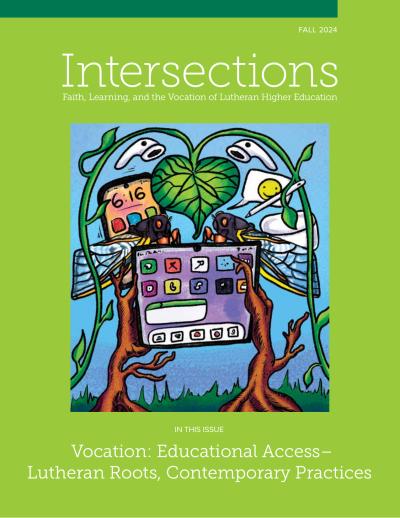 Editorial
From the Editor
Colleen Windham-Hughes
Windham-Hughes welcomes newcomers and seasoned colleagues to the conversation, lifts up Mary Elise Lowe’s three Lutheran “whys” for educational access, and commends Rev. Jen Rude’s “Sacred Pause” practice as a way to humanize one another and make opening access both easier and more joyful.
-
Editorial
From the Publisher: Reflections on the 2024 Vocational Leaders in Higher Education Conference
Lamont Anthony Wells
Wells reflects on the 2024 VLHE Conference theme — “Educational Access: Lutheran Roots, Contemporary Practices” — tracing today’s commitment to inclusivity back to Martin Luther’s radical 16th-century insistence that both boys and girls be educated, and previews NECU’s expanded engagement of student leaders alongside faculty and administrators.
-
Article
Access, Accessibility, & Change: A Call for Trustworthy Leadership in Higher Education
Emma Jones
Jones surveys the converging pressures on higher education — cost, the enrollment cliff, shifting demographics, and declining public confidence — and uses Reichheld and Dunlap’s four factors of trust (transparency, capability, reliability, humanity) to call campus leaders to rebuild trustworthy leadership from the inside out.
-
Article
Creation, Justice, and Communio: Lutheran Insights Empowering Educational Access
Mary Elise Lowe
In her VLHE keynote, Lowe names three Lutheran commitments — continuing creation, neighbor justice, and communio — as the “why” that empowers ELCA colleges and universities to pursue equitable access for students often left behind by persistence and graduation gaps.
-
Article
Committed to Paradox
Caryn Riswold
Riswold lifts up paradox — saint and sinner, lord and servant, Rooted and Open — as a distinctive Lutheran root that lets institutions honor the complicated truth of who their students are and embrace the messy, ever-reforming work of access and accessibility as a theology of the cross.
-
Article
Affirming, Entrusting, and Acting: A Baptismal Grounding of Affirmative Action in Lutheran Higher Education
Peter Carlson Schattauer
Schattauer draws on the Lutheran baptism liturgy — where the gathered assembly publicly affirms what it is for and is entrusted with responsibilities for justice and peace — to argue that NECU institutions create truly inclusive communities by affirming commitments, naming responsibilities, and acting in ways that embody both.
-
Reflection
Reflecting on Belonging
Melissa Woeppel
Woeppel, campus pastor at her own alma mater, wrestles with a Bethany student’s plea — “I want to feel like this is my home, like I belong” — and Mindy Makant’s reminder that we don’t choose the story of the past but do choose how we tell it forward, opening space for students from 35 faith traditions to find Lutheran institutions to be their home.
-
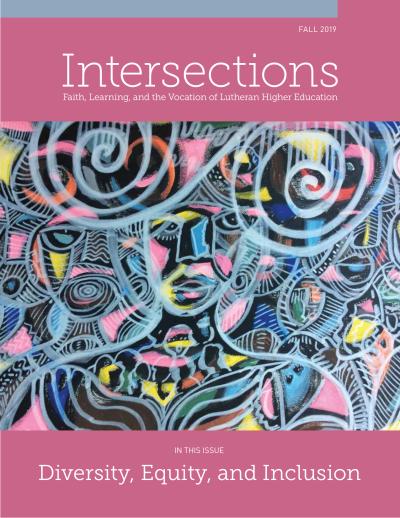 Article
The Perils and Promise of Privilege
Guy Nave
No. 50 · Fall 2019
Nave argues that privilege is always used in one of two ways — to preserve privilege by promoting inequity, or to challenge privilege by promoting diversity, inclusion, and equity — and uses examples from Indianapolis Catholic schools, Martin Luther, and equity-mindedness research to call Lutheran institutions to address the racist practices and policies that reproduce whiteness on their campuses.
-
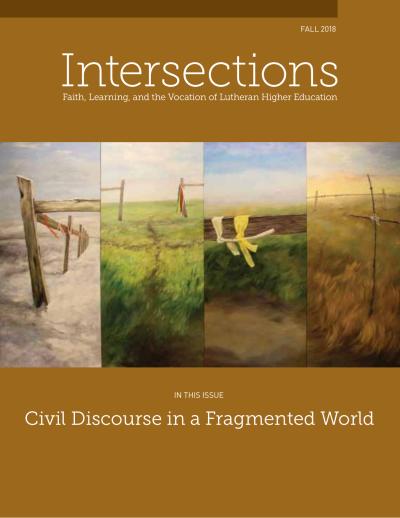 Article
Polarization, Incivility, and a Need for "Change"
Guy Nave
No. 48 · Fall 2018
Nave argues that when Americans demand “change,” they usually mean that “others” need to see things their way — and that meaningful transformative change requires acknowledging the provisional nature of our perspectives, seeking to understand as much as to be understood, and bursting the ideological echo chambers of social media through projects like Clamoring for Change.
-
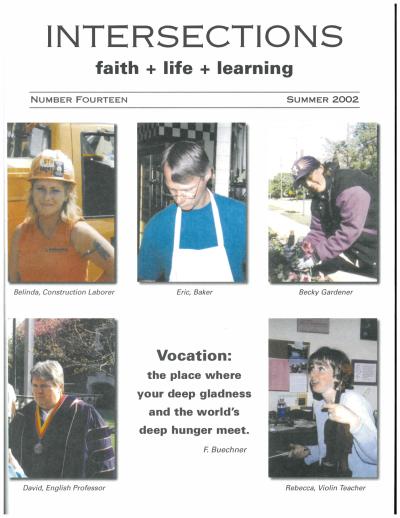 Article
Renewing a Sense of Vocation at Lutheran Colleges and Universities: Insights from a Project at Valparaiso University
Marcia Bunge
No. 14 · Summer 2002
Bunge, director of the process for writing Valparaiso’s nearly two-million-dollar Lilly grant on the Theological Exploration of Vocation, argues that contemporary culture’s reduction of vocation to either paid work or self-fulfillment requires Lutheran institutions to renew attention to a rich theological concept rooted in Luther’s expansion of vocation beyond the priesthood. She outlines eight low-cost “doorways”—caring adults, prayer, worship leadership, music and the arts, service, cross-cultural experience, church camps and wilderness, study and reflection—and describes Valparaiso’s two-program structure: a Campus-Wide Program weaving vocation into Freshman Core Courses and chapel life, and a Church Vocations Program for students considering full-time ministry. She closes with four troubling questions for any institution carrying out such a grant: what faith traditions can learn from one another, how to involve parents, whether faculty and staff have space to reflect on their own vocations, and whether daily institutional practices—family policies, treatment of low-paid staff, environmental responsibility, obligations to the wider community—actually reflect a commitment to love of neighbor.
-
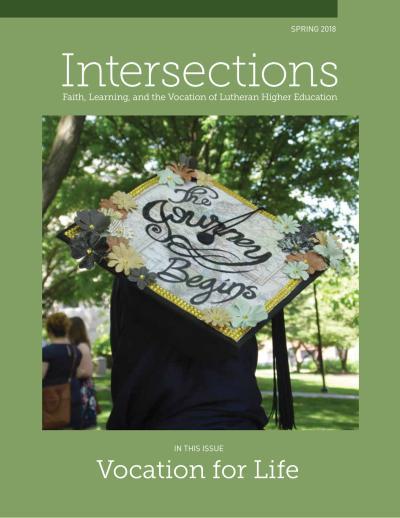 Article
One Life, Many Callings: Vocation Across the Lifespan
Katherine Turpin
No. 47 · Spring 2018
Turpin, drawing on the collaborative research behind Calling All Years Good, traces how vocational discernment shifts through adolescence, younger adulthood, middle adulthood, late adulthood, and older adulthood — arguing that focusing vocation on entry into the workforce limits the capacity of intergenerational college communities to wrestle with calling throughout life.
-
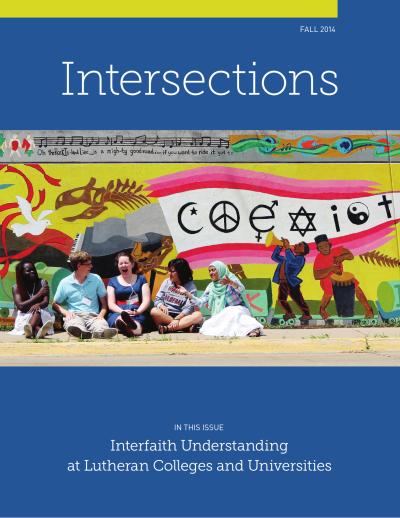 Article
Building on a Firm Foundation: ELCA Inter-Religious Relations
Kathryn M. Lohre
No. 40 · Fall 2014
Lohre traces the ELCA’s twenty-year arc of inter-religious work — from the 1994 Declaration to the Jewish Community and the Lutheran-Jewish Consultative Panel, through the post-9/11 Lutheran-Muslim Panel and the Shoulder to Shoulder Campaign, to fledgling dialogue with Sikhs and the dharmic traditions — and frames Lutheran inter-religious engagement as the strengthening, not the dilution, of Lutheran vocation.
-
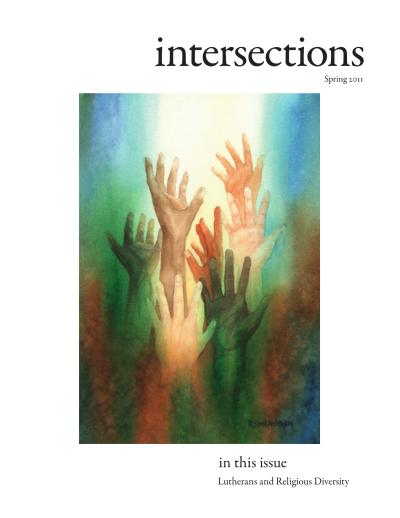 Editorial
From the Editor
Robert D. Haak
No. 33 · Spring 2011
Haak frames the issue by asking how Lutheran colleges and universities understand the changing landscape of religious identification on their campuses, and argues that Lutheran theological commitments — including the work of the Spirit and the Incarnation — call institutions to create places where the voice of “the other” is heard and valued.
-
 Article
Academic Vocation: What the Lutheran University has to Offer
Wendy McCredie
No. 19 · Summer 2004
Writing as a practicing Lutheran, a trained literary scholar, and the associate director for interpretation at the ELCA churchwide office, McCredie articulates a vocation for ELCA colleges and universities grounded in the dialogical tension Gilbert Meilaender names between “bonds of particular love” and “a love which is open to every neighbor.” Drawing on Berube and Nelson, Marsden, Pelikan, Schwehn, Toulmin, Simmons, Hughes, MacIntyre, and Wolterstorff, she argues that Lutheran tradition resists both the easy separation and the collapse of sacred and secular, that human reason errs while God’s grace makes action possible, and that listening to the marginalized and to those outside the tradition is itself a theology of the cross enacted in classroom and collegial life.
-
 Reflection
Keeping Close from a Distance: Pandemic Reflections of a Library Coordinator
Carla Flengeris
No. 53 · Spring 2021
Flengeris reflects on a year of running Luther College’s library at the University of Regina from her basement and mourns the loss of the hourly walks through the stacks—the “roving reference” that, she realizes, were never disruptions to her work but were the work itself.