Although it is located in a small rural town in the middle of the state, Newberry College in a sense belongs to the entire state of South Carolina, which in turn sits on the unseeded lands of the Kusso, Yemassee, Santee, Cherokee, Saluda, and Catawba. Not only does the college have deep connections to the state’s historic and cultural roots, but also its current student population mirrors the state’s demographics.
Located 154 miles from Charleston, where approximately 40 percent of all enslaved Africans were brought into the United States, Newberry College owes its history to the practice of enslavement. The college’s founder, Rev. Dr. John Bachmann, gave the opening blessing at the South Carolina Secession Convention, and he wrote eloquent theological defenses of the institution of slavery (curiously, even as he affirmed, in contrast to other scientific writer of his day, that whites and blacks were of the same species).
Fast forward to today and to who our students are: Newberry is one of the few schools in the state that nearly perfectly mirrors the demographics of South Carolina— in terms of race, gender, socio-economic status, and urban-versus-rural origins. A predominantly white institution, its proportion of minority students reflects the population of the state. Yet it is less reflective of the city and county of Newberry, where there is a slight majority of Black residents, with white residents close in number and only a tiny percentage of Latinx and Asian residents. Socioeconomically, there is also mirroring, with the City posting a median income is $31,000, while the student population of the college includes 50 percent first-generation students, 40 percent Pell-eligible students, and a little over 30 percent racial minority students (with significant overlap across these categories).
Our ‘culture of community’ has both promise and plenty of room for growth.
Our “culture of community” has both promise and plenty of room for growth. On campus, we are trying to build a culture of true belonging, which is the central theme of the DEI Strategic Plan developed by a Presidential Task Force during the 2020-21 academic year. We conducted a campus-wide campus climate survey (HEDS) and have established a series of listening session opportunities for students to come and speak openly about concerns. Our student orientations and student fairs have had more intentional aims to connect students no only across campus but with the broader community. Finally, in the last couple of years, students have established the Social Justice Club and Spectrum (for LGBTQ+ and allies) with campus-wide impact beyond their small membership sizes.
In and with the city of Newberry, the Muller Center for Exploration and Engagement is heavily involved with civic engagement activities—connecting students, staff, and faculty to opportunities for community-based learning and service opportunities. There’s also a strong connection between the athletics department and the community, and the support travels in both directions. There is tremendous community support for the college’s sports teams. In turn, our athletic teams lead the campus in volunteer work in the community, followed by the campus’s Greek organizations and students in community-engagement courses.
The challenges of building a sense of community on campus and off are plenty, however. First and most central is a basic lack of time and energy. For students, staff, and faculty, schedules are packed with demanding commitments, while community-based education and relationship-building takes time. Even when the desire and will is there, there is scant breathing space.
This draw to broader activist movements frequently orients students away from the local and toward the national and global issues.
Another challenge is the generational characteristics of Gen Z students, where there tends to be less focus on service and more on activism, often based on social media. This draw to broader activist movements frequently orients students away from the local and toward the national and global issues. The way technology can mobilize coalitions across space and time is nothing short of miraculous. The challenge is to not sacrifice local relationships and needs.
Whereas that is a challenge for students, there is a specific one for the personnel of Newberry College—namely, the fact that a large proportion of the upper administration and faculty, along with some staff, do not live in the city of Newberry. The community is small, and there is a widespread impression that there is not enough to do and/or the local public schools are not strong enough. This means, however, that the people who live in Newberry the city and the people who work at Newberry the college do not overlap as significantly as they could, which in turn impedes the development of organic relationships of trust, support, and collaboration.
And yet, there are ample signs of hope. Where city-college relationships are good, they are really strong. The mayor and Newberry City Council regularly recognize the college as the largest provider of volunteers in the city, and annually the city holds a ceremony to honor those graduating seniors who have shown strong service to the city during their time as Newberry College students. In addition, there are alumni and alumnae who have chosen to remain in the community following graduation; several now serve in influential positions in the city—from city administration to churches to the local newspaper.
What is more, civic leaders from the community and the campus are currently involved in two significant projects: Coming Together for Newberry, an alliance of people seeking to practice and advance interracial engagement and understanding in Newberry County, and the Gallman School Project, an initiative to acquire and renovate the historically significant Black high school and establish a community center that will provide a range of services and opportunities for the surrounding community.
Finally, the growing number of international corporations coming to the area promises to turn little Newberry into a global city where the possibilities for collaboration among the town, the college, and the business industry will grow.
There is plenty of room to grow in terms of community-building on campus and beyond. There is also a great deal of promise, rooted primarily in the already rich relationships that are possible only in a small town.
-
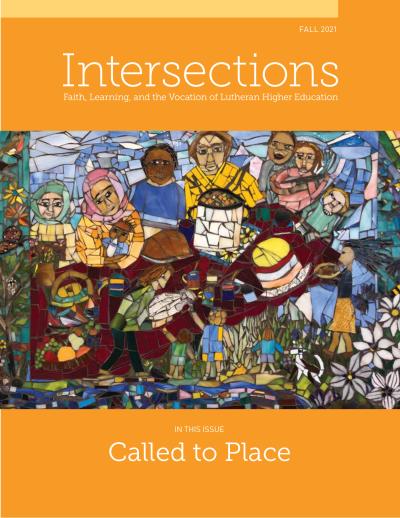 Editorial
From the Editor
Jason A. Mahn
Mahn introduces the “Called to Place” theme of the 2021 VLHE Conference, arguing that Lutheran higher education’s emphasis on vocation must be grounded in particular geographies and embodied communities — for, as Wallace Stegner put it, “If you don’t know where you are, you don’t know who you are.”
-
Article
Where Your Feet are Standing: Institutional Engagement and Place
Melissa Maxwell-Doherty
Maxwell-Doherty draws on Cal Lutheran’s Hispanic-Serving Institution designation and its location on Chumash, Fernandino Tataviam, and Ohlone lands to ask how the university’s mission might shift if it depended on where its students are standing — not just where the institution sits.
-
Article
Just Communities: From Liberal Arts in Prison to Racial Healing over Zoom
Monica Smith
Smith showcases how Augustana College’s commitment to social justice extends into the Quad Cities through two initiatives: the Augustana Prison Education Program at East Moline Correctional Center, and Racial Healing conversations developed through the Truth, Racial Healing and Transformation framework.
-
Reflection
Caught in a Place Between Caesar and God
Darrel D. Colson
Colson reflects on his anguish, as Wartburg’s president, over an Iowa law that prevents him from requiring student COVID-19 vaccinations — reading Luther’s “Whether One May Flee From a Deadly Plague” alongside the conflict between obeying the law and serving neighbor.
-
Article
Hospitality to the Wild
Laura M. Hartman
Drawing on research with a Wild Ones Native Landscaping chapter and Marilyn Matevia’s ethic of “creature comfort,” Hartman argues that Christian hospitality must extend to non-human animals and plants — and asks whether college campuses can foster not just human diversity but biodiversity.
-
Article
Return to Purpose: Learning in an Age of Collapse
Ahmed Afzaal
Afzaal argues that the cascading crises facing higher education are not temporary glitches but symptoms of planetary and civilizational collapse — and that colleges must embrace “double-loop” learning and return to a shared sense of purpose if they are to help humanity descend gradually rather than catastrophically.
-
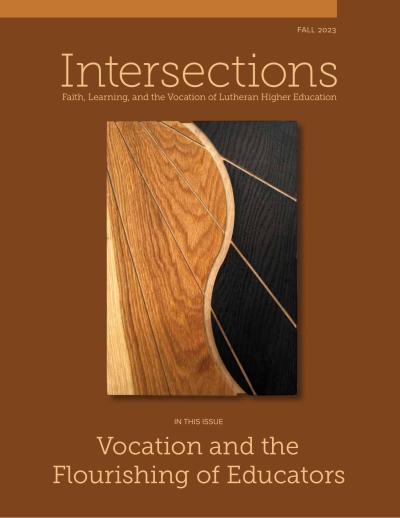 Article
A Lutheran Call for Educator Flourishing
Krista E. Hughes
No. 58 · Fall 2023
Hughes argues that without educator flourishing there is no student flourishing, traces how an exploitative “passion tax” can distort vocation, and offers seven Lutheran “third-way” value pairings — including Metrics/Grace, Efficiency/Kairos, and DEI/Priesthood of All Believers — to reframe institutional success at NECU campuses.
-
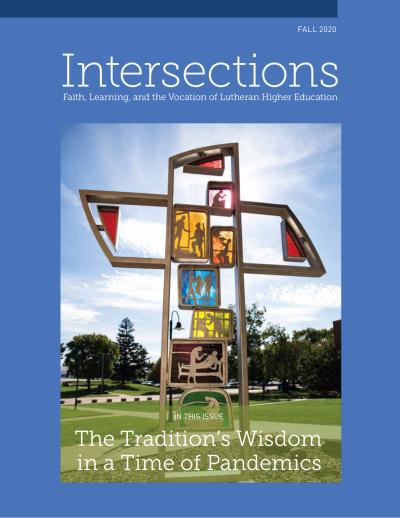 Article
Radical Hospitality on Haunted Grounds: Anti-Racism in Lutheran Higher Education
Krista E. Hughes
No. 52 · Fall 2020
Writing from Newberry College’s campus on land once home to the Cherokee and within a day’s drive of Mother Emanuel A.M.E., Hughes argues that NECU’s call to “practice radical hospitality” demands that predominately white institutions open themselves to the hauntings of racism — pursuing belonging rather than mere welcome, and risking kenotic transformation of institutional identity itself.
-
Article
Leadership in Lutheran Key at a Time of Pandemics
Deanna Thompson
No. 52 · Fall 2020
Thompson draws on Luther’s theology of the cross and Shelly Rambo’s theology of trauma to sketch a Lutheran model of leadership for a season of pandemics — one that is attentive to pain, responsive to need, and intentionally nourished by food, friends, and deep conversation.
-
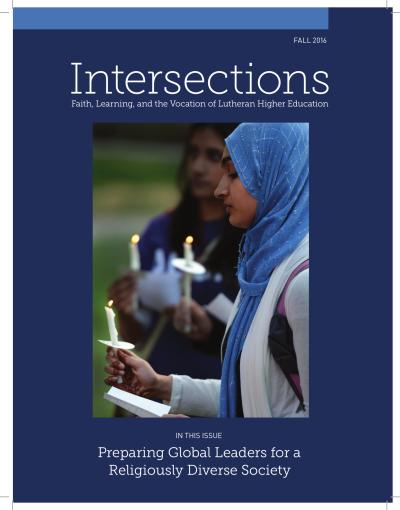 Article
Risky Speech–Gifted Friendships
Sonja Hagander
No. 44 · Fall 2016
Augsburg College Pastor Sonja Hagander reflects on pastoral care across faith traditions — from a campus chapel service after the 2008 murder of Muslim student Achmednur Ali, to her decade-long friendship with Jewish colleague Barbara Lehmann — and reads the Gospel of John as a roadmap for interfaith friendships marked by love, free speech, public space, and a willingness to risk being changed.
-
 Article
The State of Civil Discourse on Campus and in Society
Terence S. Morrow
No. 33 · Spring 2011
Morrow examines the troubled state of civil discourse in the United States and on college campuses, drawing on three deep traditions — the liberal arts, Lutheranism, and the Anglo-American legal tradition — to argue that Lutheran colleges can serve students and society by acknowledging the tensions inherent in civil discourse and helping students navigate them, and surveys promising campus programs at St. Thomas, Tufts, Loyola, and Harvard.
-
 Article
2024 VHLE Conference: "Rooting Access" Panel Talking Points
Guy Nave
No. 60 · Fall 2024
Nave reads “access” across Deuteronomy 23, Ruth, Isaiah 56, Acts 10, and Matthew 15:21-28 as an ongoing biblical conversation that evolves from exclusion to ever-widening welcome — and presses ELCA institutions to shift their focus from “student readiness” to “institutional readiness.”
-
 Reflection
Fumbling Toward Integrity: A Sermon on Mark 8:34-38, Pastor Kaj Munk, and Father Maximilian Kolbe
Darrell Jodock
No. 34 · Fall 2011
Preached at the 2007 ELCA Convocation of Teaching Theologians at Lenoir-Rhyne College, Jodock holds up two World War II martyrs—Polish Franciscan Father Maximilian Kolbe, who took the place of a condemned father in Auschwitz’s starvation bunker, and Danish pastor-playwright Kaj Munk, who was shot by the Nazis after helping save 97 percent of Denmark’s Jews—as mirrors for our own priorities. Drawing on the rescuer characteristics identified by Samuel and Pearl Oliner (agency, moral independence, universalistic caring, a history of care-giving) and on Jesus’s words in Mark 8:34-38, Jodock asks how we who routinely opt out at the first sign of opposition might fumble toward integrity in our own time.
-
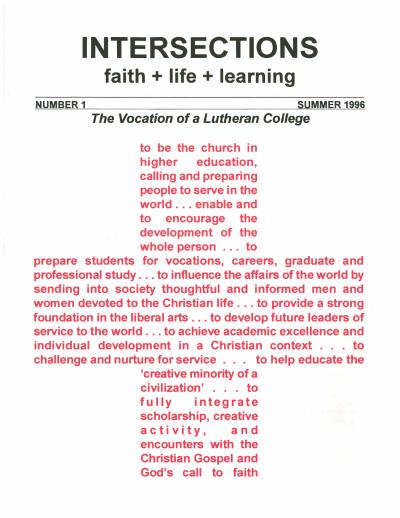 Editorial
From the Editor
Tom Christenson
No. 1 · Summer 1996
Christenson, feeling like a proud parent, welcomes readers to the inaugural issue and acknowledges three people without whom the publication would still be just an idea: Naomi Linnel of the ELCA office for Higher Education and Schools, publisher Jim Unglaube, and Capital University president Josiah Blackmore. He invites readers’ reactions, suggestions, and active involvement as editors, reviewers, authors, artists, and critics in shaping the dialogue across the ELCA college and university family.