A university has many faces. At CLU, we recognize that the 850 undergraduates who live on our campus have a rather different experience than do the 450 students who commute. The 500 students enrolled in ADEP (our adult education program) are all at least 25 years of age and hold associate degrees from another school; they typically come to our campus only one or two evenings a week. They have an experience of university life that is quite different from that of undergraduate students. In addition, we have almost 1,000 graduate students, who also attend evening classes and work toward advanced degrees in business, education, public policy and psychology.
While our students may experience CLU in different ways, we believe that there is a rather distinctive ethos on this campus, an ethos shaped by our religious heritage and expressed through the commitment and contributions of faculty, staff and students over the years. Three aspects of our ethos are particularly important:
1. First, we are a small university in which we strive for personal attention and excellence in instruction. We are a total community comprised of approximately 2800 students, 150 administrators and staff, 100 full time faculty and almost as many part-time faculty members. What happens in classrooms is very important for us. What happens in co-curricular activities, in our campus dorms and in other areas of student life is also important for us.
2. Secondly, we are a church-related university. We are affiliated with the Evangelical Lutheran Church in America. In recent years, we have devoted considerable attention to our university mission statement, which declares:
—CLU is a diverse scholarly community dedicated to excellence in the liberal arts and professional studies.
—Rooted in the Lutheran tradition of Christian faith, the University encourages critical inquiry into matters of both faith and reason.
—The mission of the University is to educate leaders for a global society who are strong in character and judgment, confident in their identity and vocation, and committed to service and justice.
As I have pondered the question of the distinctive ethos of CLU, I have found myself thinking about Norman MacLean’s classic work A River Runs Through It. In that work he describes how a mountain river defines the geography of his western Montana world. We also have a river which crosses the CLU campus. It is not a mighty river, however. Once I saw it when it flooded the entire heart of our campus. But most of the time, our creek is only a quiet stream. The banks are filled with wonderful wildflowers and for much of the year, when night falls, the world along our creek is alive with the sound of a symphony of frogs. In its own way, our small creek adds beauty and grace to the campus and brings definition particularly to Kingsman Park, which is at the heart of the CLU campus.
In a similar way, I believe that a particular stream of Christian faith and tradition also runs through this campus. This stream does not run like a mountain river but is much more like our quiet creek. It is a stream that does not overwhelm the community. Many of us believe that this is appropriate, and at the same time, believe strongly that this stream of faith is central to our ethos and adds beauty, grace and definition to all that we do here. Some people on our campus take our church-relatedness with great seriousness; others do not. But many who are not even sure how to articulate what “church-relatedness” means still express the feeling that our Lutheran identity and heritage brings something unique and special to this academic community.
3. A third aspect of our ethos is not as easy to explain and is often quite puzzling for those who are new to this place. We are a community committed to critical inquiry into matters of both faith and reason. We speak of a dialectic between the realm of faith and the realm of reason. This has been a longstanding characteristic of Lutheran higher education. To some it might appear that we see faith and reason as separate realms. But they are not really separate. Like poles of a battery, the realms of faith and reason are intimately related, and equally essential. In Lutheran tradition, many will argue that neither realm, neither faith nor reason, should be able to “trump” the other. Sometimes faith needs to be corrected by reason just as reason needs to be tempered by faith. Like a well-charged battery, a healthy dialectic between matters of reason and faith can spark electricity and yield productive energy for a community. At times that energy results in heat; just as often we hope that the energy can also yield light or new insight.
I see the dialectic working itself out in various ways here at CLU:
In the realm of faith, we have an active “Lord of Life” student congregation on our campus. The student congregation has two pastors; other staff members and a church council oversee a broad spectrum of discussion or activity groups. The student congregation worships at a Sunday evening service each week and also sponsors a large Wednesday evening gathering known as “Common Ground.” We have a full-time Assistant to the President for Church Relations who has the specific responsibility of developing good lines of communications with area clergy and congregations. As part of the governance of the university, people known as Convocators come to our campus once each year as representatives of the five western synods of the ELCA. They review the work of the college and along with other responsibilities, have the task of electing all new members of our Board of Regents.
In the academic realm, our core academic curriculum requires a minimum of two religion courses for all four-year students. Our “Introduction to Religious Studies: The Christian Tradition” course involves historical and critical study of Old and New Testament literature, and includes an introduction to selected themes in Christian history. Beyond that introductory course, the religion department offers a wide range of elective courses, three different religion minors (five courses) and a religion major (nine courses). In addition, the religion department is committed to integrated study with other academic departments through cluster programs, global studies and various seminars. Religious themes are regularly assigned in various departments across the curriculum and frequently appear within the University Artist and Speakers series.
A university chapel service is held each Wednesday morning at 10 a.m., designed as a place where matters of faith and reason may come together. The chapel service is clearly a time of worship and praise. But during a past academic year, the chapel schedule included a morning focused on welcoming international students and several other occasions when athletic teams or other groups on campus were introduced. The campus pastors participate in the opening convocation, the Founders Day convocation and the spring honors convocation, when students who have achieved academic distinction are recognized.
Chapel attendance is voluntary. The administration asks that student and faculty committees not meet during the Wednesday chapel hour and most administrative offices close during that time. But there would be very little if any support on this campus for making chapel participation a requirement.
The dialectic between faith and reason in Lutheran tradition goes back all the way to the writings of Martin Luther. In his 1520 treatise on “The Freedom of the Christian,” for example, Luther wrote:
“The Christian is free lord of all, subject to none”
And at the same time, because of the obligations of love and compassion, he declared:
“The Christian is servant to all, subject to all.”
Luther contends that both propositions are true. Church historian Richard Solberg and others before him have called this dialectical characteristic of Lutheran thought a “theology of paradox” (Solberg 74). Most famous, perhaps, is Luther’s statement about the nature of human beings; they are, he declared, “simul justus et peccator”—simultaneously “saints and sinners.” By that, Luther meant that individual human beings are capable of bringing great good and/or great evil in the world. It is important to note that the Lutheran colleges and universities affiliated with the Evangelical Lutheran Church in America (ELCA) have not been governed by creedal statements or specific affirmations about particular church doctrines. Consequently, ELCA Lutheran colleges and universities in north America have for the most part not experienced the bitter feuds over questions of “biblical inerrancy”, “verbal inspiration” or the debates over dogmatic truths that have haunted many formerly Protestant church-related schools.
Rather, as Richard Hughes has noted: [In Lutheran tradition] “… the task of the Christian scholar … is not to impose on the world—or on the material that he or she studies—a distinctly ‘Christian worldview’. It is rather ‘to study the world as it is and then to bring that world into dialogue with the Christian vision of redemption and grace.” (Hughes 6)
What, then, is distinctive about the ethos of this Lutheran university? As an invitation to further conversation, I want briefly to introduce six virtues or commitments that I believe characterize the ethos of CLU. They are not accidental virtues. I believe that these six commitments flow directly from the stream of Christian tradition which provided the energy for those who founded this school in the era from 1959–1964 and new energy for those who have continued to nurture the ethos of this campus.
1. Commitment to Academic Freedom
This commitment is at the heart of our Lutheran heritage. We celebrate the memory that Martin Luther was a progressive academic within his medieval world. Martin Marty has said that the Lutheran tradition in higher education begins with the protest of a rebellious untenured junior faculty member! In 1517, Martin Luther was still a rather young member of the faculty at the university at Wittenberg, Germany, which had been founded only a decade or two earlier by the German Elector, Frederick the Wise.
As a devout Roman Catholic priest, Luther’s passion for reformation emerged from his commitments as a scholar and as a member of that university community. He felt a very real sense of responsibility as a professor of Biblical interpretation to speak out in debate about the crass selling of indulgences. In the spirit of Luther, we treasure the words of the gospel of St. John:
“You shall know the truth and the truth will set you free!” (John 8:32)
We welcome and embrace the academic quest for truth on this campus. We welcome new faculty who come from various backgrounds who are committed to that quest. At the same time, we see the quest also tempered by the admonition of the ancient prophet Jeremiah, who wrote:
“Seek the welfare of the human community … for in its welfare, you will find your own!” (Jeremiah 29:7)
2. Commitment to Vocation
Luther wrote extensively about vocation. I am not always sure how well we communicate what we mean by vocation today, but I think that it involves an understanding that our human life is a gift. We did not create ourselves.
Vocation also involves a vision about the future. When students catch a hopeful vision about the future, and when they can see themselves within that vision, university education becomes rather exciting.
We are not just helping people simply to learn how to earn a living. Much more, we are helping people to learn how to live. By that, we mean, we have the opportunities to help students discover meaningful, productive and satisfying lives. Hopefully, the life they choose will bring blessings for themselves and for the larger world in which they will live.
3. Commitment to Service
In the Bible, the notion of election (the calling to be “a chosen people”) is not a calling to privilege; it is rather a call to servant life. Already in the eighth century BCE, the prophet Amos complains because the people of his time misunderstood divine election to mean “privilege” (Amos 3:1–2 and 9:7–8). In a world of wealth, we contend that meaningful life is not to be discovered through privilege or through the selfish accumulation of luxuries. We consciously affirm an ethic of service on this campus—through the devoted work of faculty and staff, by the example of custodians and maintenance people, through our Habitat for Humanity chapter, through periodic Service Days and in many other service-related activities. We seek consciously to model a service ethic in the way we relate to students. I think it fair to say that we aspire to communicate an “ethic of service” that is consistent with the message of Israel’s prophets and the life and teaching of Jesus.
4. Commitment to Grace—and to Graciousness
I hope it is also accurate to say that “grace” permeates the ethos of CLU. We intentionally create and maintain serious academic standards and a code of responsible conduct. Almost every semester, some students are suspended or placed on probation for violations of established rules. From time to time, a student is expelled from the university. Whenever this happens, it is a painful experience, particularly for our student affairs staff and for the faculty who have known the particular student. In these situations, I have seen our staff people struggle with the complex issues of law and grace. Faculty members struggle in similar ways with questions of law and grace when they respond to students who fail on projects large or small. We aspire to hold high standards and expectations. But “forgiveness” and a willingness to go “the second mile” are also hallmarks of this academic community. This is not accidental. The Lutheran tradition is grounded in an understanding of a gracious God who is compassionate toward all people. And, while we do not always articulate this reality with the specific language of faith, those of us who are from the Christian tradition know very well that we are attempting to be the “body of Christ” on this campus.
At a faculty meeting this past year, I reflected on our commitment to grace by quoting the words that William Shakespeare gives to Portia, in her famous courtroom oration, as she appears disguised as a lawyer, pleading for the life of the merchant of Venice:
The quality of mercy is not strain’d;
It droppeth as the gentle rain from heaven
Upon the place beneath. It is twice blest:
It blesseth him that gives and him that takes.
’Tis mightiest in the mightiest; it becomes
The throned monarch better than his crown;
His scepter shows the force of temporal power,
The attribute to awe and majesty,
Wherein doth sit the dread and fear of kings;But mercy is above this sceptred sway,
It is enthroned in the hearts of kings,
It is an attribute of God himself;
An earthly power doth then show likest God’s
When mercy seasons justice.
(Shakespeare, Merchant of Venice, Act 4, Scene I)
We believe that the “quality of mercy” enriches and enhances the climate of a university and the lives of all who live or work there.
5. Commitment to Diversity
In our mission statement, we say that we aspire to be “a diverse scholarly community.” Some might contend that we are too diverse; others will say that we are not diverse enough. Within our faculty and staff, we have a rather significant number of people of Jewish heritage. We have several Muslims, as well as faculty members who come from a variety of Asian religious traditions. Our faculty includes people from various Christian denominations and some who are agnostic. Our student body is more diverse than the faculty, in terms of race, ethnicity and religious background.
We believe that diversity within a university community is essential and healthy. Diversity enhances our academic environment, even when it can bring certain difficult problems. Diversity raises the energy level on the campus and brings new dynamics of thought or debate within classrooms and dormitory life. In particular, a diverse population on a church-related campus must prompt those who are of Christian faith to reflect seriously on the question: “What does Christian witness look like to those who come from other religious backgrounds or from other parts of the world? Is Christian witness seen as triumphal, condescending, and judgmental or is it a witness characterized by respect and tolerance?
6. Commitment to Reverence
For me, this is the common commitment that unites and holds together a church-related university, along with its faculty and staff. It is the common virtue that we seek to inspire in all of our students. CLU has long had a strong commitment to music, art, drama, and other fine arts. We are thrilled to have a graceful and beautiful chapel, a sacred space where we can gather as a community for worship and ritual. It is particularly interesting to be in our university chapel when the space is used for other events—for recitals, for academic lectures and for public events. Particularly in those situations, the architecture and the symbolism of the chapel invite those present to reflect on the interrelatedness of all of life, the worlds both of reason and faith.
We look forward to the day when we will have other new facilities on this campus. In the meantime, we seek to affirm a commitment that has been here since the founding of this school—a commitment of respect for the environment, for the earth which is our home, and for the sanctity of human life. In particular, as an academic community, we seek to respect the people who walk these campus pathways and occupy our classrooms. In respecting our students, we also show reverence and respect for divine mystery, the mystery of God.
The author of Proverbs, ch. 9 writes: “The fear of the Lord is the beginning of wisdom!” Those of us who teach that ancient literature know that the poetic phrase “fear of the Lord” really means “reverence,” “awe,” or “wonder.” Most of us, most of the time, are delighted to have the opportunity to work with students, both the young and the old, particularly at those moments when they catch the sense that it is very good to be alive. It is good to be with students when they discover the freedom and the courage to think for themselves. It is good to be with them when they pose difficult questions, especially when they realize that they can do so without losing a sense of wonder about the world.
A Concluding Word about the Stream of Tradition
A river runs through it! The stream of tradition at CLU is one that advocates responsible academic freedom, concern for vocation, commitment to service, commitment to gracious and compassionate words and actions, respect for diversity, and commitment to a sense of reverence for things large and small in this world. These commitments contribute directly to the ethos of this school. Many of us believe that this ethos that has been shaped by Christian faith. At its best, the ethos is like a stream that adds definition to the landscape, distinctive beauty and grace to the campus and meaning for the tradition in which we teach.
Works Cited
Hughes, Richard T. “Introduction” in Hughes, Richard T. and Adrian, William B. Models for Christian Higher Education: Strategies for Success in the Twenty-First Century. Grand Rapids: Eerdmans, 1997.
Lull, Timothy F. Martin Luther’s Basic Theological Writings. Minneapolis: Fortress Press, 1989.
Shakespeare, William. The Complete Works. G.B. Harrison, Editor. New York: Harcourt Brace Jovanovich, Inc., 1968.
Solberg, Richard W. “What Can the Lutheran Tradition Contribute to Christian Higher Education” in Hughes, Richard T. and Adrian, William B. Models for Christian Higher Education: Strategies for Success in the Twenty-first Century. Grand Rapids: Eerdmans, 1997.
Solberg, Richard W. Lutheran Higher Education in North America. Minneapolis: Augsburg, 1985.
-
 Editorial
From the Publisher
Arne Selbyg
Selbyg reports that the Lutheran Brotherhood Foundation and the Lilly Endowment have funded the Lutheran Academy of Scholars, which since 1999 has gathered ten to twelve Lutheran scholars at Harvard for two-week summer seminars under Ronald Thiemann (themes: “Finding Our Voice—Christian Faith and Critical Vision” in 1999–2000 and “The Lutheran Public Intellectual: Faith, Reason and the Arts” in 2001), and announces that the academy will move to Berkeley in 2002 under Ted Peters to take up the intersection of faith and science.
-
Editorial
From the Editor
Tom Christenson
Christenson introduces three pieces from the summer 2000 Vocation of a Lutheran College Conference at Dana College—noting that Leonard Schulze was asked to keynote before becoming executive director of DHES—and recommends Peter C. Hodgson’s God’s Wisdom: Toward a Theology of Education and Douglas Sloan’s Faith and Knowledge: Mainline Protestantism and American Higher Education for their accounts of how faith and knowledge have been dissociated in modern higher education and what it might take to recover their connection.
-
Article
Teaching as a Form of Servant Leadership
Leonard G. Schulze
Schulze defines teaching as a paradoxical “servant leadership” rooted in the etymology of educare, e-ducere, Erziehung, and Bildung, surveys representative models of the teacher (Plato’s cave, the Theatetus midwife, Socrates of the Apology, and Freire’s Pedagogy of the Oppressed), and proposes a four-fold taxonomy of learning—information, critical thinking, praxis, and teleology—each requiring its own form of teacherly leadership. He closes with ten Wittenberg-style theses for teachers at Lutheran colleges, including that the Gospel liberates us from using knowledge as power, that disputatio is an expression of faith, and that we are called to lead students from the tyrannies of ignorance, rote knowledge, incompetence, and anomy to the freedoms of awareness, critical understanding, skillful action, and purposive lives in community.
-
Article
The Vocation of a Lutheran College
L. DeAne Lagerquist
Lagerquist places the twenty-eight ELCA-affiliated colleges in the context of American higher education from Harvard (1636) through the “old time college,” the post-Civil-War research university, and the postwar expansion—drawing on Christopher Lucas, Philip Schaff’s Neo-Lutheran/moderate/Old Lutheran categorization, Sydney Ahlstrom’s scholastic/pietistic/critical currents, Luther’s appeal to the German nobility, Lewis Hyde’s gift economy, and Alasdair MacIntyre’s After Virtue. She proposes five characteristic practices (the school as learning community, study of Bible and Christian tradition, participation in the arts as makers and audience, application of learning in service, and on-campus Christian worship) grounded in Lutheran teaching about grace, image-and-fall, gratitude, and revelation through created “masks,” and four virtues these practices engender in graduates—loving gratitude, faithful wisdom, bold freedom, and hopeful humility.
-
Article
Perspectives on Institutional Service: All Hands on Deck
Ruth Henricks
Henricks, President and CEO of Lutheran Family Services of Nebraska, uses Annie Dillard’s image of Christians tourist-like on Deck C to call colleges and social ministry organizations to “all hands on deck” in a church standing at a threshold of shifting demographics—a growing rich-poor gap, a coming Hispanic majority, an aging baby-boom, dual-career families, contingency workers, and for-profit Lockheed Martin-style competitors entering human services. Drawing on Foster McCurley, Andrew Grove’s Only the Paranoid Survive, Justo Gonzales’s Manana, Arthur Becker, Bob Bacher, David Tiede, and the ELCA constitution, she argues that SMOs and colleges are the “hands” of the body of Christ and asks whether we have courage to require Spanish, partner ecumenically, cut services to Caucasian clients, and lead the church from the front rather than the rear.
-
 Article
Service Beyond the Comfort Zone
Kathryn Wolford
No. 18 · Fall 2003
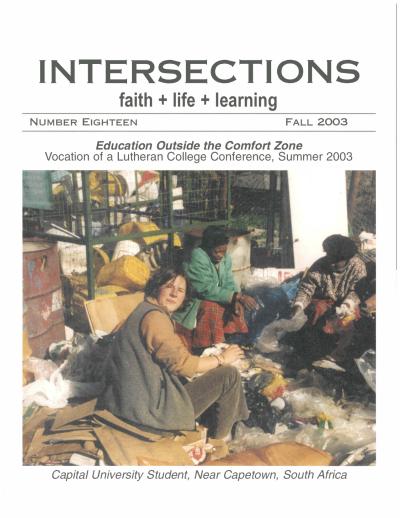
Wolford names economic globalization and the growth of civil society as the two issues shaping Lutheran World Relief’s mission, illustrating with the Guatemalan storekeeper undercut by subsidized “gringo” chickens, fair-trade coffee and chocolate campaigns, and Charles Onyango-Obbo’s warning about anti-terrorism laws in fragile African democracies. Drawing on Darrell Jodock, Art Simon, and the Good Samaritan, she frames the global vocation of Lutheran colleges as inviting students past comfort zones of race, class, ethnicity, and ideas through service-learning that links mercy and justice, and closes with a concrete LWR partnership invitation including site visits, internships, fair-trade campus campaigns, and the “A Place for Peace in Colombia” advocacy program.
-
 Editorial
From the Publisher
Mark Wilhelm
No. 50 · Fall 2019
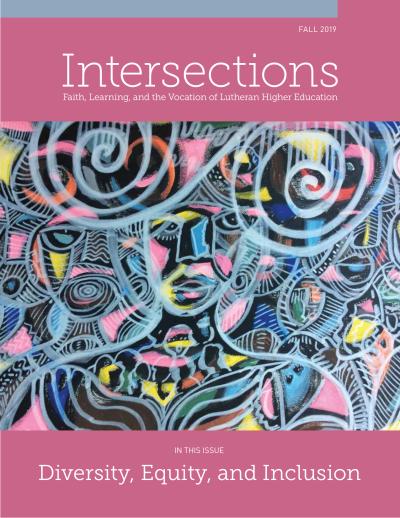
Wilhelm frames the issue by noting that a federal court’s vindication of Harvard’s race-conscious admissions process is a win for higher education’s commitments to diversity, equity, and inclusion — and argues that for Lutheran higher education, the commitment to diversity is an old and foundational claim, rooted in Christianity’s openness to all and reflected in the four diverse gospels of the New Testament.
-
 Article
Honesty of Mind: On the Uses and Abuses of Socratic Ignorance in Environmental Studies, Religion, and the Classroom
Don Braxton
No. 15 · Winter 2002
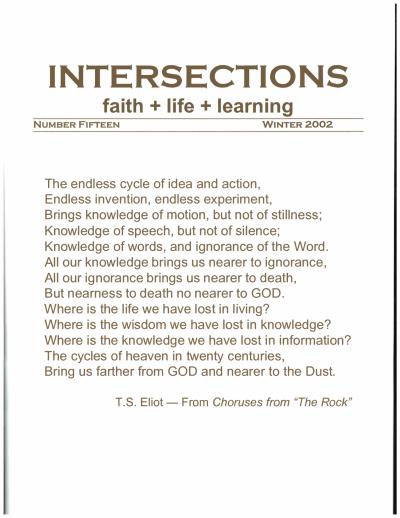
Braxton, taking his cue from David James Duncan’s defense of ignorance as a fly-fisher’s most crucial tool and from Socrates’ midwife’s art in the Theaetetus, defends a doctrine of “honesty of mind” resting on four premises—knowledge is constructed, judgments are wagered amid imperfect knowledge, expertise can disable learning, and we are encumbered by other ways of knowing. He field-tests the disposition against three domains: the climate-change and creationism debates in environmental studies, the post-September 11 turn toward religious pluralism (engaging Union Seminary’s Joseph Hough and Hauer and Young’s “three-world” approach to the Bible), and the liberal arts classroom where students “become democrats of the mind” through Reinhold Niebuhr’s balance of conviction and contrition.
-
 Article
Practical Approaches for Lutheran Colleges to Engage Civil Society
Katherine A. Tunheim
No. 35 · Spring 2012
Tunheim distinguishes a college’s mission from its vocation—a calling from the community—and offers four examples of Lutheran colleges “dancing with their neighbors”: Augsburg’s engagement with the Cedar Riverside Neighborhood, her Gustavus students’ work with the St. Peter Soccer Club, St. Olaf football players in the All-Star After-School Program in Northfield, and Concordia students filling sandbags during the 2009 Red River flood. She presses Lutheran educators to ask the troubling questions that prepare students to lead with ethics rather than merely with money.
-
 Institutional Focus
Letters to the Editor
No. 7 · Summer 1999
The journal’s first letter to the editor: Pastor John L. Vaswig of Spokane, a Pacific Lutheran University alumnus and member of the PLU Board of Regents, writes after reading James Tunstead Burtchaell’s The Dying Light: The Disengagement of Colleges and Universities from Their Christian Churches to ask whether church-related institutions, in their effort to be open and tolerant, have abandoned a compelling word of hope and forgiveness in Jesus Christ.
-
 Article
A Church, the Human Condition, and the Fissured Face of Peace
D. M. Yeager
No. 22 · Spring 2006
Yeager, a member of the ELCA Task Force for Studies on Sexuality, reflects on lessons for the church’s educational mission in the wake of the 2005 Churchwide Assembly. Drawing on Macquarrie’s The Concept of Peace, Polanyi on the personal coefficient of knowledge, Hannah Arendt’s The Human Condition, and responses to the task force report from Roy Harrisville III and Larry Rasmussen, she proposes “the fissured face of peace”—peace as the absence of hostility rather than disagreement—and maps how Arendt’s five conditions of human existence (life, earth, natality, mortality, worldliness, plurality) might shape Lutheran colleges’ curricula in history, epistemology, and the sociology of knowledge so that graduates can disagree without hostility and embrace the slow work of reformation.