Last fall, I taught a section of Valparaiso University’s first-year experience course. My course theme was “Re-Thinking Citizenship.” During one session, I asked my students to consider the different communities to which they belong — families, schools, even online — and to write about a specific action they had taken that demonstrated their “citizenship” within that community.
When I read their responses, I was surprised to find that many of them thought of citizenship in terms of random gestures of kindness toward strangers. Many students talked about service projects like showing up at food banks with boxes of canned goods. One described drawing smiley faces on customers’ cups at Starbucks. But few students described actions that contributed to genuine communities built on enduring and reciprocal relationships. They gave, others received. End of story. These responses reflect a common model of “service” that is well-meaning and charitable, but also transactional and simplistic. While this approach may lead to many worthy actions, genuine civic engagement requires more.
It is hardly a surprise that growing up with few compelling examples of citizenship, our students’ understanding of the concept is limited.
In its mission statement, Valparaiso University states an intention to “prepare students to lead and serve in both church and society.” The first step in fostering this kind of civic engagement is to nurture connections between students and communities. We must do so at a time where the students’ own communities are increasingly fractured and fragile due to political, economic, and social polarization. It is hardly a surprise that growing up with few compelling examples of citizenship, our students’ understanding of the concept is limited.
How can we counter this? Community engagement is central to a Valpo education. In the first-year program, students participate in “Field Work” projects that connect them to the broader community and build civic skills. Valpo students commit hundreds of thousands of hours each year to community outreach and service learning. One project that I have been involved with is the Community Research and Service Center (CRSC). In this office, Political Science students conduct research projects for local governments and non-profit organizations. Over thirty years, CRSC students have completed dozens of projects, from surveying community members about their perceptions of local needs to evaluating the effectiveness of after-school programming.
This kind of community-based research teaches students that genuine community engagement depends on building long-term relationships. These projects require sustained collaboration in which research is only the beginning of a process of discerning and responding to community needs. We draw on our partners’ local knowledge and expertise, while they count on us to gather data, analyze it carefully, and communicate findings in ways that are useful to them. This work demands patience, communication, and accountability over time.
One challenge for community-engaged education is that it is resource intensive, demanding significant faculty time and sustained institutional funding. During periods of enrollment decline and financial pressure, these programs become difficult to sustain. At Valpo, this has meant significantly scaling back CRSC operations to reflect this reality. We are exploring partnerships with other campus units and new funding sources to expand our capacity, but that remains a work in progress. Community outreach may be central to our mission, but that does not mean it is easy — or inexpensive — to sustain.
If institutions are to be true to their missions, they must invest in these programs. The CRSC enables students to apply their research skills and intellectual training to benefit communities while learning the discipline of building genuine partnerships. My hope is they come to see their Social Sciences education as the foundation for a life vocation. In these kinds of experiences, our students can begin to transform from well-intentioned individuals into, engaged, and generous citizens of their communities and the world.
-
 Editorial
From the Publisher & Editor
Colleen Windham-Hughes, Lamont Anthony Wells
6 min audio
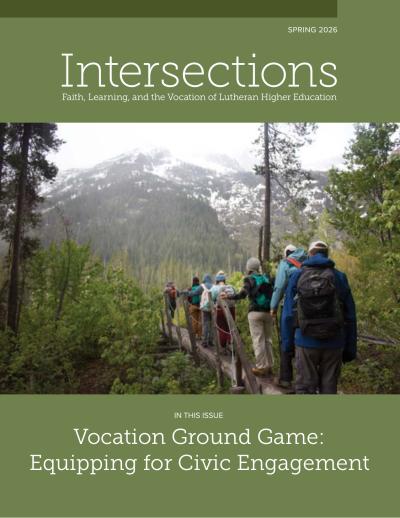
Wells and Windham-Hughes frame vocation as “ground game” — the practical, public living-out of faith through civic engagement — and introduce the issue’s focus on how Lutheran higher education equips students to repair the world.
-
Reflection
I am a Treaty Partner
Kyrie Fairbairn
7 min audio
A recent California Lutheran graduate reflects on how a course on Indigenous Rights and Practices, and a conversation with a former Chairman of the Lummi Nation, led her to claim a “treaty partner” identity and to challenge readers to learn the treaties that shape the lands they call home.
-
Article
Civic Engagement and Faith Perspectives
William O'Brochta
15 min audio
Guest editor William O’Brochta introduces the section by overviewing the ELCA’s call to civic engagement, recapping the Fall 2025 Civic Engagement and Faith Perspectives conference at Texas Lutheran University, and previewing the participant essays that follow.
-
Article
Leaning-In to the Civic Lessons of Our Namesakes
A. Lanethea Mathews-Schultz
6 min audio
Mathews-Schultz uses the civic legacy of the Muhlenberg family — from General Pete’s Revolutionary call to action to President Muhlenberg’s inaugural address on the “education of conscience” — to invite students at Muhlenberg College into a shared civic inheritance.
-
Article
Teaching and Mentoring in Service of Civic Engagement
Haco Hoang
6 min audio
Hoang describes how her teaching, mentoring, and research at California Lutheran University — including a multi-year collaboration with the Lutheran Office of Public Policy on Lutheran Lobby Day — cultivate civic skills grounded in ELCA social statements and the Lutheran tradition of faith and reason.
-
Article
An Ecosystem of Democracy
David Thomason
6 min audio
Thomason argues that faith-based institutions should equip students not to dominate the public sphere with their convictions but to cultivate an “ecosystem of democracy” — pursuing universal values with virtue and tolerance while acknowledging humanity’s incomplete grasp of truth.
-
Article
Bringing Core Values to Life through Civic Engagement
Austin Trantham
5 min audio
Trantham shows how Saint Leo University’s Benedictine Core Values shape his civic engagement work — from advising a “Why Vote?” campaign and Constitution Day panels to engaging students in the Unify Challenge for respectful cross-institutional discourse.
-
Article
Civic Engagement, "Baylor In Deeds," and Engaged Learning
Rebecca Flavin
6 min audio
Flavin describes how Baylor’s strategic plan “Baylor in Deeds” and its Office of Engaged Learning are building civic engagement into the Arts & Sciences core curriculum, with early Global Engagement Survey data showing gains in civic efficacy and global civic responsibility.
-
Article
Fragmented in Faith: The Concerns and Hopes Found in Student Spirituality and Civic Engagement
Emma Bohmann, Monica Sitachitta
11 min audio
Two Texas Lutheran University students reflect on the cyclical pattern of low spiritual and civic engagement on their campus and argue that distinguishing Lutheran values from Lutheran practice could open space for civic engagement to become a non-optional expression of neighbor-justice for all students.
-
 Article
Rooting Science in Empathy: Growing Towards a Sustainable Science Practice for the 21st Century
Cheryl L. Ney
No. 7 · Summer 1999
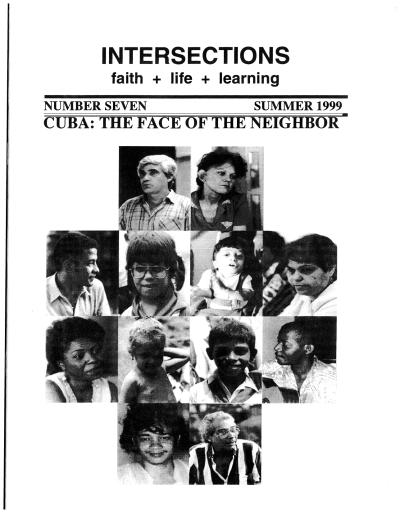
Ney, a DNA biochemist turned feminist science educator at Capital University, traces her own search for the “grounding” of teaching from Ernest Boyer’s scholarship of teaching through Cathleen Loving’s Scientific Theory Profile, Evelyn Fox-Keller’s critiques of science as “truly masculine philosophy” and her biography of Barbara McClintock (“A Feeling for the Organism”), and Arnold Pacey’s definition of science as a web of technical, organizational, and cultural practice. Drawing on the Dutch Science Shops, the Loka Institute’s community-based research, and academic service learning, she calls for “sustainable science practice” rooted in empathy and asks whether Lutheran institutions have the courage to claim an institutional freedom of vision rather than reduce themselves to preparation for the job market.
-
 Article
How Mister Rogers’ Neighborhood Reminds Us About Work
Than Oo
No. 61 · Spring 2025
5 min audio
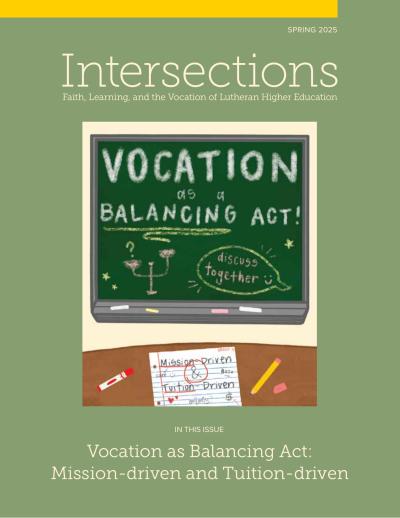
Drawing on a Season 15 arc of Mister Rogers’ Neighborhood in which residents redirect pool funds to fix a plumbing problem, Oo finds in Fred Rogers’ vocation-honoring storytelling a reminder that limited resources are an invitation to creativity, perseverance, and optimism in higher education.
-
 Reflection
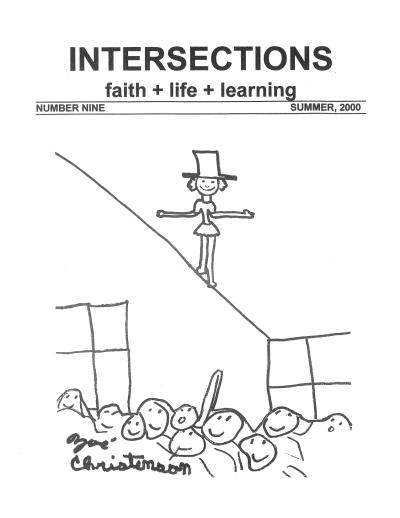
Calling and Learning: On Losing and Then Finding Myself
Rachel Hammond
No. 9 · Summer 2000
Hammond, a Capital University junior who spent two semesters studying in Guayaquil, Ecuador, recounts watching the sucre collapse from 10,500 to 29,000 per dollar between September and January, the overthrow of President Jamil Mahuad, the freezing of bank accounts over $4,000, the threatened eruption of the volcano at Baños, and her work at an orphanage that needed only $6.81 to feed a child for a month—and calls her fellow students, in light of Elie Wiesel’s warning that indifference is the enemy, to recognize their education as a gift and a responsibility to speak for those who cannot speak for themselves.
-
 Article
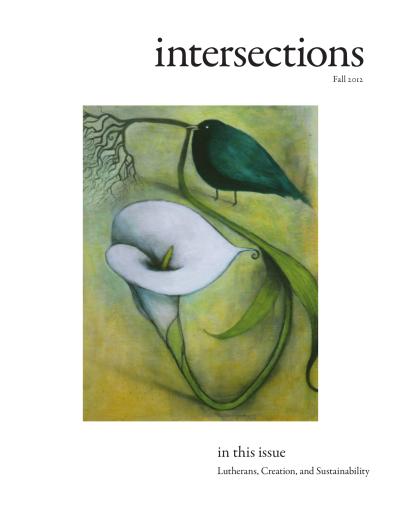
Sustaining Sustainability
Baird Tipson
No. 36 · Fall 2012
Tipson—former Provost of Gettysburg College, President of Wittenberg University, and President of Washington College—reads Romans 12:2 (“be not conformed to this world…”) against Victor Ferrall’s Liberal Arts at the Brink and the contemporary financial reality of small Lutheran colleges. He tells three case-study stories from Washington College’s Center for the Environment and Society—the Chino Farms partnership, the Chesapeake Semester, and the acquisition of the work boat Callinectes—to show how presidents must engage “the world” to secure resources for sustainability work without being conformed to it.
-
 Editorial
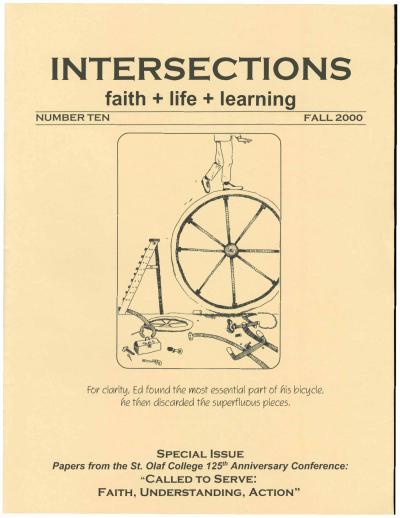
From the Editor
Tom Christenson
No. 10 · Fall 2000
Christenson recommends the St. Olaf 125th-anniversary volume Called to Serve—edited by Pamela Schwandt with Gary de Krey and L. DeAne Lagerquist—particularly Walter Sundberg’s “What Does It Mean To be Lutheran?” and Darrell Jodock’s “The Lutheran Tradition and the Liberal Arts College.” He notes that the volume’s biographical sketches of Lars Boe, F. Melius Christiansen, Ole Rolvaag, Emil Ellingson, Agnes Larson, John Berntsen, Arne Flaten, and Howard and Edna Hong show, against an outsourcing age, that the life of an institution like St. Olaf is the committed life of the people who work there.
-
 Article
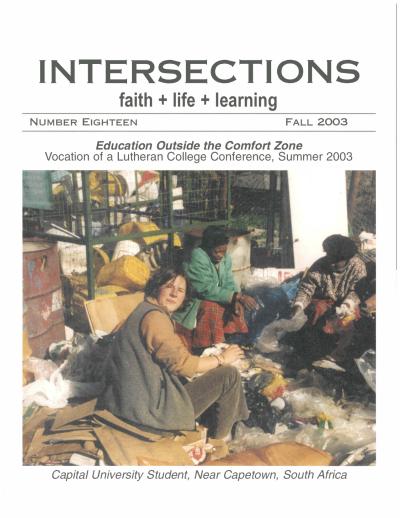
Educating for Peace: 21st Century Models for Thinking Globally and Acting Locally
Janet E. Rasmussen
No. 18 · Fall 2003
Rasmussen opens with a rabbinic story about the one-step distance between East and West and describes Pacific Lutheran University’s four-phase “Global Education Continuum”—Introductory, Exploratory, Participatory, Integrative—developed with Teagle Foundation support and grounded in Perry, Bennett, and Musil. She illustrates intentional global/local partnership through three case studies: Barbara Temple-Thurston’s Trinidad-and-Salishan initiative; the China Partners Network with the Amity Foundation, Good Samaritan Hospital, and PLU’s Wang Center; and Ann Kelleher’s three-institution “Norway in Namibia” partnership with Hedmark University College, the University of Namibia, NAMAS, and the Ondao mobile schools for the Himba people. She closes with Daloz, Keen, Keen, and Parks’s Common Fire research and Lee Knefelkamp’s call to be “communities of peace.”