Introduction. Like Mark Schwehn, I will look back to look ahead. Unlike Schwehn, my focus will address what we might do—faith in practice—the “body” which is excluded from the meaningful education he says must simultaneously address “mind and spirit.” I propose a redefinition of how Lutherans activate the moral dimensions of our relationships with others as a key to energizing the future of our higher education tradition: particularly, Kretzmann’s suggestion that our future lies in the development of those who might influence society, with all its inequalities and injustices. It seems to me that if we are to promote this development with integrity, the meaningfulness of theological reflection and academic scholarship must be grounded in day to day experiences and face to face relationships with others.
While service learning is one model for such a dialectic of theory and practice, this discussion will not address models. Rather, I believe our future lies in reminding ourselves of Kretzmann’s call to action in 1940. Perhaps he would concur with Arthur Preisinger who suggests 56 years later, that being Lutheran requires a dead honest look at the human condition and the truth of it, and offers, for those who care about it, a radical way out. It is our supreme responsibility to… be ready to speak and hear “the truth in love.” (Preisinger 1996)
… Our future may have less to do with considering what it means to be Lutheran, or even Christian, and more about the moral clarification of how we act out our commitment to those who have less or who are different.
Kretzmann’s development as well as Preisinger’s “dead honest look” necessitate discourse among divergent, even non-Lutheran, perspectives of the truth as Schwehn implies. We are challenged to engage with the living, breathing pluralism of the earthly kingdom rather than considering diversity from the safe, pristine distance of a purely academic perspective. (Digging a foundation is messier than creating architectural blueprints.) Doing must be given a higher priority than the last of six articulations of eternity (see Schwehn’s closing sentence) and our definition of “social” must go beyond his acknowledgment that education is public.
David Lotz articulates a definition of the earthly kingdom and its relationship to education and service which will gauge this conversation:
… the earthly kingdom includes the whole of humanity, Christians and non Christians alike, all of whom are God’s agents, ultimately answerable before him, for maintaining the world in peace and order… Rigorous education at the highest levels is required, therefore, indeed is commanded by God, to the end that the citizens of the earthly kingdom are enabled to appropriate their intellectual heritage, and are thereby equipped for responsible service in the world. In the process their own best capacities of mind and spirit are cultivated to their full potential. (Lotz 1979, p/7)
In other words, while Schwehn claims that our young people must feel in their bones the truths, in practice it may be more important for them to struggle against what is not true, however that may be defined. And, I will look back to Luther and ask different questions (it has been said that what we question is what we value) than Schwehn about our future. My queries about how faculty, staff and students at Lutheran colleges and universities can LIVE our faith, Lutheran or not, day to day in community with one another and the world around us, in a way which makes a difference, are introduced powerfully by Starla Stensaas of Dana college. In her response to materials for the Vocation of a Lutheran College Conference Stensaas asked,
Does the “church” demand the canon (and a particular theological, denominational canon at that) over the experience of living in community as an act of waiting for God together? Do we prefer to sit like the Pharisees and wring our hands over those who do not keep the Sabbath as we do? Or have we forgotten the cost of a “church” gone mad: the Inquisition, the Crusades, the white churches who rose up against civil rights? (1995)
She further legitimizes my response by explaining that she has been “lead to the church as a feminist academic who chose to teach at an institution that claims to value the whole person, an institution which makes this claim based on the Gospel and a church-relatedness.” Accepting that claim as a truth claim, she notes that she is “empowered to engage in conversation on social justice issues from a spiritual as well as an academic ground.” This paper will do the same, adding a call to action.
Luther’s Legacy. If all that remains as a “stay against the confusions of our time is a set of several religious traditions” as Schwehn implies because they offer a remedy for the human condition, I suspect we will wait a very long time for clarity and justice. Although working toward a world which offers safety and sanity for all, regardless of faith, cultural, personal or political traditions seems more urgent than refurbishing an ideal of the Lutheran College, Luther does offer support for social justice. Luther, as Simmons points out, was a relational thinker:
He saw all human life as existing simultaneously in relationship with God and neighbor, so all discussion of human life, including the life of faith is to be expressed through a dialectical understanding. It is the simultaneity of these relationships which gives human life its tension but also its ultimate meaning. (Simmons 1966)
This relationship with the world must be sustained in love. One of Simmons’ key points is that we have lost the call of vocation in service to our neighbor, in the earthly kingdom, and replaced it with vocation based on material satisfaction. It seems to me that we have also lost the sense of power the church community has to take action. Perhaps our influence is needed even more than in 1940 when the injustices were clearer. Schwehn offers various perspectives of how Lutheran institutions live out the relationship of Christ and culture. Luther further contextualizes this relationship when he “explicates his ethical teachings in terms of dualities. The antithetical duality pits the kingdom of God against the kingdom of the devil… in a complementary duality …God uses two governances (the spiritual and the temporal) as instruments in helping creation overcome the evil of the antithetical duality.” (Preisinger 1995) Add to this discussion Luther’s view of vocation as a calling, a call to moral responsibility, and his conviction that we must do our duty (and our best) in whatever situation God places us, and our future may have less to do with considering what it means to be Lutheran, or even Christian, and more about the moral clarification of how we act out our commitment to those who have less or who are different. How we identify and meet these needs may vary; as Lotz explains, education itself is “an instrument and expression of this freedom of will, and exists to instruct the will to choose rightly and wisely.” Of service he continues, “Given its placement and legitimization within the earthly kingdom, education is above all education for citizenship, for responsible service to one’s city and country.” (Lotz 1979)
Schwehn values an education which simultaneously addresses the mind and the spirit. I would propose that an education which simultaneously embodies theory and action, faith and practice, reflection and execution has a more dynamic meaning and significance for the future. Clearly, a liberal education is not enough. The Nazis, Hitler himself, appreciated the classics and could probably pass any test or teach any class offered by our general education programs. Nor is faith alone enough.
For example, of the Nazi German Lutherans Preisinger explains that it was “the misinterpretation of, the misapplication and the distortion of the doctrine [Luther’s] which was used by German churchmen to justify their pro-Nazi attitude during the third Reich.” (Preisinger 1995). Preisinger continues that Luther’s teaching not only “can but MUST be used to motivate action toward peace and social justice,” even though misinterpretations of Luther’s ethics led the church to feel it should not get ‘mixed up’ in politics.” (Preisinger 1995) Thus, I think our future lies more in the moral consideration of how we, and our graduates, choose to be citizens whose influence makes a difference, than it does in pondering our Lutheran version of the Christian faith.
Differences. “Making a difference” is an interesting colloquialism for this discussion in that most social injustice occurs precisely because, like the Jews, one is different than others with power. Those who are different become marginalized—become the Other. In a world which I argue is not so “obviously less perilous” than Schwehn might consider it to be, being culturally responsive and embracing diversity by demonstrating respect for differences may not be as easy as it sounds encouraging. Being politically correct does not necessarily mean being morally responsive or response-able. Actually living with someone who has decidedly different views is much more challenging than being a tourist in an exotic culture or undertaking a mission project to enlighten those deemed less fortunate. I write this response in a sense as an Other. Although I am an Anglo woman, of partial German descent who grew up Lutheran, I write also as someone from the Northeast and a convinced member of the Religious Society of Friends, a Quaker, in a Southern, Lutheran college. These differences, and my perspectives, have not always been to my benefit. For example, some may dismiss this essay, and in the process my voice, as simplistic, more affective than scholarly and decidedly “non Lutheran.” Ironically, I have realized more about my Lutheran roots, and discovered more about my colleagues in the process of writing this essay; I now have deeper and more meaningful connections to both. Long lunches, shared literature and anecdotes with others on campus empowered our understanding of each others’ perspectives. Thus, the discussions intended to result from reading this journal not only prompted its inception, but also its composition.
Stensaas explains eloquently that without the voice of the other:
the church has little of the hope of the gospel to offer. The hope is for all people—not just Lutherans with a particular political point of view. To live out our vocation, or mission, as a college of the church, means to me to work intentionally, institutionally and individually toward community that models the kind of acceptance that Jesus willingly gave to those not like him/us. (1995)
Lutherans are not always open to this. It seems that too often those who don’t fit the mold or model are viewed as antithetical rather than complementary.
The future of Lutheran Education then seems to lie within the challenge of integrating our faith and practice in relationship with others; those who teach, eat, worship and celebrate with us in our institutions, and those who suffer because of our privilege. Schwehn prioritizes, “the role of the Lutheran college is…to open itself up to change and enlargement of its own vision of the relationship between Christ and culture.” (p3) which he feels will lead to “the more urgent conversation among the Christian tradition and other great religious traditions.” I suspect it would be more timely for “change and an enlarged vision” to lead both to meaningful conversations among others with whom we come face to face on a daily basis and to action in a Freireian (1970) dialectic of empowerment with marginalized and disenfranchised others.
Conclusion: Given that there are multiple interpretations of Schwehn’s view of the future Lutheran Higher Education may anticipate, I again challenge his opening contrast between Kretzmann’s time and our’s. I question the priorities implied by Schwehn’s suggestion that we do not envision a possible end to Western Civilization but instead “worry over declining enrollments, cost containment and the waning of denominational identity… in the midst of less obviously perilous times to strengthen the explicitly Lutheran character of our schools’. For a moment, it would seem Schwehn shares my sense when he notes that Kretzmann’s address will “help us deeply to feel and consider … how much it [our world] has remained the same…” But he seems at best to oversimplify and at worst to vilify the significance of his comparison.
He quips only a paragraph later, that if he were a woman he could and would more quickly explain his(her) choice to be Lutheran rather than Roman Catholic. I would suggest that if he were a woman, or a person of color, the waning of denominational identity may not be a priority. And, if the comparison of Kretzmann’s time to our own did help him/her to “deeply feel and consider” how much our world has remained the same, the future of Lutheran higher education would be less defined by theological identity and more committed to social action.
For example, how might Texas Lutheran College maximize its impending change to Texas Lutheran University as an opportunity to renew, redefine and/or reenergize its maxim “community of faith and learning.” The Scholars Leadership Program at Guilford College, in Greensboro, North Carolina offers a summer intensive Spanish program in Mexico for women of faith committed to social justice and in the ELCA, Augsburg’s Cuernevaca, Mexico program is geared toward peace and justice issues. I want to see more programs like this offered in Lutheran institutions of higher education. Those who would suggest such programs are more appropriate as auxiliary programs rather than integrated across our curricula and our day to day lives are missing my point. And, according to Preisinger, Luther’s; he notes that if “German Lutheranism had understood the two kingdoms teaching correctly, it might have resisted the tyranny of Nazism on theological grounds.” (Preisinger 1995) I think if we are to understand correctly, our curricula must include moral reflection in a dialectic with moral action. Our future lies less in defining the distinctiveness of being Lutheran than in discerning the universality of being human; less in students “feeling in their bones the truths” than in moving their muscles against what is not true.
Our future lies less in defining the distinctiveness of being Lutheran than in discerning the universality of being human; less in students “feeling in their bones the truths” than in moving their muscles against what is not true.
Certainly, the time has come to provide living examples which will compel our students to moral action, trusting that through heartfelt scholarly reflection they will soon make the connections between their faith and such practice? An exaggerated view of Schwehn’s analysis and Luther’s notion of “saved by grace not by actions” might lead us to spend time and energy engaged in theological and philosophical reflections rather than righting the wrongs of a perilous society. Lutheran higher education has been so reflecting for decades and we still haven’t clarified the distinctive value and future of being Lutheran. Yet, the world around us continues to struggle with, as James B. MacDonald might say, “what it means to be human and how we might live together.” I have tried to make a case, with the support of Luther and Kretzmann, as cited by Schwehn, which will compel us to compassionate service in the cause of truth and love. It is time for action. It is time for us to do our best.
Works Cited
Freire, Paulo. Pedagogy of the Oppressed. New York: The Continuum Publishing Corporation. 1970.
Lotz, David W. “Education for Citizenship in the Two Kingdoms: Reflections on the Theological Foundations of Lutheran Higher Education.” In the Papers and Proceedings of the 65th Annual Convention Lutheran Educational Conference of North America. Washington D.C. February 3–4, 1979.
Macdonald, James B. (1978) “A Transcendental Ideology of Education.” In Gress and Purel (Ed.), Curriculum: An Introduction to the Field, (pp. 95–123). Berkeley: Mcuchan Publishing Co.
Preisinger, Arthur A. “What Makes a Lutheran College Lutheran?” Address delivered at Joseph H. Sittler Luncheon: Texas Lutheran College, Seguin Texas. April 11, 1996.
Simmons, Ernest L. “A Lutheran View of Christian Vocation in the Liberal Arts—II: Education and Scholarship in Theonomous Perspective.” The Cresset, January 1989, pp. 13–17.
Stensaas, Starla. “Meditations on the Vocation of Lutheran Colleges.” Unpublished Manuscript, Dana College. 1995.
-
 Editorial
From the Publisher
James M. Unglaube
Unglaube welcomes readers to the inaugural issue of Intersections, crediting Editor Tom Christenson and Capital University, and announces the new annual Vocation of a Lutheran College Conference whose continuing dialogue the journal exists to enhance. He gives thanks to the Lilly Endowment for a sizable grant supporting the 1996 conference, campus dialogues, and the birth of the publication.
-
Editorial
From the Editor
Tom Christenson
Christenson, feeling like a proud parent, welcomes readers to the inaugural issue and acknowledges three people without whom the publication would still be just an idea: Naomi Linnel of the ELCA office for Higher Education and Schools, publisher Jim Unglaube, and Capital University president Josiah Blackmore. He invites readers’ reactions, suggestions, and active involvement as editors, reviewers, authors, artists, and critics in shaping the dialogue across the ELCA college and university family.
-
Article
The Future of Lutheran Higher Education
Mark Schwehn
Schwehn’s keynote, framed against Otto Paul Kretzmann’s October 1940 inaugural at Valparaiso, organizes itself around four topics: the idea of a Christian University (Lutheran schools as a tributary of the Christian intellectual tradition, voices in a conversation in the spirit of H. Richard Niebuhr and Alasdair MacIntyre rather than phases of James Burtchaell’s devolutionary scheme); the pursuit of truth (against Foucauldian reduction of truth to power, with Hilary Putnam, toward a cruciform discipleship that discovers truth ambulando); the critique of knowledge (developing Christian theories of knowing in conversation with Benne, Lotz, Wolterstorff, LeClerc, and Augustine); and Christianity and liberal learning (objectivity refurbished as Thomas Haskell’s ascetic self-discipline, and the recovery of texts that have claims upon us).
-
Response
Knowing and a Tradition to be Known
Kurt Keljo
Keljo, University Pastor at Capital, embraces Schwehn’s vocational call but challenges his epistemological framing. We are called to bear witness to the Truth more than to pursue it; truth and power need not be dissociated when power is understood cruciform-ly as love and service; alongside objectivity, a case can be made from the tradition for connected knowing (image of God, idolatry, repentance, Incarnation). Christians offer not a particular epistemology but a foundation for epistemology—a tradition to be known. He closes with James Fowler’s four marks of the “public church”: particularly Christian, prepared for pluralism, balancing intimacy with public engagement, and unafraid of ideological pluralism in confident, nondefensive civility.
-
Response
Lutheran Colleges: The Context for the Conversation
Thomas Templeton Taylor
Taylor of Wittenberg engages Schwehn’s first argument by sketching the institutional predicament of Lutheran colleges through three converging forces: the collapse of differences among old-line Protestant groups in the wake of ELCA-era ecumenism (with Robert Wuthnow); the secularization of American higher education described by George Marsden; and the post-war decline of liberal arts colleges under pressure to professionalize. The result is an “in-between stage” in which Lutheran colleges retain rhetoric without substance. Following Richard John Neuhaus’s “Eleven Theses,” he argues that, for a time at least, Lutheran colleges’ institutional affiliations must remain actively Lutheran if they are to remain in any sense Christian.
-
Response
Renewing Our Journey: Some Thoughts on Pursuing the Truth
John Rehl
Rehl, a Capital University graduate pursuing doctorates in theology at Chicago and in economics at Wisconsin, takes up Schwehn’s invitation to think again on the nature of truth. He sets aside truth as information, as object, and as mere words; recasts the church-related college’s task as a renewed emphasis on classroom teaching (Kierkegaard’s teacher as midwife) and on brave, articulate professors. He calls for moral education in courage, discipline, patience, and love, illustrates the costs of the fact-value split with examples from economics, and argues that we honor Lutheran heritage not by preserving it as a museum piece but by testing it—Luther’s theology of the cross over a theology of glory—and by preparing students for a world of Untruth, strengthened (with Julian of Norwich) by the promise that they will not be overwhelmed.
-
Institutional Focus
Diversity and Dialogue: Gustavus Adolphus College
Florence D. Amamoto
Amamoto, a third-generation Japanese-American Buddhist who teaches American literature at Gustavus Adolphus and regularly attends daily chapel, writes as an “inside outsider.” Engaging Schwehn’s closing call to refurbish the Lutheran college, she argues that church-related colleges are vitally important to society, that “refurbishing” must take up diversity, and describes how Lutheranism is manifest at Gustavus: Christ Chapel as the highest point on campus, the ecumenical chapel program led for thirty years by Chaplain Richard Elvee, the Nobel Conferences that pair scientists with philosophers and theologians, the First-term Seminar and Tuesday Conversations, the India study-abroad program organized by Deane Curtin, and the Sponberg Chair in Ethics. She names the pressures of money, secularization, and the publications-driven push for “excellence” that threaten this creative tension.
-
Institutional Focus
Continuing the Dialogue: Augustana College
Sandra C. Looney
Looney describes Augustana College, Sioux Falls, debating and renaming its values—Christian, Liberal Arts, Community, Excellence, Service—under the leadership of religion professor Dr. Arthur Olsen and the T’N’T (“Through Thick and Thin”) committee, in the wake of ELCA Region III’s “What Does It Mean to be a College of the Church?” conversations. She describes Augustana’s 56% Lutheran student body, daily 10 a.m. chapel, dual Christmas Vespers in Our Savior’s Lutheran Church and St. Joseph’s Cathedral, the Capstone classes on moral and aesthetic issues, and the ongoing work of enlarging Augustana’s conversation to include Native American, Jewish, and Islamic voices.
-
 Book Review
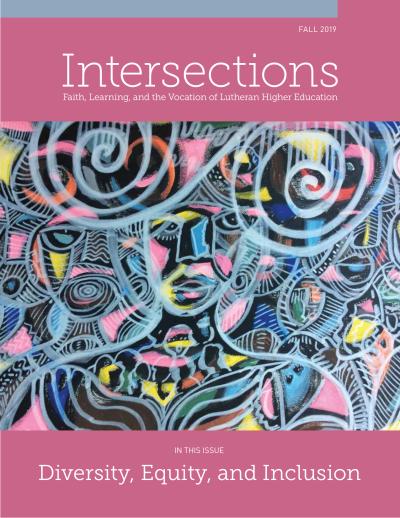
The American Myth of White Supremacy: A Review of Myths America Lives By
Susan VanZanten
No. 50 · Fall 2019
VanZanten reviews Richard T. Hughes’s Myths America Lives By: White Supremacy and the Stories that Give Us Meaning, which argues that the United States grounds its identity in five myths — Chosen Nation, Nature’s Nation, Christian Nation, Millennial Nation, and Innocent Nation — all informed by the primal myth of white supremacy, and considers what Lutheran theological values can offer for resisting that myth.
-
 Article
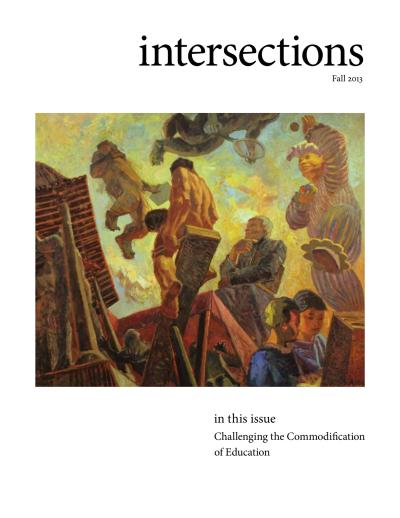
More Value than Many Sparrows: A Sermon on Matthew 10:26-31
Patricia Lull
No. 38 · Fall 2013
Preaching at the 2013 Vocation of a Lutheran College conference, Lull recalls her own arrival at the College of Wooster the summer after Kent State and contrasts that era’s sense of students as participants in a college’s mission with today’s talk of “butts in seats.” Reading Matthew 10:26-31, she promises that the way of the cross—and its hard opportunities for slow-paced learning, genuine debate, and access for students who cannot pay the full cost—is the easy yoke, the lightest burden of all.
-
 Article
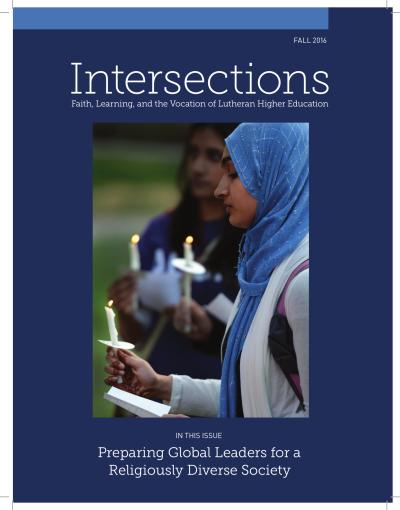
Why Interfaith Work is Not a Luxury: Lutherans as Neighboring Neighbors
Martha E. Stortz
No. 44 · Fall 2016
Stortz argues that interfaith work is not a luxury but a constitutive commitment of Lutheran higher education — institutions she describes as both “faith-based and interfaith-dependent.” Reading the parable of the Good Samaritan as both an intra-faith and inter-faith encounter, she offers a four-fold matrix of theological reflection, spiritual engagement, social action, and everyday experience as portals into the work of being neighbor.
-
 Article
Cultivating Staff Flourishing in Lutheran Higher Education: A Framework for Advocacy and Engagement
Laree Winer
No. 58 · Fall 2023
Winer narrates her own “love affair” with Lutheran Higher Education to argue that the heart of the tradition — vocation, de-emphasized hierarchy, and shared humanity — equips NECU institutions to advocate for staff flourishing through data collection, professional development, and ongoing relational commitment.
-
 Reflection
Meditation—Band Chapel Service, St. Olaf College
Erik Haaland
No. 7 · Summer 1999
Haaland, a St. Olaf senior, offers a brief Band Chapel meditation that defines art as “the expression of what is deeply human through the manipulation of the physical world” and defends worship—architecture, stained glass, music, eloquence—as an art form requiring our best and most sincere efforts. When the God we worship and the salvation we proclaim do not seem near, artful worship offers not propositions but something real and tangible to hold on to.
-
 Response
Tat for Teat: Ratke Responds
David Ratke
No. 9 · Summer 2000
Ratke, agreeing with much of VonDohlen’s critique but contending that VonDohlen misreads both Luther and the two-realms doctrine, marshals Luther’s To the Christian Nobility, On the Freedom of a Christian, Temporal Authority, Whether Soldiers Too Can Be Saved, and the “Sermon on Keeping Children in School,” along with Walther von Loewenich, to argue that Luther was well aware of structurally differentiated society, made no claim to a monistic epistemology, and intended the two-realms doctrine to combat—not introduce—dualistic bifurcation between sacred and secular. Our identity is “not as either Christian or academic, but as Christian and scholar.”