Baylor University’s mission is “to educate men and women for worldwide leadership and service by integrating academic excellence and Christian commitment within a caring community.” The University’s current strategic plan, “Baylor in Deeds,” strives to deepen this commitment to preparing our students for civic engagement through academic and character formation and expands our longstanding motto, Pro Ecclesia, Pro Texana, with an additional, broader global focus — Pro Mundo. “Baylor in Deeds” is inspired by Christ’s Sermon on the Mount, where he instructs us, “let your light shine before others, that they may see your good deeds and glorify your Father in heaven” (Matthew 5:16). Among the foundational pillars of this strategic plan is providing students with a “transformational undergraduate educational experience” including experiential learning opportunities outside the classroom.
Baylor’s Office of Engaged Learning (OEL) is a campus hub that connects students to these opportunities for engagement beyond the classroom including research, internships, and public service work in local, state and national communities, endeavoring to embody Paul’s exhortation in the First Epistle to Timothy, “to do good, to be rich in good deeds, and to be generous and willing to share…so that they may take hold of the life that is truly life” (I Timothy 6:18-19). Through these learning experiences, the OEL equips students to “transform the cultural, social, economic, and political contexts around them so that they might help to create a world that is more just, fair, inclusive, equitable, and sustainable — one in which all flourishing is mutual.” We achieve our goals when our students orient their learning toward the needs of others, participating in civic engagement not for self-interested reasons such as bolstering their resumes but in service of the greater good.
We achieve our goals when our students orient their learning toward the needs of others, participating in civic engagement not for self-interested reasons such as bolstering their resumes but in service of the greater good.
One of OEL’s more recent initiatives is working alongside academic departments across campus to build the Engaged Learning Distribution List (ELDL) for Baylor’s College of Arts & Science’s Core Curriculum. While the requirement is only in its second year, the EL DL already boasts approximately 50 unique undergraduate courses from more than 20 distinct departmental prefixes, including disciplines spanning Arts and Sciences divisions as well as offerings from other colleges. Moreover, over 75% of these courses are either newly developed or revised for this requirement, underscoring widely shared enthusiasm for this work that will continue to blossom through “Baylor in Deeds.”
The College’s learning objectives for the ELDL include an explicit commitment to civic engagement: “Students will use knowledge gained and skills developed in the course to cultivate civic virtues and contribute to the public good.” Among the courses currently offered in the ELDL, those in the Philanthropy and Public Service Program (PPS) enroll the most total students, including PPS 1101 Learning for the World and PPS 2101 Community Based Global Learning. Each of these courses requires between ten and twenty hours of community-engaged service during the semester, with most students in PPS 1101 and PPS 2101 volunteering with English as a Second Language (ESL) programs offered at a local church and community college. Data from the Global Engagement Survey (GES) for courses offered in the 2024-2025 academic year is encouraging and indicates that students show improvement in both civic efficacy and global civic responsibility between the pre-test administered at the start of the semester and the post-test administered at the end of the class. These results bear witness to the positive impact that community engaged learning has in our quest to train students for “worldwide leadership and service” grounded in our Christian commitment to love our neighbor as ourselves.
-
 Editorial
From the Publisher & Editor
Colleen Windham-Hughes, Lamont Anthony Wells
6 min audio
Wells and Windham-Hughes frame vocation as “ground game” — the practical, public living-out of faith through civic engagement — and introduce the issue’s focus on how Lutheran higher education equips students to repair the world.
-
Reflection
I am a Treaty Partner
Kyrie Fairbairn
7 min audio
A recent California Lutheran graduate reflects on how a course on Indigenous Rights and Practices, and a conversation with a former Chairman of the Lummi Nation, led her to claim a “treaty partner” identity and to challenge readers to learn the treaties that shape the lands they call home.
-
Article
Civic Engagement and Faith Perspectives
William O'Brochta
15 min audio
Guest editor William O’Brochta introduces the section by overviewing the ELCA’s call to civic engagement, recapping the Fall 2025 Civic Engagement and Faith Perspectives conference at Texas Lutheran University, and previewing the participant essays that follow.
-
Article
Leaning-In to the Civic Lessons of Our Namesakes
A. Lanethea Mathews-Schultz
6 min audio
Mathews-Schultz uses the civic legacy of the Muhlenberg family — from General Pete’s Revolutionary call to action to President Muhlenberg’s inaugural address on the “education of conscience” — to invite students at Muhlenberg College into a shared civic inheritance.
-
Article
Teaching and Mentoring in Service of Civic Engagement
Haco Hoang
6 min audio
Hoang describes how her teaching, mentoring, and research at California Lutheran University — including a multi-year collaboration with the Lutheran Office of Public Policy on Lutheran Lobby Day — cultivate civic skills grounded in ELCA social statements and the Lutheran tradition of faith and reason.
-
Article
Community-Based Research as Engaged Citizenship
James Paul Old
6 min audio
Old argues that genuine citizenship requires more than charitable gestures — it demands long-term, reciprocal community partnerships — and describes how Valparaiso’s Community Research and Service Center embodies that vision even amid the financial pressures threatening such programs.
-
Article
An Ecosystem of Democracy
David Thomason
6 min audio
Thomason argues that faith-based institutions should equip students not to dominate the public sphere with their convictions but to cultivate an “ecosystem of democracy” — pursuing universal values with virtue and tolerance while acknowledging humanity’s incomplete grasp of truth.
-
Article
Bringing Core Values to Life through Civic Engagement
Austin Trantham
5 min audio
Trantham shows how Saint Leo University’s Benedictine Core Values shape his civic engagement work — from advising a “Why Vote?” campaign and Constitution Day panels to engaging students in the Unify Challenge for respectful cross-institutional discourse.
-
Article
Fragmented in Faith: The Concerns and Hopes Found in Student Spirituality and Civic Engagement
Emma Bohmann, Monica Sitachitta
11 min audio
Two Texas Lutheran University students reflect on the cyclical pattern of low spiritual and civic engagement on their campus and argue that distinguishing Lutheran values from Lutheran practice could open space for civic engagement to become a non-optional expression of neighbor-justice for all students.
-
 Article
Martin Luther, Vocation, and Church Colleges: Nurturing Future Leaders for Faith and Community
Richard W. Rouse
No. 14 · Summer 2002
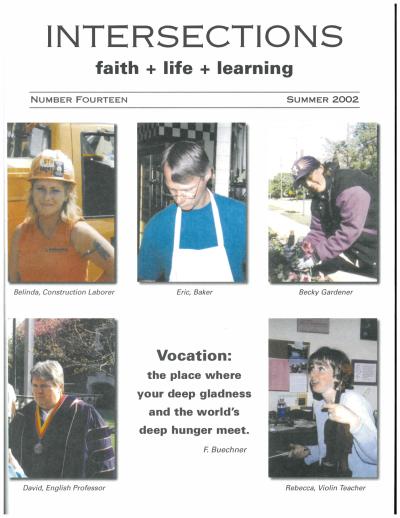
Rouse, citing Arne Selbyg’s statistic that thirteen of sixteen newly elected ELCA bishops graduated from a Lutheran college (and 49 of 65 in the new Conference of Bishops), argues that ELCA colleges are training grounds for future church and community leaders because of Luther’s doctrine of the priesthood of all believers and his distinction between vocation and station—the basis of PLU’s motto “educating for lives of service, inquiry, leadership, and care.” He describes “Paths Unknown: Where is God Leading Me?” a Western Mission Cluster collaboration of California Lutheran, Luther Seminary, Pacific Lutheran Theological Seminary, PLU, and Trinity Lutheran College that used a dedicated web site (godleading.com), a January-February 2001 online virtual forum reaching over 300 participants in 40 states and Canada and Mexico, and one-day interactive video workshops featuring Trump’s play “Holy Odors,” and reports LECNA’s Reclaiming Lutheran Student Project findings on teaching, community, and faith integration at Lutheran schools.
-
 Article
You Don't Seem Angry: Methodological Confessions Of A Lutheran Lay-Woman
L. DeAne Lagerquist
No. 5 · Summer 1998
Lagerquist, opening from a colleague’s 1981 observation about her M.A. thesis on four female abolitionists, traces her path from feminist historian and battered women’s shelter advocate through the University of Chicago’s obsession with method to a more self-conscious account of her own. The method grows out of four Lutheran themes—original sin (caution and humility), the eighth commandment against bearing false witness (generosity and forgiveness), the neighbor as “little Christ” (cooperative interpretation), and vocation (interpretation as calling, located alongside feeding the hungry and visiting the lonely)—and shapes her ongoing work on a history of Lutherans in the United States with a plot about learning to live with diversity.
-
 Response
Finding the Words: The Trouble of Being California Lutheran University
Pamela M. Jolicouer
No. 6 · Winter 1999
Jolicoeur, provost and vice president for academic affairs at California Lutheran, recounts the marketing problem of a university whose middle name is Lutheran in a Southern California religious landscape where the operative modifier is “Christian” (Pepperdine, Azusa Pacific) and tests Christenson’s three themes against her own “alumni magazine test”—the Jesuit standard set by Santa Clara. She concludes that freedom, gift, and vocation, though not uniquely Lutheran, are the words she can actually use: with prospective faculty, with the constituent church bodies who pressed for “Christian” in the new CLU mission statement (compromise: “rooted in the Lutheran tradition of Christian faith…”), and with the “C student” alumna headed for a Ph.D. in psychology whose consciousness of her own gifts had evaporated.
-
 Editorial
From the Publisher: Navigating Affirmative Action, DEI Policies, and Lutheran Vocational Identity
Lamont Anthony Wells
No. 59 · Spring 2024
Wells surveys the converging pressures on NECU institutions — the unsettled landscape of affirmative action, political and academic scrutiny of DEI work, and the preservation of distinctively Lutheran vocational identity — and previews how the issue draws on affirmative practices, sociological viewpoints, and theological responses to navigate a path forward.
-
 Book Review
Review of Educating for Shalom: Essays on Christian Higher Education
Tom Christenson
No. 20 · Fall 2004
Christenson reviews Nicholas Wolterstorff’s Educating for Shalom: Essays on Christian Higher Education (Eerdmans, 2004), edited by C.W. Joldersma and G.G. Stronks. After recounting his own early prejudice against Wolterstorff’s Reason Within the Bounds of Religion and his subsequent conversion through Art in Action, he focuses on two threads: Wolterstorff’s expansive reading of shalom—not merely peace but justice, community, communal responsibility, and delight—as the overall goal of Christian collegiate education, and the influence of Abraham Kuyper’s claim of “privileged cognitive access” for Christian inquirers, which Wolterstorff demonstrates rather than declares.
-
 Editorial
From the Editor
Jason A. Mahn
No. 54 · Fall 2021
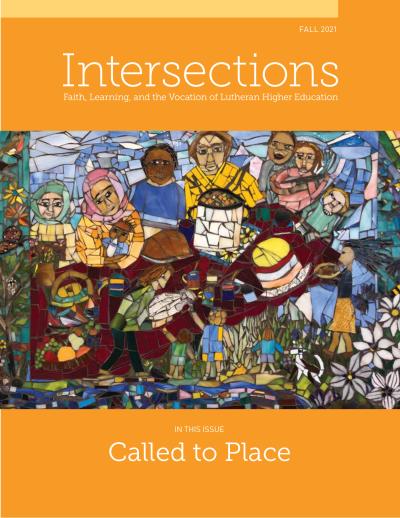
Mahn introduces the “Called to Place” theme of the 2021 VLHE Conference, arguing that Lutheran higher education’s emphasis on vocation must be grounded in particular geographies and embodied communities — for, as Wallace Stegner put it, “If you don’t know where you are, you don’t know who you are.”