Response to Mark Wilhelm: DEI, Great; DWS (Dismantling White Supremacy), Even Better
Intersections No. 56 · Fall 2022
The purpose of higher education at Lutheran colleges and universities is to contribute to the flourishing of all. DEI is great, but if Lutheran colleges and universities want to up their game, DWS (dismantling white supremacy) is even better. Dismantling white supremacy is essential to the flourishing of all. Thus, it should be a core practice of our higher education.
The protests and rebellion around the deaths of George Floyd, Ahmaud Arbery, Breonna Taylor, and others have helped the wider/whiter public in the United States understand both the importance and urgency of dismantling white supremacy. Around the same time, Trump-appointed, Acting Secretary of Homeland Security Kevin McAleenan confirmed white supremacy to be our greatest domestic threat.
Given how hot this summer has been, we could also make connections between white supremacy on the one hand, and climate disruption and environmental degradation on the other, like James Cone does.
“The logic that led to slavery and segregation in the Americas, colonization and apartheid in Africa, and the role of white supremacy throughout the world is the same one that leads to the exploitation of animals and the ravaging of nature. It is a mechanistic and instrumental logic that defines everything and everybody in terms of their contribution to the development and defense of white world supremacy.”
What is white supremacy, and what is a key harm to BIPOC communities? According to Frances Ansley,
“White supremacy is a political, economic, and cultural system in which whites overwhelmingly control power and material resources, conscious and unconscious ideas of white superiority and entitlement are widespread, and relations of white dominance and non-white subordination are daily re-enacted across a broad array of institutions and social settings.”
If any part of the above quote describes business as usual at our colleges and universities, it’s time for a long, hard look at ourselves in light of our commitment to the flourishing of all.
There are some Lutheran sensibilities that can help us make dismantling white supremacy a core practice of higher education. I’ll just mention three.
1) To Lutherans, self-righteousness is totally sus. Lutheran understandings of human beings as created and loved by God, and of infinite worth, make them skeptical about self-justification, attempts to earn and prove your worth. We’re thus free to see our beauty and our flaws.
My own higher education has often felt like a seemingly endless valorization, endorsement, and aggrandizement of the West and whiteness. Whether it’s been about the Enlightenment/Enwhitenment, science and technology, industry and development, or equality and democracy, the sense of white superiority has been at once tedious and terrible. But if classic scary movies have taught us anything, it’s that what you disavow comes back to haunt you. We’re being haunted by the legacies of genocide, slavery, and colonialism today. It’s time to interrogate this past, undo its impacts in the present, and work for a better future.
2) To Lutherans, the death of Jesus was a decolonial shockwave, still reverberating across space and time. We’re all living in a state of thrownness because of it. It turns out that the eye-averting execution of this thirty-something, Palestinian-Jewish construction worker—condemned for blasphemy by his religious community and viewed as a threat to society by the political regime—inspires our solidarity with marginalized peoples, those subordinated by white supremacy. It also turns out that this particular death generates momentum in decolonizing higher education. It’s time to rewrite general education based on a more diverse and inclusive range of sources.
3) Finally, Lutheran colleges and universities are supposed to deliver higher education that lays a foundation for critical thinking that can still register awe. Dismantling white supremacy means more awe, and thus more wonder and joy, based on a much richer, broader cross-section of human experience. It also contributes to intellectual curiosity and humility.
How can Lutheran colleges and universities make a stronger commitment to DEI? By making the dismantling of white supremacy a core practice of higher education.
-
 Editorial
From the Editor: Why All This Talk About Vocation?
Colleen Windham-Hughes
Windham-Hughes introduces the Fall 2022 issue built around Mark Wilhelm’s keynote “Why all this talk about vocation?” and previews five panel responses, two first-time conference reflections, and companion pieces on Womanist theology — framing vocation as a call not to privilege but to constructive and corrective work that undoes unjust systems.
-
Article
Why All This Talk About Understanding the Mission of NECU Member Institutions as a Vocation?
Mark Wilhelm
In his valedictory keynote, retiring NECU Executive Director Mark Wilhelm argues that Lutheran higher education is, properly understood, vocation-based education — outlining four core practices recovered over the past fifty years and naming the constructive and corrective work still to be done, including a fuller embrace of DEIJ and of the diverse vocations of NECU’s 27 institutions.
-
Response
Response to Mark Wilhelm: Vocation, Mission and Privilege
Marit Trelstad
Trelstad affirms Wilhelm’s claim that vocation is the foundational shared mission of Lutheran higher education rather than one program among many, and presses the critique that calls to “vocational reflection” can mask privilege — arguing that an intersectional lens shows vocational discernment is in fact a matter of survival and flourishing for students from marginalized communities.
-
Response
Response to Mark Wilhelm: Distinguishing Between Identity and Vocation
Andrew Tucker
Tucker proposes that NECU’s next most faithful step is to faithfully and effectively differentiate vocations and identities — arguing that identity is who you are, vocation is what you do, and that recognizing the plurality of both helps Lutheran institutions name which work is theirs to take up and which is good work that belongs to someone else.
-
Response
Response to Mark Wilhelm: Vocation—Wide Perspective Questions
Mary-Paula Cancienne
Cancienne, drawing on Iain McGilchrist, asks whether higher education has prioritized micro lenses at the expense of the macro view, and invites educators to hold the drama of individual vocation stories within a wider plot that includes James Webb Telescope wonder, climate grief, the long shadow of enslavement, and the resilience of native populations.
-
Response
Response to Mark Wilhelm: Adopting the Framework of ‘Because’ and ‘Therefore’
Paul C. Pribbenow
Pribbenow describes how Augsburg University responded to its dramatic demographic transformation (from 18% to nearly 70% BIPOC entering students over sixteen years) by adopting an institutional vocational statement and a simple “because/therefore” framework for translating particular Lutheran theological convictions into institutional programs, policies, and practices.
-
Article
Work Works
Julius Crump
Crump argues that in an era of class-stratified careerism and the “ruins of neoliberalism,” commencement-speech rhetoric about heroic vocation will not resuscitate vocation — instead, professors embodying vulnerability, extemporaneity, and contemporaneity in the classroom can show students that consistent work, embodied as service to others, is itself worthy.
-
Reflection
Why All This Talk About Vocation?
Madyson Ray
Ray, a junior at Midland University and the only student attendee at the 2022 conference, reflects on four workshops — on teaching womanist thought, on supporting student-athletes, on resistance to the word “vocation,” and on vocational reflection — and brings home concrete ideas including a women’s-history scavenger hunt and semester-long vocational reflections.
-
Institutional Focus
LibGuide: Introduction to Womanist Theology
Elli Cucksey
Cucksey, the head librarian at Trinity Lutheran Seminary, recounts how Beverly Wallace’s Introduction to Womanist Theology class — the first offering of the ELCA Seminaries’ Womanist Theology Initiative — led her to build a publicly available LibGuide that amplifies Black women’s voices and gathers the resources of the course for future students.
-
Article
Doing the Work One’s Soul Must Have
Beverly Wallace, Yolanda M. Norton
Norton and Wallace describe the Womanist Experiential Learning Initiative — including the Beyoncé Mass, study-abroad partnerships in Portugal, Brazil, and Ghana, and the Black Girl Magic Academy for teenage girls — as a way of centering Black women’s voices in theological education and doing, as Katie Geneva Cannon put it, “the work…that one’s soul must have.”
-
 Reflection
Shelter in Place: Reflections from March 22, 2020
Jason A. Mahn
No. 53 · Spring 2021
On the fourth Sunday of Lent in 2020, Mahn meditates on the etymology of “shelter” (from shield) and on an email from a former student in Boston whose mutual-aid organizing models a Lutheran understanding of vocation: the upending of ego by divine love that frees us, finally, to see and serve the neighbor.
-
 Editorial
From the Publisher: Staying Connected
Mark Wilhelm
No. 38 · Fall 2013
Wilhelm frames Intersections as a tool for maintaining relationships among leaders in ELCA higher education, welcomes the journal’s new editorial advisory board, and points readers toward the 2014 Vocation of a Lutheran College conference at Augsburg and a special interfaith understanding conference at Augustana with Eboo Patel and Presiding Bishop Elizabeth Eaton.
-
 Response
Response to Robert Benne
Baird Tipson
No. 17 · Summer 2003
Tipson responds to Robert Benne’s comments in the previous issue about his review essay of The Future of Religious Colleges, affirming their fundamental agreement that the Enlightenment epistemology dominant in higher education poses the most serious threat to the vitality of Lutheran colleges. Using the example of lecturing on early Mormon history and the Book of Mormon, he concedes that the methodological “solvent” of Enlightenment historiography acts on Christian as well as Mormon faith claims, and concludes that while H. Richard Niebuhr’s “inner” and “outer” history and Walter Brueggemann’s approach in The Theology of the Old Testament are comforting to believers, they do not offer an epistemology that can stand alongside the Enlightenment model in evaluating truth claims in the academy.
-
 Editorial
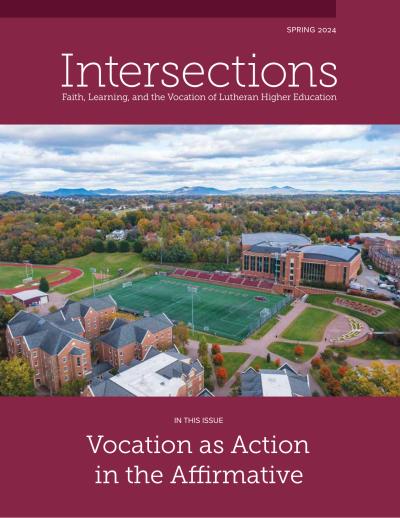
From the Editor: Vocation as Action in the Affirmative
Colleen Windham-Hughes
No. 59 · Spring 2024
Windham-Hughes frames vocation as practicing “at the borders of our incompetence” — every small yes to the callings we experience, every effort made in the direction of life, is action in the affirmative — and previews the issue’s essays on diversity, transformation, AI, championship team culture, and dreaming big within and beyond our limitations.
-
 Article
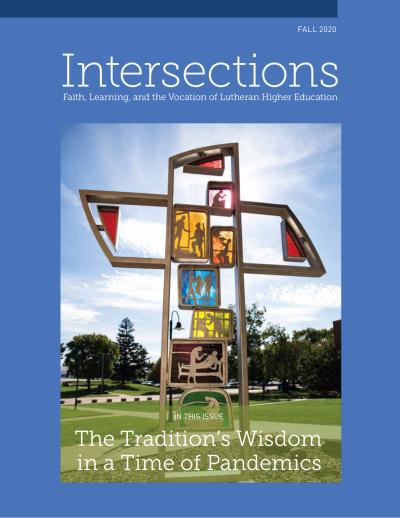
Learning from Luther on Covid-19
Carl Hughes
No. 52 · Fall 2020
Reading Martin Luther’s 1527 treatise “Whether One May Flee from a Deadly Plague,” Hughes finds practical and spiritual guidance for a pandemic age: serve the neighbor, follow medical experts, honor those whose vocations put them at risk, and trust that even when we fail, God will not abandon the community.
-
 Editorial
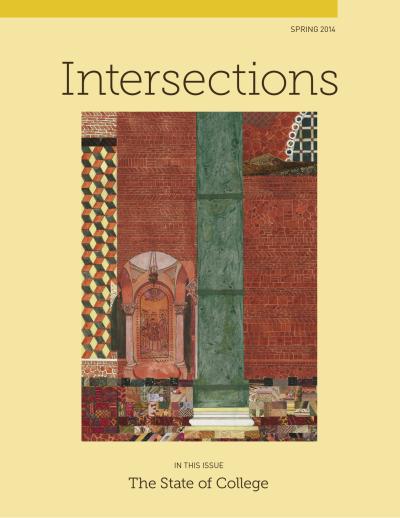
From the Editor
Jason A. Mahn
No. 39 · Spring 2014
Mahn reports on the working group “People of Wondrous Ability: Introducing Faculty and Staff to Lutheran Higher Education,” shares creative ways campuses are introducing colleagues to the charisms of the Lutheran tradition, and frames the issue as a set of reflective reviews that move from national trends to homegrown conversations about the state of college.