I teach and serve at Saint Leo University, a private Catholic institution rooted in long-standing Benedictine values. These Core Values — Community, Excellence, Integrity, Personal Development, Respect, and Responsible Stewardship — inform the daily work of our students, faculty, and staff, and are held in high esteem across campus. Whether working with civically minded students, promoting democratic discourse on campus with my faculty colleagues, or directly educating students in the classroom, my civic engagement efforts are guided by a desire to advance these founding principles.
I was honored to serve as a Faculty Advisor for Saint Leo’s “Why Vote?” campaign, helping to guide student leaders to promote the inviting and inclusive theme of “Empower, Elevate, and Educate.” Everyone worked tirelessly to plan and execute the university’s first “Civic Engagement Day.” Multiple community organizations participated in informative sessions discussing the impact of civic engagement, and the direct impact that college students can make through targeted activism. The event culminated with a conversation between the student organizers and a member of the Florida House of Representatives. This gathering demonstrated our Community Core Value, inviting “all of us to listen, to learn, to change, and to serve.” Subsequent activities included presentations and informal events aligning with National Voter Registration Day and Civic Engagement Week. This work illustrates the Saint Leo Core Value of Excellence, which includes a call to “develop the character, learn the skills, and assimilate the knowledge essential to become morally responsible leaders.”
Each year, I am privileged to collaborate with colleagues on an event celebrating Constitution Day that meaningfully engages the Saint Leo community. We invite faculty members from various disciplines to discuss a thematic issue relating to civic engagement and constitutionalism in order to link Founding principles to modern political and social issues. In 2025, I moderated our conversation on “Immigration, Citizenship, and the Constitution” with professors in criminal justice, history, and political science. While differences of opinion were expressed on topics regarding assimilation and cultural heritage, the evening cultivated with insightful student questions. I thoroughly enjoyed leading an event that directly engages our Core Value of Respect, noting the importance of “unity and diversity…the free exchange of ideas, and… learning, living, and working harmoniously.”
Finally, I strive to cultivate civic awareness through my teaching by connecting students directly with community leaders and opportunities for democratic dialogue. In my American State and Local Government course, students covered with a former student, Luke King, now Judge/Executive of Cumberland County, Kentucky. He discussed the creation of the Cumberland County Civics Club, a pioneering initiative in youth civic engagement. Students in my Introduction to Politics class participate in the Unify Challenge, practicing respectful discourse on policy issues with peers from other institutions holding differing political perspectives. Though some are initially nervous about this prospect, all come away appreciating the opportunity to hone their civic knowledge, critical thinking, and oral communication skills. These efforts correlate with the Saint Leo Core Value of Personal Development and our emphasis on the “development of every person’s mind…to help strengthen the character of our community.”
Though some are initially nervous about this prospect, all come away appreciating the opportunity to hone their civic knowledge, critical thinking, and oral communication skills.
It is gratifying to work at a faith-based institution that intentionally strives to promote Core Values, and my work in civic engagement has certainly benefited from engaging with these mission-based practices to educate and empower students, colleagues, and the community.
-
 Editorial
From the Publisher & Editor
Colleen Windham-Hughes, Lamont Anthony Wells
6 min audio
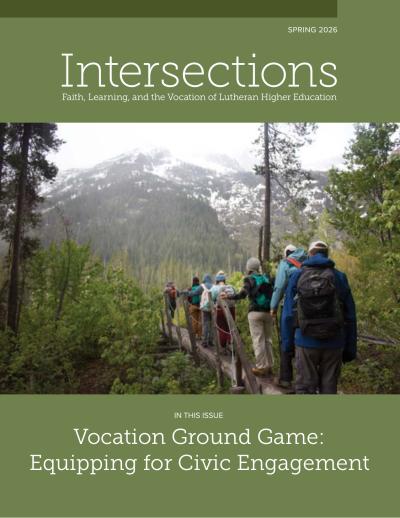
Wells and Windham-Hughes frame vocation as “ground game” — the practical, public living-out of faith through civic engagement — and introduce the issue’s focus on how Lutheran higher education equips students to repair the world.
-
Reflection
I am a Treaty Partner
Kyrie Fairbairn
7 min audio
A recent California Lutheran graduate reflects on how a course on Indigenous Rights and Practices, and a conversation with a former Chairman of the Lummi Nation, led her to claim a “treaty partner” identity and to challenge readers to learn the treaties that shape the lands they call home.
-
Article
Civic Engagement and Faith Perspectives
William O'Brochta
15 min audio
Guest editor William O’Brochta introduces the section by overviewing the ELCA’s call to civic engagement, recapping the Fall 2025 Civic Engagement and Faith Perspectives conference at Texas Lutheran University, and previewing the participant essays that follow.
-
Article
Leaning-In to the Civic Lessons of Our Namesakes
A. Lanethea Mathews-Schultz
6 min audio
Mathews-Schultz uses the civic legacy of the Muhlenberg family — from General Pete’s Revolutionary call to action to President Muhlenberg’s inaugural address on the “education of conscience” — to invite students at Muhlenberg College into a shared civic inheritance.
-
Article
Teaching and Mentoring in Service of Civic Engagement
Haco Hoang
6 min audio
Hoang describes how her teaching, mentoring, and research at California Lutheran University — including a multi-year collaboration with the Lutheran Office of Public Policy on Lutheran Lobby Day — cultivate civic skills grounded in ELCA social statements and the Lutheran tradition of faith and reason.
-
Article
Community-Based Research as Engaged Citizenship
James Paul Old
6 min audio
Old argues that genuine citizenship requires more than charitable gestures — it demands long-term, reciprocal community partnerships — and describes how Valparaiso’s Community Research and Service Center embodies that vision even amid the financial pressures threatening such programs.
-
Article
An Ecosystem of Democracy
David Thomason
6 min audio
Thomason argues that faith-based institutions should equip students not to dominate the public sphere with their convictions but to cultivate an “ecosystem of democracy” — pursuing universal values with virtue and tolerance while acknowledging humanity’s incomplete grasp of truth.
-
Article
Civic Engagement, "Baylor In Deeds," and Engaged Learning
Rebecca Flavin
6 min audio
Flavin describes how Baylor’s strategic plan “Baylor in Deeds” and its Office of Engaged Learning are building civic engagement into the Arts & Sciences core curriculum, with early Global Engagement Survey data showing gains in civic efficacy and global civic responsibility.
-
Article
Fragmented in Faith: The Concerns and Hopes Found in Student Spirituality and Civic Engagement
Emma Bohmann, Monica Sitachitta
11 min audio
Two Texas Lutheran University students reflect on the cyclical pattern of low spiritual and civic engagement on their campus and argue that distinguishing Lutheran values from Lutheran practice could open space for civic engagement to become a non-optional expression of neighbor-justice for all students.
-
 Article
An Aristotelian Twist to Faith and Learning
Gregg Muilenberg
No. 3 · Summer 1997
Muilenburg, chair of Philosophy at Concordia, surveys the four traditional models for faith and reason—conflict, independence, dialogue, and integration—and argues that the Lutheran dialogical model is insufficient for wholeness. Drawing on the post-foundationalist epistemology of perspective and Aristotle’s account of knowing as desire-driven action, he proposes that faith is an ultimate value (an assessment belief of the form ‘x is better than y’), that learning is desire-directed action, and that the core of Christian education is the education of Christian desire—requiring both reflection and commitment, both integration and diversity.
-
 Article
Lutheran Heritage Across the Curriculum: Reflections from a Faculty/Staff Development Seminar
Cynthia Bane, Fred Waldstein, Kathryn A. Kleinhans, Penni Pier
No. 26 · Fall 2007
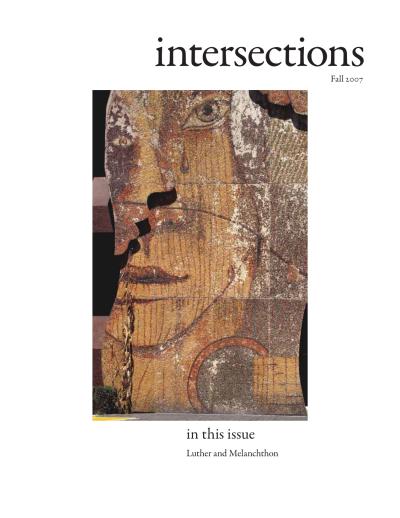
Four Wartburg College colleagues share fruits of the 2006 Lilly-funded “Discovering and Claiming Our Callings” faculty/staff development seminar in Wittenberg, Eisenach, and Neuendettelsau. Kleinhans frames the curriculum and books used; Bane (psychology) finds Lutheran convictions about the value of humans, the affirmation of creation, and the universality of sin congruent with her discipline; Pier (communication arts) reads Luther as a model of dialectical rhetoric that gives educators permission to challenge students with uncomfortable ideas; and Waldstein (political science) reflects on the paradox of humility and self-confidence in Luther and on the Luther-Melanchthon collaboration as a model for the seminar group’s own work.
-
 Editorial
From the Publisher and Editor
Jason A. Mahn, Mark Wilhelm
No. 44 · Fall 2016
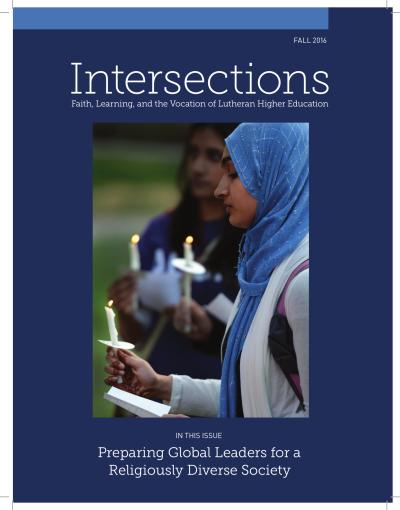
Writing weeks after the 2016 presidential election, Wilhelm and Mahn frame interfaith engagement as the urgent and ongoing work of ELCA colleges and universities, recap NECU’s growing commitments to inter-religious leadership, and introduce essays first delivered at the summer 2016 Vocation of a Lutheran College Conference under the theme “Preparing Global Leaders for a Religiously Diverse Society.”
-
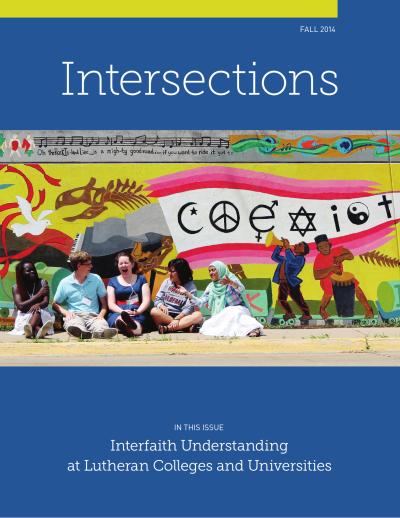 Article
Well, Well…Plumbing Our Depths, Telling Our Stories
Ann Boaden
No. 40 · Fall 2014
Beginning with a college visit that turned into a grieving mother’s confidence about her daughter’s last moments, Boaden uses John 4’s well of living water to argue that an interfaith education worthy of the name requires Lutherans to plumb the depths of their own tradition’s wells — with rituals, stories, and seasons intact — before they can see, respectfully, into the wells from which others drink.
-
 Article
Do One Thing: Academic Vocation in the Age of Burnout
Jonathan Malesic
No. 58 · Fall 2023
Malesic draws on Oliver Burkeman’s 4,000 Weeks and Søren Kierkegaard’s Purity of Heart is to Will One Thing to argue that academic burnout is fundamentally institutional — a widening gap between mission ideals and working conditions — and urges colleges to resist “projectitis” by focusing on the one thing that matters most.
-
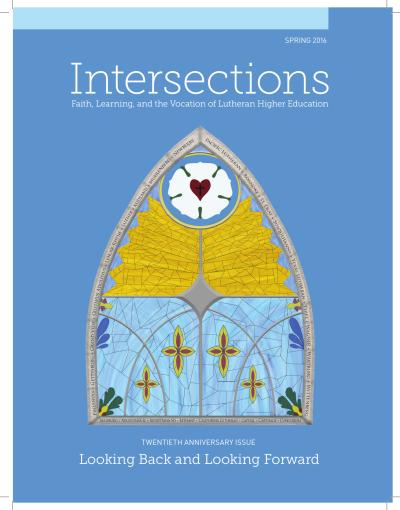 Article
Diversity and Dialogue: Twenty Years and Counting
Florence D. Amamoto
No. 43 · Spring 2016
Twenty years after her essay “Diversity and Dialogue” in the first issue of Intersections, Amamoto returns to Gustavus Adolphus College to reflect on what has changed and what has not: rising numbers of students of color and international students, faculty turnover and increased publication pressures, the disappearance of the Center for Vocational Reflection, and the renewed importance of articulating Gustavus’s Swedish Lutheran heritage and inclusive sense of community in a tuition-dependent, cost-cutting environment.