A well-founded premise is that public policy is initiated by self-interest. A group petitions the city to expand public parks for new pickleball courts. Residents living in a neighborhood request that their county install a stoplight at a nearby intersection. Both of these succeed because specific interests bring the concerns to those making public decisions. Democracy is rarely this simple. Often, we are driven to public advocacy because we recognize that our self-interest is at odds with others on the same issue. The stakes are higher when the conflicting public problem ties into our deeply held beliefs. Given the opportunity, should the tools of power be used to make public life mirror our deeply held beliefs? For example, should Christians invoke a state requirement to display the Ten Commandments in public schools, require Christian prayers in school, or mix Christian theology in public school curriculum?
A central problem of democracy is whether and how individuals and groups can simultaneously advocate for personal values, while also recognizing, tolerating, and respecting the public sphere as a shared space of divergent, competing, incommensurable held values. Some resolve this by an agency of dominant power in the public space, overtaking the system with the values they support at the expense of all others that disagree. In other words, some claim that since their values are the truth and the democratic majority is on their side, then what is stopping them from transferring their values into law?
Is this how faith-based institutions should equip students to engage as citizens of our democracy: teaching that faith is a catalyst to overpower and dominate other interests in society? I suggest it is not. Rather, I see faith-based institutions equipping students to understand and promote a healthy ecosystem of democracy. As Romans 3:23 states, “for all have sinned and fall short of the glory of God.” Human beings are flawed, imperfectly conveying God’s truth.
The tools of faith-based civic engagement should lead students to pursue universal values while acknowledging how imperfectly humanity applies them to social, political, economic, and even religious institutions.
Unlike public universities, faith-based institutions should help students embrace their faith with conviction, encouraging them to connect how their faith can guide them in addressing public problems. Faith-based institutions must promote the recognition of humanity’s incomplete grasp of truth. The tools of faith-based civic engagement should lead students to pursue universal values while acknowledging how imperfectly humanity applies them to social, political, economic, and even religious institutions.
Christian citizens should advocate their beliefs with virtue and tolerance, even when other participants are locked in a zero-sum outcome. Faith-based institutions should promote a public space more akin to an ecosystem of interests, with a healthy promotion of the American republic. Transferring religious values directly into political institutions endangers any open society, especially when those values belong to a single religious tradition. The American founders understood this in the First Amendment, that “Congress shall make no law respecting an establishment of religion.”
Christian citizens should advocate for public values that can best promote shared aspirations of justice, liberty, equality, and peace among all citizens and non-citizens. Instead of mounting the Ten Commandments on a wall or prayer in public schools, we should ask whether either promotes a healthy ecosystem of democracy. Teaching self-restraint and limits is a critical part of a faith-based education. An ecosystem of democracy provides a more properly understood, respectful approach to promoting self-interest in a community of competing and often incommensurable values. It should be the responsibility of faith-based institutions to cultivate the civic virtues of tolerance, respect for the law, and using reason for public discourse; some of the virtues the American Founders understood as cooperatively unifying a deeply held faith and an active democratic participation, while optimistically encouraging strong citizens for this world, as well as hope in the one to come.
-
 Editorial
From the Publisher & Editor
Colleen Windham-Hughes, Lamont Anthony Wells
6 min audio
Wells and Windham-Hughes frame vocation as “ground game” — the practical, public living-out of faith through civic engagement — and introduce the issue’s focus on how Lutheran higher education equips students to repair the world.
-
Reflection
I am a Treaty Partner
Kyrie Fairbairn
7 min audio
A recent California Lutheran graduate reflects on how a course on Indigenous Rights and Practices, and a conversation with a former Chairman of the Lummi Nation, led her to claim a “treaty partner” identity and to challenge readers to learn the treaties that shape the lands they call home.
-
Article
Civic Engagement and Faith Perspectives
William O'Brochta
15 min audio
Guest editor William O’Brochta introduces the section by overviewing the ELCA’s call to civic engagement, recapping the Fall 2025 Civic Engagement and Faith Perspectives conference at Texas Lutheran University, and previewing the participant essays that follow.
-
Article
Leaning-In to the Civic Lessons of Our Namesakes
A. Lanethea Mathews-Schultz
6 min audio
Mathews-Schultz uses the civic legacy of the Muhlenberg family — from General Pete’s Revolutionary call to action to President Muhlenberg’s inaugural address on the “education of conscience” — to invite students at Muhlenberg College into a shared civic inheritance.
-
Article
Teaching and Mentoring in Service of Civic Engagement
Haco Hoang
6 min audio
Hoang describes how her teaching, mentoring, and research at California Lutheran University — including a multi-year collaboration with the Lutheran Office of Public Policy on Lutheran Lobby Day — cultivate civic skills grounded in ELCA social statements and the Lutheran tradition of faith and reason.
-
Article
Community-Based Research as Engaged Citizenship
James Paul Old
6 min audio
Old argues that genuine citizenship requires more than charitable gestures — it demands long-term, reciprocal community partnerships — and describes how Valparaiso’s Community Research and Service Center embodies that vision even amid the financial pressures threatening such programs.
-
Article
Bringing Core Values to Life through Civic Engagement
Austin Trantham
5 min audio
Trantham shows how Saint Leo University’s Benedictine Core Values shape his civic engagement work — from advising a “Why Vote?” campaign and Constitution Day panels to engaging students in the Unify Challenge for respectful cross-institutional discourse.
-
Article
Civic Engagement, "Baylor In Deeds," and Engaged Learning
Rebecca Flavin
6 min audio
Flavin describes how Baylor’s strategic plan “Baylor in Deeds” and its Office of Engaged Learning are building civic engagement into the Arts & Sciences core curriculum, with early Global Engagement Survey data showing gains in civic efficacy and global civic responsibility.
-
Article
Fragmented in Faith: The Concerns and Hopes Found in Student Spirituality and Civic Engagement
Emma Bohmann, Monica Sitachitta
11 min audio
Two Texas Lutheran University students reflect on the cyclical pattern of low spiritual and civic engagement on their campus and argue that distinguishing Lutheran values from Lutheran practice could open space for civic engagement to become a non-optional expression of neighbor-justice for all students.
-
 Article
Low-Hanging Fruit, Moonshots, and Coffee: Dreaming Big Within and Beyond Our Limitations
Jeremy Myers
No. 59 · Spring 2024
Myers shares the process used by Augsburg’s Christensen Center for Vocation to help teams move from a shared experience to next steps — an Ignatian-rooted Awareness Examen followed by naming low-hanging fruit, moonshots, and the coffee conversations that build the coalition to make it all happen.
-
 Article
Education for Peace and Justice
David J. O'Brien
No. 10 · Fall 2000
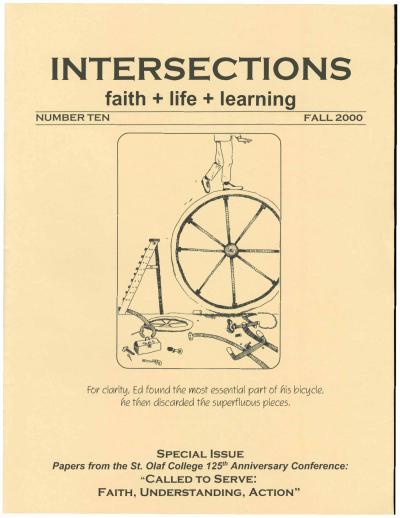
O’Brien surveys justice and peace education in Catholic higher education from Vatican II through the 1980s pastoral letters on nuclear weapons and the American economy, contrasting evangelical radicals (“what would Jesus do?”) with comfortable accomodationists, and argues that Catholic social teaching remains the church’s “best-kept secret.” Drawing on Bryan Hehir, David Hollenbach, Pope John XXIII, Patricia Hample’s “placing ourselves in the world to be of use,” and Martin Luther King’s last book on the “world house,” he develops pastoral care, solidarity (rooted in the mystical Body of Christ), and a realistic vocation-and-citizenship as the three needed responses for Catholic and Lutheran colleges alike.
-
 Article
A River Runs Through It: CLU as a Church-Related University
A. Joseph Everson
No. 12 · Summer 2001
Everson borrows Norman Maclean’s A River Runs Through It and the small creek that flows through California Lutheran University’s Kingsman Park as images for the quiet stream of Christian tradition on campus, describes the dialectic of faith and reason (with a “Lord of Life” student congregation, two required religion courses, and a voluntary Wednesday chapel) as the “theology of paradox” that runs from Luther’s simul justus et peccator through Richard Solberg and Richard Hughes, and names six commitments that constitute the CLU ethos—academic freedom (Jeremiah 29:7 and John 8:32), vocation, service (Amos and Habitat for Humanity), grace and graciousness (Portia’s “quality of mercy” speech from The Merchant of Venice), diversity, and reverence (Proverbs 9 as awe and wonder).
-
 Editorial
From the Publisher
Mark Wilhelm
No. 43 · Spring 2016
Wilhelm announces the new Network of ELCA Colleges and Universities — established in 2015 and convened for its first Board of Directors meeting in February 2016 — as a missional collaboration between the churchwide organization and the twenty-six ELCA colleges and universities, replacing former churchwide units lost to budget reductions and offering a stronger, more viable vision of Lutheran higher education.
-
 Editorial
From the Publisher
Mark Wilhelm
No. 46 · Fall 2017
Wilhelm reflects on how NECU’s focused work on Lutheran identity in higher education — including the forthcoming document Rooted and Open: Our Common Institutional Calling — turns out to be a fitting commemoration of the five-hundredth anniversary of the Lutheran Reformation, even though it did not arise from anniversary planning.
-
Editorial
From the Editor
Tom Christenson
No. 10 · Fall 2000
Christenson recommends the St. Olaf 125th-anniversary volume Called to Serve—edited by Pamela Schwandt with Gary de Krey and L. DeAne Lagerquist—particularly Walter Sundberg’s “What Does It Mean To be Lutheran?” and Darrell Jodock’s “The Lutheran Tradition and the Liberal Arts College.” He notes that the volume’s biographical sketches of Lars Boe, F. Melius Christiansen, Ole Rolvaag, Emil Ellingson, Agnes Larson, John Berntsen, Arne Flaten, and Howard and Edna Hong show, against an outsourcing age, that the life of an institution like St. Olaf is the committed life of the people who work there.