Muhlenberg College was named to commemorate Henry Melchoir Muhlenberg (1711-1787), German immigrant and patriarch of Lutheranism in the United States. The choice linked the College to the Lutheran faith and to a political dynasty exemplifying the promise — and responsibility — of democratic engagement. This is revealed in oft-repeated stories of college lore that I share with my students at the start of each new semester.
The first takes us back to the American Revolution before Muhlenberg College existed to Henry’s son and Virginia Lutheran minister, John Peter Gabriel Muhlenberg (1746-1807), who reportedly openly struggled with the question of revolution. Standing before his congregation in January of 1776 and drawing inspiration from Ecclesiastes, General Muhlenberg is said to have ripped off his clerical robes to reveal his officer’s uniform, shouting: “There is a time to preach and a time to pray. But there is also a time to fight, and that time has come now!” Legend has it that more than 150 men kissed their families, left the church with Muhlenberg leading the way, and joined the Revolutionary cause, becoming the core of Virginia’s 8th regiment.
Historians doubt the veracity of the account of “General Pete’s” famous 1776 speech, but his legacy nonetheless lives on — a copy of the original marble statue of General Muhlenberg found in Statutory Hall in the U.S. Capitol sits at the center of our campus green and it is in his honor that one of our eateries — the “General’s Quarters,” or “GQ” — is named. After the war, General Muhlenberg resettled in Pennsylvania, where he was elected to the first U.S. Congress. His brother, Frederick Augustus Conrad Muhlenberg (1750-1801), was also elected from Pennsylvania, becoming the first Speaker of the House of Representatives and the first to sign the Bill of Rights.
This is the history — itself a lesson about civic engagement and the nation’s founding–that Frederick Augustis Muhlenberg (1818-1901) (Henry’s great-grandson and General Pete’s great-nephew) inherited and transmitted to Muhlenberg College when he became our first president. Although less dramatic than General Pete’s call to fellow patriots, President Muhlenberg’s inaugural address continues to inspire teaching and learning at the College. He said: “No education is complete unless it prepares a man to discharge all his duties properly in this world…this kind of education contemplates the education of his conscience and the cultivation of his heart.” If they are observant, students will find references to the “education of conscience” and “cultivation of heart” on our website and note familiarity with phrases like “ethical and civic values” and “lives of leadership and service” in the College’s mission statement.
Whether or not my students themselves are Lutheran, I seek to convince them that they are part of the community forged by our namesakes.
I share these stories with my students not only because I hope to clue them into the statues they encounter on campus–although seeing the history around us is a useful goal. Most of my students are unfamiliar with the Muhlenbergs; many are surprised to learn of the College’s links to the ELCA (we certainly do not hide this connection, but it is evidently not something we emphasize in admissions). Whether or not my students themselves are Lutheran, I seek to convince them that they are part of the community forged by our namesakes. We are part of Muhlenberg civic history. We can — and should — lean-in to the Muhlenbergs. Their shared values, sense of civic duty, and willingness to lead when it is “time to fight” offer inspiration for our own education and democratic engagement today.
Work Cited
Susan Clemens Bruder, “Connecting the Past, Present, and Future: Muhlenberg College,” The Periodical 57, no. 1A2 (1013-2014): 3-44.
-
 Editorial
From the Publisher & Editor
Colleen Windham-Hughes, Lamont Anthony Wells
6 min audio
Wells and Windham-Hughes frame vocation as “ground game” — the practical, public living-out of faith through civic engagement — and introduce the issue’s focus on how Lutheran higher education equips students to repair the world.
-
Reflection
I am a Treaty Partner
Kyrie Fairbairn
7 min audio
A recent California Lutheran graduate reflects on how a course on Indigenous Rights and Practices, and a conversation with a former Chairman of the Lummi Nation, led her to claim a “treaty partner” identity and to challenge readers to learn the treaties that shape the lands they call home.
-
Article
Civic Engagement and Faith Perspectives
William O'Brochta
15 min audio
Guest editor William O’Brochta introduces the section by overviewing the ELCA’s call to civic engagement, recapping the Fall 2025 Civic Engagement and Faith Perspectives conference at Texas Lutheran University, and previewing the participant essays that follow.
-
Article
Teaching and Mentoring in Service of Civic Engagement
Haco Hoang
6 min audio
Hoang describes how her teaching, mentoring, and research at California Lutheran University — including a multi-year collaboration with the Lutheran Office of Public Policy on Lutheran Lobby Day — cultivate civic skills grounded in ELCA social statements and the Lutheran tradition of faith and reason.
-
Article
Community-Based Research as Engaged Citizenship
James Paul Old
6 min audio
Old argues that genuine citizenship requires more than charitable gestures — it demands long-term, reciprocal community partnerships — and describes how Valparaiso’s Community Research and Service Center embodies that vision even amid the financial pressures threatening such programs.
-
Article
An Ecosystem of Democracy
David Thomason
6 min audio
Thomason argues that faith-based institutions should equip students not to dominate the public sphere with their convictions but to cultivate an “ecosystem of democracy” — pursuing universal values with virtue and tolerance while acknowledging humanity’s incomplete grasp of truth.
-
Article
Bringing Core Values to Life through Civic Engagement
Austin Trantham
5 min audio
Trantham shows how Saint Leo University’s Benedictine Core Values shape his civic engagement work — from advising a “Why Vote?” campaign and Constitution Day panels to engaging students in the Unify Challenge for respectful cross-institutional discourse.
-
Article
Civic Engagement, "Baylor In Deeds," and Engaged Learning
Rebecca Flavin
6 min audio
Flavin describes how Baylor’s strategic plan “Baylor in Deeds” and its Office of Engaged Learning are building civic engagement into the Arts & Sciences core curriculum, with early Global Engagement Survey data showing gains in civic efficacy and global civic responsibility.
-
Article
Fragmented in Faith: The Concerns and Hopes Found in Student Spirituality and Civic Engagement
Emma Bohmann, Monica Sitachitta
11 min audio
Two Texas Lutheran University students reflect on the cyclical pattern of low spiritual and civic engagement on their campus and argue that distinguishing Lutheran values from Lutheran practice could open space for civic engagement to become a non-optional expression of neighbor-justice for all students.
-
 Article
Superheroes and Origin Stories: Tools to Discover and Claim One's Callings
TJ Warren
No. 41 · Spring 2015
Warren argues that the “Hero’s Journey” — Joseph Campbell’s monomyth with its ordinary world, call to adventure, mentors, and return with the elixir — offers a powerful pedagogical tool for helping college students discover their origin stories and claim their callings. Drawing on Superman, Wonder Woman, and Rosa Parks alike, he invites educators to mentor students into becoming the heroes of their own lives.
-
 Reflection
Otherwise
David Wee
No. 6 · Winter 1999
Wee’s September 3, 1997 St. Olaf Opening Convocation address takes its title from Jane Kenyon’s “Otherwise” and asks why we gather: to celebrate the gifts of life, place, companionship, and the work we love, and to become “otherwise”—wise about the others in our midst. He honors his own St. Olaf teachers (Ditmanson, Shaw, Stiehlow, Jordahl, Paulson, Meyer, Hove, Clausen, Larson, Jorstad) and the gruff Latvian stamp scholar Gus Eglas and Sherlock Holmes expert Randy Cox, draws Huck Finn’s “All right, then, I’ll go to hell” and Flannery O’Connor’s grandmother into a single argument, and closes on Tim Lull’s expectation that a Lutheran college campus should display contentment, courage, and cheerfulness as a family member faces day-six post-bone-marrow-transplant—“the first day of the rest of your life.”
-
 Editorial
From the Editor
Jason A. Mahn
No. 39 · Spring 2014
Mahn reports on the working group “People of Wondrous Ability: Introducing Faculty and Staff to Lutheran Higher Education,” shares creative ways campuses are introducing colleagues to the charisms of the Lutheran tradition, and frames the issue as a set of reflective reviews that move from national trends to homegrown conversations about the state of college.
-
 Article
Do One Thing: Academic Vocation in the Age of Burnout
Jonathan Malesic
No. 58 · Fall 2023
Malesic draws on Oliver Burkeman’s 4,000 Weeks and Søren Kierkegaard’s Purity of Heart is to Will One Thing to argue that academic burnout is fundamentally institutional — a widening gap between mission ideals and working conditions — and urges colleges to resist “projectitis” by focusing on the one thing that matters most.
-
 Article
Vocation at Full Stretch: Reflections on Follow Your Bliss and Other Lies about Calling and its Use among College Students
Jason A. Mahn
No. 61 · Spring 2025
43 min audio
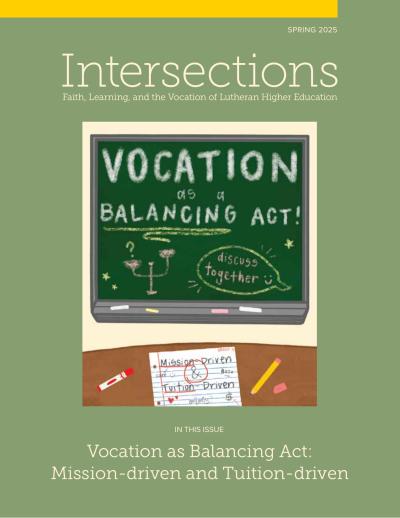
Mahn engages Bonnie Miller-McLemore’s Follow Your Bliss and Other Lies about Calling as required reading in a sophomore religion course, showing how her categories of missed, blocked, conflicted, fractured, unexpected, and relinquished callings empower young adults to perceive embodied, unplanned, and often painful dimensions of life as essential parts of vocation — and help close the gap between mission-driven and tuition-driven realities.
-
 Article
What is Required of You?: Higher Education Leadership in a Moral Key
Paul C. Pribbenow
No. 62 · Fall 2025
15 min audio
Drawing on Micah 6:8 and Stephen Carter’s “etiquette of democracy,” Pribbenow describes the three things Augsburg requires of every incoming student — show up, pay attention, and do the work — as a democratic social ethic that prepares students for engaged citizenship in a fractured public life.