Much of the discussion of the Lutheran identity of Lutheran colleges and universities is focused on Luther. However there are other important figures in the establishment and formation of these institutions. Wilhelm Löhe, the spiritual father and benefactor of Wartburg College and Wartburg Seminary is one of these figures.
Biography and Historical Context
Löhe was born in 1808 in Fürth, an industrial and manufactur- ing center near Nürnberg where he grew up in a middle class household.1 The faith that he knew was a blend of seventeenth- century Lutheran orthodoxy and eighteenth-century Pietism. Löhe’s father died when he was still a boy so his upbringing fell on the shoulders of his mother whom he adored. His mother valued education and encouraged him to go to school. Löhe was a good student and graduated from the prestigious Melanchthon-Gymnasium in nearby Nürnberg. (It should be noted that although Nürnberg was near, his attendance still demanded a sizeable commitment from both the pupil and his mother). After graduation, Löhe began theological studies at Erlangen (also nearby) where he spent all but one semester of his studies. Upon completing his studies at Erlangen, Löhe served a series of congregations as vicar. In the 1830s there were more pastors than congregations and Löhe was already a controversial figure so he was not quickly called to a congregation. Finally in 1838 he was called to serve a congregation in a tiny village in the hinterland of Franconia: Neuendettelsau where he served the remainder of his life.
A few key features of Löhe’s life bear upon his understanding of education.
First, he grew up in an industrial and manufacturing center and was thus well aware of the effects of the Industrial Revolution. He experienced firsthand how industrialization affects the lives of people. Industrialization attracted people to cities where they often only experienced misery and squalor. Education, Löhe was persuaded, was a way out of the drudgery of life in a factory or worse, unemployment.
Second, his father’s death left his mother in a difficult situa- tion. She knew that education was a way out for her son, thus she became one of his most important champions during his studies.
Third, these experiences (the Industrial Revolution, his father’s death and his mother’s encouragement of education) together shaped his passion for and sympathy with those who were less fortunate. An important component of his mission strategy had to do with what today we call “service.” His mission endeavors were often shaped by people’s physical and economic needs. “Not only are [Christians] to proclaim the Word, they are to live the Word.” (Ratke 183) Even his understanding of worship, particularly of the Lord’s Supper, is shaped by his concern for those who are poor and hungry: “The eucharistic table should not be a table where some whose bellies are full feast while others are distracted from the rich blessings of the redemptive meal because their bellies grumble with hunger.”2 (Ratke 120)
The fourth relates to Löhe’s own experience of education. His theological studies at Erlangen were enriched by the example of a geology teacher who was a fervent and active Christian. This experience contrasted sharply with the example of his own theology professors at Erlangen and his experience in Berlin. In Berlin he was dismayed by the example of Hegel (he couldn’t see any practical application or implication of Hegel’s philosophy in either Hegel’s teaching or personal life) and encouraged by the example of Friedrich Schleiermacher. He disagreed violently with Schleiermacher but admired him for his expression of Christian faith.
Education
Löhe’s understanding of education emphasized the following main points:
Teaching and education are about formation. People are trans- formed by what they know, and, I might add, experience. Löhe writes: “Every cause has an effect. Every word has power. Every lesson changes something in those who are taught and not just within the field or the type of the knowledge, but in all of [the student’s] being. Every lesson, in other words, makes humans better or worse. … In a word, teaching and education [Bildung], teaching and formation are inseparable.” (“Einige” 373) Students can become better or worse people as a result of their education. Who students become cannot be separated from what they learn in schools. More than that, teachers who educate just with words in the classroom are doing only half of the job. Löhe states, “I don’t want to say that instruction, which is given only through words, does not educate in any way whatsoever, but it certainly doesn’t educate to the degree that it might when it should and could educate [bilden: also “form”].” (“Einige” 376)
Not just teachers, but institutions as well are involved in this endeavor named education. It is too much to lay the burden of teaching or formation on the shoulders of those who are at the front of the classroom. Any institution that lays this burden on its teachers is shirking its responsibility. Schools, colleges, and universities are about education in its fullest sense. Schools must be aware of this responsibility and be prepared to teach more than mere knowledge. Education “encompasses and educates the whole person.” (“Einige” 378)
Teachers are whole persons too. They teach in places other than the classroom; and they teach in other ways besides through words. If students are to be understood as whole persons, then teachers are as well (and, for that matter, institutions of higher educa- tion). “Teaching and life are of one piece.”3 (“Einige” 376) That is, teachers teach with their actions and lives as much as they teach with their words. Just as a sacrament is the Word of God made visible, so should our teaching make our values visible.
Teachers need to be learning as well. I’ve already said that teach- ers are whole persons and that they model in their actions and their personal lives what they teach. Presumably one of the things that teachers teach is that the life of the mind is a worthy life. They teach students that learning is valuable. Teachers, who should have the best interests of their students at heart, must be involved in learning themselves. “Teachers should always be learning and researching, always asking questions.” (“Aphorismen” 418)
Education is not neutral. It is—or ought to be—religious. Education sanctifies. I have already hinted at the neutrality of education and teachers. They are not. They cannot be neutral when education is about the communication and transmission of not just knowledge and skills, but also values. “All education is religious: Religion sanctifies even the so-called worldly means of education so that it is no longer merely worldly.” (“Einige” 373) Löhe is saying here that the values of Christianity—love, mercy, justice, peace, service, etc.—sanctify the world. They make it holy. Education, at its best, is about overcoming hate, evil, injustice, and self-centeredness.
Education is not just for the present. Clearly, if we as whole persons are about teaching the whole person, our concern is not just for the immediate present, for practical and utilitarian ends. “Whoever is educated only for the present … but not for eternity, is actually defrauded with this education, because they really are not being educated.” (“Einige” 373) Education is about provid- ing students with the tools they need to meet the future with confidence and hope.
Educational institutions need to be whole institutions. I have already mentioned this, but it needs to be highlighted. Educational institutions are not only about proclaiming the Word, but living the Word. If there is a dissonance between the values of the institution and what it practices, then there is a problem. A school can hardly talk about the importance of meeting a person’s physical needs so that they are not hungry or live in poverty if its employees are underpaid. It can hardly talk about the importance of wholeness if its faculty and staff are stretched and stressed by the busyness of committee meetings and other institutional commitments. It can hardly talk about the importance of wholeness if its faculty haven’t the resources to be engaged in research and learning.
Conclusion
Education is for the whole person. While knowledge is clearly the primary “commodity” that a college has to offer, it is not the only one. A college committed to education offers values and faith as well. A college committed to education witnesses to the truth it teaches not just in the classroom with words, but in its policies and its practices as well. Finally, education is a com- munal activity that involves not just students and teachers, but administration and staff—indeed the entire college—ought to be actively engaged in this important endeavor.
Endnotes
That Fürth is an industrial and manufacturing center can be seen in the fact that the Adler, the first train in Germany, traveled between Fürth and Nürnberg.
Löhe wrote: “The obligation remains for us to care for our poor brothers, and if we do not hold an agape feast like the ancient Christians, we are not released from mercy. Undoubtedly we go in an unworthy manner to God’s table if we do not care for our brothers at the altar, if they do not have, in addition to the heavenly riches of the sacrament, their allotted share of earthly food also” [Prüfungstafel und Gebete für Beicht- und Abendmahlstage: Beicht- und Kommunion~büchlein für evangelische Christen (Zum Gebrauch sowohl im als außerhalb des Gotteshauses) in GW VII/2:287].
Löhe goes on to say: “The more teachers recognize their calling [vocation], they must all the more give all of their being to this calling [vocation] as an example of what their teaching can achieve.” (“Einige” 373)
Works Cited
GW = Löhe, Wilhelm. Gesammelte Werke. Ed. Klaus Ganzert. 7 vols. Neuendettelsau: Freimund, 1951–1986.
Löhe, Wilhelm. “Aphorismen über Schule und Schulunterricht.” GW III/2:384–419. __ . “Einige Worte zum Anfange der Windsbacher Schullehrer- Konferenzen 1838.” GW III/2: 373–77.
Ratke, David C. Confession and Mission Word and Sacrament: The Ecclesial Theology of Wilhelm Löhe. St. Louis: Concordia, 2001.
-
 Editorial
From the Publisher
Mark Wilhelm
Wilhelm reports on the difficult financial season facing the ELCA churchwide organization — a ten-percent budget reduction announced in November and significant cuts to unrestricted grants for colleges and universities — while affirming that the ELCA’s commitment to the mission of its schools remains strong, including its commitment to engaging the “other,” the theme of this issue.
-
Editorial
From the Editor
Robert D. Haak
Haak frames the issue around the question of Lutheran college identity as formed in distinction from some “other,” introducing essays by Witherup on the Joint Declaration, Reuther on Holden Village, Afzaal on Christian-Muslim dialogue, Dovre on the history of Midwestern Lutheran colleges, Radecke on service-learning, and Ratke on Wilhelm Löhe — each making the claim that the “other” is an essential partner in conversation who helps us know who we are and shape who we will become.
-
Article
Bringing an Ecumenical Milestone Out of the Shadows
Ronald D. Witherup, S.S.
Witherup draws attention to the tenth anniversary of the Lutheran-Catholic “Joint Declaration on the Doctrine of Justification” signed on Reformation Day 1999, summarizes the document’s claim that justification is the work of the triune God received by grace alone through faith, surveys the remaining questions raised by Pope John Paul II and the 2006 endorsement by the World Methodist Conference, and proposes a pastoral strategy for bringing this ecumenical milestone out of the shadows in Catholic parishes.
-
Reflection
On Sharing the Sacred Sauna
Rosemary Radford Ruether
Reprinted from the National Catholic Reporter (August 1968), Ruether’s reflection from her time as a theologian on the faculty of Holden Village describes Lutheran community life in the mountains of northern Washington from a Catholic perspective — finding more catholicity in this Lutheran retreat than in many Roman Catholic communities — and culminates in a celebration of the Holden sauna as “the new sacrament, the new fellowship, the new theology.”
-
Article
Between Suspicion and Trust
Ahmed Afzaal
Afzaal argues that scholars and educators have a unique vocation to shift Christian-Muslim relations from suspicion to trust, drawing on the 2007 Muslim open letter “A Common Word,” Robert Shedinger’s Was Jesus a Muslim?, and Muhammad Iqbal’s Reconstruction of Religious Thought in Islam to argue that Christianity and Islam converge in the insight that religion is a spiritual force for social justice and human liberation — an insight obscured by the modern Western discourse of sui generis religion.
-
Article
Lutheran Colleges: Past and Prologue
Paul J. Dovre
Dovre offers a reminiscence rather than a research paper, drawing on Aristotle’s ethos, logos, and pathos to trace fifty years of change at Midwestern Lutheran colleges through the key issues of survival, respectability, faithfulness, and relationship to the church — from the dependence of the 1950s through the independence of the late twentieth century to the partnership of the 2000s — and identifies key variables (the student marketplace, faculty formation, and the identity/diversity paradox) for shaping the identity and mission of Lutheran colleges into the future.
-
Article
SCAM-ing Service-Learning and Mission Trips: A Satirical Essay
Mark Wm. Radecke
Radecke couches his research on best/worst practices in service-learning and short-term mission trips in a fictional Screwtape-style correspondence between Horatio Gumnut, CEO of “Spiritual Consultants and Mercenaries, Incorporated” (SCAM, Inc.), and Dwayne Pipe, an untenured professor seeking to sabotage a colleague’s Nicaragua mission trip — cataloging through indirection the disorienting dilemmas, commodification of the poor, exhaustion of reflective practice, and false noblesse oblige that derail such ventures, while pointing toward the genuine philoxenia, accompaniment, and structural awareness that mark a transformative experience.
-
 Book Review
Learning Across Campus: Hearing Bok's Call to Conversation
David Ratke
No. 39 · Spring 2014
Ratke reads Derek Bok’s Our Underachieving Colleges from Lenoir-Rhyne and argues that Bok’s call to think holistically about undergraduate education and to dialogue across disciplinary boundaries names the work already underway at ELCA colleges. He weighs faculty attitudes, the role of skills in the core curriculum and the major, and the importance of the extracurriculum for student formation.
-
 Response
Tat for Teat: Ratke Responds
David Ratke
No. 9 · Summer 2000
Ratke, agreeing with much of VonDohlen’s critique but contending that VonDohlen misreads both Luther and the two-realms doctrine, marshals Luther’s To the Christian Nobility, On the Freedom of a Christian, Temporal Authority, Whether Soldiers Too Can Be Saved, and the “Sermon on Keeping Children in School,” along with Walther von Loewenich, to argue that Luther was well aware of structurally differentiated society, made no claim to a monistic epistemology, and intended the two-realms doctrine to combat—not introduce—dualistic bifurcation between sacred and secular. Our identity is “not as either Christian or academic, but as Christian and scholar.”
-
 Article
Where Your Feet are Standing: Institutional Engagement and Place
Melissa Maxwell-Doherty
No. 54 · Fall 2021
Maxwell-Doherty draws on Cal Lutheran’s Hispanic-Serving Institution designation and its location on Chumash, Fernandino Tataviam, and Ohlone lands to ask how the university’s mission might shift if it depended on where its students are standing — not just where the institution sits.
-
 Article
How Can We Keep From Singing?
Robert Scholz
No. 7 · Summer 1999
Scholz, professor of music at St. Olaf, responds to Tom Christenson’s “Freedom of a Christian” by walking through his own Nunc dimittis for the St. Olaf Christmas Festival, an Elderhostel choir of singers aged 60 to 95, and the four liberating arts (enablement and change, melioristic, embodying, and critical) as they shape conducting, composition, and music education. He defends the fine arts and folk traditions over “contemporary Christian” soft pop-rock and taped accompaniments, citing Luther’s preface to Georg Rhau’s Symphoniae iucundae and the family of God’s need to interact in song against the virtual community of TV evangelism and the Crystal Cathedrals of the air.
-
 Article
Why Lutheran Colleges Need to Engage Civil Society
Ann M. Svennungsen
No. 35 · Spring 2012
Svennungsen makes the case that Lutheran colleges must engage the larger civil sphere, drawing on her work with The Presidents’ Pledge Against Global Poverty, Darrell Jodock’s seven fundamental experiences for vocational discernment, David Brooks on civility and modesty, and Michael Sandel’s argument that the affluent are seceding from public life. She urges Lutheran educators to invest in the infrastructure of civic renewal so that service-learning and civic engagement remain central to the Lutheran college curriculum.
-
 Book Review
Assessing the Value of Liberal Arts: A Review of The Evidence Liberal Arts Needs, by Richard A. Detweiler
Robert D. Haak
No. 55 · Spring 2022
Haak reviews Richard A. Detweiler’s The Evidence Liberal Arts Needs, in which the former president of the Great Lakes Colleges Association analyzes 240 college mission statements and interviews more than 1,000 graduates to argue that liberal arts educational experiences have a measurable impact on adult lives of consequence, inquiry, and accomplishment — and invites NECU institutions into a further conversation about how Detweiler’s methodology applies to Lutheran higher education.
-
 Article
Lutheran Identity and Diversity in Education
Bruce Reichenbach
No. 17 · Summer 2003
Reichenbach applies the theological taxonomy of exclusivism, inclusivism, and pluralism to Lutheran colleges and argues that institutions self-consciously committed to inclusivism must hold a non-negotiable theological core in paradoxical tension with intentional diversity. Drawing on Richard Hughes, Darrell Jodock, Gilbert Meilaender, Robert Benne, and Mark Schwehn, he surveys the theological themes Lutheran writers identify as identity-forming—the four solas, law and Gospel, two kingdoms, vocation, simultaneously saint and sinner, the theology of the cross—and proposes that diversity at an inclusivist Lutheran college is to be employed in service of educating “head, hands, and heart,” maintained through a critical mass of faculty and staff who carry the “DNA of the school.”
-
Editorial
From the Editor
Tom Christenson
No. 9 · Summer 2000
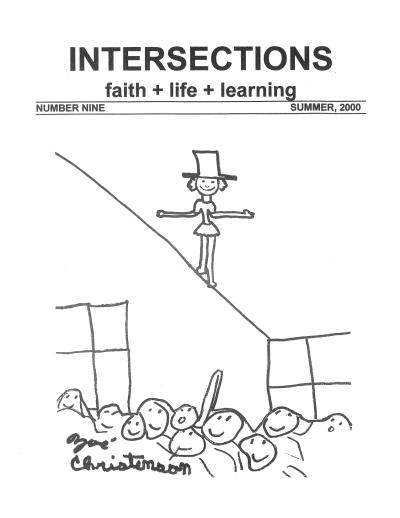
Christenson introduces a varied issue: the VonDohlen / Ratke discussion of the two kingdoms doctrine, Rachel Hammond’s “real gem” of a talk on her time in Ecuador (with an invitation to send contributions to the Home for Perpetual Hope orphanage via her home church in Oberlin, Ohio), Chuck Huff’s essay on the effect of liberal learning on the practice of psychology, and John Reumann’s reflection on a scholarly life lived between academy and church—and notes that the cover artist is his eight-year-old daughter Zoé, whose post-circus drawing of a balancing act struck him in light of Reumann’s opening line.