For God so loved Israel, God’s chosen people … well … no.
For God so loved the Church, the bride of Christ … but that’s not how it reads.
For God so loved the world … the word in Greek is “cosmos”… For God so loved the whole cosmos, the universe—discovered and not yet discovered…. For God so loved the world that he gave his only Son.
It turns out that God was into globalism long before we were!
We are singing some evocative images in the two hymns we have sung thus far at this conference. Last evening we sang that “the peace of the Lord kept within cannot live.” (ELW #646) God’s peace withers and dies when confined to a single individual or nation. It wants out into the world, as an animal wants outdoors.
This morning we have sung of the big-heartedness of God. God’s heart is so big, we sang, that it contains all of God’s vast domain. And then the hymn becomes a prayer, “O Christ, create new hearts in us that beat in time with yours … that, joined by faith with your great heart, become love’s open doors.” (ELW #722) Imagine! To have a heart as big as God’s heart, a heart that beats in time with the life and the love of Jesus.
In the early 1960s Anglican pastor and theologian J.B. Philipps wrote a book the title of which judges our hearts when left to their own devices. Your God Is Too Small (Macmillan: New York, 1961) is the title of his book, as telling an indictment today as in 1961. Too small our concept of God. Too tribal. Too personal. Too pinched.
Matthew Fox, by contrast, head of The Institute for Creation Spirituality, preaches what he calls “deep ecumenism.” Ecumenism, says Matthew Fox, is well and good—to draw closer in understanding and relationship to the whole Christian family. Interfaith relations are the next step and are urgent in a world that is increasingly polarized over religion. And then beyond religion, to feel for all human beings, asserting their value simply because they are human, is a heart-enlarging instinct.
But Saint John did not say, For God so loved Christians … nor did he say, For God so loved all religious people … nor even all people. Instead, the word is “cosmos.” For God so loved the cosmos that he gave his Son, and deep ecumenism is our response to that cosmic love of God; it is our embrace of and care for all created things, simply because all things have been created by God. Visit the website, <www.thecosmicmass.org>, and you can see how this plays itself out in worship. The Cosmic Mass draws upon visual art and music and nature and the breadth of sacred scripture and tradition. It begins in grieving and ends in dancing. It is different. It is long. There is nothing small, or tribal, or pinched, about it.
So how about at our colleges, instead of an Office of International Studies, we start an Office of Cosmic Relations… or perhaps that’s another name for Campus Ministries! How about changing the title, “Ecumenical Officer”—we have one at churchwide and in most synods. Let’s change the title to “Advocate for Deep Ecumenism”—people would really wonder what that means! And I hear there is an addendum to Evangelical Lutheran Worship coming out—Setting #11, The Cosmic Mass (just kidding). All of this an attempted answer to our prayer this morning … remember? “O Christ, create new hearts in us that beat in time with yours, that, joined by faith with your great heart, become love’s open doors.”
One of my all-time favorite movies is almost ten years old now. Called Pleasantville, the movie transports Jennifer and David, two millennial teenagers, back into a fictitious 1950s community, aptly named Pleasantville, the world of Father Knows Best and Leave It to Beaver, the world of Your God Is Too Small. In the movie the first high school class that Jennifer visits in her new hometown is geography, where the students are studying the differences between Main Street and Elm Street in Pleasantville. Profoundly bored, Jennifer raises her hand and asks, “Excuse me, but is there anything beyond Pleasantville?” At which point all the other students turn around and stare open-mouthed at Jennifer, as if she had just uttered an obscenity.
I want to claim that question as part of our vocation as Lutheran colleges. We exist here in Rock Island to encourage our students to ask, “Excuse me, but is there anything beyond Rock Island? ... anything beyond Lutheran, beyond Christian, beyond religion, beyond human?
After geography class in the movie, outside the school, Jennifer presses one other student she decides to trust. “Come on,” she says, “What’s outside Pleasantville? Tell me.” And he says, “There are places where the roads don’t go in a circle. They just keep going.”
Now, we have colleges on Main Street and congregations on Elm, and they are fine communities on well-traveled roads. But as far as the life of the mind goes, or the life of the spirit, I want to find the places where the roads don’t go in a circle, they just keep going. It’s uncharted territory, to be sure.… Imagine! to come to Rock Island in order to leave Rock Island! to be Christian in order to be more than Christian! But there is a world out there—yes, there is—a world that God loves.
We come to the table now to feed on God’s love, to take God’s love into our hearts, so that, by God’s grace, our hearts may beat in time with God’s and we come to love even the whole cosmos in the name of Christ. Amen.
-
 Editorial
From the Publisher
Arne Selbyg
Selbyg, retiring this summer as Director for ELCA Colleges and Universities, reflects on his decade serving as spokesperson between the church and its twenty-eight colleges and universities, and argues that the link between the colleges and the church has grown stronger over the last ten years — sustained by supportive church leaders like Presiding Bishop Mark Hanson, the annual Vocation of a Lutheran College conference, and a Lutheran theology of higher education whose principles (questioning authority, returning to the sources, including the excluded, serving the neighbor) remain a strong basis for operating colleges and universities in the twenty-first century.
-
Editorial
From the Editor
Robert D. Haak
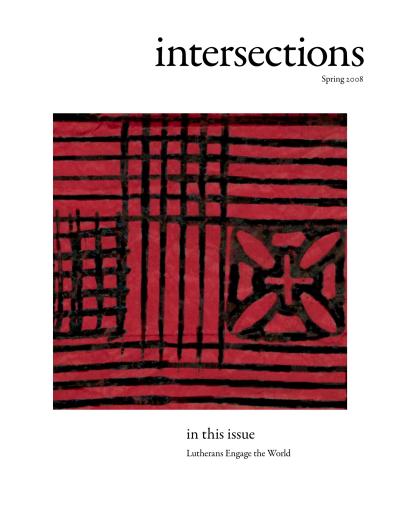
Haak frames the issue around the question of why Lutherans engage the world rather than retreat from it, locating the answer in the doctrines of creation and incarnation, and introduces essays by Erwin on globalism, Carlsen on local community engagement, Marty on multiple callings, and Mattes on the Grundtvigian heritage at Grand View. He also bids farewell to publisher Arne Selbyg, noting the fittingness of the Adinkra (“farewell”) cloth on the cover of this final issue under Selbyg’s leadership.
-
Article
Engaging the Local Community: Why Bother?
Mary S. Carlsen
Carlsen traces the often adversarial history of town-gown relations from the medieval universities through the Battle of St. Scholastica Day to the “ivory tower” pattern of American higher education, then argues that Lutheran colleges should engage their local communities for practical, educational, ecological, moral, and theological reasons. Drawing on her work in social work education at St. Olaf and on Ira Harkavy, Ernest Boyer, and the ELCA’s “Our Calling in Education,” she offers a recipe for engagement that is Passionate, Ethical (Needed, Welcomed, Mutual, Long-term, Attentive to diversity, Strengths-based, Respectful), and Reflective.
-
Article
Lutheran Higher Education in Global Context: Called to Serve the World
R. Guy Erwin
Erwin advances three theses on the global vocation of Lutheran higher education: that the vocation of a Lutheran college is to live out its mission in a service-oriented way; that Luther’s definition of vocation as love of neighbor must today have global dimensions; and that a Lutheran college best fulfills its vocation when it fosters a global perspective in its community, curriculum, and ethos. Drawing on Gustav Wingren and Luther’s catechisms, sermons on schooling, and three-realms ethics, he surveys the mission statements and websites of all twenty-eight ELCA colleges and universities for evidence of globalist commitment.
-
Article
Who Said You Have Only One Calling?
Peter Marty
Marty argues that our normal practice of thinking singularly about vocation must be enlarged: God has not limited any of us to one expression or gift, and Martin Luther never spoke of individuals as having only one calling. Drawing on Max DePree’s parable of the millwright-poet, William May on the etymology of “career,” Evelyn Underhill on the verb “to Be,” James VanOosting, Scot McKnight’s “Jesus Creed,” and a Golden Gate Bridge patrolman who has saved hundreds of lives, he identifies four features common to every story of vocation in scripture: special purpose, special gifts, a caller from outside, and the requirement of sacrifice and generosity.
-
Article
Reclaiming Grundtvig at Grand View College
Mark C. Mattes
Mattes traces the Grundtvigian heritage of Grand View College — the only North American institution founded by Grundtvigian Danes — from its origins in the 1880s split between Pietist Inner Mission and Grundtvigian Danish Lutherans through its golden years of folk dancing, gymnastics, and the weekly lecture, to the demographic and curricular changes of the 1950s through 1990s. He describes recent tangible initiatives, including the Grand View College Reader, Imaging the Journey, and the 2007 Strategic Planning Commission’s “Faith Foundations” statement, that seek to recover the “Human first, then Christian” mantra of Grand View’s ancestors for a generation of students whose “ship” has had not only its planks but its very model replaced.
-
 Article
Leadership in Lutheran Key at a Time of Pandemics
Deanna Thompson
No. 52 · Fall 2020
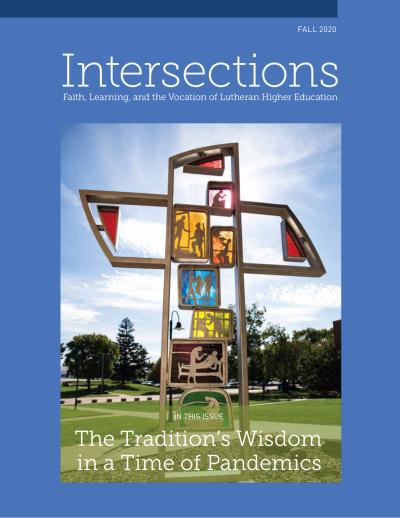
Thompson draws on Luther’s theology of the cross and Shelly Rambo’s theology of trauma to sketch a Lutheran model of leadership for a season of pandemics — one that is attentive to pain, responsive to need, and intentionally nourished by food, friends, and deep conversation.
-
 Article
Vocation and Civil Discourse: Discerning and Defining
Lynn Hunnicutt
No. 48 · Fall 2018
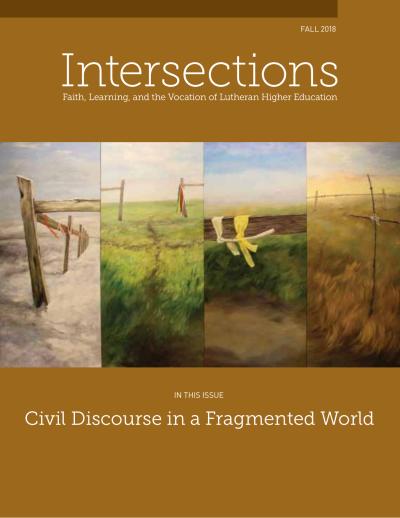
Hunnicutt draws on Rabbi Amy Eilberg’s reading of Moses’ calling to identify four features of vocational discernment — attention, wonder, communal consciousness, and humility — and argues that these same qualities are also key aspects of civil discourse, so that forming students for vocational discernment is simultaneously forming them for civility.
-
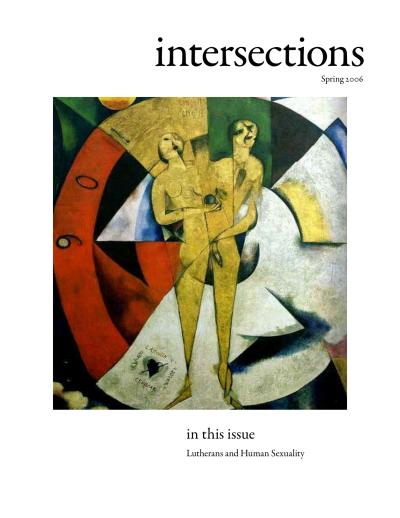 Article
Ethical Deliberation and the Biblical Text—A Lutheran Contribution to Reading the Bible
Ritva Williams
No. 22 · Spring 2006
Williams articulates a Lutheran “critical traditionalist hermeneutic”—a phrase borrowed from her Hebrew Bible professor Robert Polzin—that honors Scripture as queen while keeping Christ as its king, and tests it by critiquing Robert Gagnon’s use of Romans 1:18-32 in The Bible and Homosexual Practice. Drawing on Lazareth, Lotz, Philip Esler’s Conflict and Identity in Romans, Stanley Stowers’ Rereading Romans, and Ben Witherington III, she proposes an alternative reading in which Paul recites a Hellenistic-Jewish ethnic caricature in 1:18-32 only to overturn it in 2:1-16, making the passage a critique of self-righteous stereotyping rather than the foundation of a moral doctrine on same-sex intercourse.
-
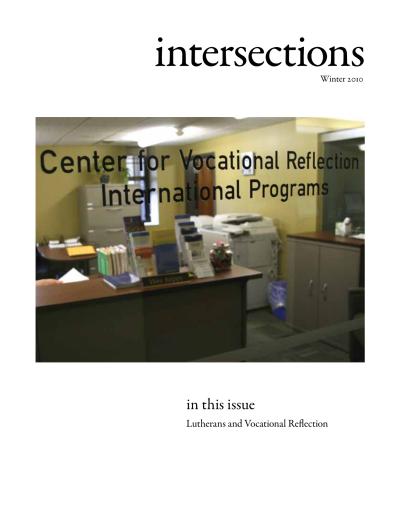 Article
Called for Life — Affirming Vocational Discernment
Richard L. Torgerson
No. 31 · Winter 2010
Torgerson introduces the “Called for Life” project, a three-year, $278,437 Lilly Endowment-funded collaboration among Luther, Augsburg, and Augustana that—in partnership with Luther Seminary’s Centered Life initiative and Wilder Research—rigorously assessed the effectiveness of campus vocation programs, examining whether students’ exposure to and understanding of calling had increased, and what program elements were most effective in shaping discernment.
-
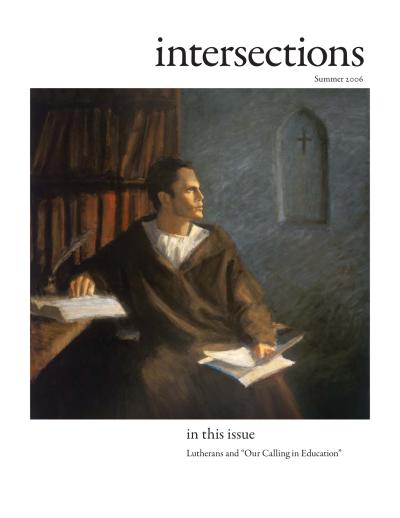 Article
The Lutheran Calling in Education: Context and Prospect
Paul J. Dovre
No. 23 · Summer 2006
Dovre, President Emeritus of Concordia College and co-chair of the ELCA Task Force on Education, undertakes three tasks: focusing on the current social context (young people’s spiritual lives, the state of mainline denominations, the family map, schools, communities, and higher education); reflecting on why Lutherans care about education (creation in God’s image, vocation, Luther’s legacy, the priesthood of all believers, civic righteousness, and hope); and considering the prospects and possibilities for addressing the calling (biblical, confessional, theological, and pedagogical legacies; the renewal of apostolic ministry, the Christian-college renaissance, K–12 reform, and the congregational education explosion).
-
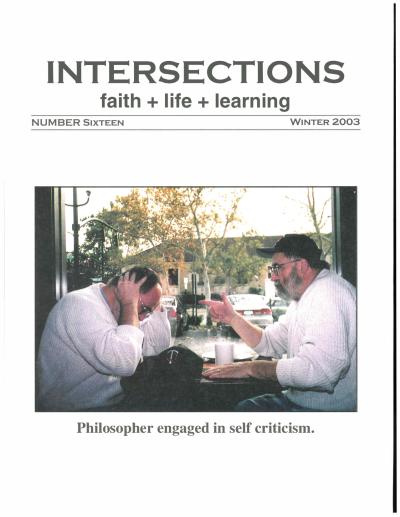 Article
Writing Toward the Night Complete: Teaching and Working at the Public, Secular Institution
Bruce Allen Heggen
No. 16 · Winter 2003
Heggen, Lutheran Campus Ministry pastor and adjunct English professor at the University of Delaware, builds on a freshman’s essay closing line—“All in all our night was complete”—to argue that even in the secular public university one can “teach hope” as a critical principle by drawing on Douglas John Hall’s Heideggerian distinction between calculative and meditative thought, the Frankfurt School’s instrumental versus substantialist reason, Luther’s theology of the cross, Parker Palmer’s “obedience to truth,” bell hooks, Lionel Basney, Shelley Shaver, and Donald Sheehan’s Frost Place “principle of compassion.” The classroom and Lutheran campus ministry together can become “communities of memory and hope” that, like the artist student’s Fourth of July, hold together danger, people getting together, explosions, and lots of fun.