The articles in this issue were presented at the Vocation of a Lutheran College Conference in the summer of 2010. (This year’s conference will be held on July 30th–August 1st. The theme will be “A Calling to Embrace Creation: Lutheran Higher Education, Sustainability, and Stewardship.” Save the dates!) The theme of the conference that summer dealt with how our campuses respond to religious diversity.
There was a time, not so long ago, when religious diversity on our campuses revolved around which branch of the Lutheran tree one identified with—usually connected in some deep way with a cultural tradition of the founders of the college. The Swedish Lutherans of Augustana, the Danish Lutherans of Dana, the Norwegians of ….. Well, you understand. I remember coming to Augustana (RI) to teach in the religion department at a time when I was considered to be “the token German.” This was a sort of diversity, but hardly the same phenomena that the colleges face today.
In recent times we have been faced with student bodies—and faculties—that often do not identify themselves as Lutheran. The range of faith identifications today covers the wide range of religious diversity that occurs within American culture. At some institutions, “none” is the most predominant religious affiliation. For some time, Lutheran colleges and universities have addressed their relation to Judaism and Jewish students and faculty. At some places, such as Muhlenberg College, this conversation has produced dramatic results. An ever increasing number of our students identify themselves with Islam. How do we as Lutheran colleges and universities understand this changing landscape?
Today it would be unusual, to say the least, if anyone on a college campus spoke out against diversity of any kind. The experience on many campuses, however, is that while diversity is espoused, little in done to encourage and support diversity. Too often this is seen as the work of an individual or small group of people who take this on as their cause. Any time the issue comes up, the response is “well, that’s the responsibility of X.” The result is that often not much progress is made on these issues.
I would argue that diversity is important on our campuses. But I would also argue that assent to that proposition is not sufficient. Diversity is not an end in itself. It is important because of the work that it can do toward the end of educating our students well. How do we understand the role of diversity in this project for which we all exist? Is there a difference in our understanding of the need for diversity based on the Lutheran tradition from which we grow?
Darrell Jodock, in his article in this issue, argues that our theological tradition leads us to a “third path” in relation to religious diversity. He founds this “third path” on the Lutheran value of giftedness. I would suggest that this theological base could be expanded to include Lutheran understandings of the work of the Holy Spirit and the Incarnation. Lutherans believe that the Spirit of Christ speaks not only in the past but continues to speak even today. And we believe that the Spirit of Christ is not under our control but speaks as the Spirit wills. Our job as Lutheran Christians is to be attentive to that voice wherever it may be heard. And we know that the place of the Spirit is not limited to where we look. Often the Spirit speaks important words through the ones that we perceive as “the other.” It is because of this that diversity (religious and of all types) is crucially important on our campuses. Those voices of “the other” may be the Spirit of Christ speaking to us in this day. If we do not listen, or are not able to because we have somehow dismissed “the other,” we may well miss the most important words we are called to hear.
So our job as institutions of Lutheran higher education is to create places where the voice of “the other” is heard and valued. Again, this is not for diversity’s sake itself, but because of our theological understanding of how God interacts with this world.
Tonight in Wallenberg Hall at Augustana College in Rock Island, on September 9, 2011, Dr. Omid Safi spoke of fear and love in our world. Those who were able heard in his words the voice of God. It is true that not all in the audience could hear those words. But in this place, at a Lutheran college gathering, the voice of “the other” was heard, and the best of religious diversity was experienced. This is what we are about as Lutheran colleges and universities.
-
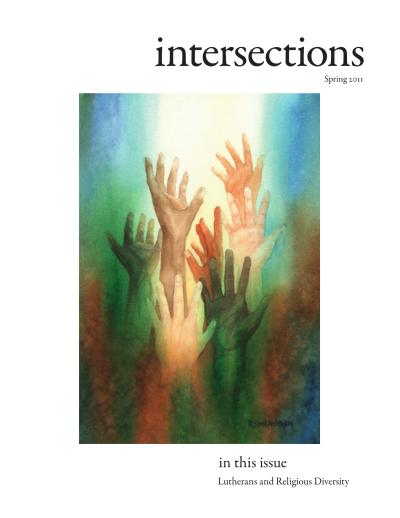 Editorial
From the Publisher
Mark Wilhelm
Wilhelm notes that while the ELCA’s vocation in higher education remains vibrant, the landscape of churchwide leadership has shifted dramatically with the dissolution of the Vocation and Education unit, and expresses appreciation for the faculty and staff at ELCA colleges and universities who have stepped up to sustain the network during this time of transition.
-
Article
Vocation of the Lutheran College and Religious Diversity
Darrell Jodock
Jodock describes a “third path” for Lutheran colleges that is both rooted in the Lutheran tradition and inclusive of religious diversity — an alternative to sectarian and non-sectarian default models — and identifies six interlocking features of the Lutheran tradition (giftedness, an engaged God, wisdom, caution about claims to know, community, and an emphasis on service and community leadership) that shape how such a college engages interreligious dialogue and civil discourse.
-
Article
The State of Civil Discourse on Campus and in Society
Terence S. Morrow
Morrow examines the troubled state of civil discourse in the United States and on college campuses, drawing on three deep traditions — the liberal arts, Lutheranism, and the Anglo-American legal tradition — to argue that Lutheran colleges can serve students and society by acknowledging the tensions inherent in civil discourse and helping students navigate them, and surveys promising campus programs at St. Thomas, Tufts, Loyola, and Harvard.
-
Article
The New (con)Texts of Jewish-Christian Engagement
Karla R. Suomala
Suomala surveys four contemporary contexts of Jewish-Christian engagement on American college campuses — campus populations, Jewish studies curricula, the changing nature of Jewish identity among Millennials, and the shift from formal Jewish-Christian dialogue toward broader religious pluralism — and argues that at Lutheran colleges this success story can serve as a model for engaging the other religious neighbors who increasingly form part of our society.
-
Article
The Breadth and the Depth: Dimensions of Christian-Muslim Relations at Educational Institutions of the ELCA
Mark N. Swanson
Swanson reflects on the spatial metaphors of depth and breadth that shape Lutheran higher education and argues that the study of Islam and real conversation between Christians and Muslims can contribute to both the broadening of horizons and the deepening of faith, drawing on his experience at the Lutheran School of Theology at Chicago and pointing to hospitality as a Christian practice in which depth and breadth come together.
-
Article
Reconciled Diversity: Reflections on our Calling to Embrace our Religious Neighbors
Jacqueline Bussie
Bussie offers three concrete recommendations for cultivating reconciled religious diversity on Lutheran campuses — Lutheran listening and the telling of stories, engendering encounters with religious neighbors through curriculum and bridge-building events, and choosing empathy and collaboration over evangelism and creed — arguing that what students fear most in encounters with the religious “other” is the loss of their own identity and distinctiveness, and that we can show them how loyalty to one’s own tradition and reverence for different traditions can coexist.
-
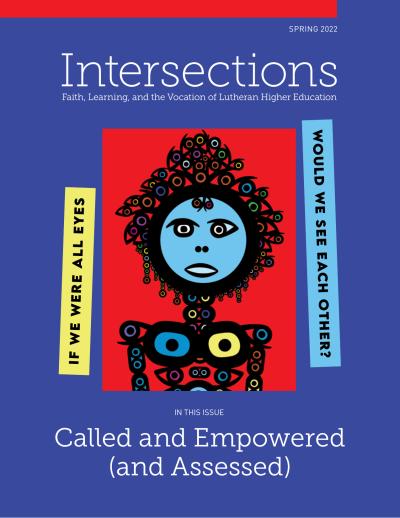 Book Review
Assessing the Value of Liberal Arts: A Review of The Evidence Liberal Arts Needs, by Richard A. Detweiler
Robert D. Haak
No. 55 · Spring 2022
Haak reviews Richard A. Detweiler’s The Evidence Liberal Arts Needs, in which the former president of the Great Lakes Colleges Association analyzes 240 college mission statements and interviews more than 1,000 graduates to argue that liberal arts educational experiences have a measurable impact on adult lives of consequence, inquiry, and accomplishment — and invites NECU institutions into a further conversation about how Detweiler’s methodology applies to Lutheran higher education.
-
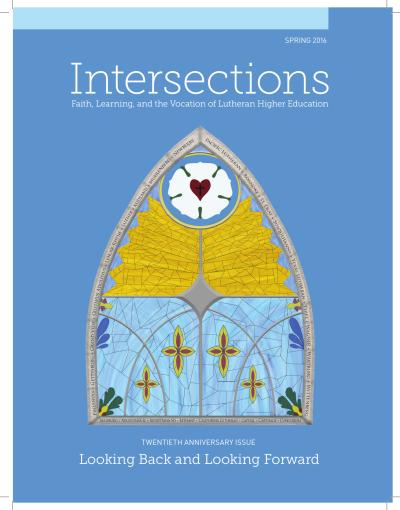 Article
The Vocation of Intersections on its Twentieth Birthday
Jason A. Mahn, Robert D. Haak, Tom Christenson
No. 43 · Spring 2016
The three editors of Intersections — Bob Haak, Jason Mahn, and Tom Christenson (in spirit, following his death in 2013) — trace the twenty-year vocation of the journal itself: its 1996 birth at Capital University; its coming-of-age years of debate over institutional markers, two-kingdoms theology, and Lutheran identity; the ascendancy of “education for vocation” as the central marker of Lutheran higher education; and its ongoing identity in relation to a changing ELCA and to the broader cultural conversation about purpose, wholeness, and the vocation of higher education.
-
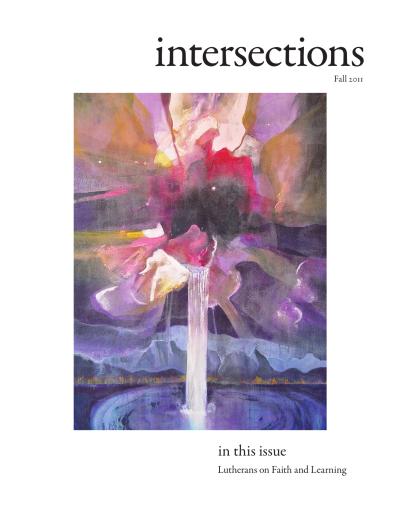 Editorial
From the Outgoing and Incoming Editors
Jason A. Mahn, Robert D. Haak
No. 34 · Fall 2011
Outgoing editor Robert D. Haak reflects on a six-year run inheriting Intersections from founder Tom Christenson, the “powerful voices” that have driven the conversation (Dovre, Jodock, Christenson, Simmons, Morgan, Olsen, Wilhelm) and the newer ones now entering (Mahn, Bussie); incoming editor Jason A. Mahn, picked up from the airport in Bob’s pickup truck five years ago, names central issues that “Lutherans on Faith and Learning” engages and previews essays by Dovre, Jodock, McDonald, Hill, Turnbull, and Jodock again.
-
 Article
Called to Serve
Robert D. Haak
No. 31 · Winter 2010
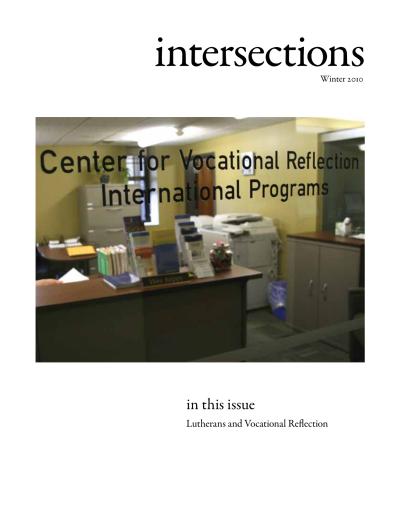
Haak describes Augustana’s Center for Vocational Reflection (CVR) and its threefold framework of skills/gifts/talents, passions/values, and needs of the community. He surveys the CVR’s Working with Faith group, seminary visits, spiritual companioning, Servant Leader Internships, international travel reflection, and the major Senior Inquiry curriculum revision—then reports the lessons learned at Augustana: that multiple exposures matter more than any single program, that the language of vocation works even for non-religious students, that student-initiated ideas (like Erin Blecha’s Athletes Giving Back) often succeed most, and that the CVR will soon merge into a new Community Engagement Center.
-
 Editorial
From the Editor
Robert D. Haak
No. 30 · Fall 2009
Haak frames the issue around the question of Lutheran college identity as formed in distinction from some “other,” introducing essays by Witherup on the Joint Declaration, Reuther on Holden Village, Afzaal on Christian-Muslim dialogue, Dovre on the history of Midwestern Lutheran colleges, Radecke on service-learning, and Ratke on Wilhelm Löhe — each making the claim that the “other” is an essential partner in conversation who helps us know who we are and shape who we will become.
-
 Editorial
From the Editor
Robert D. Haak
No. 29 · Spring 2009
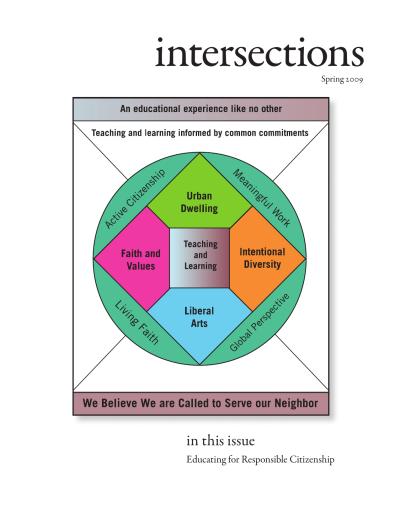
Haak frames the issue’s essays around the question of Lutheran colleges and the role of citizen, noting H. Richard Niebuhr’s typology in Christ and Culture and Luther’s own complex understanding of Christian and state, and offers a fitting farewell to Arne Selbyg with Mike Blair’s tribute song “A Fine Norwegian.”
-
 Article
Leading Students to Distinguish Between Career and Vocation: Reflections from a Lutheran Law School
Steven C. Bahls
No. 20 · Fall 2004
Bahls, writing as former dean of the Capital University Law School, argues that most law students and many legal educators confuse vocation with career—asking “what kind of lawyer do you want to be?” rather than “who do I want to be?” Drawing on John O. Mudd’s five attributes of a well-prepared lawyer and Susan Daicoff’s empirical research on lawyer dissatisfaction and the “amoral professional role,” he turns to Ernest L. Simmons’s and Darrel Jodock’s articulations of Luther’s understanding of vocation and proposes five steps—reflection, assessment, vision, integrative thinking, and reassessment—along with explicit leadership from law school deans, engagement of career services offices, and leadership within the profession (illustrated by Capital’s joint venture with the Columbus Bar Association).
-
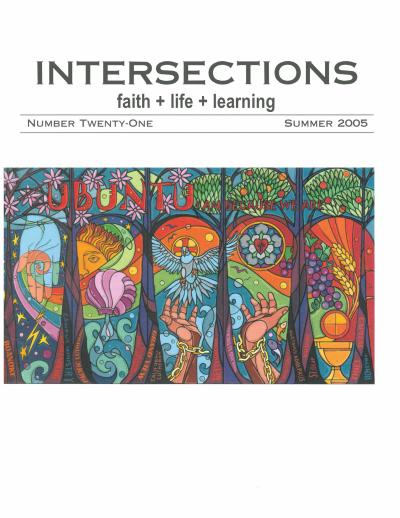 Article
The Church in Education? Education in the Church? Ten Theses on Why These Questions Matter
Leonard G. Schulze
No. 21 · Summer 2005
Writing in the months before the August 2005 Churchwide Assembly that will decommission DHES, Schulze frames his vision for the division as ten Lutheran-style theses, each followed by Luther’s catechetical question “What does this mean?” He argues that critical thinking and moral deliberation are in the Lutheran gene pool; that Luther’s devotion to learning was an expression of Christian vocation; that the rise of the research university and the binary public meaning of “evangelical” have marginalized church-related colleges; that DHES has been wrongly perceived as marginal; and that the reformed concept of vocation must drive the soon-to-be-created program unit for Vocation and Education. An appendix reproduces the 2005 DHES strategic planning overview.
-
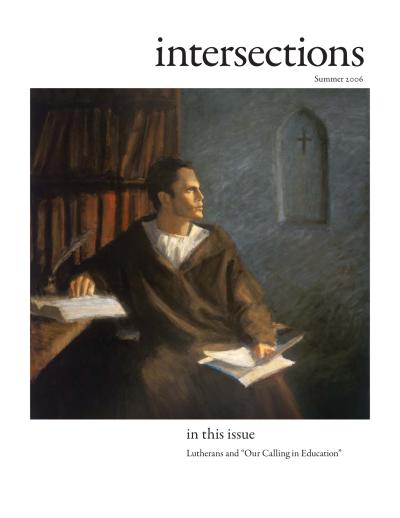 Article
"Our Calling in Education": Working Together to Generate a Strong Social Statement on Public Schools, Lutheran Schools and Colleges, and the Faith Formation of Children and Young People
Marcia Bunge
No. 23 · Summer 2006
Bunge, Professor of Theology and Humanities at Christ College, Valparaiso University, makes two claims about the ELCA’s forthcoming social statement on education: first, that it should be built on a robust Lutheran understanding of vocation, addressing four common misconceptions (vocation as occupation, as self-fulfillment, as ordained ministry, and as “vo-tech”) and recovering the breadth of Luther’s teaching; and second, that the statement should narrow its focus to three urgent areas affecting children and young people — public schools, Lutheran schools and colleges, and faith formation — rather than addressing the full lifespan of education in equal depth.
-
 Article
Lutheran Identity and Diversity in Education
Bruce Reichenbach
No. 17 · Summer 2003
Reichenbach applies the theological taxonomy of exclusivism, inclusivism, and pluralism to Lutheran colleges and argues that institutions self-consciously committed to inclusivism must hold a non-negotiable theological core in paradoxical tension with intentional diversity. Drawing on Richard Hughes, Darrell Jodock, Gilbert Meilaender, Robert Benne, and Mark Schwehn, he surveys the theological themes Lutheran writers identify as identity-forming—the four solas, law and Gospel, two kingdoms, vocation, simultaneously saint and sinner, the theology of the cross—and proposes that diversity at an inclusivist Lutheran college is to be employed in service of educating “head, hands, and heart,” maintained through a critical mass of faculty and staff who carry the “DNA of the school.”
-
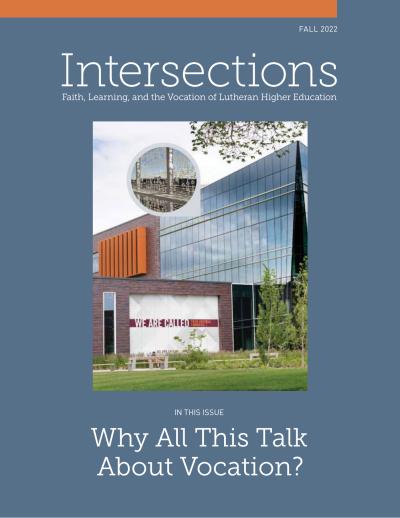 Article
Work Works
Julius Crump
No. 56 · Fall 2022
Crump argues that in an era of class-stratified careerism and the “ruins of neoliberalism,” commencement-speech rhetoric about heroic vocation will not resuscitate vocation — instead, professors embodying vulnerability, extemporaneity, and contemporaneity in the classroom can show students that consistent work, embodied as service to others, is itself worthy.
-
 Article
The Marks of an ELCA College: One Bishop's Reflections
Stanley Olson
No. 15 · Winter 2002
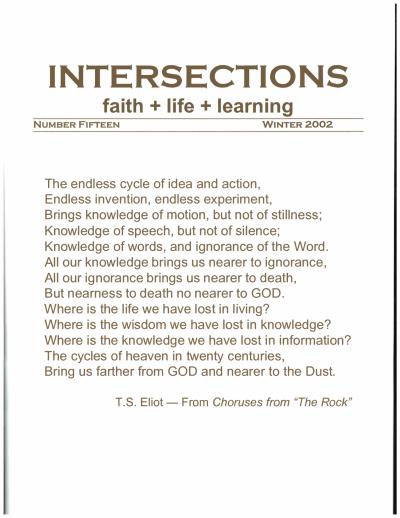
Olson, speaking as a bishop and “Harness Boy” whose job is to keep the church’s connections working, replaces his original four-noun outline (fealty, ingenuity, insouciance, focus) with eight marks the ELCA should be able to observe in its colleges: intentional Lutheran identity, significant Lutheran presence, Christian faith at every table, freedom of inquiry, coaching toward vocation, gravity and grace, nurtured community, and excellence by its own standards. Drawing on his survey of all twenty-eight ELCA college mission statements (two tables) and on Darrell Jodock and Mark Edwards, he argues that the Lutheran connection must be made explicit in mission, marketing, and faculty searches, and closes with six reciprocal expectations the colleges should hold of the ELCA—commissioner, mature parent, supporter of adventurous teenagers, advocate, steward of graduates, and a church faithful to its own Lutheran mission.