Every summer it happens: someone (and often more than one) says, “I finally get what Lutheran higher education is all about!” Some universities send newbies to the summer conference, as a way of accomplishing Lutheran Higher Education 101. Others send seasoned employees who serve in all different kinds of positions and are well-versed in the commitments and practices specific to Lutheran higher ed. Both newcomers and returners enjoy connecting to the Network of ELCA Colleges and Universities, meeting people from other campuses to share in stories of familiar struggles and inspiring initiatives.
Whether you have been to a summer conference or not, you are likely to resonate with the encouragement offered in Dr. Mary Elise Lowe’s keynote address (pp. 11-17):
“You are co-creating people. Your work with students reflects God’s ongoing creation. You are justice-seeking people. You see the injustices in our educational system, and in big and small ways, you pursue neighbor justice with and for the students on your campuses. And you are communio people. You value students as individuals and treasure the deep fellowship that exists in your campus community. I hope that these three Lutheran whys will sustain and empower you as you live out your vocations at your own ELCA institution.” [emphasis added]
Committed to vocation at the center of our educational enterprise means holding space for the ongoing unfolding of vocation within the lives of staff, faculty, and administrators, as well as students. The whole idea of vocation is that every person is gifted and skilled AND that each person needs the gifts and skills of others. When you open the widest possible access for all persons to hone and develop their gifts and skills, the community has what it needs for all to flourish.
Our work is by definition aspirational. Opening access never ends, which means there is no finish line and we cannot do it on our own. We must, as Emma Jones, Executive Vice President of Credo, pointed out in her keynote address (pp. 6-10), become ever more trustworthy in our shared work and leadership and build structures that are focused on transparency, capability, reliability, and humanity.
In order to sustain our vocations in higher education, it is important to have opportunities for what Rev. Jen Rude, University Pastor at Pacific Lutheran University, calls “Sacred Pause.” Jen led us in three such sacred pauses, which began with these provocative prompts:
- Share about a memorable or meaningful body of water, maybe connected to where you live
- Describe how you are feeling this morning using weather as a metaphor—as in bright and sunny, eye of a hurricane, sticky humid, etc.
- Share a memorable or meaningful gathering around a table
Try prompting yourself with one of these in a quiet moment of reflection. Better yet, incorporate one of these prompts into a meeting with colleagues or students. Sacred pauses humanize us to ourselves and each other, which makes opening access both easier and more joyful.
-
 Editorial
From the Publisher: Reflections on the 2024 Vocational Leaders in Higher Education Conference
Lamont Anthony Wells
Wells reflects on the 2024 VLHE Conference theme — “Educational Access: Lutheran Roots, Contemporary Practices” — tracing today’s commitment to inclusivity back to Martin Luther’s radical 16th-century insistence that both boys and girls be educated, and previews NECU’s expanded engagement of student leaders alongside faculty and administrators.
-
Article
Access, Accessibility, & Change: A Call for Trustworthy Leadership in Higher Education
Emma Jones
Jones surveys the converging pressures on higher education — cost, the enrollment cliff, shifting demographics, and declining public confidence — and uses Reichheld and Dunlap’s four factors of trust (transparency, capability, reliability, humanity) to call campus leaders to rebuild trustworthy leadership from the inside out.
-
Article
Creation, Justice, and Communio: Lutheran Insights Empowering Educational Access
Mary Elise Lowe
In her VLHE keynote, Lowe names three Lutheran commitments — continuing creation, neighbor justice, and communio — as the “why” that empowers ELCA colleges and universities to pursue equitable access for students often left behind by persistence and graduation gaps.
-
Article
Committed to Paradox
Caryn Riswold
Riswold lifts up paradox — saint and sinner, lord and servant, Rooted and Open — as a distinctive Lutheran root that lets institutions honor the complicated truth of who their students are and embrace the messy, ever-reforming work of access and accessibility as a theology of the cross.
-
Article
2024 VHLE Conference: "Rooting Access" Panel Talking Points
Guy Nave
Nave reads “access” across Deuteronomy 23, Ruth, Isaiah 56, Acts 10, and Matthew 15:21-28 as an ongoing biblical conversation that evolves from exclusion to ever-widening welcome — and presses ELCA institutions to shift their focus from “student readiness” to “institutional readiness.”
-
Article
Affirming, Entrusting, and Acting: A Baptismal Grounding of Affirmative Action in Lutheran Higher Education
Peter Carlson Schattauer
Schattauer draws on the Lutheran baptism liturgy — where the gathered assembly publicly affirms what it is for and is entrusted with responsibilities for justice and peace — to argue that NECU institutions create truly inclusive communities by affirming commitments, naming responsibilities, and acting in ways that embody both.
-
Reflection
Reflecting on Belonging
Melissa Woeppel
Woeppel, campus pastor at her own alma mater, wrestles with a Bethany student’s plea — “I want to feel like this is my home, like I belong” — and Mindy Makant’s reminder that we don’t choose the story of the past but do choose how we tell it forward, opening space for students from 35 faith traditions to find Lutheran institutions to be their home.
-
 Editorial
From the Publisher & Editor
Colleen Windham-Hughes, Lamont Anthony Wells
No. 63 · Spring 2026
6 min audio
Wells and Windham-Hughes frame vocation as “ground game” — the practical, public living-out of faith through civic engagement — and introduce the issue’s focus on how Lutheran higher education equips students to repair the world.
-
 Editorial
From the Editor
Colleen Windham-Hughes
No. 62 · Fall 2025
5 min audio
Windham-Hughes plays on the shared Latin root of “education” and “seduction” (ducere, to lead) to warn against the No-saying seductions of giving up or condemnation, and to call educators to the riskier Yes of showing up to build third-space communities of truth-telling and hope.
-
 Editorial
From the Editor
Colleen Windham-Hughes
No. 61 · Spring 2025
5 min audio
Windham-Hughes uses Fred Rogers’ neighborhood as a living embodiment of a Lutheran understanding of vocation — seeing dignity in each person, offering one’s gifts generously, and trusting that the well-being of the neighborhood is intrinsically connected to the well-being of every neighbor.
-
Institutional Focus
So That All May Belong: Lutheran Roots for Diversity, Equity, Inclusion, and Justice
Altheia Richardson, Angie Hambrick, Caryn Riswold, Colleen Windham-Hughes, Deanna Thompson, Marcia Bunge, Robert Clay
No. 61 · Spring 2025
22 min audio
The full NECU statement grounds DEIJ work in Luther’s 16th-century reforms and Lutheran theological claims about the image of God, equal dignity, and the limits of human knowing — offering definitions, Lutheran roots, and calls to action for diversity, equity, inclusion, and justice, with belonging as the outcome of DEIJ at work.
-
Institutional Focus
Scriptures That Inspire Work for Diversity, Equity, Inclusion, and Justice
Altheia Richardson, Angie Hambrick, Caryn Riswold, Colleen Windham-Hughes, Deanna Thompson, Marcia Bunge, Robert Clay
No. 61 · Spring 2025
9 min audio
A companion list of biblical verses — from Genesis 1:27 and Galatians 3:28 to Micah 6:8 and Luke 4:18-19 — that grounded NECU’s drafting of So That All May Belong, organized by the four DEIJ commitments and offered as an invitation to share other texts that ground and sustain the work.
-
Institutional Focus
So That All May Belong: Lutheran Roots for Diversity, Equity, Inclusion, and Justice [abridged]
Altheia Richardson, Angie Hambrick, Caryn Riswold, Colleen Windham-Hughes, Deanna Thompson, Marcia Bunge, Robert Clay
No. 61 · Spring 2025
8 min audio
A condensed version of the NECU statement that consolidates Lutheran theological grounding for DEIJ and a single combined call to action for Lutheran colleges and universities — offered as a shareable summary alongside the complete document.
-
 Article
Lutheran Heritage Across the Curriculum: Reflections from a Faculty/Staff Development Seminar
Cynthia Bane, Fred Waldstein, Kathryn A. Kleinhans, Penni Pier
No. 26 · Fall 2007
Four Wartburg College colleagues share fruits of the 2006 Lilly-funded “Discovering and Claiming Our Callings” faculty/staff development seminar in Wittenberg, Eisenach, and Neuendettelsau. Kleinhans frames the curriculum and books used; Bane (psychology) finds Lutheran convictions about the value of humans, the affirmation of creation, and the universality of sin congruent with her discipline; Pier (communication arts) reads Luther as a model of dialectical rhetoric that gives educators permission to challenge students with uncomfortable ideas; and Waldstein (political science) reflects on the paradox of humility and self-confidence in Luther and on the Luther-Melanchthon collaboration as a model for the seminar group’s own work.
-
 Article
The Vocation Movement in Lutheran Higher Education
Mark Wilhelm
No. 43 · Spring 2016
Wilhelm offers a brief history of the “vocation movement” in ELCA higher education, arguing that it arose as Lutheran leaders moved beyond institutional markers (percentages of Lutheran students, faculty, and board members) and the collapse of ethnic, separatist Lutheranism to re-ground their schools’ identity in a 500-year-old intellectual tradition that educates the whole person for vocation and the common good — an educational ideal open to persons of any religious or non-religious conviction.
-
 Response
Of Imaginary Cows and a White Toy Sheep: The Freedom of a Christian College
Ryan La Hurd
No. 6 · Winter 1999
La Hurd, president of Lenoir-Rhyne and a former Thiel English professor and Augsburg academic dean, responds to Christenson by insisting (with Robert Kegan’s story of Tommy’s imaginary cattle farm) that a college is composed of people but is not itself a person, and so cannot share in Luther’s freedom of the Christian. Drawing on Benedict Anderson’s Imagined Communities, Lewis Hyde’s The Gift, George Marsden, Mark Schwehn, Jacques Barzun, and the Pew Higher Education Roundtable, he distinguishes the “imagined college” (the gift-economy realm of teaching and the alma mater) from the “real college” (the commodity-economy realm of fund-raising, deferred maintenance, and federal aid reconciliation that does not have such freedom)—and ends with Pablo Neruda’s “Childhood and Poetry” and the marvelous white toy sheep offered through a hole in a fence.
-
 Article
A Lutheran Dialectical Model for Higher Education
Ernest L. Simmons
No. 37 · Spring 2013
Drawing on “The Freedom of a Christian,” simul justus et peccator, Richard Hughes, Joseph Sittler, Martha Nussbaum, and Tom Christenson, Simmons argues that the Lutheran tradition informs an open, dialectical educational model that holds Christian and academic freedom together. He locates vocation at the intersection of the practical (why are you here?) and the existential (why are you here?) and proposes Lutheran higher education as education for self-transcendence and leadership Soli Deo Gloria.
-
 Article
Through Truth to Freedom—by Way of Reconciliation
Paul C. Pribbenow
No. 52 · Fall 2020
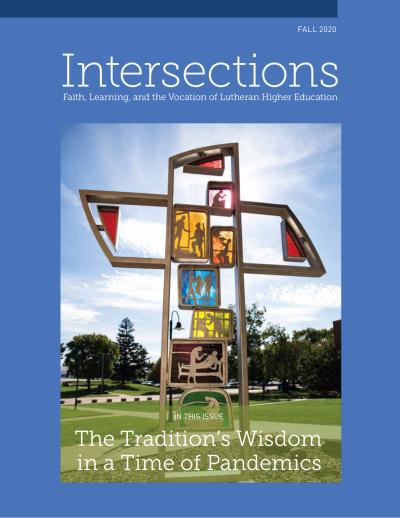
Reflecting on Augsburg’s 150th-anniversary motto “Through truth to freedom,” Pribbenow argues that in a season of three pandemics — pandemic illness, economic collapse, and the racial sin laid bare by the murder of George Floyd — higher education’s most authentic work is to educate for truth and freedom by way of confession and reconciliation.
-
 Editorial
From the Editor
Tom Christenson
No. 13 · Winter 2002
Christenson previews a varied issue—Darrell Jodock’s Bernhardson inaugural lecture, Ernie Simmons’ Valparaiso conference talk on student/parent attitudes, two South Africa travel pieces by Brian Wallace and Corin Wesner, and reviews of Richard Hughes’s and Robert Benne’s recent books—and tells the story of “the church lady from hell,” a mid-fifties returning student who condemned everyone in the class with “God and I think…,” to ask what a religious tradition without a sense of humor would look like.