I am writing this publisher’s note the day after a federal district court ruled in favor of Harvard University in its defense of the university’s practice of using race as one factor in its admissions process.
I agree with Barbara Mistick, the new president of the National Association of Independent Colleges and Universities, that “Harvard University’s successful defense of its admissions process in federal court is a win for the entire higher education community’s efforts to diversify enrollment and create opportunities for students from all sectors of our nation to achieve their dream of a college degree.” Harvard’s vindication also supports Lutheran higher education’s commitments to diversity, equity, and inclusion, which was the focus of the 2019 Vocation of a Lutheran College Conference. (Two notes for readers: First, know that NAICU is the Washington lobbying office for NECU institutions and most other church-related and private higher education. They do terrific work on your behalf every day. Second, beginning with the 2020 conference, NECU’s annual summer conference will be labeled the “Vocation of Lutheran Higher Education Conference.”)
A commitment to diversity sounds contemporary, but for Lutheran higher education, it is an old and foundational commitment. Its root is the claim that Christianity is open and available to all. Christianity’s commitment to universalism has all-too-often sadly translated into cultural and even political imperialism. Nonetheless, the commitment remains that the gospel is to be spoken to and meant for all. The earliest Christians affirmed that all people were welcomed because, in Christ, God shows no partiality.
The Christian commitment to diversity is also reflected in our basic confessional document, the Bible. The early Church rejected attempts by some Christians to harmonize the four diverse gospel books of the New Testament into a single, biographical narrative about Jesus. The early Christians insisted that Matthew, Mark, Luke, and John truly are “gospels,” not biographies of Jesus, conveying four different takes on the good news (the meaning of “gospel”) from God revealed by Jesus. Diversity in the four testimonies to the gospel, despite the resulting complexity and even contradictions contained within them, was to be honored.
This core Christian commitment to diversity means that Lutheran higher education also is committed to diversity. In our day, that commitment requires a concomitant commitment to equity and inclusion, as was demonstrated well at the Vocation Conference in 2019 and in the essays of this issue of Intersections.
-
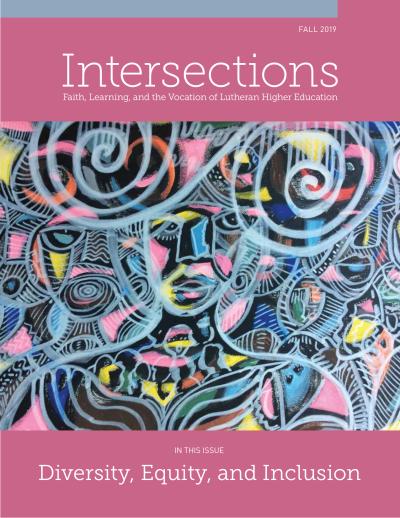 Editorial
From the Editor
Jason A. Mahn
Mahn opens with Lenny Duncan’s observation that the ELCA is 96 percent white — the whitest denomination in the U.S. — and asks how teachers and administrators at historically, predominantly, and persistently white institutions can turn from white privilege and white supremacy toward spaces where people of color thrive and white people are re-formed into antiracist allies.
-
Article
Making Diversity Matter: Inclusion is the Key
Monica Smith
Smith, Augustana’s inaugural Vice President for Diversity, Equity and Inclusion, frames the work of a Chief Diversity Officer as that of a disrupter and argues that while diversity in higher education is already happening, inclusion is a choice — one requiring a fundamental institutional transformation that diversifies faculty and staff, infuses diversity into the curriculum, invests in professional development, and draws on senior leadership to dismantle barriers.
-
Article
The Perils and Promise of Privilege
Guy Nave
Nave argues that privilege is always used in one of two ways — to preserve privilege by promoting inequity, or to challenge privilege by promoting diversity, inclusion, and equity — and uses examples from Indianapolis Catholic schools, Martin Luther, and equity-mindedness research to call Lutheran institutions to address the racist practices and policies that reproduce whiteness on their campuses.
-
Article
The Vocation of White People in a Racist Society
Caryn Riswold
Riswold proposes that whiteness is a weakness borne of apathy, atrophy, and ignorance — an atrophied muscle of race-consciousness — and offers concrete practices (reading, adjusting one’s gaze, consuming media differently, drawing on ELCA social statements like the repudiation of the Doctrine of Discovery) for exercising that muscle and naming the vocation of white people in a racist and white supremacist culture.
-
Article
Learning the Language of Inclusive Pedagogy
David Thompson
Thompson frames inclusive pedagogy as a foreign language with its own vocabulary, grammar, and cultural values, and reflects on a year of immersing himself in readings, conversations, and workshops — arguing that proficiency grows when instructors study and practice these languages repeatedly and atrophies when ignored.
-
Article
The "V" Word: Different Dimensions of Vocation in a Religiously Diverse Classroom
Martha E. Stortz
Stortz responds to a sea of blank stares when she used the word “vocation” in a religiously diverse required course by offering five metaphors — place, path, relationships, lens, and story — that point to different dimensions of vocation across the world’s religions and help students articulate their callings on their own terms.
-
Book Review
The American Myth of White Supremacy: A Review of Myths America Lives By
Susan VanZanten
VanZanten reviews Richard T. Hughes’s Myths America Lives By: White Supremacy and the Stories that Give Us Meaning, which argues that the United States grounds its identity in five myths — Chosen Nation, Nature’s Nation, Christian Nation, Millennial Nation, and Innocent Nation — all informed by the primal myth of white supremacy, and considers what Lutheran theological values can offer for resisting that myth.
-
Reflection
Seeing in a New Way: A Meditation
Kara Baylor
Baylor, the only Black campus pastor in the NECU, weaves Psalm 25, the parable of the Good Samaritan as re-read through Lenny Duncan, and the “crimson thread of divine justice” from Allen Dwight Callahan into a meditation that closes with the invitation she offered at the 2019 conference — to tie a crimson thread around the wrist as a symbol of collective commitment to moving beyond privilege toward inclusion and equity.
-
Article
Conciliatory and Queer: The Radical Love of Lutheran Higher Education
Kiki Kosnick, Sharon Varallo
Kosnick and Varallo reflect in conversation on how Augustana’s Five Faith Commitments and its conciliatory ecumenical roots in the Augsburg Confession have given them — a non-binary queer first-generation faculty member and a twenty-one-year veteran — the “street cred” to act on radical love, build bridges to imprisoned and non-binary communities, and discover that Augustana is welcoming not despite the fact that it is Lutheran, but because of it.
-
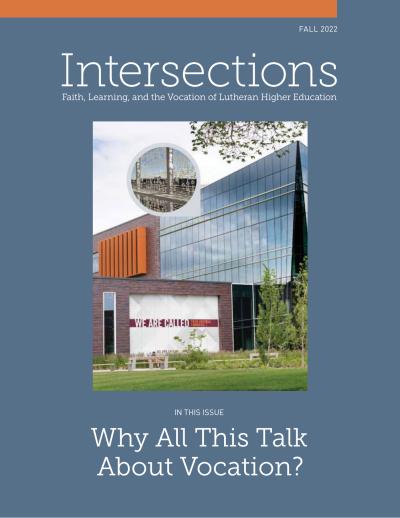 Article
Why All This Talk About Understanding the Mission of NECU Member Institutions as a Vocation?
Mark Wilhelm
No. 56 · Fall 2022
In his valedictory keynote, retiring NECU Executive Director Mark Wilhelm argues that Lutheran higher education is, properly understood, vocation-based education — outlining four core practices recovered over the past fifty years and naming the constructive and corrective work still to be done, including a fuller embrace of DEIJ and of the diverse vocations of NECU’s 27 institutions.
-
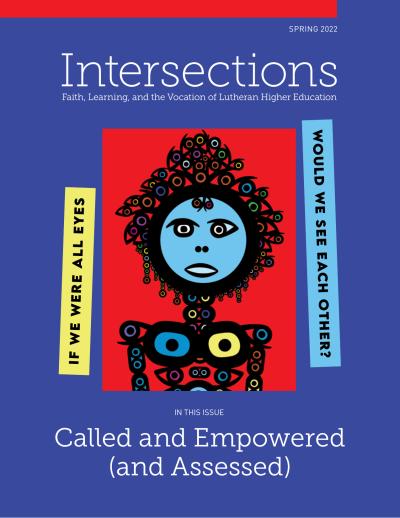 Editorial
From the Publisher
Mark Wilhelm
No. 55 · Spring 2022
Wilhelm announces his planned retirement on January 31, 2023, after serving as the founding executive director of the Network of ELCA Colleges and Universities, and gives thanks for the privilege of helping NECU articulate a shared vision for Lutheran higher education in twenty-first-century North America.
-
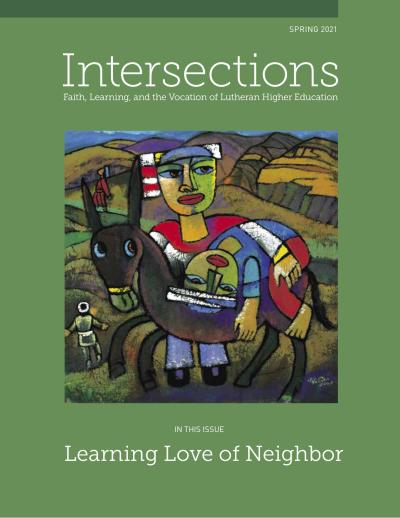 Editorial
From the Publisher
Mark Wilhelm
No. 53 · Spring 2021
Wilhelm reflects on an NPR report of teenagers’ pandemic diaries and the fraught Christian history of struggling to live out Jesus’s ethic of love, framing the issue as a record of NECU institutions working out how to act for the common good through the pandemic of 2020–2021.
-
 Editorial
From the Publisher
Mark Wilhelm
No. 52 · Fall 2020
Wilhelm argues that the “hackneyed” expressions of higher education — “you are not just a number,” “the college experience,” “risen to the challenge” — tell the simple truth about NECU institutions even as the Covid-19 pandemic has pushed budgets, employees, and campus life to the breaking point.
-
 Editorial
From the Publisher
Mark Wilhelm
No. 51 · Spring 2020
Wilhelm frames the issue by tracing how Lutheran educational ideals — once a primary source of contemporary higher education — were masked in the United States, and introduces a NECU initiative that uses the case of business ethics to explore Lutheran social teaching as an academic resource.
-
 Article
Rooted and Open: Background, Purpose, and Challenges
Mark Wilhelm
No. 49 · Spring 2019
Wilhelm traces Rooted and Open’s seventy-year backstory — from Conrad Bergendoff’s 1948 call for a Lutheran philosophy of education through the recovery of the vocation tradition — and describes the document’s process, purpose as a teaching and study resource, and the embodiment, contextual, and cultural challenges it implies for NECU institutions.
-
 Book Review
Robert Benne: Quality With Soul: How Six Premier Colleges and Universities Keep Faith With Their Religious Traditions
Joy Schroeder
No. 13 · Winter 2002
Schroeder reviews Robert Benne’s Quality With Soul (Eerdmans, 2001), which assesses the secularization documented by James T. Burtchaell’s The Dying of the Light and names six “bright lights” that resist it: Calvin, Wheaton, Baylor, Notre Dame, Valparaiso, and St. Olaf. Benne argues that piety alone or “generic Christianity” is insufficient—a school’s specific denominational intellectual tradition must permeate mission statements, classroom, and chapel, sustained by a critical mass of identifying faculty (he proposes a 2:1 ratio and at least one-third communicant membership), a first-rate theology department as “trustworthy guardian,” and visionary presidential and board leadership. Schroeder flags the under-representation of student and faculty voices but commends the book as required reading for presidents, board members, and faculty seminars at church-related institutions.
-
Article
Roots and Shoots: Tending to Lutheran Higher Education
Jason A. Mahn
No. 49 · Spring 2019
Mahn revisits why “education-for-vocation” has become a leitmotif for the 27 NECU schools, distinguishes institutional vocation from individuals’ religious identities and educational priorities from their theological grounding, and offers a friendly critique of Jodock’s bridge metaphor: Lutheran colleges grow in two directions like plants — deep roots and wide branches alike require constant tending.
-
 Response
Disputatio Pro Quo? The Search for Lutheran Education
Jon-David Hague, Kimberly Hague
No. 2 · Winter 1997
Kimberly and Jon-David Hague—both Luther College graduates completing graduate studies at Berkeley and Boston University respectively—respond to Bouman by offering Luther’s curriculum reform at Wittenberg University in the spring of 1518, only months after the 95 theses, as a model of the Lutheran voice in higher education. Inspired by humanistic principles, Luther introduced lectures on classical authors and the first instruction in Greek and Hebrew, giving students the tools to encounter scripture directly rather than receive dictated doctrine. The spirit of that reform—providing students with every possible tool while acknowledging that an instructor’s perspective is neither ultimate authority nor final word—remains useful for the search for Lutheran academia today.
-
Editorial
From the Incoming Editor
Colleen Windham-Hughes
No. 55 · Spring 2022
Windham-Hughes introduces herself as incoming editor by reclaiming the root of assess — “to sit by” — and committing to the question “What does this mean?” as she sits with readers in the worth of our work and the universality of vocation.
-
 Editorial
From the Editor
Jason A. Mahn
No. 37 · Spring 2013
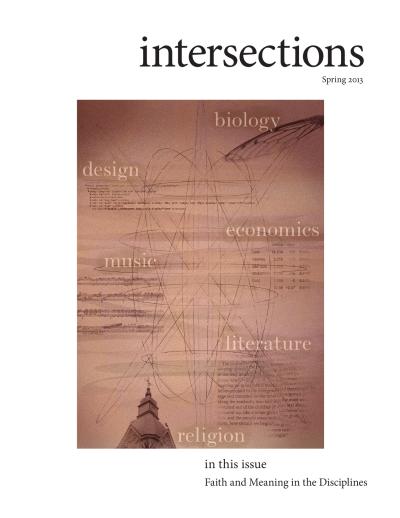
Mahn introduces the issue’s six essays as parallel attempts—from poetry, economics, choral music, biology, religion, and Lutheran higher education—to resist our culture’s fact-value split, and uses Augustana’s Fritiof Fryxell, a 1922 biology and English graduate who began teaching just as the Scopes Trial ignited, to illustrate how church-related colleges have long held faith and disciplinary inquiry together.
-
 Article
Lutheran Identity and Diversity in Education
Bruce Reichenbach
No. 17 · Summer 2003
Reichenbach applies the theological taxonomy of exclusivism, inclusivism, and pluralism to Lutheran colleges and argues that institutions self-consciously committed to inclusivism must hold a non-negotiable theological core in paradoxical tension with intentional diversity. Drawing on Richard Hughes, Darrell Jodock, Gilbert Meilaender, Robert Benne, and Mark Schwehn, he surveys the theological themes Lutheran writers identify as identity-forming—the four solas, law and Gospel, two kingdoms, vocation, simultaneously saint and sinner, the theology of the cross—and proposes that diversity at an inclusivist Lutheran college is to be employed in service of educating “head, hands, and heart,” maintained through a critical mass of faculty and staff who carry the “DNA of the school.”