When a character on the old television drama, The West Wing, asked whether President Bartlett was angry about her politically damaging lapse in judgment, she was told, “He is actually more upset that you could not come up with a retort better than, ‘If the shoe fits, wear it.’”
The tiresome use of a hackneyed expression often shows a lack of imagination, as this character joked. Sometimes, however, using a well-worn phrase is the best way to express a truth. Applying hackneyed higher education expressions to NECU colleges and universities in 2020 is a case in point. Two of them—“you are not just a number” and the “college experience”—tell the truth about our institutions as they have responded to the challenges of Covid-19 and sustained their educational missions when doing so.
“You are not just a number” at our colleges and universities, we often proclaim. It is a hackneyed expression, but at NECU institutions, it is also the truth. Care for students as individuals is real at our schools, even under the conditions of the pandemic. NECU colleges and universities attended to student success and well-being long before the higher education industry discovered “student-centered” education, and our commitment to students has not waned or been de-railed because of Covid-19.
We also offer an “experience” that allows students to grow into their fullest capacities as ethically informed and spiritually astute persons. This type of educational “experience” is the truth at our colleges and universities, and it has remained so even during the pandemic. Despite the pandemic’s complications, many students have been anxious to return to our campuses. A number of NECU institutions have even seen retention numbers rise. That’s because students are not just “numbers,” and because they “experience” an education that calls and empowers them to serve the neighbor so that all may flourish.
Please do not misunderstand. Adjusting to the pandemic has been incredibly tough. The pandemic has pushed already stressed budgets to the breaking point, requiring many beloved campus employees to be furloughed or laid off. Administrators and faculty have had to work continuously since last spring to revise and restructure instructional practices and campus life. Nothing is close to what we used to call normal. Nonetheless, core truths about higher education, encapsulated by expressions often over-used when times were much easier, still describe our realities.
The pandemic has ravaged our nation and world. It has threatened the well-being of our college communities. Our schools, however, have “risen to the challenge”—a third well worn, but truthful, phrase. Through the herculean efforts of governance boards, administrators, faculty, and students, the mission of Lutheran higher education is alive and well. In the NECU community during the Covid-19 pandemic, the hackney expressions are the simple truth.
-
 Editorial
From the Editor
Jason A. Mahn
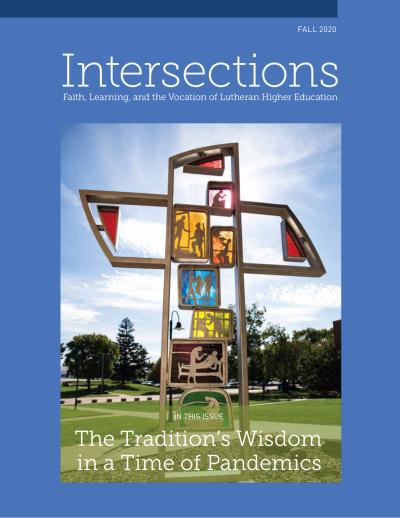
Mahn narrates a year of crisscrossing pandemics — Covid-19, economic collapse, partisan politics, and the long pandemic of white supremacy revealed anew by the murder of George Floyd — and argues that Lutheran liberal arts schools, by educating for vocation, are uniquely poised to help students respond with character and capable callings.
-
Article
A New Image for an Ancient Call: Lutheran Higher Education Amidst Pandemics Today
Caryn Riswold
Pairing Wartburg’s Lebenskreuz sculpture with the Matthew 25 acts of mercy and the commitments of Rooted and Open, Riswold reads the calls to feed the hungry, welcome the stranger, and care for the sick as urgent summons for Lutheran higher education in a year of overlapping pandemics — and as a call to dismantle the structures that produced them.
-
Article
Learning from Luther on Covid-19
Carl Hughes
Reading Martin Luther’s 1527 treatise “Whether One May Flee from a Deadly Plague,” Hughes finds practical and spiritual guidance for a pandemic age: serve the neighbor, follow medical experts, honor those whose vocations put them at risk, and trust that even when we fail, God will not abandon the community.
-
Article
Radical Hospitality on Haunted Grounds: Anti-Racism in Lutheran Higher Education
Krista E. Hughes
Writing from Newberry College’s campus on land once home to the Cherokee and within a day’s drive of Mother Emanuel A.M.E., Hughes argues that NECU’s call to “practice radical hospitality” demands that predominately white institutions open themselves to the hauntings of racism — pursuing belonging rather than mere welcome, and risking kenotic transformation of institutional identity itself.
-
Article
Activism, Justice, and the Danger of Silence
Dezi Gillon
In conversation with Jason Mahn, Augustana College alumnux Dezi Gillon traces the call to action they felt as a Black student organizing for Black Lives Matter on a predominately white campus — through seminary, art, spirituality, and restorative justice work — and warns white professors that staying silent “actually speaks volumes.”
-
Article
Leadership in Lutheran Key at a Time of Pandemics
Deanna Thompson
Thompson draws on Luther’s theology of the cross and Shelly Rambo’s theology of trauma to sketch a Lutheran model of leadership for a season of pandemics — one that is attentive to pain, responsive to need, and intentionally nourished by food, friends, and deep conversation.
-
Article
Through Truth to Freedom—by Way of Reconciliation
Paul C. Pribbenow
Reflecting on Augsburg’s 150th-anniversary motto “Through truth to freedom,” Pribbenow argues that in a season of three pandemics — pandemic illness, economic collapse, and the racial sin laid bare by the murder of George Floyd — higher education’s most authentic work is to educate for truth and freedom by way of confession and reconciliation.
-
Article
Finding Purpose in Chaos: Reflection In and Beyond the Public Health Classroom
Lena R. Hann
When the pandemic hit her new public health professionalism course, Hann recalibrated her teaching from the “how” of professional preparation to the “why” of vocational reflection — and recounts how Augustana public health students and alumni found purpose in the chaos through food banks, disaster response, palliative care, and research on health inequities.
-
Reflection
The Long Pilgrimage of 2020-21
Kara Baylor
Drawing on Martha Stortz’s definition of pilgrimage as “intentional dislocation, for the sake of transformation, where the body teaches the soul,” Baylor invites students and educators worn out by the 2020-21 academic year to ask what is essential, to listen to what their bodies are telling their souls, and to be more open to the transformations the dislocation might still yield.
-
Article
Called to Flourish: An Ethic of Care
Mindy Makant
Drawing on Lenoir-Rhyne’s core value of Care, Glennon Doyle’s Untamed, Darrel Jodock’s “Gift and Calling,” and Luther’s plague-era practice of opening his home to the sick, Makant argues that flourishing is interdependent — that self-care is a means to extending care, and that an ethic of care is the meaningful, transformative work to which Lutheran liberal arts education is called.
-
Article
Called to the Moment: A New Vocation for Lutheran Colleges
W. Kent Barnds
After a derecho ravaged Iowa in August 2020 and Pastor Katy Warren preached on 1 Peter 4, Barnds watched line workers, neighbors, and Augustana colleagues simply show up where they were needed — and proposes that the true vocation of a Lutheran college may be making the case for “meeting immediate need with a deep willingness” alongside the longer work of vocational discernment.
-
 Article
Why All This Talk About Understanding the Mission of NECU Member Institutions as a Vocation?
Mark Wilhelm
No. 56 · Fall 2022
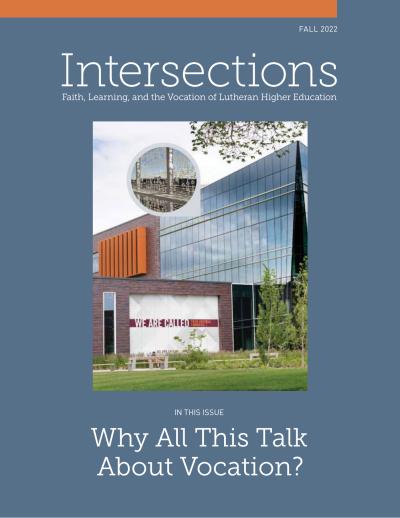
In his valedictory keynote, retiring NECU Executive Director Mark Wilhelm argues that Lutheran higher education is, properly understood, vocation-based education — outlining four core practices recovered over the past fifty years and naming the constructive and corrective work still to be done, including a fuller embrace of DEIJ and of the diverse vocations of NECU’s 27 institutions.
-
 Editorial
From the Publisher
Mark Wilhelm
No. 55 · Spring 2022
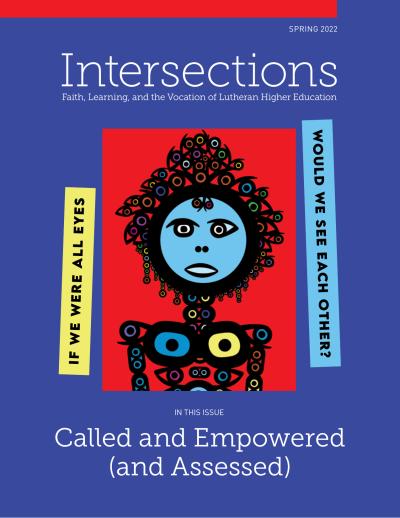
Wilhelm announces his planned retirement on January 31, 2023, after serving as the founding executive director of the Network of ELCA Colleges and Universities, and gives thanks for the privilege of helping NECU articulate a shared vision for Lutheran higher education in twenty-first-century North America.
-
 Editorial
From the Publisher
Mark Wilhelm
No. 53 · Spring 2021
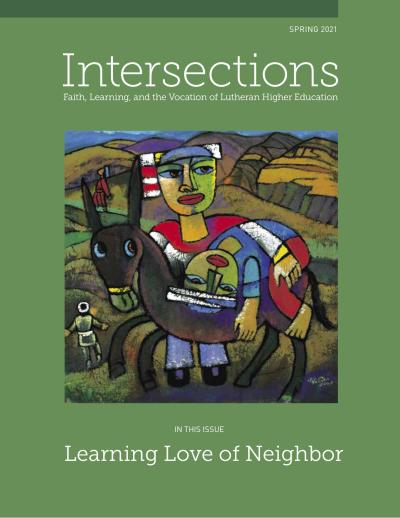
Wilhelm reflects on an NPR report of teenagers’ pandemic diaries and the fraught Christian history of struggling to live out Jesus’s ethic of love, framing the issue as a record of NECU institutions working out how to act for the common good through the pandemic of 2020–2021.
-
 Editorial
From the Publisher
Mark Wilhelm
No. 51 · Spring 2020
Wilhelm frames the issue by tracing how Lutheran educational ideals — once a primary source of contemporary higher education — were masked in the United States, and introduces a NECU initiative that uses the case of business ethics to explore Lutheran social teaching as an academic resource.
-
 Editorial
From the Publisher
Mark Wilhelm
No. 50 · Fall 2019
Wilhelm frames the issue by noting that a federal court’s vindication of Harvard’s race-conscious admissions process is a win for higher education’s commitments to diversity, equity, and inclusion — and argues that for Lutheran higher education, the commitment to diversity is an old and foundational claim, rooted in Christianity’s openness to all and reflected in the four diverse gospels of the New Testament.
-
 Article
Rooted and Open: Background, Purpose, and Challenges
Mark Wilhelm
No. 49 · Spring 2019
Wilhelm traces Rooted and Open’s seventy-year backstory — from Conrad Bergendoff’s 1948 call for a Lutheran philosophy of education through the recovery of the vocation tradition — and describes the document’s process, purpose as a teaching and study resource, and the embodiment, contextual, and cultural challenges it implies for NECU institutions.
-
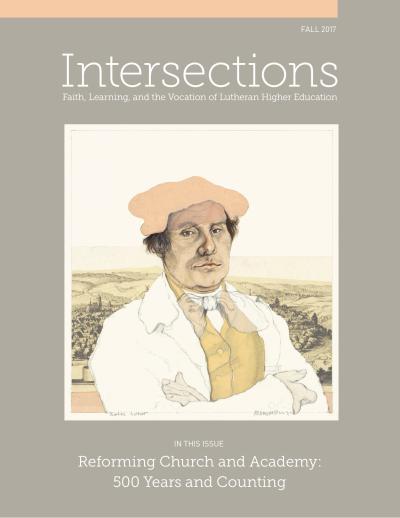 Article
Both Priest and Beggar: Luther among the Poor
Martha E. Stortz
No. 46 · Fall 2017
Reading Luther’s deathbed remark “We are all beggars” against his “priesthood of all believers,” Stortz argues that priest and beggar are two sides of a human reality — one that locates civic responsibility for the poor at the heart of the Reformation legacy and that pushes beyond paternalistic service toward the systemic question of justice.
-
Editorial
From the Editor
Jason A. Mahn
No. 46 · Fall 2017
Mahn returns to Luther’s opening thesis on whole-life repentance to argue that the deepest critique of the indulgence economy — and of our own American meritocracy — is the very assumption that grace and human striving can be measured, exchanged, and earned.
-
Institutional Focus
Sharing the Gift of Vocation at (and beyond) Augsburg University
Paul C. Pribbenow
No. 55 · Spring 2022
Pribbenow, drawing on a 2022 NetVUE panel with Dorothy Bass and Jodi Porter, considers how the gift of vocation forged with undergraduates can be extended — beyond undergraduate campuses to graduate students, faculty, and staff; across the vocational lifespan from high schoolers to alumni navigating the “gig economy”; and into accompaniment of faith communities through Augsburg’s Riverside Innovation Hub.
-
 Article
Freedom, Humor, and Community: A Lutheran Vision for Higher Education
Darrell Jodock
No. 13 · Winter 2002
Jodock’s inaugural lecture for the Bernhardson chair at Gustavus Adolphus develops three interlocking themes drawn from the Lutheran tradition as a deeper grounding for the liberal arts college than contemporary American assumptions. A sense of humor rests on Luther’s discovery that God takes the initiative—Luther could call himself a beggar, joke about the epistle of James, and credit Wittenberg beer for the Reformation—and underwrites the freedom of inquiry that John Updike traces to Grace Lutheran Sunday School in Shillington. Community, grounded in Augsburg Confession VII and Luther’s 1524 letter to the German city councils, makes the college a community of discourse pursuing wisdom rather than “the same old blockheads.” Freedom is both “freedom from” and “freedom for,” illustrated by Nechama Tec’s Polish Holocaust rescuers and by Jodock’s Holocaust-class corporate role-play in which students voted to build a factory in a death camp rather than risk losing their board seats—a vivid case for educating toward “a passion for justice.”
-
Article
In the Beginning of the Reformation Was the Word
George Connell
No. 46 · Fall 2017
Drawing on a Concordia faculty pilgrimage to German Luther sites, Connell appropriates John’s prologue to frame the Reformation as a movement about words — the printed page, the university classroom, the Marburg confession, the Wartburg translation, Bach’s music, and the dining-room conversations of Table Talk — while soberly noting that words can wound as well as heal.
-
 Article
"Our Calling in Education": An Educator's Perspective
Cheryl Budlong
No. 23 · Summer 2006
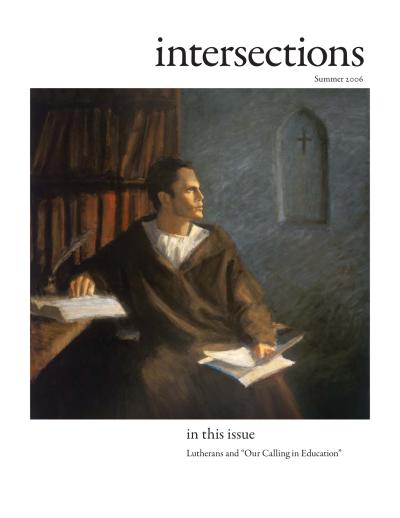
Budlong, Professor of Education at Wartburg College, asks educators to reexamine their ‘mental models’ of what education itself means in light of the rapidly expanding literature on how young people learn. Drawing on Malcolm Gladwell, Eric Jensen, Ruby Payne, Judith Harris, Robert Slavin, and the AACTE’s Leading a Profession retrospective on the AACTE agenda 1980–2005, she calls on Lutheran educators to articulate vocation intentionally in their classrooms and to ground curricular and pedagogical reform in Wartburg’s focus on Discovering our Calling.