Affirming, Entrusting, and Acting: A Baptismal Grounding of Affirmative Action in Lutheran Higher Education
Intersections No. 60 · Fall 2024
“How do you define affirmative action in the context of Lutheran (NECU) higher education, and what are its main objectives?”
This provocative question was asked to those of us who attended this past summer’s Vocation of Lutheran Higher Education Conference at Augsburg University after a panel discussion on our commitment to diversity, equity, and inclusion at institutions of the Network of ELCA Colleges and Universities (NECU).
We were asked to respond to this question while gathered in small groups with colleagues who occupy similar positions at other NECU institutions.
When this question came up on the screen, it immediately stimulated my imagination.
I thought perhaps, as the whitest Christian denomination in North America, institutions of the ELCA had little to say about the practice of affirmative action in our society.
As institutions grounded by the vision presented in “Rooted and Open: The Common Calling of the Network of ELCA Colleges and Universities,” I began to imagine how it was that Lutheran theology and practice might support and affirm the ways our institutions strive to create spaces for all students, particularly for those who come from under-represented populations on our campuses.
To this end, I asked myself, “Where in the shared practice of Lutheran communities do we make affirmations and where do we take action?”
As a Lutheran pastor, I immediately thought of the sacrament of baptism because it is through baptism that individuals are welcomed and incorporated into the community of the church.
Baptism is a sign of radical welcome into a community, where the baptized now unconditionally belong.
To do this, the Lutheran baptism liturgy includes a moment where the pastor presiding over the baptism asks the entire gathered assembly to make a profession of their faith.
“Where in the shared practice of Lutheran communities do we make affirmations and where do we take action?”
In this profession of faith, the pastor asks the assembly a series of six questions. The first three ask the gathered assembly to renounce ways of the world that defy God’s desire for humanity and creation, including evil and sin. The second three ask the assembly what they believe, using the words of the Apostles’s Creed to affirm faith.
The assembly is ritually asked what they say “no” to and what they say “yes” to. In their responses, they make affirmative statements about the content of their belief.1
Earlier in the liturgy, the presiding minister lists the responsibilities that are entrusted to those who are baptized, concluding with the effect these responsibilities have on the baptized, namely “so that [they] may learn to trust God, proclaim Christ through word and deed, care for others and the world God made, and work for justice and peace.”2
In the sacrament, the act of affirming belief entrusts the baptized with responsibilities, through which they are called to action in the world.
Action that promotes care, justice, and peace in our world.
As all these thoughts swirled in my head, I shared some of these initial ideas with colleagues at the conference. Speaking together, they helped me articulate a connection between my thinking and our shared work. Because similar to the way the gathered assembly affirms what they are for in the baptismal liturgy, our colleges and universities are also called to affirm what it is that we are for.
“Because similar to the way the gathered assembly affirms what they are for in the baptismal liturgy, our colleges and universities are also called to affirm what it is that we are for.”
In “Rooted and Open,” the authors affirm that “In their appreciation and cultivation of diversity in its many forms, Lutheran colleges and universities welcome all and learn from all.”3
This is an affirmation echoed by many of our schools in mission statements and college or university values. At my own school, St. Olaf College, our mission statement specifically names that we strive for our students to learn in an “inclusive, globally engaged community.”4
In this mission, we make an affirmative statement about the community of which we are a part.
“As the sacrament of baptism reminds us, our affirmations also entrust us with responsibilities, which move us towards action in our communities and the world.”
But, as the sacrament of baptism reminds us, our affirmations also entrust us with responsibilities, which move us towards action in our communities and the world.
The questions for our communities, then, are: What responsibilities do our affirmations to create diverse, inclusive communities create for us? And what actions do our responsibilities call us towards?
A Lutheran perspective on affirmative action argues that we will create truly inclusive and just communities when we clearly affirm our commitments, name the responsibilities that our affirmation entrusts to us, and act in ways that embody our affirmations.
May our work be grounded in such affirmations, responsibilities, and actions that we continue to move our communities to be places of belonging so that all our students may flourish.
Endnotes
1. “Holy Baptism,” in Evangelical Lutheran Worship (Minneapolis, MN: Augsburg Fortress, 2006), 229.
2. Ibid, 228
3. “Rooted and Open,” May 18, 2018, https://elcamediaresources.blob.core.windows.net/cdn/wp-content/uploads/Rooted_and_Open.pdf.
4. “Mission,” About St. Olaf, June 7, 2023, https://wp.stolaf.edu/about/mission/.
-
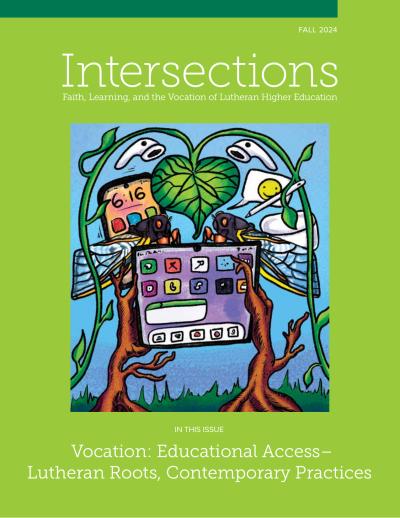 Editorial
From the Editor
Colleen Windham-Hughes
Windham-Hughes welcomes newcomers and seasoned colleagues to the conversation, lifts up Mary Elise Lowe’s three Lutheran “whys” for educational access, and commends Rev. Jen Rude’s “Sacred Pause” practice as a way to humanize one another and make opening access both easier and more joyful.
-
Editorial
From the Publisher: Reflections on the 2024 Vocational Leaders in Higher Education Conference
Lamont Anthony Wells
Wells reflects on the 2024 VLHE Conference theme — “Educational Access: Lutheran Roots, Contemporary Practices” — tracing today’s commitment to inclusivity back to Martin Luther’s radical 16th-century insistence that both boys and girls be educated, and previews NECU’s expanded engagement of student leaders alongside faculty and administrators.
-
Article
Access, Accessibility, & Change: A Call for Trustworthy Leadership in Higher Education
Emma Jones
Jones surveys the converging pressures on higher education — cost, the enrollment cliff, shifting demographics, and declining public confidence — and uses Reichheld and Dunlap’s four factors of trust (transparency, capability, reliability, humanity) to call campus leaders to rebuild trustworthy leadership from the inside out.
-
Article
Creation, Justice, and Communio: Lutheran Insights Empowering Educational Access
Mary Elise Lowe
In her VLHE keynote, Lowe names three Lutheran commitments — continuing creation, neighbor justice, and communio — as the “why” that empowers ELCA colleges and universities to pursue equitable access for students often left behind by persistence and graduation gaps.
-
Article
Committed to Paradox
Caryn Riswold
Riswold lifts up paradox — saint and sinner, lord and servant, Rooted and Open — as a distinctive Lutheran root that lets institutions honor the complicated truth of who their students are and embrace the messy, ever-reforming work of access and accessibility as a theology of the cross.
-
Article
2024 VHLE Conference: "Rooting Access" Panel Talking Points
Guy Nave
Nave reads “access” across Deuteronomy 23, Ruth, Isaiah 56, Acts 10, and Matthew 15:21-28 as an ongoing biblical conversation that evolves from exclusion to ever-widening welcome — and presses ELCA institutions to shift their focus from “student readiness” to “institutional readiness.”
-
Reflection
Reflecting on Belonging
Melissa Woeppel
Woeppel, campus pastor at her own alma mater, wrestles with a Bethany student’s plea — “I want to feel like this is my home, like I belong” — and Mindy Makant’s reminder that we don’t choose the story of the past but do choose how we tell it forward, opening space for students from 35 faith traditions to find Lutheran institutions to be their home.
-
 Response
Of Imaginary Cows and a White Toy Sheep: The Freedom of a Christian College
Ryan La Hurd
No. 6 · Winter 1999
La Hurd, president of Lenoir-Rhyne and a former Thiel English professor and Augsburg academic dean, responds to Christenson by insisting (with Robert Kegan’s story of Tommy’s imaginary cattle farm) that a college is composed of people but is not itself a person, and so cannot share in Luther’s freedom of the Christian. Drawing on Benedict Anderson’s Imagined Communities, Lewis Hyde’s The Gift, George Marsden, Mark Schwehn, Jacques Barzun, and the Pew Higher Education Roundtable, he distinguishes the “imagined college” (the gift-economy realm of teaching and the alma mater) from the “real college” (the commodity-economy realm of fund-raising, deferred maintenance, and federal aid reconciliation that does not have such freedom)—and ends with Pablo Neruda’s “Childhood and Poetry” and the marvelous white toy sheep offered through a hole in a fence.
-
 Article
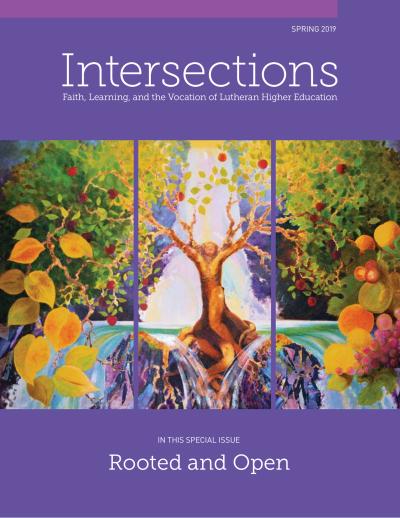
Rooted and Open: Background, Purpose, and Challenges
Mark Wilhelm
No. 49 · Spring 2019
Wilhelm traces Rooted and Open’s seventy-year backstory — from Conrad Bergendoff’s 1948 call for a Lutheran philosophy of education through the recovery of the vocation tradition — and describes the document’s process, purpose as a teaching and study resource, and the embodiment, contextual, and cultural challenges it implies for NECU institutions.
-
 Editorial
Guest Editor
Madeleine Forell Marshall
No. 25 · Spring 2007
Marshall introduces the four papers in this issue from the 70th annual meeting of the Association of Lutheran College Faculties, held at California Lutheran University in October 2006 on the theme “Identity and Diversity in the Lutheran College.” She notes a geographic pattern—the two East Coast contributors (Balmer and Bailey) defend Christian liberal arts against perceived suspicion, while the two Westerners (Marichal and Brubaker) treat Lutheran identity as advantage and diversity as a Lutheran given—and announces the 2007 ALCF meeting at Newberry College on “Beyond ‘Whatever’: Values Based Learning in Lutheran Higher Education.”
-
 Article
Uneasy Partners? Religion and Academics
Storm Bailey
No. 11 · Spring 2001
Bailey, a philosopher at Luther College, takes up the reflex of describing church-related colleges as “pretty good in spite of the religion” and argues instead that religious commitment serves academic goals on three fronts: service as central academic purpose (Richard Hughes on Mennonite colleges in Models of Christian Higher Education), educational community (Plato’s dialogues, Parker Palmer, and Mark Schwehn’s Exiles from Eden), and integration of knowledge across disciplines against Nelson and Watt’s “entrepreneurial disciplinarity.” He then defends academic freedom on Christian grounds by drawing on Mill’s On Liberty argument from fallibilism, the centrality of epistemic weakness in the Christian tradition, and Wolterstorff’s claim that to infringe academic freedom is to desecrate an image of God—making personal and institutional religious commitment a foundation, not a foe, of the liberal academic ideal.
-
 Editorial
From the Editor
Tom Christenson
No. 16 · Winter 2003
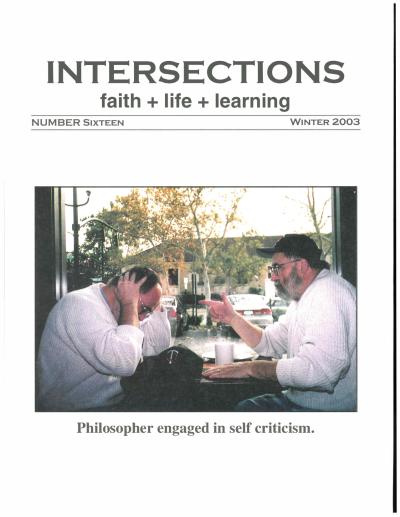
Christenson previews this issue’s papers from the Vocation of a Lutheran College Conference—Curt Thompson on “the Lutheran knot,” Carol Gilbertson on the creative dimensions of language, Bruce Heggen on theological vocabulary in the state university, Susan Poppe on the boundaries of campus freedom, and Sig Royspern’s oracular gems—welcomes Robert Benne’s response to the previous issue as a sign that Intersections is becoming a locus of continuing conversation, and confesses his reluctant consent to appear on the cover.
-
 Article
Lutheran Education in the None Zone
Samuel Torvend
No. 23 · Summer 2006
Torvend, Associate Professor of Religion at Pacific Lutheran University, argues that any ELCA social statement on education must speak not only to those raised within the cultural and theological traditions of ELCA Lutheranism but also to the diverse communities of the “none zone” — the Pacific Northwest and other regions where religious affiliation is increasingly unaffiliated. The statement must therefore equip Lutheran colleges, congregations, and schools for engagement with religious pluralism and cultural diversity rather than presuming a Lutheran cultural baseline.