I would like to respond to Professor Benne’s characteristically generous comments in the last issue of Intersections about my review essay of his and the other contributions to The Future of Religious Colleges, edited by Paul Dovre. It was certainly not my intention to misrepresent his position, and I am grateful for his clarifications. I believe our disagreements are minor alongside our fundamental agreement that the epistemology of the Enlightenment — the dominant epistemology throughout higher education — poses the most serious threat to the continuing vitality of our Lutheran colleges. That is why I began my essay with the arguments of Douglas Sloan that mainstream Protestantism had not succeeded in finding a way by which its truth claims could be adjudicated in the academy — and returned to those arguments at the conclusion.
Practicing scholars in the academy, who are seldom preoccupied with epistemology, look for a methodology that can place conflicting explanations side-by-side and provide a means of adjudicating the relative power of those explanations. Despite the persuasiveness of many of its critics, the Enlightenment model continues to be the one to which most scholars will default. So long as practicing historians, for example, wish to speak to the larger profession rather than to a particular faith community, the specter of David Hume, even more so than that of Rene Descartes, will continue to hover over historical explanation.
Let me put the threat concretely. If I am lecturing to a class of students on early Mormon history, I do not find a compelling alternative to the Enlightenment model when evaluating the truth claims of The Book of Mormon. I respect, and make the class aware of, the very different interpretation of that text offered by a practicing member of the Church of Jesus Christ of Latter Day Saints, but as a scholar exercising professional judgment, I do not grant that interpretation equal status as an “historical” account. I agree completely with Benne when he argues that the assumptions of my methodology act as a solvent on Mormon faith claims. The same methodological solvent has acted for two centuries to challenge basic Christian assertions about the “historical Jesus.” As I write, Jews and Christians can pick up a popular news magazine and read how “scientific” archeology (as offered, for example, in Uncovering the Bible) is disproving their cherished beliefs about David, Solomon, the Exodus, and the entire biblical account of the history of ancient Israel.
In The Meaning of Revelation, H. Richard Niebuhr offered one possibility (“inner” and “outer” history) for reconciling faith and Enlightenment history. Walter Brueggemann offers another in The Theology of the Old Testament (treat the text as authoritative without concern for its “historicity”). Such approaches may be comforting to believers (personally, I find myself drawn to both), but they do not in my judgment offer an epistemology that can stand alongside of, and command equal respect with, the Enlightenment model in evaluating truth claims in the academy. That, I believe Benne and I agree, continues to be a fundamental challenge for church-related higher education.
Sincerely,
Baird Tipson
Wittenberg University
-
 Editorial
From the Publisher
Arne Selbyg
Selbyg explains that the four essays in this issue grew out of the first Lutheran Academy of Scholars in Higher Education—a two-week seminar funded by the Lutheran Brotherhood Foundation and the Lilly Endowment, led for its first three years by Dr. Ronald Thiemann of Harvard Divinity School—whose official theme “Finding Our Voice—Christian Faith and Critical Vision” became informally “What’s Faith Got To Do With It?”
-
Editorial
From the Editor
Tom Christenson
Christenson introduces the four essays by participants in the first Lutheran Academy of Scholars as fruit of the “genuine conversation” that emerges when specialists set aside their lecturers’ podiums to speak as human beings, and welcomes the issue’s additional “Intersections first”—a response to a response to a review—continuing the conversation between Baird Tipson and Robert Benne about the paradigm of Lutheran higher education.
-
Article
'In, With, and Under:' The Tradition and the Teaching of Christian Ethics
Pamela K. Brubaker
Brubaker describes how she teaches Introduction to Christian Ethics at California Lutheran University—a religiously diverse classroom where about 30% of students are Lutheran, 30% Roman Catholic, and many are “unchurched”—as a community of moral discourse rooted in the Lutheran dialectic of faith and reason. Drawing on Larry Rasmussen and Bruce Birch, Elizabeth Bettenhausen, Roger Crook, and Robert Benne’s typology of “Hot and Cool Connections” between church and politics, she walks through her course’s units on human sexuality, economic life, and war and peace—including the Bomb Shelter simulation, a mock Disney stockholders meeting on sweatshops, and a Congressional hearing on the School of the Americas—to show how ELCA social statements function as case studies in critical inquiry and education for citizenship.
-
Article
Impelled to Pluralism: Thoughts About Teaching in a Lutheran University
Jim Huffman
Huffman traces his personal journey through three stages of faith—the “comfortable Christ” of his Midwestern Christian childhood, Clark Pinnock’s “faith principle” of accessible salvation, and finally Christ as the “humble teacher”—to a pluralism that rejects religious triumphalism without abandoning Christian commitment. Drawing on Diana Eck, Wesley Ariarajah, John Cobb, the Catholic novelist Endo Shusaku, and the histories of Confucian China and imperial Japan, he then describes how this commitment shapes his teaching of East Asian religion and nationalism at Wittenberg University: insisting on respectful language, working sympathetically through doctrines like Buddhist non-attachment, and helping students see the pernicious effects of triumphalism in both religious and political life.
-
Article
Making Dry Bones Stand: Lutheran Higher Education at Century's End
Diane Scholl
Scholl reads John Winthrop’s “A Model of Christian Charity,” the banishment of Anne Hutchinson, de Crevecoeur’s American farmer, Olaudah Equiano, Phyllis Wheatley, and Hawthorne’s The Scarlet Letter alongside Ezekiel’s vision of the dry bones to ask how a Lutheran college can be a community that holds difference and commonality together. Drawing on Ernest Simmons’s warning against collapsing into either dogmatic absolutism or thoroughgoing relativism and Bruce Reichenbach’s companion essay in this issue, she identifies five features of shared life at a Lutheran college—the liberal arts, political process, the arts, the community of caring, and the recognition of difference and the right to dissent—and argues that the necessary tension between individualism and corporate identity, framed by theological vision, is “our best legacy and our best hope for the future.”
-
Article
Lutheran Identity and Diversity in Education
Bruce Reichenbach
Reichenbach applies the theological taxonomy of exclusivism, inclusivism, and pluralism to Lutheran colleges and argues that institutions self-consciously committed to inclusivism must hold a non-negotiable theological core in paradoxical tension with intentional diversity. Drawing on Richard Hughes, Darrell Jodock, Gilbert Meilaender, Robert Benne, and Mark Schwehn, he surveys the theological themes Lutheran writers identify as identity-forming—the four solas, law and Gospel, two kingdoms, vocation, simultaneously saint and sinner, the theology of the cross—and proposes that diversity at an inclusivist Lutheran college is to be employed in service of educating “head, hands, and heart,” maintained through a critical mass of faculty and staff who carry the “DNA of the school.”
-
Poem
Emily Dickinson in Columbus, Ohio
Caitlin McHugh
McHugh imagines Emily Dickinson waking up on a COTA bus to find “the world had ended, and her violets were gone forever,” then escaping the crowd to wander High Street, taste “actual brewed liquor,” quit “the act of reclusive-drama queen-ghost,” and finally smash a bouquet of violets when she realizes that “Beauty had not stopped for her death, but crawled bravely onward.”
-
 Article
Sustaining Sustainability
Baird Tipson
No. 36 · Fall 2012
Tipson—former Provost of Gettysburg College, President of Wittenberg University, and President of Washington College—reads Romans 12:2 (“be not conformed to this world…”) against Victor Ferrall’s Liberal Arts at the Brink and the contemporary financial reality of small Lutheran colleges. He tells three case-study stories from Washington College’s Center for the Environment and Society—the Chino Farms partnership, the Chesapeake Semester, and the acquisition of the work boat Callinectes—to show how presidents must engage “the world” to secure resources for sustainability work without being conformed to it.
-
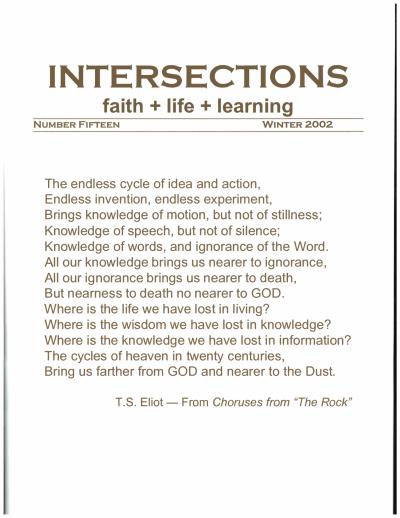 Book Review
Paul Dovre, ed.: The Future of Religious Colleges
Baird Tipson
No. 15 · Winter 2002
Tipson, president of Wittenberg University, reviews Paul Dovre’s edited proceedings of the October 2000 Harvard Conference on the Future of Religious Colleges (Eerdmans, 2002), summarizing essays by Douglas Sloan on the failure of the “two-realm theory of truth,” George Marsden on faith-shaped scholarship, DeAne Lagerquist, Father David O’Connell, Mark Noll, Robert Benne, Mark Roche on Notre Dame, Joel Carpenter on neo-Calvinist Kuyperianism, and Mark Schwehn on a Lutheran “college-related church” and the centrality of vocation. Against Benne’s suggestion that only two or three robustly Lutheran colleges can be sustained, Tipson defends a less robust but still authentically Lutheran model embodied at places like Wittenberg, Gettysburg, and Roanoke, arguing for the enlightenment commitment to subjecting all truth claims to rigorous criticism and for hiring Marsden-style faith-shaped scholars rather than counting Lutheran heads.
-
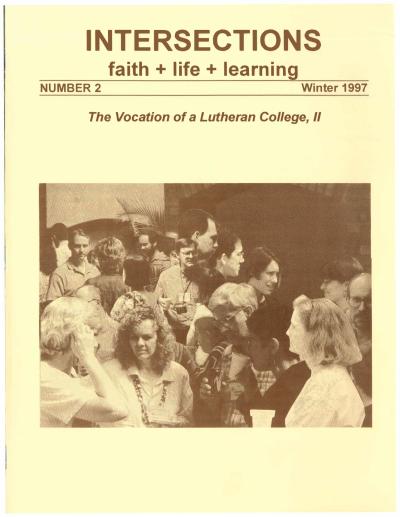 Institutional Focus
Embodying the Tradition: The Case of Wittenberg University
Baird Tipson
No. 2 · Winter 1997
Tipson, President of Wittenberg University, locates Wittenberg in the “American” strain of Ohio Lutheranism founded in 1845 under Ezra Keller (a Pennsylvania College and Gettysburg Seminary graduate and disciple of Samuel Simon Schmucker), with English-language preaching, financial support from the pan-Protestant New England Society, Presbyterians on the Board, and an Episcopalian teaching Latin. He names two ongoing challenges—remaining authentically Lutheran while welcoming a pluralistic student body (just under a quarter are Lutheran in a primary service area that is 5% Lutheran), and making the tradition clear and compelling to non-Lutheran or lukewarm Lutheran students—and presents the five things every Wittenberg graduate should be able to do (respond to the human condition; recognize, define, and solve problems; develop a sense of vocation; assume servant-leadership; take moral responsibility) as authentic expressions of the Gospel and of the university’s ELCA relationship.
-
 Article
A Lutheran Dialectical Model for Higher Education
Ernest L. Simmons
No. 37 · Spring 2013
Drawing on “The Freedom of a Christian,” simul justus et peccator, Richard Hughes, Joseph Sittler, Martha Nussbaum, and Tom Christenson, Simmons argues that the Lutheran tradition informs an open, dialectical educational model that holds Christian and academic freedom together. He locates vocation at the intersection of the practical (why are you here?) and the existential (why are you here?) and proposes Lutheran higher education as education for self-transcendence and leadership Soli Deo Gloria.
-
 Article
Sexuality over the Lifespan—Social Trends Pose Moral Dilemmas for Communities of Faith
Adina Nack
No. 22 · Spring 2006
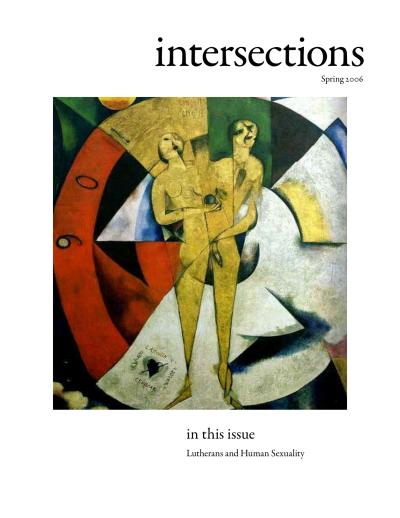
Nack, a sociologist who presented to the ELCA Task Force for Studies on Sexuality, surveys empirical research on three life-stages flagged by the Task Force as particularly contested—premarital sexuality among adolescents and young adults, sexuality after divorce and within single parenting, and sexuality in late adulthood. Drawing on the Alan Guttmacher Institute, the Office of the Surgeon General, AARP, National Council on the Aging, and the World Health Organization’s 2002 definition of sexual health, she closes each section with questions about the church’s role in education, blessing of committed nonmarital relationships, and dismantling stereotypes about aging and sexuality.
-
 Article
Lutheran Identity, Academic Integrity, and Religious Diversity
Storm Bailey
No. 25 · Spring 2007
Bailey argues that one might rightly say of a college “that’s a pretty good school because it’s religious,” defending the proposition under three headings: academic and curricular virtues, free inquiry, and religious diversity. Drawing on Mark Schwehn’s Exiles from Eden, Richard Hughes on the Lutheran tradition’s “most potent theological resources” for the life of the mind, Parker Palmer, Lendol Calder, Mill’s On Liberty, Newman’s Idea of a University, and the AAUP’s 1940 Statement, he proposes a “critical mass” alternative in which the Lutheran commitment to truth-seeking and self-critique itself requires—rather than tolerates—a religiously diverse faculty whose opposing voices are needed for the mission to flourish.
-
 Article
What it Means to Build the Bridge: Identity and Diversity at ELCA Colleges
Eboo Patel
No. 40 · Fall 2014
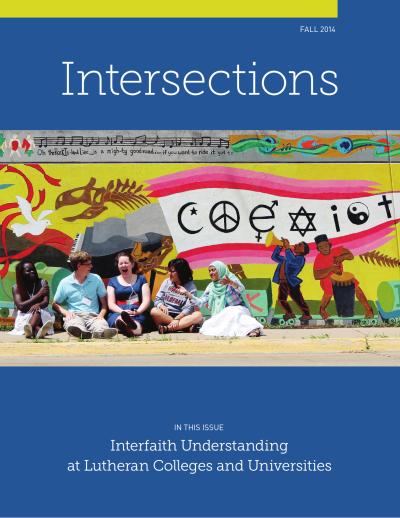
Through the contrasting stories of two college students — Cassie’s identity relativism and April’s soft fundamentalism — Patel diagnoses Peter Berger’s twin pathologies of modernization and argues that ELCA campuses, anchored in Bonhoeffer and the Lutheran capacity to “have faith without laying claim to certainty,” are uniquely equipped to be places where the light falls: bridges of cooperation that nurture both strong religious identity and benevolence toward others.
-
 Article
Mission and Hiring in the Christian College
Bruce Reichenbach
No. 3 · Summer 1997
Reichenbach of Augsburg argues that the Christian or Church-related college’s mission to educate the whole person from a perspective of Christian faith and values can only succeed through intentional hiring of a “critical mass” of faculty, administrators, and staff committed to that mission (following George Marsden and the 1960s Danforth Commission), supplemented by on-going faculty development. He defends an inclusive community-with-diversity, a freedom-and-commitment tension grounded in Alasdair MacIntyre’s account of tradition, and the legality of preferential religious hiring under Title VII of the Civil Rights Act and the relevant case law (Tilton, Hunt, Roemer, Blanton, Grove City, Amos).
-
 Article
Vocation and the Vocation of a Lutheran College (Cows, Colleges and Contentment)
Stanley Olson
No. 24 · Fall 2006
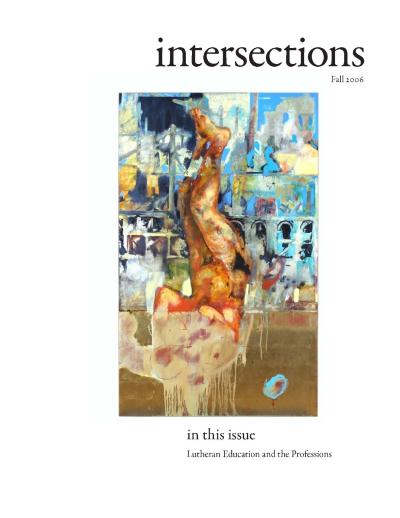
Drawing on a childhood image of contented cows on Lutheran-owned farmland in Northfield, Olson—Executive Director of the ELCA Vocation and Education unit—asks whether Lutheran colleges are content because they draw nourishment from the Lutheran tradition, or merely because they happen to be standing on Lutheran soil. He proposes the mantra “Because of Christ, the world; because of the world, vocation; because of vocation, education,” and traces what each clause demands of the colleges and universities of the ELCA.