I’ll start with the bad news: You and I and everyone we work with and everyone we know is going to die. Sooner or later, and I hope it’s later, each of our lives will run out. The British writer Oliver Burkeman’s recent, excellent book on “time management for mortals” is titled 4,000 Weeks. That’s a little less than 77 years, roughly the life expectancy of someone in the United States. Thinking about our lifespan in terms of weeks is clarifying and perhaps a bit jarring. You only have so many more Tuesdays left.
It’s tempting to react to this grim realization by trying to cram as much as possible into those remaining weeks, to “seize the day,” as they say.
Burkeman thinks this is the wrong lesson. The fact is, no matter how long we live, we will almost certainly die with things still on our to-do list. You simply cannot do everything you might like to do. There is no lifehack, no motivational mantra, no self-management habit that will make it possible to accomplish everything you want. Burkeman counsels readers to accept that they won’t be able to cross every item off the “bucket list.” Once you accept that, you’re free to let go of the things you know you won’t get to.
Here is much better news: Mortality is only half the reason we can’t do all we might want to do. The other half is that we are desiring, imagining beings. The scope of what we can picture ourselves doing, what we might wish to do, is virtually limitless. And so we live forever in the contradiction between what we can imagine and what we can accomplish. You might see this condition as a tragedy, the source of endless frustration. But many thinkers have seen it as a great condition of possibility for human thought and action. The writer Annie Dillard, for instance, wrote that “Wherever we go, there seems to be only one business at hand—that of finding workable compromises between the sublimity of our ideas and the absurdity of the fact of us.” That search for compromise is human life.
“The scope of what we can picture ourselves doing, what we might wish to do, is virtually limitless. And so we live forever in the contradiction between what we can imagine and what we can accomplish.”
This tension between what we might like to do and what our limited nature will allow us to do also exists on the smaller scale. I have taught at the college level for 25 years, in 14 or 15 week increments, each semester about four tenths of a percent of my allotted 4,000 weeks. There is so much my students don’t know, so much I want to teach them. At the start of a semester, writing a syllabus is an exercise in cutting topics, readings, and assignments. By the end, we usually haven’t even covered everything that was on the syllabus. And yet, the enterprise is still worthwhile. My students still learned something.
“There is so much my students don’t know, so much I want to teach them. At the start of a semester, writing a syllabus is an exercise in cutting topics, readings, and assignments. By the end, we usually haven’t even covered everything that was on the syllabus. And yet, the enterprise is still worthwhile. My students still learned something..”
The fundamental contradiction between what we can imagine and what we can accomplish is true for colleges and universities, too. They typically have longer lifespans than we do—and, in fact, one reason people found universities and other institutions is to continue a project for longer than a single lifetime. But their lives do eventually end, too. Finlandia University, founded in 1896, was a member of the Network of ELCA Colleges and Universities, but it closed earlier this year. Several other small religious colleges have also recently shut their doors. More, unfortunately, are sure to follow.
Even a college that’s in a stable position can only accomplish, year to year, what its budget, its strengths and weaknesses, its culture, and the time and talents of its employees will allow. And yet our institutions face tremendous pressure to do more and more. These pressures come from sources like enrollment trends, accreditation, public skepticism toward the value of higher education, and the continued disruption caused by the Covid-19 pandemic. In the regions of the country facing the “demographic cliff” of smaller traditional-aged student cohorts, colleges are competing with each other to recruit and retain a shrinking population of prospective students at the same time as students are struggling with cost, mental health, and academic success. Often, institutions respond to such crises by chasing an untapped applicant pool, a grant, a donation, or national prestige. They start doing things they have never done before, that they don’t know how to do, and that may either replicate or conflict with other work they are already doing. The education researchers Wendy Fischman and Howard Gardner named this expansive agenda “projectitis.” It diffuses the college’s mission, and it often doesn’t even work to stabilize the institution. As I write this, West Virginia University is proposing deep cuts to longstanding academic programs—things the university had done well for decades—to cover losses incurred by an unrealistic, failed expansion begun in 2014.
All of these pressures, internal and external, are ultimately borne by employees. They are the ones who carry out a university’s mission. If that mission expands without a corresponding expansion of the time and resources needed to carry it out, then university employees are highly susceptible to burnout.
Burnout is the experience of being chronically stretched across a gap between your ideals for work and the reality of your job. Ideals are the things workers feel they can expect from their work. These expectations often motivate workers to do their best. Key expectations can include explicit promises by an employer, including a reasonable schedule, salary, and benefits. Ideals also include implicit promises of dignity, or an opportunity to serve or express oneself in one’s work. These implicit promises come as much from the culture as they do from an employer. Parents, pastors, and politicians help set our ideals for work. So do movies and TV. What did “The Mary Tyler Moore Show” say we should expect from work? What does a more recent show like Apple TV’s “Severance”?
When someone’s working conditions do not match their ideals over a long period of time, they undergo the stretching we call burnout. That mismatch might stem from unmet expectations for salary or promotion. Or from suffering discrimination. Or from working in an institution whose values do not match one’s own. It’s important to remember that there are two sides to the gap that causes burnout: Unreasonable expectations contribute just as much to burnout as inadequate conditions. Burnout can result not only when a reasonable promise is not kept but also when an unreasonable promise should never have been made in the first place. Burnout, then, is a small-scale instance of the fundamental tension in human life between what we can imagine and the finitude of our lives. Burnout can perhaps never be entirely done away with, but it can certainly be mitigated.
The culture of academia contributes to burnout. Academic workers often have high ideals, and those ideals sometimes cover up poor working conditions. In religious academia especially, the ideals of work are often put in terms of vocation—the individual worker’s calling to a specific line of work. Christian ideas of vocation can contribute to overwork and burnout as people persist in conditions that supposedly reflect God’s calling for them. Martin Luther, for instance, wrote that every office, every “station” in life was ordained by God, from prince to tailor. “If he is a Christian tailor,” Luther wrote, “he will say: I make these clothes because God has bidden me do so, so that I can earn a living, so that I can help and serve my neighbor.” Vocational language can be inspiring. It elevates the work you do to a transcendent level. Your work matters; it matters to God.
But keep in mind: Burnout results when ideals depart from reality. The idea of vocation raises your ideals. At religious institutions, the appeal to mission or vocation can often seem like a way to get people to keep working, or work harder, in conditions where they don’t have adequate support. “You’re fulfilling your divine calling,” a leader at such an institution might say. “You’re doing God’s work. Why can’t you do a little extra? Why do you need a raise?”
The pressure on academic institutions just to survive is no excuse for them to allow the gap to widen between their ideals and the working conditions they provide. When enough of the faculty, staff, coaches, and administrators responsible for the college’s mission burn out, the institution will fail at its central purpose. And in that case, it may as well shut down, regardless of its financial health.
To overcome burnout, academia needs to narrow the gap between the ideals people bring to work and the reality they encounter on the job. Some ideals are individual, but many are drawn from the institutional and academic culture at large. Likewise, working conditions are largely set by employers. Because the causes of academic burnout are primarily institutional, the solutions need to be institutional, too.
“Burnout has three key dimensions: exhaustion, cynicism, and a sense of ineffectiveness.”
Before any college can fix its burnout problem, it needs to understand not only how prevalent burnout is, but how its workers are experiencing burnout. Burnout has three key dimensions: exhaustion, cynicism, and a sense of ineffectiveness. In some workers, burnout will look like chronic weariness. In others, it will look like cynicism—antisocial behavior that could include anything from outbursts in meetings to gossip.
To get a sense of the patterns of burnout in its workforce, an institution could undertake a psychometric survey of its employees. But it can also gather useful information simply (and more cheaply) from interviews and conversations with employees. Through conversation, workers can give voice to their ideals and specify where those ideals are being met and where they are not. A benefit of holding such conversations is that they can enhance the sense of community on campus; that alone might begin to chip away at some burned-out workers’ cynicism.
To become not just better places to work, but better colleges and universities, academic institutions also need to rethink what they mean by “vocation” and “mission.” As I mentioned, these terms are too often used to justify doing more: “You need to do this new thing for the sake of the mission.” But then the mission gets lost amid all these proliferating projects.
A mission should not be a mandate to do anything and everything that seems financially expedient. Rather, a mission should be one thing. I’m borrowing this idea from the Danish Lutheran writer Søren Kierkegaard, who wrote a book in 1846 called Purity of Heart is to Will One Thing. For Kierkegaard, the “one thing” is the Good. “There is only one end: the genuine Good,” he writes, “and only one means: this, to be willing only to use those means which genuinely are good.” A pure heart, Kierkegaard argues, will subordinate all other things to the Good and desire it for its own sake. If you desire something other then the Good for its own sake—even something relatively good like honor or wealth—then your will is divided, your heart impure.
If we apply Kierkegaard’s notion to colleges and universities, then we might say academic workers should think of mission as the one thing that matters most to their institution, department, or office. Perhaps that mission will be the one thing they can do better than anyone else. “Ideally,” Fischman and Gardner write in The Real World of College, “any significant program should clearly reflect—indeed, embody—the school’s announced purpose and mission.” An institution should be clear about the one thing it is best positioned to do, and then make sure that the things it undertakes for the sake of the mission do not become ends in themselves. That will involve sacrificing some quite worthy activities that nevertheless distract from the one thing that matters above all others.
As Burkeman argued in relation to our individual lives, there will always be more good things we might wish to do than we ever could do. If we tried to do them all, we would fail anyway. Letting go of some of those things in order to focus on a few of the very most important may be painful. But it’s also a necessary step to do the one thing that matters most in academia: the transformational education of students, undertaken in a way consonant with the university’s values.
-
 Editorial
From the Editor: So That We, Too, May Flourish
Colleen Windham-Hughes
Windham-Hughes introduces the 2023 VLHE conference theme of educator flourishing, drawing on Dr. Monica Smith’s plenary challenge — “How can we flourish if only some are centered and others are at the margins?” — and invites readers to ground themselves in Us/We, the cover art by Augustana graduate William Hatchet, and join the conversation.
-
Editorial
Maintaining Our Lutheran Identity: A Source of Strength
Lamont Anthony Wells
Wells reflects on the well-being of staff, faculty, and administration in Lutheran higher education across four pillars — rest, creativity and innovation, religious diversity and pluralism, and the preservation of Lutheran identity — and addresses the painful reality of Finlandia University’s closure as a reminder of the network’s shared mission.
-
Article
A Lutheran Call for Educator Flourishing
Krista E. Hughes
Hughes argues that without educator flourishing there is no student flourishing, traces how an exploitative “passion tax” can distort vocation, and offers seven Lutheran “third-way” value pairings — including Metrics/Grace, Efficiency/Kairos, and DEI/Priesthood of All Believers — to reframe institutional success at NECU campuses.
-
Article
Cultivating Staff Flourishing in Lutheran Higher Education: A Framework for Advocacy and Engagement
Laree Winer
Winer narrates her own “love affair” with Lutheran Higher Education to argue that the heart of the tradition — vocation, de-emphasized hierarchy, and shared humanity — equips NECU institutions to advocate for staff flourishing through data collection, professional development, and ongoing relational commitment.
-
Article
Staff Governance at St. Olaf College, Northfield, MN
Don Ezra Cruz Plemons
Cruz Plemons describes how staff at St. Olaf, in the wake of a decade of difficult events, have built a three-year, glacier-paced effort toward a Staff Governance model — through affinity groups, the Council for Equity and Inclusion, and the Task Force to Confront Structural Racism — that gives staff a voice alongside faculty and students.
-
Article
Vocare: A Spiritual Practice for the Spaces Between
Charlene Rachuy Cox
Cox introduces Vocare, a six-word spiritual practice developed through the Nourishing Vocation Project at St. Olaf, that uses the acronym V-O-C-A-R-E to help individuals and communities honor the spaces “between no longer and not yet” and discern their callings for the common good.
-
Reflection
The Importance of Connection
Alex Piedras
Piedras reflects on the 2023 “So that We, Too, May Flourish” Conference at Augsburg as a refreshing space for a weary DEI advocate — surfacing burnout, the Talking Circle on Indigenous Issues, and Dr. Monica Smith’s Racial Healing Circle as opportunities to recharge the soul and build authentic connections for the long journey.
-
Article
“A Decolonizing Conversation”: Indigenous Engagement at Luther College at the University of Regina
Marc Jerry, Sarah Dymund
Jerry and Dymund describe Luther College at the University of Regina’s response to Canada’s Truth and Reconciliation Commission — Land Acknowledgments, a Starblanket ceremony, the Project of Heart, an Elder in Residence, and the unedited video conversation with Elder Lorna Standingready that anchored their 2023 VLHE keynote.
-
Article
Beyond Deep Gladness: Coming to Terms with Vocations We Don’t Choose
Deanna Thompson
Thompson, living with incurable cancer, expands Frederick Buechner’s definition of vocation to make room for deep sadness — drawing on Arthur Frank, Shelly Rambo, Beverly Wallace, and Ross Gay to argue that practices of lament, including the public lament of Friday Flowers at St. Olaf, open space for gladness, joy, and even flourishing to emerge.
-
 Institutional Focus
Pivoting to Imaginative Programming in the Midst of the Pandemic at Bethany College
Arminta Fox
No. 55 · Spring 2022
Fox recounts how Bethany College’s NetVUE Program Development Grant — originally designed around service-learning trips — was reimagined under COVID-19 into a guest-speaker model that tripled student participation and opened new vocational possibilities through the close, personal stories of alumni, alums-turned-volunteers, and community partners.
-
 Article
Marked by Lutheran Higher Education
Martha E. Stortz
No. 49 · Spring 2019
Stortz offers an “operating manual” to Rooted and Open by tracing how the writing team moved from descriptive marks of the institutions to aspirational verbs that mark people — “called and empowered, to serve the neighbor, so that all may flourish” — and shows how each mark generates educational priorities theologically grounded in the radical mystery of God, the wild generosity of God, and the God who became one of us.
-
 Article
Building a Third Space in the Age of AI: A Conversation with Dr. Walter Earl Fluker
Elizabeth Kubek
No. 62 · Fall 2025
11 min audio
Prompted by AI chatbots being marketed to students as a safer alternative to messy human relationships, Kubek interviews Fluker on how Howard Thurman’s vision of common consciousness, somaesthetics, and nature-rooted learning offers educators a “third space” alternative to AI’s hall of mirrors.
-
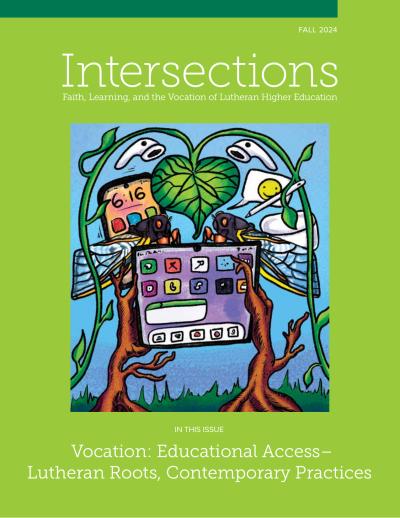 Editorial
From the Publisher: Reflections on the 2024 Vocational Leaders in Higher Education Conference
Lamont Anthony Wells
No. 60 · Fall 2024
Wells reflects on the 2024 VLHE Conference theme — “Educational Access: Lutheran Roots, Contemporary Practices” — tracing today’s commitment to inclusivity back to Martin Luther’s radical 16th-century insistence that both boys and girls be educated, and previews NECU’s expanded engagement of student leaders alongside faculty and administrators.
-
 Editorial
From the Publisher
Arne Selbyg
No. 27 · Spring 2008
Selbyg, retiring this summer as Director for ELCA Colleges and Universities, reflects on his decade serving as spokesperson between the church and its twenty-eight colleges and universities, and argues that the link between the colleges and the church has grown stronger over the last ten years — sustained by supportive church leaders like Presiding Bishop Mark Hanson, the annual Vocation of a Lutheran College conference, and a Lutheran theology of higher education whose principles (questioning authority, returning to the sources, including the excluded, serving the neighbor) remain a strong basis for operating colleges and universities in the twenty-first century.
-
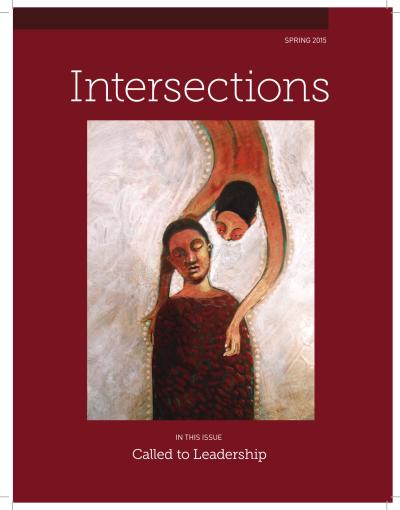 Article
Sharing Leadership within Colleges and Universities
Leanne Neilson
No. 41 · Spring 2015
Building on Jodock’s framework, Neilson applies vocational leadership to the unique work environment of higher education — mission statements, faculty governance, the slow pace of consensus, and the sometimes uneasy relationships between faculty and staff — and asks how leaders, followers, and team players can create an atmosphere of mutual empowerment on Lutheran college campuses.