During her opening remarks at the Radcliffe Institute’s January 2023 conference on “The Age of Roe: The Past, Present, and Future of Abortion in America,” Jane Kamensky, director of the Schlesinger Library on the History of Women in America at Harvard, articulated a hope for everyone attending to come away with new knowledge and fresh framing. That accurately captured why we were there, a professor of religion at a Lutheran college and the director for gender justice and women’s empowerment for the Evangelical Lutheran Church in America. We heard from over two dozen speakers in a dizzying array of professions and disciplines who covered a wide ideological spectrum: historians, political scientists, lawyers, nurses, medical doctors, global health activists, scholars of religion, ethicists, community organizers, and sociologists. There were Christians, Jews, Muslims, atheists, women and nonbinary people, men, and queer people, people who rejoiced when Roe v. Wade was overturned last summer, and people who likened it to a re-enslavement of women and pregnant people.
New knowledge about an issue that is among the most fraught and conflicted in American public life. Fresh framing for an experience that is among the most personal and intimate in a person’s life.
How will we collectively navigate a social, political, and religious landscape where access to reproductive health care is more limited now than it has been in fifty years? When the Supreme Court issued its decision in the case of Dobbs v. Jackson, it effectively eliminated access to safe and legal abortion care services in about half of the States that are anything but United on this issue.
Now what?
And, what do our respective roles in the Lutheran church and in Lutheran higher education have to do with whatever it is that comes next?
Caryn:
What I heard from the range of speakers throughout the two-day conference affirmed the need to equip more people for complex thought and community engagement. This is one way to encapsulate a goal of Lutheran higher education, which Rooted and Open declares as producing graduates who are “called and empowered to serve the neighbor so that all may flourish.” Reading that statement through the frame of reproductive justice in a post-Dobbs world calls my attention to the nature of “flourishing.”
“The conference affirmed the need to equip more people for complex thought and community engagement.”
SisterSong defines reproductive justice as “the human right to maintain personal bodily autonomy, have children, not have children, and parent the children we have in safe and sustainable communities.” Importantly, it addresses “intersecting oppressions. Audre Lorde said, ‘There is no such thing as a single-issue struggle because we do not live single-issue lives.’”1 In her panel remarks at the Radcliffe conference, Getty Israel, CEO of Sisters in Birth, described it as multifaceted, intersectional, and comprehensive. It requires attention to economic justice, racism, sexism, environmental justice, mass incarceration, violence, equity in health care, and many more things.
Additionally, University of California-Berkeley law professor Khiara Bridges reminded us that it has long been the case that black people obtain a disproportionate number of abortions in the United States. Rather than inaccurately frame it as some nefarious predatory plan, she noted that this results from a complex set of factors including disproportionate rates of poverty, unequal access to contraception, higher rates of intimate partner violence, and reproductive coercion.2 With many states now rendering healthcare more inaccessible, we will continue to see infant and maternal mortality and morbidity rates worsen.
Placing this in the context of our current carceral state, where, despite the fact that white people engage in criminalized behavior at the same rates, black and brown people are five times more likely to end up in the criminal justice system,3 Bridges noted an additional risk. The need for abortion care services will not vanish. The Dobbs decision and many states’ individual decisions to criminalize abortion make it more likely that women and pregnant people will engage in behavior that has been criminalized, and again, more likely to be swept into the incarceration system.
None of this is what I would call “flourishing.”
For me, hope looks like people who are empowered to think in more complicated ways. Where there isn’t one right and one wrong answer. Where multiple types of knowledge are needed to solve complex problems. Where individuals are empowered to discern while embedded in communities. Where women are trusted.
Much of this is reflected in educational and missional goals found in Lutheran colleges and universities. Liberal arts education insists on skills and knowledge that broaden a person’s sense of the world and of themselves. Depth of education found in a variety of majors offered at NECU institutions strengthens preparation for professions like medicine, law, education, ministry, and a host of other things. Dedicated community engagement experiences bring students and campuses into relationship with and knowledge about their neighbor’s actual needs so that they might continue to grow as leaders in the communities that they will call home. Studying and living in communities where religion matters, where the Lutheran tradition is one of the roots that grounds this very work, is a powerful resource in this new era.
“For me, hope looks like people who are empowered to think in more complicated ways.”
The call is here. Our job is to empower.
Now, what resources does this particular Lutheran church have when it comes to thinking about this particular issue of Abortion?
Mary:
As Caryn shares, multiple speakers called for the critical need to understand the total picture of reproductive justice when advocating and legislating specifically on abortion. As Khiara Bridges said, as a society, we must “respond to the structures within which people exist.” Only one of the three people who spoke overtly as Christian offered a complex perspective because of their faith. MT Dávila, an ethicist at Merrimack College, appealed to other Christians to privilege suffering. A theology of the cross, she said, compels us as Christians to discern Christian moral language and ethics through a deep understanding of patriarchy and racism and the effects of these sins in national history.
“Within national history, the social statement on Abortion offers a third way to approach reproductive justice and abortion specifically.”
This might seem like a task too big to begin now in Lutheran thinking and action. From my perspective, the hard work among Lutherans began just as the Evangelical Lutheran Church in America was forming. The 1991 ELCA Churchwide Assembly voted in favor of social teaching and policy on abortion in the form of a social statement. In the current historical moment, no matter our views on abortion, I think this church can rely on the ELCA social statement on Abortion to remember, renew, and advance a complex religious approach to reproductive justice so that all may flourish.
Within national history, the social statement on Abortion offers a third way to approach reproductive justice and abortion specifically. “A developing life in the womb does not have an absolute right to be born, nor does a pregnant woman have an absolute right to terminate a pregnancy” (2). It not only lays out the kind of total social and personal picture Khiara Bridges, Getty Israel, and others advocated at the conference, it claims no labeled position for this church—neither “’pro-choice’” nor “’pro-life.’”
Instead, it calls for, among other things, healthcare, childcare, birth control, and equitable pay (8). And it explains this church’s position on access to abortion: it should not be easily accessible after a certain point in pregnancies and should not be treated like birth control, yet it should be safe, legal, and accessible (4; 9-10).
In addition, this ELCA social statement aligns with much of what we heard from legal scholars and women’s health advocates at this conference—that women and girls should be the ones to make decisions about pregnancies in the context of their own lives and relationships. (See 5-6.)
The Evangelical Lutheran Church in America takes the analysis further through the social statement Faith, Sexism, and Justice: A Call to Action. It teaches that it is a Christian calling to foster social and religious beliefs, structures, and habits to provide what people need to flourish and that do not discriminate or control people based on sex and gender.
At the heart of the questions of fostering justice and being critical thinkers, as Caryn points out, are real people. ELCA social teaching and policy gives moral guidance to a church body whose theology says governments are intended to serve people for flourishing. Just like our faith formation instructs individual persons to serve neighbors, so does a Lutheran understanding of justice compel us to serve neighbors through advocacy. What should happen in church and society to serve, as Getty Israel, who founded a health clinic in Mississippi to improve birth outcomes said, the big picture of reproductive justice for all?
Conclusion
Not only do institutions that are part of this Network of ELCA Colleges and Universities have their own common calling upon which to lean, we have church teaching and policy and a theological rootedness that empowers us to engage in advocacy work, support members of our communities, and model complex thinking for the learners who live among us. So when it comes to new knowledge and fresh framing, we are already grounded in the gifts of this tradition, freed and empowered to serve our neighbors.
So that all may truly flourish.
Endnotes
1. SisterSong Inc., “About Reproductive Justice.” Online: https://www.sistersong.net/reproductive-justice. Accessed 2/2/23.
2. See Guttmacher Institute, “Abortion Rates by Race and Ethnicity” (2017). Online: https://www.guttmacher.org/infographic/2017/abortion-rates-race-and-ethnicity; See also the report from the Pew Research Center, “What the data says about abortion in the U.S.,” by Jeff Diamant and Besheer Mohamed. Online: https://www.pewresearch.org/fact-tank/2023/01/11/what-the-data-says-about-abortion-in-the-u-s-2/
3. Ashley Nellis, “The Color of Justice: Racial and Ethnic Disparity in State Prisons,” The Sentencing Project. Online: https://www.sentencingproject.org/reports/the-color-of-justice-racial-and-ethnic-disparity-in-state-prisons-the-sentencing-project/. Accessed 2/2/23.
-
 Editorial
From the Publisher: Introduction and Invitation
Lamont Anthony Wells
Wells introduces himself as the new Executive Director of NECU, succeeding Rev. Dr. Mark Wilhelm, and frames this Spring issue as a passionate response to the crises facing higher education amid threats to academic freedom and the well-being of educators.
-
Editorial
From the Editor: Vocation [in] Disruption
Colleen Windham-Hughes
Windham-Hughes introduces the issue’s theme — vocation amidst disruption — previews new features including contributor contact information, a study guide for So That All May Flourish, and invited pieces on reproductive rights, and shares results from the Fall survey of readers.
-
Institutional Focus
So That All May Flourish Study Guide
A chapter-by-chapter study guide to So That All May Flourish (Fortress Press 2023), a new volume by NECU authors that develops the central tenet of “Rooted and Open” and offers discussion questions for use in orientation programs, classes, workshops, task forces, and professional development settings.
-
Reflection
“Miracles are no longer required”—Life Writing as a Healing Tool
Barbara Reul
A music historian and cancer survivor chronicles how a uterine cancer diagnosis in the early months of the COVID-19 pandemic disrupted her vocation as a university professor, and how writing two open-access memoirs became an unexpected tool for healing body, mind, and soul.
-
Article
The Power of Ritual Action and George Floyd Square
Mary Clare Tiede Hottinger
A California Lutheran University senior examines how George Floyd Square in Minneapolis has been transformed into sacred space through ritual action, and considers what this site of remembrance, mourning, and ongoing struggle for justice can teach us about the power of ritual to unify and sustain community.
-
Reflection
Be Like Jesus: Flip Some Tables
Jessica Easter
Easter argues that the example of Jesus overturning the moneychangers’ tables in Matthew 21 calls Christians not to work within unjust systems but to disrupt them — and that this table-flipping must be done in community with others who share the vision of a world where all are seen, heard, and valued.
-
Article
Necessary Disruptions: Centering Vocation in the Common Good
Erin VanLaningham
VanLaningham previews the forthcoming NetVUE volume Called Beyond Our Selves: Vocation and the Common Good, arguing that vocation, common, and good all need to be disrupted and expanded so that students might arrive at a wider sense of individual purpose and collective well-being.
-
Article
Where Disruption and Vocation Meet: One Path Toward Teaching Reproductive Justice in Challenging Times
Lena R. Hann
Hann recounts how a missed math class in her first college term led her into volunteer work at a feminist abortion clinic and ultimately a career in public health, and describes how she designed and taught a Reproductive Justice immersive term course at Augustana College through the disruptions of COVID-19, George Floyd’s murder, and the Dobbs decision.
-
Article
The Duty to Teach and Restore Bodily Autonomy: Reflections from the Classroom
Cynthia Richards
Richards reflects on a Narrative Medicine course she taught at Wittenberg University in the wake of the Dobbs decision, in which students examined cultural “first recognitions” of the reproductive body and discovered that almost none had ever had a way of talking openly about their reproductive selves — an alienation she calls educators to address.
-
Article
Turning to a Reproductive Justice Framework for Inclusive Dialogue across Differences
Jenny M. James
James makes the case that a reproductive justice framework, rooted in the work of black feminist scholars and activists, gives educators tools to overhaul polarized pro-choice/pro-life conversations and to host inclusive dialogues across differences of race, sexuality, gender identity, and faith.
-
Article
A Reconsideration of the Political Approach to Abortion
Sophia Cruz Ponce
Cruz Ponce argues that the pro-life versus pro-choice binary distracts from the underlying social factors that lead to unwanted pregnancies, and proposes a reframed political approach focused on mandated sex education, free contraception, and crisis pregnancy centers that address the social, political, and economic barriers women face.
-
Article
Take Heart: Is Neutrality Really What We Need Right Now?
Abbylynn Helgevold
Helgevold, an ethicist at Wartburg College, argues that calls for faculty neutrality on abortion in the post-Roe classroom stifle the courageous conversations Lutheran higher education is uniquely positioned to host — conversations grounded in “Rooted and Open” and the ELCA’s 1991 Social Statement on Abortion.
-
 Institutional Focus
So That All May Belong: Lutheran Roots for Diversity, Equity, Inclusion, and Justice
Altheia Richardson, Angie Hambrick, Caryn Riswold, Colleen Windham-Hughes, Deanna Thompson, Marcia Bunge, Robert Clay
No. 61 · Spring 2025
22 min audio
The full NECU statement grounds DEIJ work in Luther’s 16th-century reforms and Lutheran theological claims about the image of God, equal dignity, and the limits of human knowing — offering definitions, Lutheran roots, and calls to action for diversity, equity, inclusion, and justice, with belonging as the outcome of DEIJ at work.
-
Institutional Focus
Scriptures That Inspire Work for Diversity, Equity, Inclusion, and Justice
Altheia Richardson, Angie Hambrick, Caryn Riswold, Colleen Windham-Hughes, Deanna Thompson, Marcia Bunge, Robert Clay
No. 61 · Spring 2025
9 min audio
A companion list of biblical verses — from Genesis 1:27 and Galatians 3:28 to Micah 6:8 and Luke 4:18-19 — that grounded NECU’s drafting of So That All May Belong, organized by the four DEIJ commitments and offered as an invitation to share other texts that ground and sustain the work.
-
Institutional Focus
So That All May Belong: Lutheran Roots for Diversity, Equity, Inclusion, and Justice [abridged]
Altheia Richardson, Angie Hambrick, Caryn Riswold, Colleen Windham-Hughes, Deanna Thompson, Marcia Bunge, Robert Clay
No. 61 · Spring 2025
8 min audio
A condensed version of the NECU statement that consolidates Lutheran theological grounding for DEIJ and a single combined call to action for Lutheran colleges and universities — offered as a shareable summary alongside the complete document.
-
 Article
Committed to Paradox
Caryn Riswold
No. 60 · Fall 2024
Riswold lifts up paradox — saint and sinner, lord and servant, Rooted and Open — as a distinctive Lutheran root that lets institutions honor the complicated truth of who their students are and embrace the messy, ever-reforming work of access and accessibility as a theology of the cross.
-
 Article
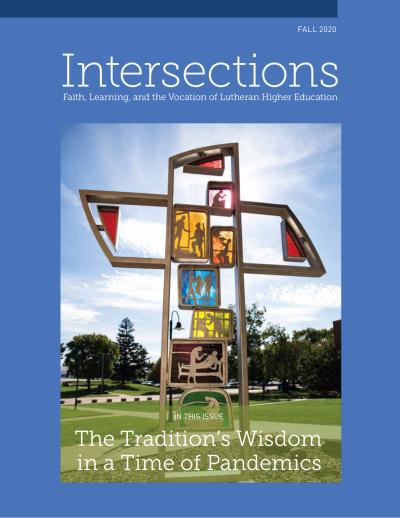
A New Image for an Ancient Call: Lutheran Higher Education Amidst Pandemics Today
Caryn Riswold
No. 52 · Fall 2020
Pairing Wartburg’s Lebenskreuz sculpture with the Matthew 25 acts of mercy and the commitments of Rooted and Open, Riswold reads the calls to feed the hungry, welcome the stranger, and care for the sick as urgent summons for Lutheran higher education in a year of overlapping pandemics — and as a call to dismantle the structures that produced them.
-
 Article
The Vocation of White People in a Racist Society
Caryn Riswold
No. 50 · Fall 2019
Riswold proposes that whiteness is a weakness borne of apathy, atrophy, and ignorance — an atrophied muscle of race-consciousness — and offers concrete practices (reading, adjusting one’s gaze, consuming media differently, drawing on ELCA social statements like the repudiation of the Doctrine of Discovery) for exercising that muscle and naming the vocation of white people in a racist and white supremacist culture.
-
Article
Creation, Justice, and Communio: Lutheran Insights Empowering Educational Access
Mary Elise Lowe
No. 60 · Fall 2024
In her VLHE keynote, Lowe names three Lutheran commitments — continuing creation, neighbor justice, and communio — as the “why” that empowers ELCA colleges and universities to pursue equitable access for students often left behind by persistence and graduation gaps.
-
 Reflection
Calling and Learning: On Losing and Then Finding Myself
Rachel Hammond
No. 9 · Summer 2000
Hammond, a Capital University junior who spent two semesters studying in Guayaquil, Ecuador, recounts watching the sucre collapse from 10,500 to 29,000 per dollar between September and January, the overthrow of President Jamil Mahuad, the freezing of bank accounts over $4,000, the threatened eruption of the volcano at Baños, and her work at an orphanage that needed only $6.81 to feed a child for a month—and calls her fellow students, in light of Elie Wiesel’s warning that indifference is the enemy, to recognize their education as a gift and a responsibility to speak for those who cannot speak for themselves.
-
 Response
Feeling at Home: Dimensions of Faculty Life
Jane Hokanson Hawks
No. 2 · Winter 1997
Hawks of Midland Lutheran College responds to Bouman by reflecting on her path from a Lutheran childhood through the BSN at St. Olaf and thirteen years at four non-church-related institutions to her present home at Midland, where teaching at a Lutheran institution finally feels “right.” Bouman’s framing of the five themes as the Lutheran argument about what it means to be human helped her ad-hoc committee articulate the spiritual role in Midland’s new faculty mentoring program (recently funded by the Lilly Foundation), and grounds her work as a nurse educator confronting the daily humanness of grief, joy, ethical dilemmas, and care across cultural and religious difference.
-
 Editorial
From the Publisher
Arne Selbyg
No. 6 · Winter 1999
Selbyg reports on the work of the Division of Higher Education and Schools to focus what makes Lutheran colleges and universities distinctive, recaps the 1998 Vocation of a Lutheran College conference at Wittenberg, previews the 1999 Susquehanna conference on “Identity and Fragmentation: Can the Lutheran Center hold?” (inspired by Yeats’s vision of the Second Coming), commends Ernest Simmons’s Lutheran Higher Education: An Introduction for Faculty (Augsburg Fortress, 1998), and announces a new NEH/NSF-style initiative called “The Lutheran Academy of Scholars in Higher Education.”
-
 Article
Leading Students to Distinguish Between Career and Vocation: Reflections from a Lutheran Law School
Steven C. Bahls
No. 20 · Fall 2004
Bahls, writing as former dean of the Capital University Law School, argues that most law students and many legal educators confuse vocation with career—asking “what kind of lawyer do you want to be?” rather than “who do I want to be?” Drawing on John O. Mudd’s five attributes of a well-prepared lawyer and Susan Daicoff’s empirical research on lawyer dissatisfaction and the “amoral professional role,” he turns to Ernest L. Simmons’s and Darrel Jodock’s articulations of Luther’s understanding of vocation and proposes five steps—reflection, assessment, vision, integrative thinking, and reassessment—along with explicit leadership from law school deans, engagement of career services offices, and leadership within the profession (illustrated by Capital’s joint venture with the Columbus Bar Association).
-
 Article
Negotiating Legitimate and Conflicting Values
Eboo Patel, Katie Bringman Baxter, Mark S. Hanson
No. 44 · Fall 2016
In a closing-day conversation at the 2016 Vocation of a Lutheran College Conference, Mark Hanson and Eboo Patel — moderated by Katie Bringman Baxter of Interfaith Youth Core — share case studies in which legitimate religious values come into tension with one another, and make the case that Lutheran colleges should teach interfaith leadership through the hard cases rather than the easy ones.