If in early 2020 someone had told me—a healthy, extroverted, middle-aged music historian with a sunny disposition and wicked sense of humor—that a global pandemic and a sudden medical diagnosis would disrupt my vocation as a busy university professor, I would have laughed out loud.
I will not forget Friday, March 13, 2020, because my work life would be turned upside down: “You have four days to move all your classes online.”
But that day pales against July 31, 2020, when I received a uterine cancer diagnosis out of the blue: “You will need surgery immediately, followed by chemotherapy and radiation treatments since the cancer has already spread,” my medical team informed me.
“God sure has a sense of humor,” I remember thinking.
Or was this some kind of sick joke, given that my life as I knew had just been put on hold for no apparent reason? And how could I be so ill, given that I felt full of energy?
“It’s not your fault,” said the three (breast) cancer survivor-friend-colleagues who quickly rallied around me. Random mutations were the single biggest factor in causing cancer, they pointed out—not a poor diet, or exposure to chemicals, or inherited genes. They also assured me that I would not have to go through this ordeal by myself and predicted that the pandemic would likely be over by Christmas.
They were wrong on both counts.
“If in early 2020 someone had told me—a healthy, extroverted, middle-aged music historian with a sunny disposition and wicked sense of humor—that a global pandemic and a sudden medical diagnosis would disrupt my vocation as a busy university professor, I would have laughed out loud.”
As a non-partnered and soon to be immunocompromised individual, welcoming “visitors from away”—which was code for my family who lived thousands of miles away in Germany and elsewhere—was out of the question. As a result, I had to rely on my “family in town” to get me through surgery and seven months of cancer treatments while COVID-19 held the rest of the world in check.
A trusted neighbor who had lost her husband to cancer years ago immediately volunteered to be my “go-to, in-house person.” When I returned from hospital, a close friend and fellow academic interrupted her research sabbatical to look after me for a week. It was her idea that I keep a diary to document my health journey and enlist the help of “walking buddies” to get my strength back.
To that end, several members of my “work family” brought along their beloved pets for walks around the lake that is near my house. One of them, Winston, the Miniature Schnauzer, quickly turned into a therapy dog of sorts for his “favorite auntie” Barb.
Spending time with him (and the rest of my walking buddies) almost made me forget how much I missed being in the classroom and working on various research projects. At the same time, I felt sorry for my colleagues who struggled with reinventing themselves online (see their “Stories from the Pandemic Podium” in the Winter 2022 issue of Impetus, Luther College at the University of Regina’s online magazine).
As time went on, managing side effects became increasingly difficult. Severe fatigue, insomnia, hair loss, and weight gain (who knew?) wreaked havoc with my body and psyche. But it was “chemo brain”, a medically induced state of permanent brain fog, that made me wonder whether this was perhaps the tragic end to my very own “from rags to riches” tale.
It had begun in 1986, when a set of 18-year-old orphaned twins from Germany emigrated to the West coast of Canada to join family and build a new life. Mine had been a mostly stable ride with many blessings for which I—who would likely never have attended university, let alone become an academic if I had stayed back—was more than grateful.
A Special Task
Imagine my surprise when I was woken up in the middle of the night on February 23, 2021: my inner guidance system had an important message for me. For the record, the latter has contacted me, a woman of strong faith, in the form of a distinguished looking male with a top hat for many years. I consider him my very own “angel of intuition”, despite the lack of wings.
“Write down your cancer story,” he said with a serious tone.
Forty-five minutes later, I was staring at a Table of Contents for a book manuscript that provided an autobiographical snapshot of sorts. This type of automatic or channeled writing did not really surprise my inner scholar who often benefits from it while carrying out research and preparing publications.
What was new, however, was the thought of “Dr. Barb” writing a non-academic book that focused on, of all things, herself!
In the past, I had excelled in shedding scholarly light on the lives and works of German court musicians from the distant past (who were all named Johann, of course). Inviting perfect strangers into my inner world, therefore, frightened me, or, more precisely, my inner child. She would have given anything to turn the clock back to when life was “normal.”
Instead, she watched “Zombie Barb” emerge after six rounds of chemotherapy and haunt me through 28 pelvic radiation therapy treatments (“Stock up on toilet paper!”).
Thankfully, the journal I had kept ever since my surgery and my—admittedly sometimes somewhat foggy—memory were the only primary sources I needed to consult during the three months that it took me to finish the first complete draft of my memoir.
Did I feel exhausted, drained, and weepy on most of my writing days? Yes, especially during the copy-editing stage which turned out to be a special type of authorial hell.
The thought that my recollections would make a welcome and valuable addition to a colleague’s English literature class on illness narratives energized me enough to keep going, however. Not only that: it also fueled my desire to make my memoir highly entertaining, laugh-out-loud funny.
After all, I had survived a killer “balcony scene” triggered by hot flashes from “chemo hell” instead of my very own Romeo. The latter would undoubtedly have enjoyed watching me strip down to my birthday suit before stepping outside and basking in the moonlight for several glorious minutes on a super-cold, but beautifully starry night.
I also figured that readers would want to know more about a piece of “pelvic homework” (for lack of a better term) that had been assigned to my new alter-ego, “Barb 2.0.” After treatments had ended, she would have to carry out an activity several times a week for an entire year (!) that involved a decidedly unattractive vaginal stretching device.
“You will need to begin on April 2, 2021,” my medical team emphasized.
“Good Heavens,” I replied after checking the calendar on my phone. “That’s Good Friday.”
Enough said.
An Unexpected Gift at a Perfect Time
Whenever someone asked me about my life priorities before my diagnosis, I would jokingly refer them to a cute German poem of unknown origin. Its speaker, in my mind, is an alluring mixture of Supergirl and Professor McGonagall. The poem reads as follows in English:
The impossible we attend to immediately.
Miracles take a little longer.
Upon request, witchcraft will be used.
In my case, it was the last line of the poem—an unwavering belief in a higher power and the loving support of my family, friends, and church community—that helped me navigate uncharted territory successfully.
The most unexpected gift, or “miracle” if you will, was the realization that writing about myself would help my body, mind, and soul heal on multiple levels.
To my great delight, Perfect Timing: Recollections of Coping with Cancer During a Pandemic was published in December 2021 as an open educational resource. My target audience were individuals who had previously been touched by a critical illness, including caregivers and friends of cancer survivors, as well as health professionals, and fellow members of the university community, to name but a few.
In March 2022, I visited the English literature class in which my brand-new memoir had been assigned as a required reading. From what I could tell, the decision to chronicle my—apparently never dull—health journey had made a favorable impression on the students and the instructor.
“Since writing the book and thinking more about it, how have the categories of impossible, miracles, and witchcraft, shifted—what are they now?” my colleague asked.
To my complete surprise, “Barb 2.0” provided the answer without hesitation.
I attend to the possible today.
Miracles are no longer required.
Witchcraft, that is prayers, are used daily to keep me going.
“You should have these three lines tattooed on your forehead or some other place of your anatomy that’s hard to miss,” my top-hatted guide promptly suggested, albeit only in my head.
I opted instead for writing a sequel. I figured that it would allow my inner wise woman/stand-up comedian to document what happened during the year of healing I spent near family who live on Vancouver Island off the West Coast of Canada.
The new book, Right on Time: Healing from Cancer During a Pandemic, has multiple “life echoes,” as I like to call them, woven into its narrative fabric. Specifically, I touch upon my childhood and teenage years in Bavaria, Germany, and my early formative years as a new immigrant to Canada. My cast of characters in the sequel include both familiar ones (if you have read Perfect Timing) and new, fascinating ones (if you have not), both real and imagined, top-hats and other accessories included. Some of these individuals (spoiler alert!) also experience a “karmic course correction” of their own alongside yours truly.
In hindsight, my two autobiographical efforts to date have taught me the same, unforgettable lesson. What appeared to be a disruption of my vocation as a university professor turned out to be something different altogether—a recent cancer survivor’s call to action, that is, to share her personal story with others.
To that end, I hope to see Right on Time through to publication in 2023 on the same open access platform as its predecessor. Given that my energy level has never been the same since my diagnosis, and I have made a (more or less) triumphant return to the campus I left in March 2020, it will likely take me longer than anticipated.
That is okay though. Miracles are no longer required in my world.
-
 Editorial
From the Publisher: Introduction and Invitation
Lamont Anthony Wells
Wells introduces himself as the new Executive Director of NECU, succeeding Rev. Dr. Mark Wilhelm, and frames this Spring issue as a passionate response to the crises facing higher education amid threats to academic freedom and the well-being of educators.
-
Editorial
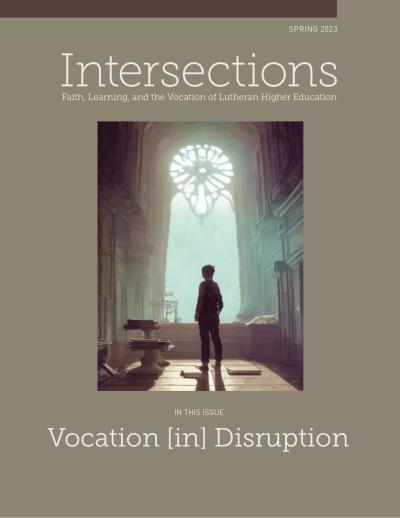
From the Editor: Vocation [in] Disruption
Colleen Windham-Hughes
Windham-Hughes introduces the issue’s theme — vocation amidst disruption — previews new features including contributor contact information, a study guide for So That All May Flourish, and invited pieces on reproductive rights, and shares results from the Fall survey of readers.
-
Institutional Focus
So That All May Flourish Study Guide
A chapter-by-chapter study guide to So That All May Flourish (Fortress Press 2023), a new volume by NECU authors that develops the central tenet of “Rooted and Open” and offers discussion questions for use in orientation programs, classes, workshops, task forces, and professional development settings.
-
Article
The Power of Ritual Action and George Floyd Square
Mary Clare Tiede Hottinger
A California Lutheran University senior examines how George Floyd Square in Minneapolis has been transformed into sacred space through ritual action, and considers what this site of remembrance, mourning, and ongoing struggle for justice can teach us about the power of ritual to unify and sustain community.
-
Reflection
Be Like Jesus: Flip Some Tables
Jessica Easter
Easter argues that the example of Jesus overturning the moneychangers’ tables in Matthew 21 calls Christians not to work within unjust systems but to disrupt them — and that this table-flipping must be done in community with others who share the vision of a world where all are seen, heard, and valued.
-
Article
Necessary Disruptions: Centering Vocation in the Common Good
Erin VanLaningham
VanLaningham previews the forthcoming NetVUE volume Called Beyond Our Selves: Vocation and the Common Good, arguing that vocation, common, and good all need to be disrupted and expanded so that students might arrive at a wider sense of individual purpose and collective well-being.
-
Article
Where Disruption and Vocation Meet: One Path Toward Teaching Reproductive Justice in Challenging Times
Lena R. Hann
Hann recounts how a missed math class in her first college term led her into volunteer work at a feminist abortion clinic and ultimately a career in public health, and describes how she designed and taught a Reproductive Justice immersive term course at Augustana College through the disruptions of COVID-19, George Floyd’s murder, and the Dobbs decision.
-
Article
The Duty to Teach and Restore Bodily Autonomy: Reflections from the Classroom
Cynthia Richards
Richards reflects on a Narrative Medicine course she taught at Wittenberg University in the wake of the Dobbs decision, in which students examined cultural “first recognitions” of the reproductive body and discovered that almost none had ever had a way of talking openly about their reproductive selves — an alienation she calls educators to address.
-
Article
Turning to a Reproductive Justice Framework for Inclusive Dialogue across Differences
Jenny M. James
James makes the case that a reproductive justice framework, rooted in the work of black feminist scholars and activists, gives educators tools to overhaul polarized pro-choice/pro-life conversations and to host inclusive dialogues across differences of race, sexuality, gender identity, and faith.
-
Article
A Reconsideration of the Political Approach to Abortion
Sophia Cruz Ponce
Cruz Ponce argues that the pro-life versus pro-choice binary distracts from the underlying social factors that lead to unwanted pregnancies, and proposes a reframed political approach focused on mandated sex education, free contraception, and crisis pregnancy centers that address the social, political, and economic barriers women face.
-
Article
Take Heart: Is Neutrality Really What We Need Right Now?
Abbylynn Helgevold
Helgevold, an ethicist at Wartburg College, argues that calls for faculty neutrality on abortion in the post-Roe classroom stifle the courageous conversations Lutheran higher education is uniquely positioned to host — conversations grounded in “Rooted and Open” and the ELCA’s 1991 Social Statement on Abortion.
-
Article
Views on Flourishing After the Age of Roe
Caryn Riswold, Mary J. Streufert
Riswold and Streufert reflect on the Radcliffe Institute’s January 2023 conference “The Age of Roe” and argue that the ELCA’s 1991 Social Statement on Abortion and its 2019 statement Faith, Sexism, and Justice offer Lutheran higher education a third way to approach reproductive justice grounded in serving the neighbor so that all may flourish.
-
 Article
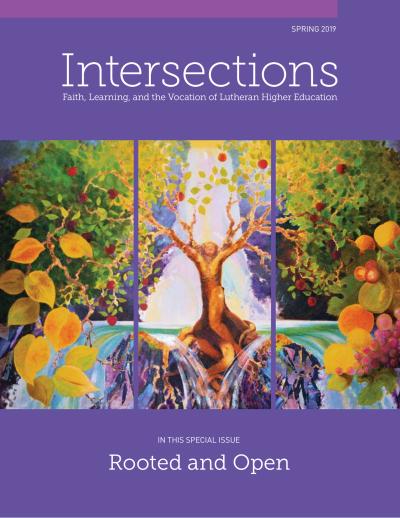
Roots and Shoots: Tending to Lutheran Higher Education
Jason A. Mahn
No. 49 · Spring 2019
Mahn revisits why “education-for-vocation” has become a leitmotif for the 27 NECU schools, distinguishes institutional vocation from individuals’ religious identities and educational priorities from their theological grounding, and offers a friendly critique of Jodock’s bridge metaphor: Lutheran colleges grow in two directions like plants — deep roots and wide branches alike require constant tending.
-
 Editorial
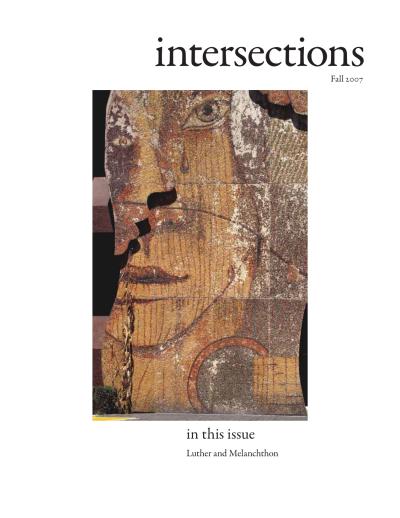
From the Publisher
Arne Selbyg
No. 26 · Fall 2007
Selbyg notes that, while a stated purpose of Intersections over its twelve years and twenty-six issues has been the intersection of faith, learning, and teaching, surprisingly few articles have addressed how Lutheran faculty teach and why — and credits the editor for assembling essays from authors whose teaching has benefited from the ELCA Wittenberg Center, on the eve of the City of Wittenberg’s “Luther Decade” leading up to the 2017 Reformation anniversary.
-
 Book Review
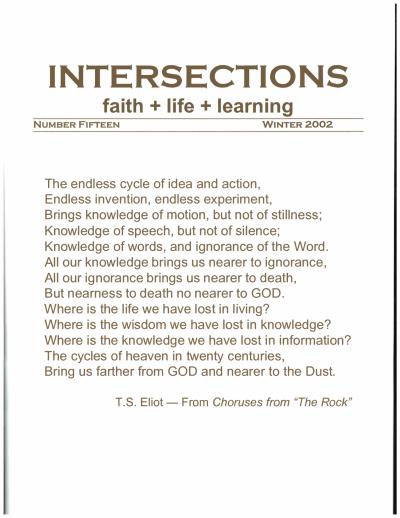
Paul Dovre, ed.: The Future of Religious Colleges
Baird Tipson
No. 15 · Winter 2002
Tipson, president of Wittenberg University, reviews Paul Dovre’s edited proceedings of the October 2000 Harvard Conference on the Future of Religious Colleges (Eerdmans, 2002), summarizing essays by Douglas Sloan on the failure of the “two-realm theory of truth,” George Marsden on faith-shaped scholarship, DeAne Lagerquist, Father David O’Connell, Mark Noll, Robert Benne, Mark Roche on Notre Dame, Joel Carpenter on neo-Calvinist Kuyperianism, and Mark Schwehn on a Lutheran “college-related church” and the centrality of vocation. Against Benne’s suggestion that only two or three robustly Lutheran colleges can be sustained, Tipson defends a less robust but still authentically Lutheran model embodied at places like Wittenberg, Gettysburg, and Roanoke, arguing for the enlightenment commitment to subjecting all truth claims to rigorous criticism and for hiring Marsden-style faith-shaped scholars rather than counting Lutheran heads.
-
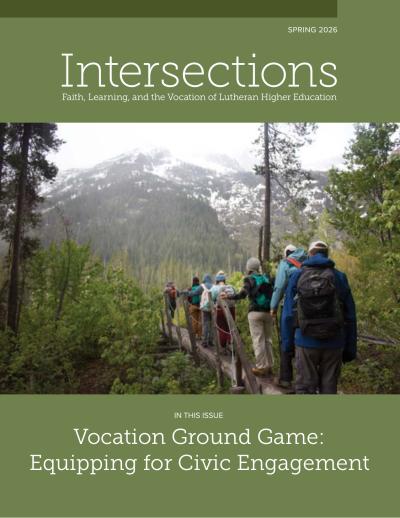 Article
An Ecosystem of Democracy
David Thomason
No. 63 · Spring 2026
6 min audio
Thomason argues that faith-based institutions should equip students not to dominate the public sphere with their convictions but to cultivate an “ecosystem of democracy” — pursuing universal values with virtue and tolerance while acknowledging humanity’s incomplete grasp of truth.
-
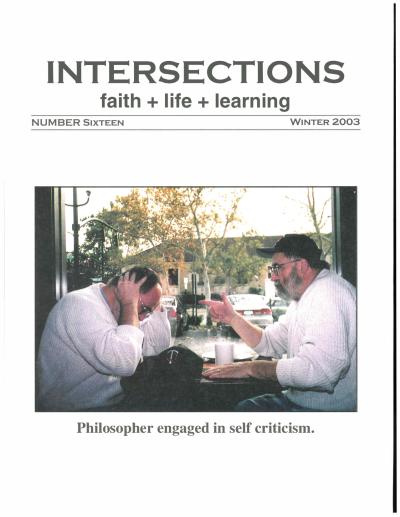 Article
Writing Toward the Night Complete: Teaching and Working at the Public, Secular Institution
Bruce Allen Heggen
No. 16 · Winter 2003
Heggen, Lutheran Campus Ministry pastor and adjunct English professor at the University of Delaware, builds on a freshman’s essay closing line—“All in all our night was complete”—to argue that even in the secular public university one can “teach hope” as a critical principle by drawing on Douglas John Hall’s Heideggerian distinction between calculative and meditative thought, the Frankfurt School’s instrumental versus substantialist reason, Luther’s theology of the cross, Parker Palmer’s “obedience to truth,” bell hooks, Lionel Basney, Shelley Shaver, and Donald Sheehan’s Frost Place “principle of compassion.” The classroom and Lutheran campus ministry together can become “communities of memory and hope” that, like the artist student’s Fourth of July, hold together danger, people getting together, explosions, and lots of fun.
-
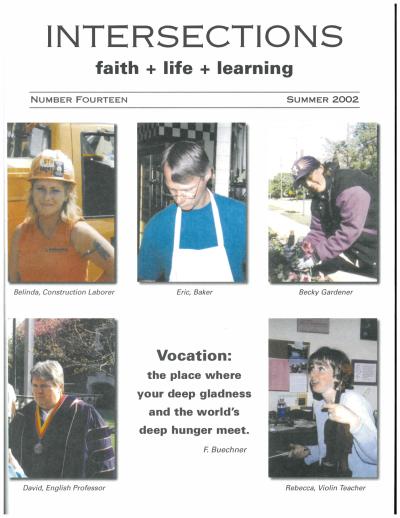 Article
Martin Luther, Vocation, and Church Colleges: Nurturing Future Leaders for Faith and Community
Richard W. Rouse
No. 14 · Summer 2002
Rouse, citing Arne Selbyg’s statistic that thirteen of sixteen newly elected ELCA bishops graduated from a Lutheran college (and 49 of 65 in the new Conference of Bishops), argues that ELCA colleges are training grounds for future church and community leaders because of Luther’s doctrine of the priesthood of all believers and his distinction between vocation and station—the basis of PLU’s motto “educating for lives of service, inquiry, leadership, and care.” He describes “Paths Unknown: Where is God Leading Me?” a Western Mission Cluster collaboration of California Lutheran, Luther Seminary, Pacific Lutheran Theological Seminary, PLU, and Trinity Lutheran College that used a dedicated web site (godleading.com), a January-February 2001 online virtual forum reaching over 300 participants in 40 states and Canada and Mexico, and one-day interactive video workshops featuring Trump’s play “Holy Odors,” and reports LECNA’s Reclaiming Lutheran Student Project findings on teaching, community, and faith integration at Lutheran schools.