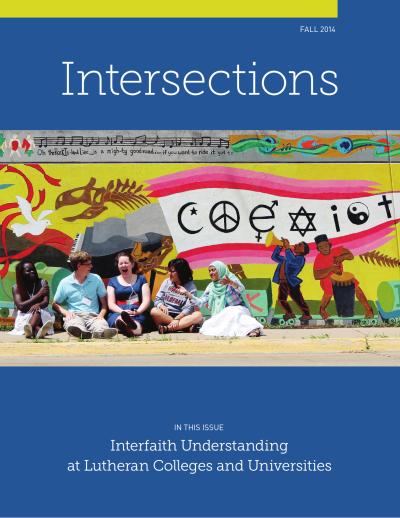
As many of us can attest to, there is a lot of “buzz” about interfaith engagement on our campuses. As we reflect on the themes and questions of “What does it mean to be interfaith?,” we can’t help but hear the questions of “What does it mean to be a Lutheran College” echoed in the same question.
Two anecdotes as further background: First: two years ago, we attended a conference on Interfaith Engagement on college campuses. In one session, we heard a powerful personal story from a Sikh student also attending the conference. With bold pride, he explained to us how the Jesuit values of his university enabled him to be welcomed, accepted, and invited to fully participate as a Sikh on his own campus. This conference began a thought process for us: What would it sound like to hear a non-Lutheran or non-Christian student articulate with bold confidence the Lutheran identity of his or her college as a foundation for a thriving, welcoming, and religiously diverse community? What story could we collectively share as a group of ELCA colleges that might be surprising to “outside” observers?
A second anecdote: A new faculty member visiting campus before moving to Rock Island met with us. As excited as she was to be on campus, she shared that she had “Googled” the definition of a Lutheran, a Lutheran College and other items she had read about on the college website. As a non-Christian, she was happy and surprised to learn of and be invited to think about the role of interfaith initiatives on the Augustana campus. She also did not know what a college chaplain was and was very interested to learn about the role of a chaplain. She said, “I wondered if these things I read about only concerned the history of the college and had nothing to do with the present or the future.”
We imagine there are many similar experiences among our 26 ELCA colleges and universities. In response to a growing movement of interfaith initiatives on campuses such as the White House sponsored President’s Interfaith and Community Service Campus Challenge, it seemed there could be a unique opportunity for the colleges and universities of the ELCA to bring students, faculty, staff and chaplains together to explore the central question of why a Lutheran College is compelled to be a part of an interfaith movement because of our unique heritage, identity, and core values.
At the invitation of Augustana president Steve Bahls, we began exploring the design of such a conference with the various constituent groups above. In June of 2014, Augustana College in Rock Island hosted the first Interfaith Understanding Conference for ELCA Colleges and Universities. Grounded in the question, “What does it mean to be Interfaith at a Lutheran College?,” presidents, students, faculty and chaplains from 17 of the 26 colleges and universities gathered as cohort groups. Participants not only engaged in dialogue, but also in planning for and implementing these types of interfaith partnerships on campus. Throughout the conference we heard from excellent scholars, students, faculty, and chaplains of various religious and non-religious identities as well as from ELCA Presiding Bishop Elizabeth Eaton and other community partners in this work.
We are grateful for the many people who helped make the conference possible, including Mark Wilhelm and Kathryn Lohre from the ELCA Churchwide Organization, President Steve Bahls of Augustana College, the conference planning team, staff of Interfaith Youth Core and the Pluralism Project at Harvard University, and all of the attendees who offered their full participation in the conference. Many of the reflections, including the keynote addresses by Jason Mahn, Eboo Patel, and Bishop Elizabeth Eaton, are captured in the pages of this journal. But perhaps what stands out the most for us in the months since the conference is how this kind of conference was a living, breathing example of the praxis of what it means to be a part of a Lutheran college in the twenty-first century.
-
 Editorial
From the Publisher
Mark Wilhelm
Wilhelm draws a parallel between the rediscovery of vocation and the rediscovery of interfaith understanding in Lutheran higher education, arguing that previously under-emphasized aspects of the Lutheran tradition point us to interfaith work and that an authentic Lutheran college or university will make interfaith understanding a feature of its mission.
-
Article
Vocational Re-Formation for a Multi-Religious World
Elizabeth Eaton
ELCA Presiding Bishop Elizabeth Eaton frames vocational formation for a multi-religious world as one of the most significant challenges facing the church and the liberal arts today, calling ELCA colleges and universities to live into Darrell Jodock’s “third path” that is both deeply rooted and dialogical.
-
Article
Why Interfaith Understanding is Integral to the Lutheran Tradition
Jason A. Mahn
Mahn returns to the root of the Lutheran tradition — church, theology, and pedagogy — to argue that interfaith encounter is not the vanishing point of Lutheran identity but central to it, beginning with confession of Luther’s anti-Judaic legacy, working through the typology of exclusivism / inclusivism / pluralism, and showing how the kenotic Christ and the theologian of the cross open Lutherans to authentic encounter with religious others.
-
Article
What it Means to Build the Bridge: Identity and Diversity at ELCA Colleges
Eboo Patel
Through the contrasting stories of two college students — Cassie’s identity relativism and April’s soft fundamentalism — Patel diagnoses Peter Berger’s twin pathologies of modernization and argues that ELCA campuses, anchored in Bonhoeffer and the Lutheran capacity to “have faith without laying claim to certainty,” are uniquely equipped to be places where the light falls: bridges of cooperation that nurture both strong religious identity and benevolence toward others.
-
Reflection
Danya Tazyeen
Danya Tazyeen
Tazyeen, a Pakistani-American Muslim student at Augustana College, reads Qur’an 49:13 — that God made us into peoples and tribes “that you may know one another” — as a charge to break down fear with open dialogue and to see one another as flawed and relatable fellow human beings.
-
Article
Building on a Firm Foundation: ELCA Inter-Religious Relations
Kathryn M. Lohre
Lohre traces the ELCA’s twenty-year arc of inter-religious work — from the 1994 Declaration to the Jewish Community and the Lutheran-Jewish Consultative Panel, through the post-9/11 Lutheran-Muslim Panel and the Shoulder to Shoulder Campaign, to fledgling dialogue with Sikhs and the dharmic traditions — and frames Lutheran inter-religious engagement as the strengthening, not the dilution, of Lutheran vocation.
-
Article
Building an Interfaith Bridge
Belle Michael
Drawing on the holiday of Shavuot, the Book of Ruth, and Martin Buber’s I-Thou, Rabbi Belle Michael picks up Patel’s bridge metaphor and identifies three building blocks for it: experiences with people of different ethnic and religious groups, genuine and long-lasting relationships, and the holy curiosity to ask the questions we are otherwise afraid to ask.
-
Reflection
Gifty Arthur
Gifty Arthur
Reading John 10:3 as a Ghanaian Christian student at Luther College, Arthur reflects on how Luther’s Journey Conversations have deepened her own spirituality precisely by giving room for students to share the personal experiences and beliefs at the center of their own traditions.
-
Article
Journey Toward Pluralism: Reimagining Lutheran Identity in a Changing World
Jacqueline Bussie
Bussie chronicles Concordia College’s Forum on Faith and Life initiative — assessing campus climate, building a President’s Interfaith Advisory Council, and drafting a one-sentence statement that Concordia practices interfaith cooperation “because of” (not “guided by”) its Lutheran identity — to argue that simul justus et peccator thinking equips Lutheran institutions to hold loyalty to tradition and reverence for others together as one piece.
-
Reflection
David Kamins
David Kamins
Kamins, a Jewish student at Muhlenberg College, reads Rabbi Joseph Soloveitchik’s The Lonely Man of Faith alongside his own journey at the Interfaith Understanding conference on the eve of Shavuot, finding in the dual figures of Adam I and Adam II a way to remain firmly grounded in his faith community while going out to learn from those around him.
-
Article
What's in a Name?
Matthew J. Marohl
St. Olaf College Pastor Matt Marohl tells the story of designing The Undercroft’s prayer and meditation room with a campus meditation group whose members began as “Matt” and ended — as their mutual respect grew — calling him “Pastor Matt,” a counterintuitive movement toward a more formal address that signals what intentional Lutheran-Christian hospitality looks like in practice.
-
Reflection
Annie Schone
Annie Schone
Schone, raised in a small conservative Central Illinois congregation, recounts how Augustana’s Interfaith Understanding group and Interfaith Youth Core gave her the first chance to befriend Muslim, Unitarian Universalist, and atheist peers, and how she hopes to bring the joy of those friendships back to her home church through the power of storytelling.
-
Article
Journey Conversations
Amy Zalik Larson, Sheila Radford-Hill
Larson and Radford-Hill describe Luther College’s Journey Conversations Project, a four-phase contemplative practice — quiet, listen, speak, respond — rooted in the Lutheran call to be true to one’s own faith while welcoming all faiths or none, and illustrate its fruit through faith journey stories from Luther students Sukeji Mikaya (South Sudan), Habibullah Rezai (Afghanistan), and Gifty Arthur (Ghana).
-
Reflection
Tom Natalini
Tom Natalini
Natalini, a Susquehanna University senior raised Lutheran, schooled Mennonite, and seasoned by a meditative encounter in India, reflects on his journey through churchgoing, philosophy, near-Jewish conversion, and Buddhist practice to a stance he calls patience — neither Christian, Jew, Buddhist, seeker, nor “none.”
-
Article
Well, Well…Plumbing Our Depths, Telling Our Stories
Ann Boaden
Beginning with a college visit that turned into a grieving mother’s confidence about her daughter’s last moments, Boaden uses John 4’s well of living water to argue that an interfaith education worthy of the name requires Lutherans to plumb the depths of their own tradition’s wells — with rituals, stories, and seasons intact — before they can see, respectfully, into the wells from which others drink.
-
 Article
Responding to Student Hunger at NECU Institutions
Kristen Glass Perez
No. 51 · Spring 2020
Glass Perez recounts how her work as college chaplain at Augustana and Muhlenberg evolved after a student offhandedly declared, “I am always so hungry at this school,” and shares five lessons learned from launching campus pantries, emergency grant programs, and the HOPE Survey to address food insecurity as a defining calling of NECU institutions.
-
 Article
Moving Forward by Looking Back: Lutheran Vocation as Foundation for Interfaith Ministry
Kristen Glass Perez
No. 43 · Spring 2016
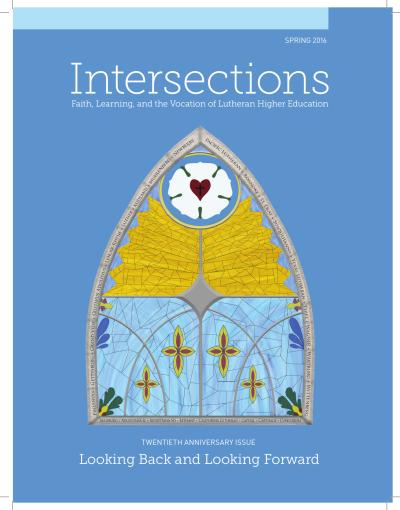
Recounting how Augustana students mentored her into the role of presider at a campus vigil following the 2012 Sikh Temple of Wisconsin shooting, Glass Perez proposes that interfaith understanding become a mode of praxis for the twenty-first century Lutheran college. Drawing on Engaging Others, Knowing Ourselves and Interfaith Youth Core’s leadership practices, she urges ELCA schools to develop a common language linking interfaith engagement to vocational exploration and to the wider mission of the church.
-
 Reflection
John 3:16-17
Richard Priggie
No. 27 · Spring 2008
Preached at the Vocation of the Lutheran College conference in August 2007, Priggie’s sermon on John 3:16-17 reads the Greek word “cosmos” as evidence that “God was into globalism long before we were” and calls Lutheran colleges to embrace Matthew Fox’s “deep ecumenism” — an embrace of and care for all created things. Drawing on J.B. Philipps’s Your God Is Too Small and the movie Pleasantville, he invites his hearers to come to Rock Island in order to leave Rock Island, to be Christian in order to be more than Christian, and to find the places where the roads don’t go in a circle but just keep going.
-
 Article
Rich and Poor in an Era of Globalized Religion and Economies: Challenges to Lutheran Colleges
Pamela K. Brubaker
No. 25 · Spring 2007
Brubaker opens with two World Council of Churches communion stories—a generous Aymara potato meal in Bolivia and a gated invitation-only lunch at a prosperous immigrant German Lutheran church in Brazil—to frame the question of which stance Lutheran colleges will adopt toward diversity. Drawing on Richard Hughes and Ernest Simmons on Lutheran “ecumenical confessionalism,” Linell Cady, Ulrich Beck, Held and McGrew, the World Bank’s 2006 Equity and Development report, Mark Juergensmeyer’s Global Religions, Harvey Cox on the Market as God, the WCC’s “economy of life” / AGAPE document, and Larry Rasmussen on universal human rights, she argues that part of the academic work of Lutheran colleges is to educate for critical citizenship by questioning neo-liberal assumptions and equipping students to claim social, economic, cultural, civil, and political rights for the whole human family.
-
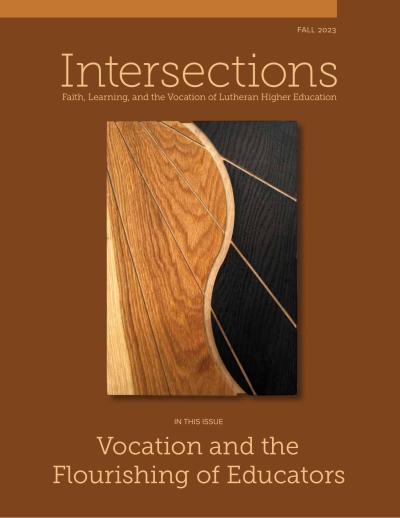 Editorial
Maintaining Our Lutheran Identity: A Source of Strength
Lamont Anthony Wells
No. 58 · Fall 2023
Wells reflects on the well-being of staff, faculty, and administration in Lutheran higher education across four pillars — rest, creativity and innovation, religious diversity and pluralism, and the preservation of Lutheran identity — and addresses the painful reality of Finlandia University’s closure as a reminder of the network’s shared mission.
-
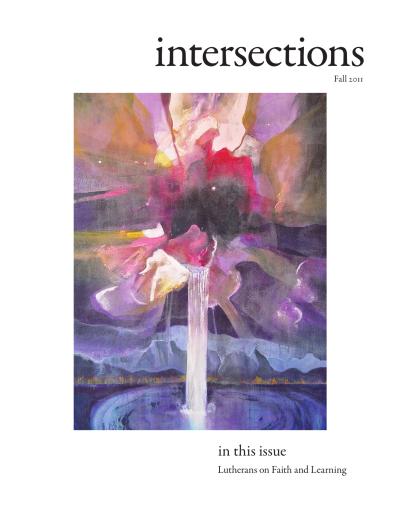 Article
A Lutheran Learning Paradigm
Paul J. Dovre
No. 34 · Fall 2011
Drawing on Hughes and Adrian’s Models of Christian Higher Education and on Ernest Simmons, Darrell Jodock, Tom Christenson, Robert Benne, and Richard Hughes, Dovre sketches a Lutheran learning paradigm shaped by four deep narratives—the biblical, the confessional, the theological, and the vocational—and traces their implications for curriculum (the study of scripture, theology, and vocation), for the religion faculty’s college-wide responsibility, and for pedagogy (moral deliberation, dialectic, paradox, the engagement of faith and the secular disciplines).
-
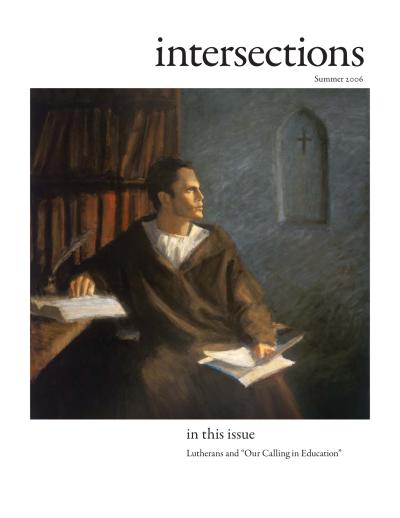 Editorial
From the Editor
Robert D. Haak
No. 23 · Summer 2006
Haak previews the issue’s four essays by Marcia Bunge, Paul Dovre, Samuel Torvend, and Cheryl Budlong — each engaging the ELCA Task Force on Education’s study document and first draft of the social statement on Lutheran education — and invites readers to bring their distinctive voices as professional educators at Lutheran institutions into the conversation before the October 15 deadline. He also invites submissions to Intersections and directs readers to LauraOMelia@augustana.edu to be added to the direct mailing list.
-
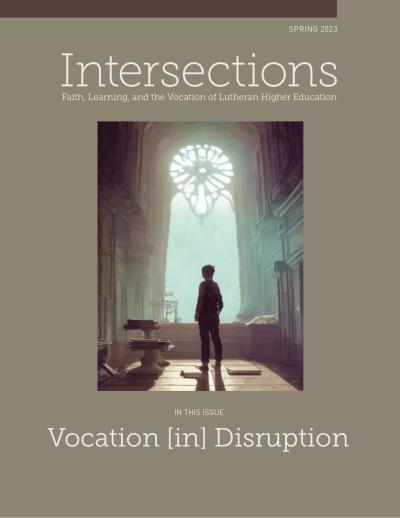 Article
Take Heart: Is Neutrality Really What We Need Right Now?
Abbylynn Helgevold
No. 57 · Spring 2023
Helgevold, an ethicist at Wartburg College, argues that calls for faculty neutrality on abortion in the post-Roe classroom stifle the courageous conversations Lutheran higher education is uniquely positioned to host — conversations grounded in “Rooted and Open” and the ELCA’s 1991 Social Statement on Abortion.
-
 Editorial
From the Publisher
Arne Selbyg
No. 19 · Summer 2004
Selbyg notes that while the primary source of articles for Intersections is the annual Vocation of a Lutheran College Conference, this issue draws on participants in the Lutheran Academy of Scholars in Higher Education, whose Lutheran Brotherhood and Lilly Endowment grants have been exhausted but which has been continued through DHES, the colleges, and especially St. Olaf’s release of DeAne Lagerquist to direct it. He draws attention to editor Tom Christenson’s new book The Gift and Task of Lutheran Higher Education (Augsburg Fortress).