Heralded as a critical milestone in the journey for women’s rights, Roe v. Wade (1973) created a right to abortion by reinterpreting the Due Process Clause of the Constitution. It was a dramatic display of judicial intervention that reaffirmed the right to privacy and granted women the liberty to obtain an abortion before twenty-four weeks of pregnancy without intervention by the state (Congressional Record House Articles, 2020). Planned Parenthood v. Casey (1992) also broadened women’s rights by ruling that states could not reduce abortion rights if they placed an “undue burden” on women who seek abortions (Weingarten, 2016, p. 27). However, on June 24, 2022, the Supreme Court overturned Roe v. Wade (1973) through Dobbs v. Jackson Women’s Health Organization (2022), eliminating the constitutional right to abortion at the federal level. In the meantime, while the country faces a volatile political climate, there is still a bounty of shaming rhetoric regarding the right to abortion that has created a partisan divide between pro-life and pro-choice movements.
Politicians and lawmakers nationwide have continued to act in opposition to abortion. In the past, states such as North Dakota in March 2013 and Arkansas have passed laws prohibiting abortion once a fetal heartbeat is detected, which in most cases is only a week or two after most women become aware of their pregnancies (Weingarten, 2016). Most recently, between 2022 and 2023, states such as Tennessee and West Virginia have passed or amended laws restricting abortions, imposing prison sentences should an individual “lie” to get an abortion and removing or establishing limited exemptions for rape or incest (e.g., SB 857 and SB 584) (Tennessee General Assembly legislation, n.d.; Campbell, 2023).
In opposition to the approach politicians and lawmakers enact to prohibit and limit abortion, I am suggesting a solution to instead rewrite the rhetoric and political approach to abortion that has become the staple of activist claims for the past few decades. Unlike pro-choice and pro-life activists who make their political goal either the criminalization or decriminalization of abortion, the proposed framework will advocate for abortion rights under the guise of tackling specific social factors and preventative measures to combat this undesired behavior. The problem is not abortion, but rather, it is a symptom of a broader range of issues that have been left disregarded by politicians and several activists.
Much of the discourse surrounding abortion is often based on moral judgments and beliefs that tend to produce shaming rhetoric that justify these legal measures. Oftentimes, many anti-abortion laws claim to be protecting “unborn children” or create the argument that if women understood that they were taking a human life, they would no longer be so inclined to receive an abortion. According to Weingarten, this particular approach patronizes women, but also engenders shame by suggesting that a “‘real’ woman would never be able to abort once she visibly or audibly witnessed the life inside of her” (2016, p. 27). In such rhetoric, the process of abortion creates unfair circumstances in which the burden of shame is placed solely on the woman and not those complicit in the decision of abortion or the unwanted pregnancy.
Likewise, arguments regarding restricting abortion are equally likely to include moral judgments which have their basis in religious influences. Woodrum & Davidson, for example, discuss how members of more conservative churches often lean towards more restrictive abortion laws, while those on the opposing end of the spectrum with liberal attitudes support nonrestrictive laws (1992). These are not the only factors contributing to whether or not an individual supports abortion, but Woodrum & Davidson argue that religious influence maintains a “powerful” and substantial effect on abortion attitudes (1992, p. 229). By this rhetoric, legislators and policymakers, whether intentionally or not, permit the intersection of Church and State, which according to our founding beliefs, should not occur in the government.
Ultimately, the divide between pro-life and pro-choice claims creates an atmosphere in which abortion is framed through the rhetoric of individual choice and is linked to the presence of shame. As such, these moral arguments regarding the sanctity of life remain the most powerful tools that activists in particular possess. However, once again, I would like to reiterate that abortion should not be the issue that legislators should tackle. Pro-life should not mean protecting the unborn fetus while in the womb and pro-choice should not only encompass the freedom of bodily autonomy. If protecting life and reproductive rights is truly the goal, then it would be crucial to reword the rhetoric surrounding abortion to include support and resources for the mother prior to and following birth.
As previously stated, both the pro-life and pro-choice positions often solely focus on the decision of whether or not a woman should be able to receive an abortion without acknowledging the economic, social, and political factors that press women into these distasteful situations in the first place. Reproductive health encompasses much more than just the right to abortion. Reproductive rights allow women to experience greater socioeconomic well-being, overall health, relationship stability, and financial stability (Hess et al., 2015). As such, there are several recommendations that policymakers and legislators should consider when crafting reproductive laws.
First, there should be mandated sex education nationwide so that young adults and adolescents can make more informed decisions about their sexuality and intimate relations. Hess et al. (2015) reaffirm this notion by indicating that research on the use of sex education has been critical so that young men and women may make more thoughtful decisions about how they approach contraception, unwanted pregnancies, and STDs. If there were a fixed and appropriate curriculum that addresses sex education, many young men and women who engage in sexual relations from an early age might be more likely and willing to prevent unwanted outcomes, thus circumventing the need for abortions.
“First, there should be mandated sex education nationwide so that young adults and adolescents can make more informed decisions about their sexuality and intimate relations.”
Secondly, free contraception should be a staple when it comes to women’s reproductive health. To obtain birth control at a manageable price is a difficult feat for many women. For women making the federal minimum wage of $7.25, the cost of birth control is equal to 51 hours of work (Hess et al., 2015). Of course, many challenges of price have been mitigated by the enactment of the Affordable Care Act, which has required many healthcare insurers to cover certain forms of contraception (Hess et al., 2015). Even so, this is not enough. Corporations may find loopholes, or may only cover certain forms of contraception that may not be compatible with women’s bodies. One woman may be able to only take a certain brand of pill, or may only be able to use an IUD due to adverse reactions to other forms of birth control. Likewise, free contraception is not solely an excuse to engage in sexual relations, as many may claim, but it also poses a safeguard for women who may become victims of sexual violence, incest, or even a torn condom. Free contraception is not a luxury, but it is another preventative measure so that the prevalence of abortion decreases.
“Secondly, free contraception should be a staple when it comes to women’s reproductive health.”
One final recommendation is to create crisis pregnancy centers that articulate their position in favor of challenging the social, political, and economic barriers that women from multiple backgrounds may face. These centers could provide primary healthcare and pregnancy services, GED classes, child placement services, and literacy training, among other resources that may help women to become more prepared for parenthood or, more importantly, their ability to take family planning circumstances into their own hands. As author Andrew Smith (2005) put it, “We cannot encourage women to have babies and then continue their dependency on the system. We can’t leave them without the resources to care for their children and then say, ‘Praise the Lord, we saved a baby’”. In doing so, these programs and centers could serve as places of reproductive justice, education, and proper care for women to make informed decisions without the burden of the criminalization and decriminalization of abortion lingering over their heads.
There are several other recommendations to be made such as better foster care systems, mental health resources, welfare programs, and even legislation holding the men who are involved in the conception of the fetus responsible for child support. However, what these three recommendations hope to achieve is a pathway beyond the aforementioned rhetoric of abortion that brings with it the specter of shame and moral judgment. These recommendations would only serve to expand the scope of women’s reproductive rights while at the same time potentially preventing the result of abortion.
In today’s political discourse legislators and activists consistently perpetuate cycles of oppression against women and their reproductive rights without acknowledging the social roots and causes that may permit and force women to seek such services in the first place. The burden of shame and choice should not solely rely on women. Governments and their capitalist structures are complicit in these decisions as is a lack of accountability on the male counterparts who take part in these sexual relations. Too many external factors are involved in these circumstances that it should not be acceptable to boil reproductive rights down to whether certain acts are criminalized or not.
When speaking of public health, it is not a moral conversation on abortion that is required, but rather a practical conversation that ensures both fetus and mother have access to exceptional and maintained reproductive healthcare. It acknowledges the flexibility and variability of conceptions and pregnancies, operating with the assumption that establishing one law cannot accurately nor justifiably apply to various conceptions and pregnancies. In the future, political legislation should provide the tools and resources to more completely encompass the safe practice and protection of reproductive rights.
Works Cited
Campbell, C. (2023, February 8). W.Va. Senate introduces bill to remove abortion exemptions for rape and incest. https://Www.wtap.com; Gray Television, Inc. https://www.wtap.com/2023/02/08/wva-senate-introduces-bill-remove-abortion-exemptions-rape-incest/
Congressional Record House Articles. (2021, September 19). https://www.congress.gov/congressional-record/2020/01/15/house-section/article/H246-2
Hess, C., Milli, J., Hayes, J., Hegewisch, A., Mayayeva, Y., Roman, S., Anderson, J., & Augeri, J. (2015, May). Status of Women in the States: 2015. Washington DC; Institute for Women's Policy Research.
SB 0857 M – The Tennessee General Assembly legislation. (n.d.). Retrieved February 19, 2023, from https://wapp.capitol.tn.gov/apps/BillInfo/Default.aspx?BillNumber=SB0857
Smith, A. (2005). Beyond Pro-Choice versus Pro-Life: Women of Color and Reproductive Justice. NWSA Journal, 17(1), 119–140. http://www.jstor.org/stable/4317105
Weingarten, K. (2016). Shame before the Law: Affects of Abortion Regulation. In M. MENDIBLE (Ed.), American Shame: Stigma and the Body Politic (pp. 27–43). Indiana University Press. http://www.jstor.org/stable/j.ctt1bmzmdz.5
Woodrum, E., & Davison, B. L. (1992). Reexamination of Religious Influences on Abortion Attitudes. Review of Religious Research, 33(3), 229–243.
-
 Editorial
From the Publisher: Introduction and Invitation
Lamont Anthony Wells
Wells introduces himself as the new Executive Director of NECU, succeeding Rev. Dr. Mark Wilhelm, and frames this Spring issue as a passionate response to the crises facing higher education amid threats to academic freedom and the well-being of educators.
-
Editorial
From the Editor: Vocation [in] Disruption
Colleen Windham-Hughes
Windham-Hughes introduces the issue’s theme — vocation amidst disruption — previews new features including contributor contact information, a study guide for So That All May Flourish, and invited pieces on reproductive rights, and shares results from the Fall survey of readers.
-
Institutional Focus
So That All May Flourish Study Guide
A chapter-by-chapter study guide to So That All May Flourish (Fortress Press 2023), a new volume by NECU authors that develops the central tenet of “Rooted and Open” and offers discussion questions for use in orientation programs, classes, workshops, task forces, and professional development settings.
-
Reflection
“Miracles are no longer required”—Life Writing as a Healing Tool
Barbara Reul
A music historian and cancer survivor chronicles how a uterine cancer diagnosis in the early months of the COVID-19 pandemic disrupted her vocation as a university professor, and how writing two open-access memoirs became an unexpected tool for healing body, mind, and soul.
-
Article
The Power of Ritual Action and George Floyd Square
Mary Clare Tiede Hottinger
A California Lutheran University senior examines how George Floyd Square in Minneapolis has been transformed into sacred space through ritual action, and considers what this site of remembrance, mourning, and ongoing struggle for justice can teach us about the power of ritual to unify and sustain community.
-
Reflection
Be Like Jesus: Flip Some Tables
Jessica Easter
Easter argues that the example of Jesus overturning the moneychangers’ tables in Matthew 21 calls Christians not to work within unjust systems but to disrupt them — and that this table-flipping must be done in community with others who share the vision of a world where all are seen, heard, and valued.
-
Article
Necessary Disruptions: Centering Vocation in the Common Good
Erin VanLaningham
VanLaningham previews the forthcoming NetVUE volume Called Beyond Our Selves: Vocation and the Common Good, arguing that vocation, common, and good all need to be disrupted and expanded so that students might arrive at a wider sense of individual purpose and collective well-being.
-
Article
Where Disruption and Vocation Meet: One Path Toward Teaching Reproductive Justice in Challenging Times
Lena R. Hann
Hann recounts how a missed math class in her first college term led her into volunteer work at a feminist abortion clinic and ultimately a career in public health, and describes how she designed and taught a Reproductive Justice immersive term course at Augustana College through the disruptions of COVID-19, George Floyd’s murder, and the Dobbs decision.
-
Article
The Duty to Teach and Restore Bodily Autonomy: Reflections from the Classroom
Cynthia Richards
Richards reflects on a Narrative Medicine course she taught at Wittenberg University in the wake of the Dobbs decision, in which students examined cultural “first recognitions” of the reproductive body and discovered that almost none had ever had a way of talking openly about their reproductive selves — an alienation she calls educators to address.
-
Article
Turning to a Reproductive Justice Framework for Inclusive Dialogue across Differences
Jenny M. James
James makes the case that a reproductive justice framework, rooted in the work of black feminist scholars and activists, gives educators tools to overhaul polarized pro-choice/pro-life conversations and to host inclusive dialogues across differences of race, sexuality, gender identity, and faith.
-
Article
Take Heart: Is Neutrality Really What We Need Right Now?
Abbylynn Helgevold
Helgevold, an ethicist at Wartburg College, argues that calls for faculty neutrality on abortion in the post-Roe classroom stifle the courageous conversations Lutheran higher education is uniquely positioned to host — conversations grounded in “Rooted and Open” and the ELCA’s 1991 Social Statement on Abortion.
-
Article
Views on Flourishing After the Age of Roe
Caryn Riswold, Mary J. Streufert
Riswold and Streufert reflect on the Radcliffe Institute’s January 2023 conference “The Age of Roe” and argue that the ELCA’s 1991 Social Statement on Abortion and its 2019 statement Faith, Sexism, and Justice offer Lutheran higher education a third way to approach reproductive justice grounded in serving the neighbor so that all may flourish.
-
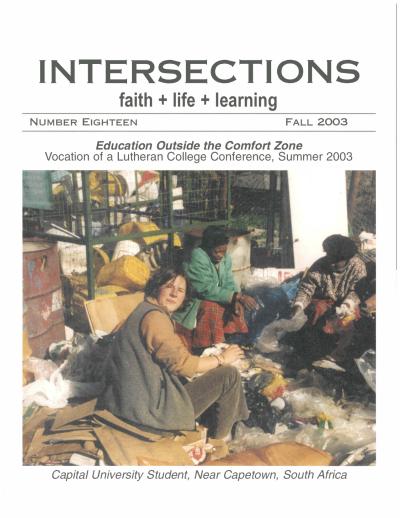 Article
The Search for a Just Peace in a Globalized World
Munib A. Younan
No. 18 · Fall 2003
Younan, Lutheran Bishop in Jerusalem, grounds Palestinian Christian identity in Incarnation theology and a Lutheran theology of grace and the cross, then surveys the Evangelical movement’s nineteenth-century legacy in the Middle East—the 1864 Arabic Bible, ELCJ schools, women’s ordination, and the Middle East Council of Churches. Engaging Edward Said’s critique of Samuel Huntington, he calls for international and local mutual-recognition agreements (including the Jerusalem Lutheran-Anglican agreement and a Lutheran-Reformed agreement in the Middle East), four marks of interfaith dialogue, and a sharp distinction between Lutheran “Evangelical” identity and the Dispensationalist evangelistic Right whose Israel-Palestine scenarios he names a heresy. He closes by proposing concrete scholarship, faculty exchange, and sabbatical partnerships between U.S. Lutheran colleges and the ELCJ’s churches, schools, and Dar al-Kalima Lutheran Academy.
-
 Article
Critical Engagement in Public Life: Listening to Luther's Troubling Questions
Samuel Torvend
No. 35 · Spring 2012
Torvend narrates the medieval “spiritual/temporal” division and the neo-platonic devaluation of the body that shaped the world into which Luther was born, then traces the disruptive questions Paul’s letters provoked in Luther: about indulgences, the two estates, vocation, and the public reach of baptism. He argues that Luther’s reform — expressed in Kirchenordnungen, social welfare reform, public schools, and writings on lobbyists, usury, and monopolies — carries a “genetic encoding” of public engagement that Lutheran colleges should reclaim against the temptations of holy apathy and Christian nationalism.
-
 Institutional Focus
Health Food in the Inner City: An Interview with Brian Noy about Augsburg's Campus Kitchen
Brian Noy
No. 36 · Fall 2012
Noy, Director of Campus Kitchen at Augsburg College in Minneapolis, describes the Kitchen’s four-fold program—Food to Share (2,000 meals per month from surplus dining-services food and Campus Cooking Classes), Food to Grow (an 80-plot community garden), Food to Buy (two farmers markets that accept EBT/food stamps), and Food to Know (educational programming)—and the deep history of Augsburg’s service to the immigrant communities of the Cedar Riverside neighborhood, now Somali and Mexican as well as historically Norwegian.
-
 Article
The Impropriety of Jesus' Teaching: The Woman at the Well and The Vagina Monologues
Susan M. O'Shaughnessy
No. 16 · Winter 2003
O’Shaughnessy Poppe dedicates her message to those who worked to put on Eve Ensler’s The Vagina Monologues against administrative resistance and reads the Samaritan woman at Jacob’s well alongside the testimony of a Bosnian rape survivor whose story Ensler asked to tell, arguing that the “impropriety” of Jesus—his scandalous recognition of those silenced by sexism, racism, war, custom, and the church—is the model for the mission of a college of the church to defend academic freedom and to break the chains of oppression by inflicting discomfort on the proper and pure.
-
 Article
Mars, Mammon—and Other Options
Carl Skrade
No. 20 · Fall 2004
In a wide-ranging public lecture from a Capital University Philosophy and Religion department series on “The Empire, Its Religions, and Some Alternatives,” Skrade distinguishes the military from militarism (using Oxford and Chalmers Johnson definitions), catalogs evidence of contemporary U.S. militarism—budget allocations, arms sales, the military-academic complex, post-1945 interventions, overseas bases, and Bush-era profiteering through Bechtel and Halliburton—and traces its roots in resource greed, racism, right-wing religiosity, and Augustinian incurvatus in se ipsum. After surveying the financial and human costs through testimony from Jonathan Shay’s Achilles in Vietnam, Samuel Hynes’s The Soldier’s Tale, Dalton Trumbo’s Johnny Got His Gun, and Staff Sergeant Jimmy Massey, he applies Vincent Ferraro’s seven principles of just war to Gulf II, reads Matthew 5:43-48 as a call to indiscriminate care, and proposes a www.religiousleft.org website to host a Christian alternative to Mars and Mammon.
-
 Article
"Annoying the Student With Her Rights:" Human Life Coram Hominibus; Reflections on Vocation, Hope, and Politics
Caryn Riswold
No. 32 · Spring 2010
Riswold takes a student’s course-evaluation complaint that she had been “annoyed with her rights” about voting as the entry point for reflection on fear of change, mistrust of difference, and right-wing extremist violence—Poplawski, Von Brunn, Roeder, and the Sotomayor hearings. Drawing on Gerhard Ebeling’s reading of Luther’s fourfold relationality (coram Deo, mundo, meipso, hominibus), Brian Gerrish, Alister McGrath, Gustaf Wingren, Philip Hefner, Mary Rose O’Reilley, and bell hooks, she argues that the vocation of the Lutheran college is precisely to “annoy students with their rights” by forming them for socially responsible voice grounded in faith active in love.