On the Outside Looking Out: A Personal and Social Psychological Response
Intersections No. 2 · Winter 1997
Several years ago, sitting after dinner on the front porch, my friend DeAne Lagerquist suggested to me that I was likely a Lutheran at heart. I took this remark from such a staunch and storied Lutheran to be a compliment, but felt it as unlikely as my taking up buttered lutefisk instead of buttered grits; cold aquivit instead of warm bourbon. But research on couples suggests that they come to resemble each other more, in both opinion and physical appearance, the longer they live together. I may now have lived long enough among Lutherans to understand why DeAne made her comment, and having now heard Professor Bouman’s comments on the Lutheran tradition, may even have some words to put to this foreboding.
In my comments here, I would like to make some personal responses to Professor Bouman’s themes of Lutheran tradition, and to offer at least one social psychological comment on his observations. The personal comments are more in line with a conversation that might occur between a theologian and a beginning student - I bring no special expertise to them, and am aware of Professor Bouman’s immense reputation. The social psychological comments are more about who should participate in the conversation that currently defines the tradition on Lutheran college campuses.
A Personal Response to the Themes:
I am a Metho-Bap-terian, raised in the Southern United States. Of the three traditions, Baptist is likely the most evident in my foundational beliefs (or at least in those I now react against). This is partly because Baptists are certain to be clear about what they believe (or at least about what you should believe) and partly because the place I picked up my Baptist schooling is Bob Jones University, an oddly apolitical but staunchly conservative institution. After steeping in fundamentalism for some time, I began inexplicably to think. This led to disastrous consequences for my youthful faith, along the lines of Kant’s critique, outlined by Bouman.
I appreciate honesty in people, and coming from the South, am still surprised when I find it in religous scholars.
My main reason for remaining with the Christian faith has been my conviction that there is a “mysterium” both “tremendum” and “fascinans,” and that Christianity is as fine a tradition as many within which to explore it. It has been around long enough so that we have markers for many of the most egregious mistakes (crusades, inquisitions, etc.) and are not likely blithely to believe we are immune from repeating them. Some of Bouman’s themes begin to convince me there may be a more stable reason for my choice than the existential and pragmatic one I have made.
First, I was pleasantly surprised to hear Professor Bouman say baldly what I had often surreptitiously thought, that biblical inerrancy is a non-biblical doctrine. I appreciate honesty in people, and coming from the South, am still surprised when I find it in religious scholars. I was also pleased with his description of the current tension in the discussion of the authority of scripture; that scripture gives us unique access to the gospel, but only the gospel gives real authority to scripture. This preference for a dynamic story rather than a static idolatry (or even bibliolatry) seems to run through many of the themes Bouman explicates. To search for the gospel within the scripture is a fine way of bringing to life what in my youth was a rule book rather than a storybook.
To search for the gospel within the scripture is a fine way of bringing to life what in my youth was a rule book rather than a storybook.
This distinction between gospel and scripture has the advantage of giving people on both sides of the debate about homosexuality something to say. We can surely say (like Paul in Romans over the eating of meat) that people on both sides of this difficult debate have at least some good intentions. The more usual conclusion relies on conspiracy theories to understand the disagreement. The standard conspiracy theory runs thusly: The plain truth of the scripture (or the gospel) is self-evidently true to me, and anyone who cannot see it the way I do must not be able to see well. Why would they persist in their blindness? Perhaps it is because they are ensnared in a conspiracy to destroy [insert beloved thing here]. The trick is to believe your perceptions are the true ones, and that the other’s claimed perceptions are really cover for moral inadequacy. If we found we were both claiming a good, we might be able to have a calmer (though no less difficult) discussion.
I have always been most uncomfortable in those parts of Christian services where we are required to read millennium old committee documents about what it is we believe. On these occasions, having swallowed a resurrection, it seems no large thing to add a virgin birth or two or even a logical impossibility before breakfast. The gospel as a story comes up again as a central issue in Bouman’s claim for the Lutheran tradition in dealing with these uncomfortable creeds. As in the scripture, it is the gospel in the creeds we should care about. With one roundhouse conceptual swing (it is about who can make promises unconditioned by death) Bouman helps me to scale off the Hellenistic accouterments that have puzzled me for decades. It now seems less about exactly what I believe, but rather who I believe in. Whether there is some third (or fourth) way to solving the conundrums in the creeds (e.g. through process or feminist approaches) I don’t know. Perhaps another conference will tell us.
Its also nice to see from Professor Bouman’s pen that the “evangelical” that first scared me about ELCA is not the evangelical with which I became acquainted in the South. Bouman even makes a fine case that our present day difficulty of finding meaning can be constructed in the same terms as Luther’s concerns about finding grace. Both salvation and meaning are, in Bouman’s version of Lutheran theology, about death not having the last word. And if death is not the final word, I may have “more to do with my life than preserve and protect it.” This makes the gospel relevant to the way I live my life, to the meaning in my life, rather than the simple insurance policy I took out at the altar many years ago.
... the problem of getting the tradition to continue is precisely the problem of getting the conversation to continue... in a way that is thoughtful, fair, inclusive, charitable, focussed, and still true to the tradition...
The sacramental part of the Lutheran tradition is the one I have the most trouble with. This may be partly because as a Baptist from the South, I enjoy shocking Lutherans at the dinner table by talking about the three times I have been baptized. Each was a different aesthetic experience, though I only remember two, having been cast as an infant in the first experience. Bouman admits his explanation is short and telegraphic. But the Jewish storytelling tradition seems again central in his interpretation of the Lutheran understanding. Having Jesus come “from the future” fits the story-telling tradition well, but I am still left with a question about whether this approach is magic or meaning-making (do we mean really from the future or from the end of the story?).
A Social Psychological Response
The tradition that Professor Bouman gives us is constructed out of the historic conversation, arguments, discussions, and even schisms within the Lutheran church. I, for one, feel enlightened to have heard it, and feel he has done admirably in summarizing a complex subject in a paper short enough for an empiricist social scientist to read. I am still left wondering about how the conversation he has described relates to the ones I have with my colleagues on a Lutheran college campus everyday.
In many churches, tradition is treated as a reason for doing something. Bouman treats tradition as a continuing conversation about what we ought to do. MacIntyre’s description of tradition that Bouman quotes is twofold; it is a historically extended and socially embodied conversation. Bouman gives us much of one and a little of the other. Professor Bouman prefers to avoid demographics as defining characteristics of the tradition. But if the tradition is a continuing one those demographics must be important to understand.
How is the conversation currently socially embodied? Which conversation are we talking about? I presume (and Bouman hints) we are talking about the conversation on college campuses of the Lutheran church. Here, it does matter who is included in the conversation and who is not. The demographics do matter.
A colleague of mine and I thought a year ago to do a study of the social networks on our campus. We were encouraged in this by people who felt that the less religious among our faculty felt like “outsiders,” like they were not included in the conversation on campus about what the college was “about.” Preliminary interviews led us to a surprising conclusion: everyone felt “outside” in some way. Those who were highly religious, who came from the most storied Lutheran and Norwegian families, felt outside, felt there weren’t very many of “them” left, felt isolated. They suspected the secular turks (or the cold hearted administrators) had taken over. More secular (or at least non-Lutheran) faculty, seemed to think there was an inner cabal of Norwegian Lutherans who ran things and who were loath to explain the rules. Everyone felt outside, feminists, fundamentalists, Lutherans, non-Lutherans, all; no one felt comfortable. This odd pattern stumped us, and led us to discontinue plans for the interviews.
With this isolated morsel of data to motivate a point, let me suggest that the problem of getting the tradition to continue is precisely the problem of getting the conversation to continue. And the conversation has to continue among those who will show up for it. We cannot compel them into it (despite the dinner parable), nor can we simply hope that nice folks will come to dinner. We ought to offer, in the way I think Professor Bouman has, some fine food for thought. We should also invite other people to bring their favorite foods with them to contribute. If we all think we are outsiders, there is no sense having a conversation.
The problem then involves constructing the current conversation in a way that is thoughtful, fair, inclusive, charitable, focussed, and still true to the tradition. To do this will require more than a good grasp of the historical roots of the tradition (though it will certainly require that).
-
 Editorial
From the Publisher
James M. Unglaube
Unglaube reports on the second annual Vocation of a Lutheran College conference of August 1996, where Walter Bouman of Trinity Lutheran Seminary addressed “What is Lutheran; What is the Lutheran Tradition” (biblical, catholic, evangelical, sacramental, world-affirming—the world “received, enjoyed, served as God’s Gift”). He previews presentations by Wendy McCredie of Texas Lutheran and Baird Tipson of Wittenberg on how the Lutheran tradition is embodied in its colleges, and Bob Vogel’s challenge in “Coherence—And Now what?” that the tradition comes to life in how faculty give expression to their beliefs and values in the classroom and with colleagues.
-
Editorial
From the Editor
Tom Christenson
Christenson opens with an invitation for reader submissions to balance the conference-paper format of the first two issues, then asks how college and universities can turn students positively toward learning. Drawing on Aristotle’s claim that study is loved for its own sake (which students greet with disbelieving laughter) and Neil Postman’s The End of Education, he argues that students lack narratives within which learning makes sense and proposes four Lutheran mega-narratives—stewardship of creation, the freedom of the Christian, the sacramental presence of the transcendent in the concrete and ordinary, and vocation—that could inspire learning at the 28 ELCA colleges and universities.
-
Article
Lutheran Tradition: Five Continuing Themes
Walter R. Bouman
Bouman of Trinity Lutheran Seminary identifies five themes central to the Lutheran theological tradition (understood through Alasdair MacIntyre’s account of tradition as “an historically extended, socially embodied argument”): biblical (a non-oppressive authority for the Bible rooted in the gospel rather than in scholastic inerrancy, against the backdrop of Luther’s 1517 challenge to Tetzel and the post-Enlightenment marginalization of theology); catholic (continuity with the Book of Concord and the three ancient creeds, with Luther’s “Christology from below” recovering a Jewish rather than Hellenistic understanding of God, revived by Tillich, Pannenberg, Forde, and Jenson); evangelical (justification by faith as the answer to mortality’s radical question); sacramental (Word, Eucharist, and Baptism as Christ’s presence from the future of God’s consummated Reign); and world-affirming (creation as gift, vocation as God’s work in every calling, and stewardship of the ecological crisis).
-
Response
“My Wife, We Have Not Come to the End of All Our Trials, but a Measureless Labor Yet”: The Lutheran Argument in Colleges
Steven Paulson
Paulson of Concordia College responds to Bouman by invoking Penelope’s unreasonable patience for Odysseus and asking whether Bouman’s five “principles” deliver the “continuities of conflict” that MacIntyre’s account of a living tradition demands. He argues that the proper Lutheran “continuity of conflict” is the praxis of proclamation—Christ crucified as “a stumbling block to Jews and folly to Gentiles”—which is given outside the institution’s walls and which colleges and universities, as socially embodied arguments, “can’t like” because it places truth beyond their control. The Lutheran problem, he concludes, is not the Enlightenment or Post-Modernism but the “old Adam,” the Odysseus still unsure of his identity.
-
Response
Disputatio Pro Quo? The Search for Lutheran Education
Jon-David Hague, Kimberly Hague
Kimberly and Jon-David Hague—both Luther College graduates completing graduate studies at Berkeley and Boston University respectively—respond to Bouman by offering Luther’s curriculum reform at Wittenberg University in the spring of 1518, only months after the 95 theses, as a model of the Lutheran voice in higher education. Inspired by humanistic principles, Luther introduced lectures on classical authors and the first instruction in Greek and Hebrew, giving students the tools to encounter scripture directly rather than receive dictated doctrine. The spirit of that reform—providing students with every possible tool while acknowledging that an instructor’s perspective is neither ultimate authority nor final word—remains useful for the search for Lutheran academia today.
-
Response
Feeling at Home: Dimensions of Faculty Life
Jane Hokanson Hawks
Hawks of Midland Lutheran College responds to Bouman by reflecting on her path from a Lutheran childhood through the BSN at St. Olaf and thirteen years at four non-church-related institutions to her present home at Midland, where teaching at a Lutheran institution finally feels “right.” Bouman’s framing of the five themes as the Lutheran argument about what it means to be human helped her ad-hoc committee articulate the spiritual role in Midland’s new faculty mentoring program (recently funded by the Lilly Foundation), and grounds her work as a nurse educator confronting the daily humanness of grief, joy, ethical dilemmas, and care across cultural and religious difference.
-
Response
“You Shall Know the Truth, and the Truth Will Set You Free”: A Scientist’s Response
Ben Huddle
Huddle of Roanoke College proposes adding a sixth theme to Bouman’s five—the scientific method—as a tool for knowing the Truth not available to Luther but central to twentieth- and twenty-first-century learning. Diagramming the continuous cycle of observations, laws, theories, and predictions, he argues that scientists must be ethical and that scholars in other fields must understand the scientific method (lest environmentalists ignore the Second Law of Thermodynamics). A Lutheran college, he concludes, should treasure both the religious and the scientific tradition: stifling either loses meaning or significance, and the Lutheran tradition is therefore biblical, catholic, evangelical, sacramental, scientific, and world-affirming.
-
Poem
Two Poems: The Advent Carol / The Madonna of Dohany Street
Brian Forry Wallace
Two poems by Brian Forry Wallace of Capital University: “The Advent Carol,” a litany of the babies who were not adored—the Jewish baby shot with a Luger, the Black child hanged from a tree, the female messiah tossed into a river, the Tutsi infant cut by machetes, the Japanese newborn incinerated by atom bombs, the Chinese baby crushed by Japanese bombs, the aborted Mary’s child—ending with the baby “whom we do not understand, cannot feed, whom we kill”; and “The Madonna of Dohany Street,” on a Holocaust photograph in a Budapest museum of a dead mother and her dead Christ-child daughter in the former ghetto, in which annunciation, nativity, adoration, and crucifixion are seen together in a single instant.
-
Institutional Focus
Embodying the Tradition: The Case of Wittenberg University
Baird Tipson
Tipson, President of Wittenberg University, locates Wittenberg in the “American” strain of Ohio Lutheranism founded in 1845 under Ezra Keller (a Pennsylvania College and Gettysburg Seminary graduate and disciple of Samuel Simon Schmucker), with English-language preaching, financial support from the pan-Protestant New England Society, Presbyterians on the Board, and an Episcopalian teaching Latin. He names two ongoing challenges—remaining authentically Lutheran while welcoming a pluralistic student body (just under a quarter are Lutheran in a primary service area that is 5% Lutheran), and making the tradition clear and compelling to non-Lutheran or lukewarm Lutheran students—and presents the five things every Wittenberg graduate should be able to do (respond to the human condition; recognize, define, and solve problems; develop a sense of vocation; assume servant-leadership; take moral responsibility) as authentic expressions of the Gospel and of the university’s ELCA relationship.
-
 Article
Modeling Virtue: In Which a Social Psychologist Decides He Can Do Good Without Freely Choosing It
Chuck Huff
No. 9 · Summer 2000
Huff, recalling his 1975 sophomore disillusionment with a sterile introductory psychology in South Georgia (and Danny Saunders’s question from The Chosen), defends a scientific psychology as model-making rather than meaning-finding, traces the collapse of Lawrence Kohlberg’s totalizing theory of moral development into chastened mini-theories, and presents William Damon and Anne Colby’s interview study of twenty-three “moral exemplars” whose lives were marked by self-good unity, constant self-examination in community, a felt inability to have done otherwise, religious grounding, and genuine happiness. Following Aristotle on virtue as learned habit and the Christian tradition of the “slave for Christ,” he concludes that goodness flows from the choice of constraints rather than from the lone free-will hero of fairy tales, complicating C. P. Snow’s two-cultures divide. Originally the 1998 Mellby Lecture at St. Olaf.
-
 Reflection
Confessions of a Collaborator
Chuck Huff
No. 3 · Summer 1997
Huff of St. Olaf offers a tongue-in-cheek public confession of his lifelong sin of collaboration—from elementary-school reports on dinosaurs and Cliff notes on Faulkner, through high-school algebra and college group projects, to borrowed syllabi, group work imposed on resentful students, tutorials, independent studies on every form of self-reliance, and circulated drafts. Even this confession was collaborated on, and (he confesses) he enjoyed it.
-
 Article
Journey Toward Pluralism: Reimagining Lutheran Identity in a Changing World
Jacqueline Bussie
No. 40 · Fall 2014
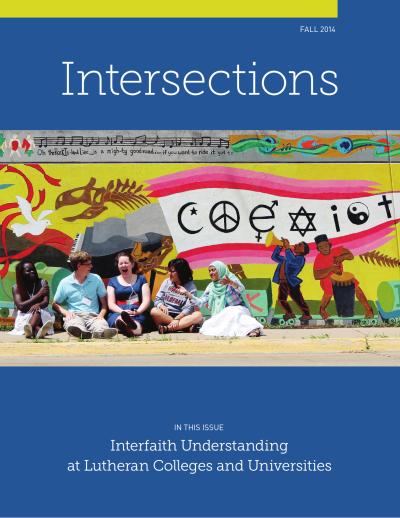
Bussie chronicles Concordia College’s Forum on Faith and Life initiative — assessing campus climate, building a President’s Interfaith Advisory Council, and drafting a one-sentence statement that Concordia practices interfaith cooperation “because of” (not “guided by”) its Lutheran identity — to argue that simul justus et peccator thinking equips Lutheran institutions to hold loyalty to tradition and reverence for others together as one piece.
-
 Article
Bringing Core Values to Life through Civic Engagement
Austin Trantham
No. 63 · Spring 2026
5 min audio
Trantham shows how Saint Leo University’s Benedictine Core Values shape his civic engagement work — from advising a “Why Vote?” campaign and Constitution Day panels to engaging students in the Unify Challenge for respectful cross-institutional discourse.
-
 Article
Diversity and Dialogue: Twenty Years and Counting
Florence D. Amamoto
No. 43 · Spring 2016
Twenty years after her essay “Diversity and Dialogue” in the first issue of Intersections, Amamoto returns to Gustavus Adolphus College to reflect on what has changed and what has not: rising numbers of students of color and international students, faculty turnover and increased publication pressures, the disappearance of the Center for Vocational Reflection, and the renewed importance of articulating Gustavus’s Swedish Lutheran heritage and inclusive sense of community in a tuition-dependent, cost-cutting environment.
-
 Article
Vocation of the Lutheran College and Religious Diversity
Darrell Jodock
No. 33 · Spring 2011
Jodock describes a “third path” for Lutheran colleges that is both rooted in the Lutheran tradition and inclusive of religious diversity — an alternative to sectarian and non-sectarian default models — and identifies six interlocking features of the Lutheran tradition (giftedness, an engaged God, wisdom, caution about claims to know, community, and an emphasis on service and community leadership) that shape how such a college engages interreligious dialogue and civil discourse.
-
 Editorial
From the Editor
Jason A. Mahn
No. 45 · Spring 2017
Mahn introduces “Education in the Age of Trump” by recounting a difficult academic year on his own campus — the Augustana “chalking” incident, a Latinx Unidos rally, and post-election conversations with marginalized students and quietly conservative Trump supporters alike — and frames the issue’s essays as careful (re)imaginings of the vocation of Lutheran higher education in an anxious political climate.
-
 Institutional Focus
So That All May Belong: Lutheran Roots for Diversity, Equity, Inclusion, and Justice [abridged]
Altheia Richardson, Angie Hambrick, Caryn Riswold, Colleen Windham-Hughes, Deanna Thompson, Marcia Bunge, Robert Clay
No. 61 · Spring 2025
8 min audio
A condensed version of the NECU statement that consolidates Lutheran theological grounding for DEIJ and a single combined call to action for Lutheran colleges and universities — offered as a shareable summary alongside the complete document.